Category : Correspondence(303)
-
 2023-03-15
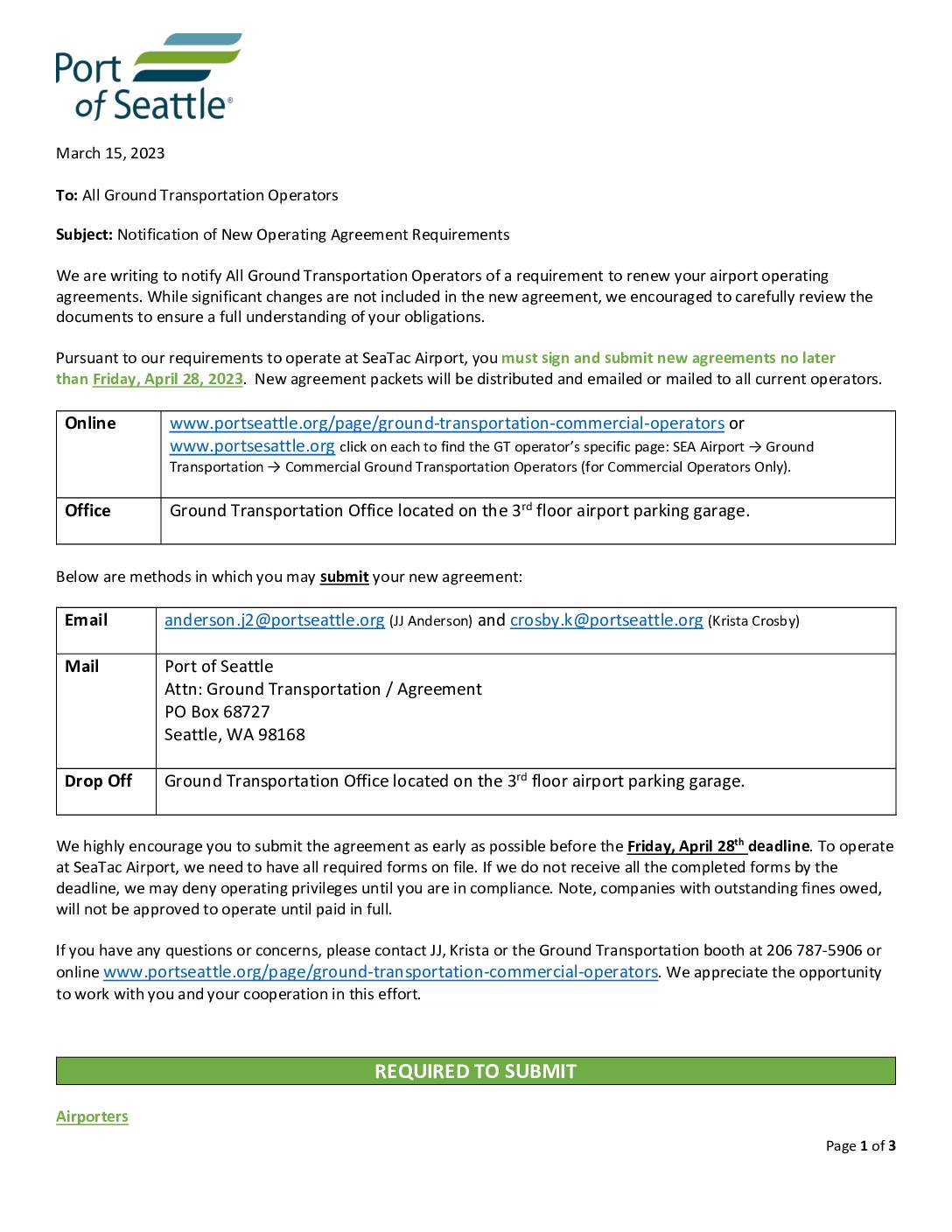
Notification of new operating agreement requirements
The Port of Seattle issued a March 2023 notice requiring all ground transportation operators at Seattle-Tacoma International Airport to sign and submit renewed operating agreements by April 28, 2023. Operators can submit agreements by email, mail, or in person at the Ground Transportation Office on the third floor of the airport parking garage. Required documents vary by operator type—such as airporters, charter buses, crew vans, and limousines—but generally include a signed agreement, proof of insurance, vehicle registrations, and a company information form. -
2023-01-17
Adam Smith Meeting on Aviation Bills
Representative Smith. I am writing to provide our input as to what residents of Sea-Tac Airport need to address the impacts of commercial aviation. Although these four suggestions are specific to our community, they apply to all major airport communities. As we have always said: Solving for Sea-Tac, solves for all airports. That was the -
 2022-12-05
Letter to Washington congressional delegation on aircraft noise and emissions policy priorities for FAA Reauthorization
In December 2022, the Port of Seattle and six nearby cities (SeaTac, Burien, Des Moines, Normandy Park, Tukwila, and Federal Way) wrote to Washington's congressional delegation urging them to include aircraft noise and emissions reforms in the 2023 FAA Reauthorization bill. Their seven proposals cover topics such as expanding federal funding for noise insulation upgrades in homes near Sea-Tac Airport, creating a new Aircraft Noise Advisory Committee, and accelerating the adoption of sustainable aviation fuels (SAF) to cut carbon and air pollution. The letter reflects the work of the SEA Stakeholder Advisory Round Table (StART), a collaborative forum the Port and cities jointly established to address the growing impact of airport operations on surrounding communities. -
2022-12-04
November 29, 2022 Port Commission Meeting
A letter to the Commissioners of the Port of Seattle regarding the 29 November Commission Meeting and passage of the Port’s 2023 Budget. Commissioners, Congratulations on passing the Port’s 2023 Budget at your 29 November meeting. Here are a few thoughts about that meeting, the budget you passed, and the year ahead: 1. There was not -
 2022-10-17
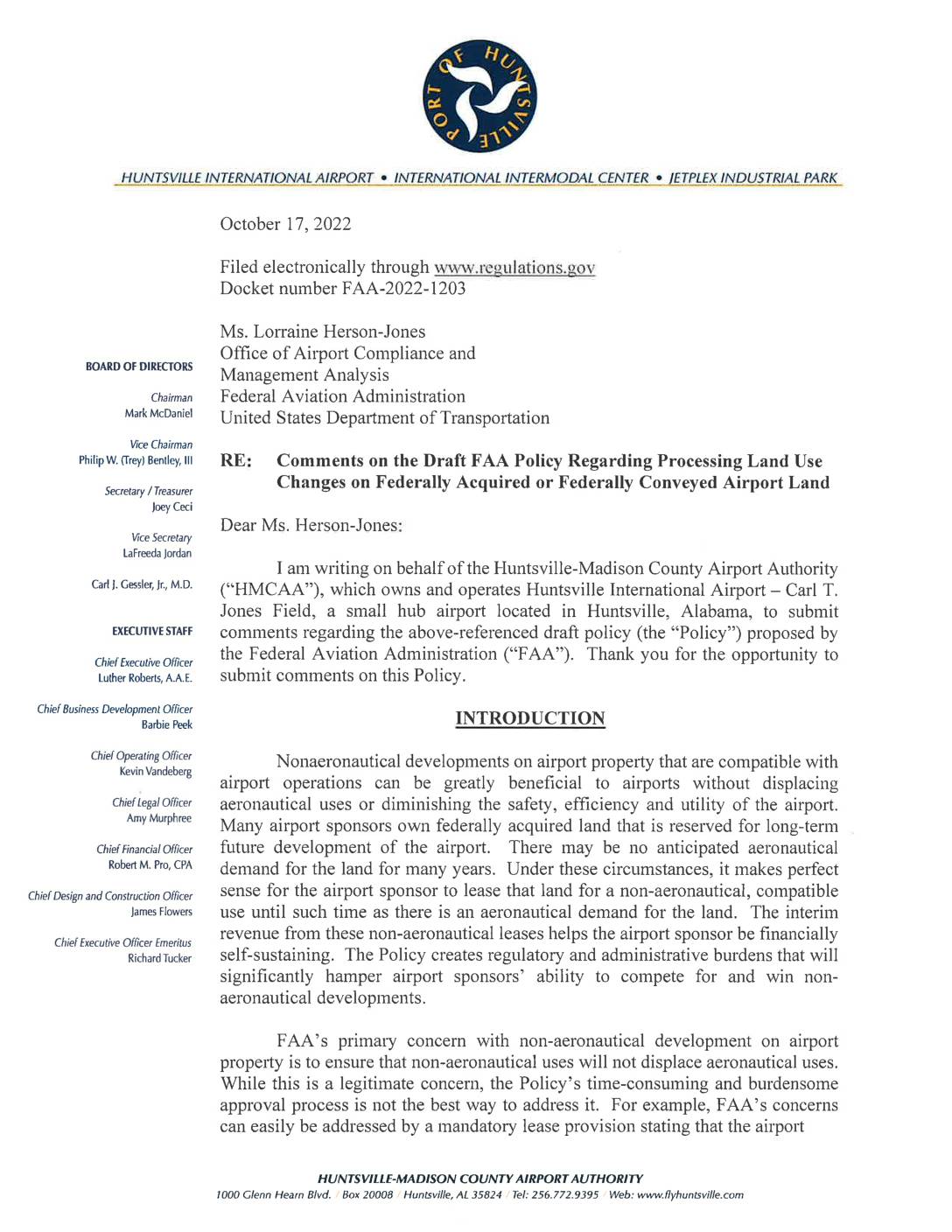
Comments on the draft FAA policy regarding processing land use changes on federally acquired or federally conveyed airport land
The Huntsville-Madison County Airport Authority submitted comments to the FAA in October 2022, objecting to a proposed federal policy governing land use changes on federally acquired or conveyed airport property. The authority argues the policy creates unnecessary regulatory burdens that hamper airports' ability to pursue compatible non-aeronautical developments, and calls for clearer, simpler rules — such as broader definitions of 'airport purpose' and airport-led category determinations rather than FAA approval for every land use change. -
 2022-10-17
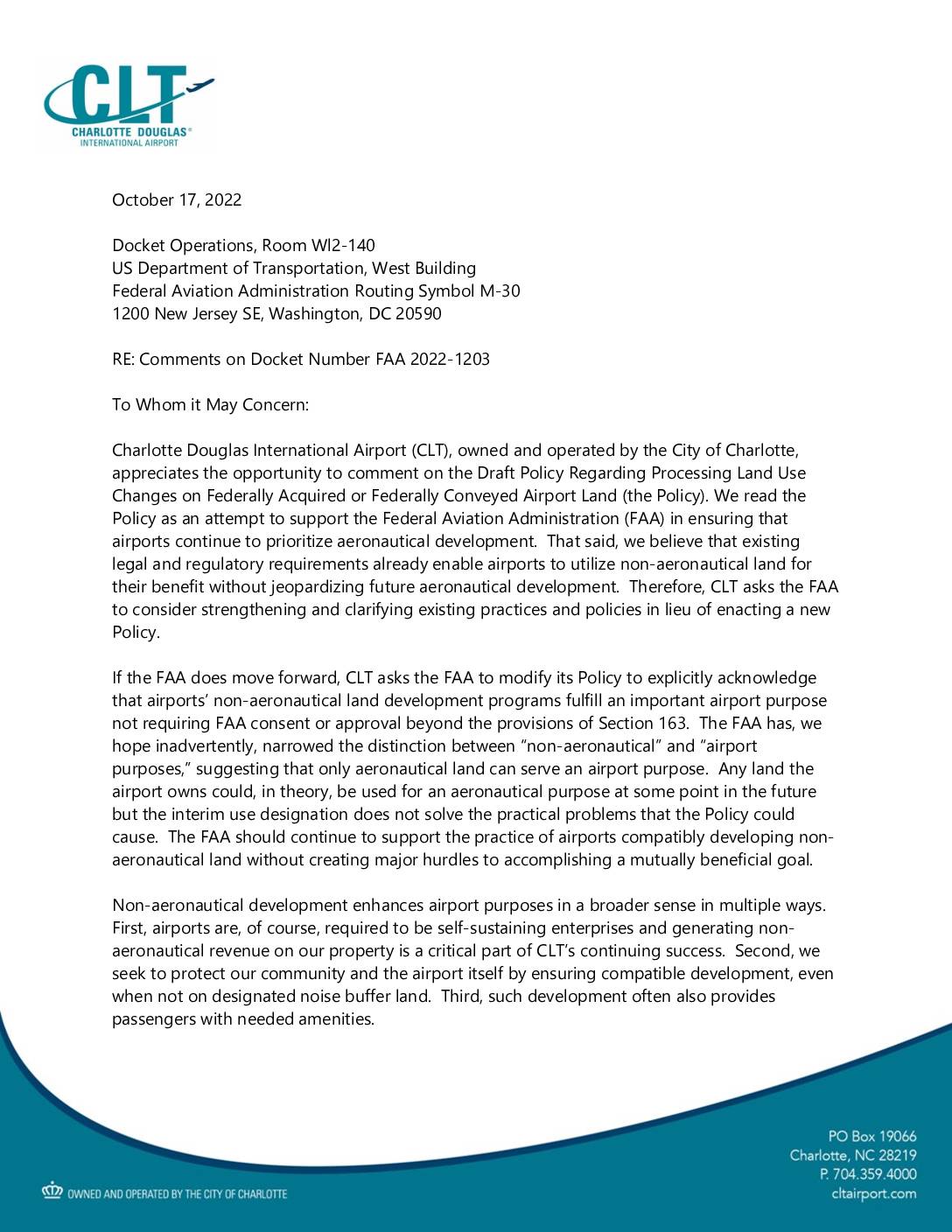
Comments on Docket Number FAA 2022-1203: Draft Policy regarding processing land use changes on federally acquired or federally conveyed airport land
Charlotte Douglas International Airport (CLT) submitted comments to the FAA in October 2022 opposing a proposed new policy on land use changes at federally acquired airport land, arguing that existing regulations already adequately govern non-aeronautical land use. CLT requested that if the policy moves forward, the FAA clarify approval timelines, lease evaluation procedures, and criteria for mixed-use land decisions. The letter emphasizes that non-aeronautical development is essential for airports to remain financially self-sustaining and to ensure compatible land use around airport property. -
 2022-10-17
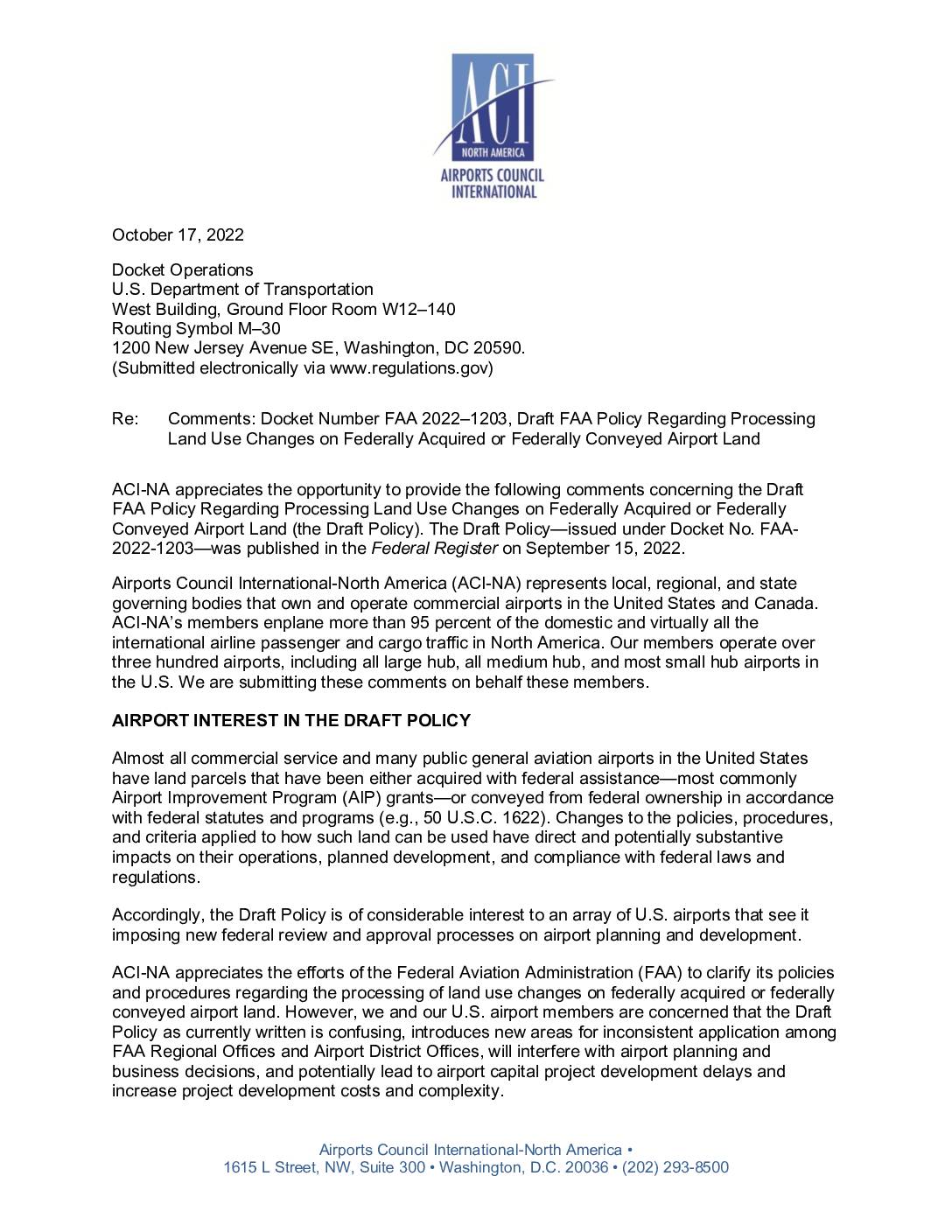
ACI-NA comments on draft FAA policy regarding processing land use changes on federally acquired or federally conveyed airport land
Airports Council International-North America (ACI-NA) submitted comments to the FAA in October 2022 opposing a draft policy that would impose new federal review and approval processes on how airports can use land that was federally acquired or conveyed. ACI-NA argued the policy is confusing, could lead to inconsistent decisions across FAA regional offices, and may delay airport development projects and increase costs. The organization urged the FAA to grandfather existing land use designations, clarify key undefined terms, and work collaboratively with airports to revise the policy. -
 2022-10-17
NASAO comments on draft FAA policy regarding processing land use changes on federally acquired or federally conveyed airport land
The National Association of State Aviation Officials (NASAO) submitted comments to the FAA in October 2022 regarding a draft policy on land use changes at federally acquired or conveyed airport land. NASAO raised concerns about lengthy lease review processes, the lack of defined timelines for approvals, and unclear procedures for lease renewals and extensions. The letter also questioned how the policy would affect existing leases and called for greater consistency across FAA regions. -
 2022-10-17
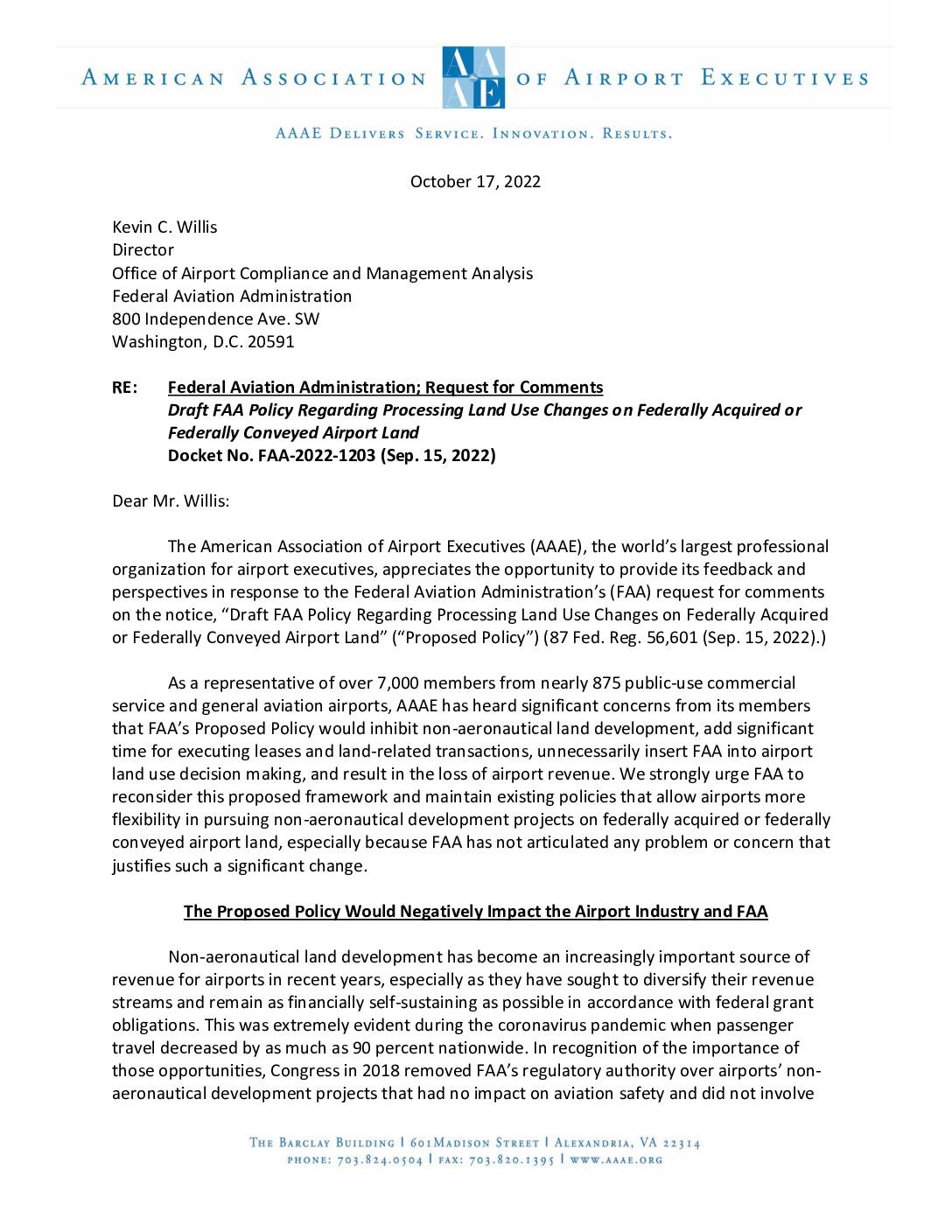
AAAE comments on draft FAA policy regarding processing land use changes on federally acquired or federally conveyed airport land
The American Association of Airport Executives (AAAE) submitted formal comments in October 2022 opposing a proposed FAA policy that would require federal review of individual leases, subleases, and non-aeronautical development projects on federally acquired or conveyed airport land. AAAE argues the policy would reduce airport revenue, slow development, and exceed FAA's appropriate role, which should be limited to aviation safety oversight rather than involvement in specific real estate transactions. The organization urges FAA to maintain existing policies and work collaboratively with the airport industry on any needed improvements. -
 2022-07-28
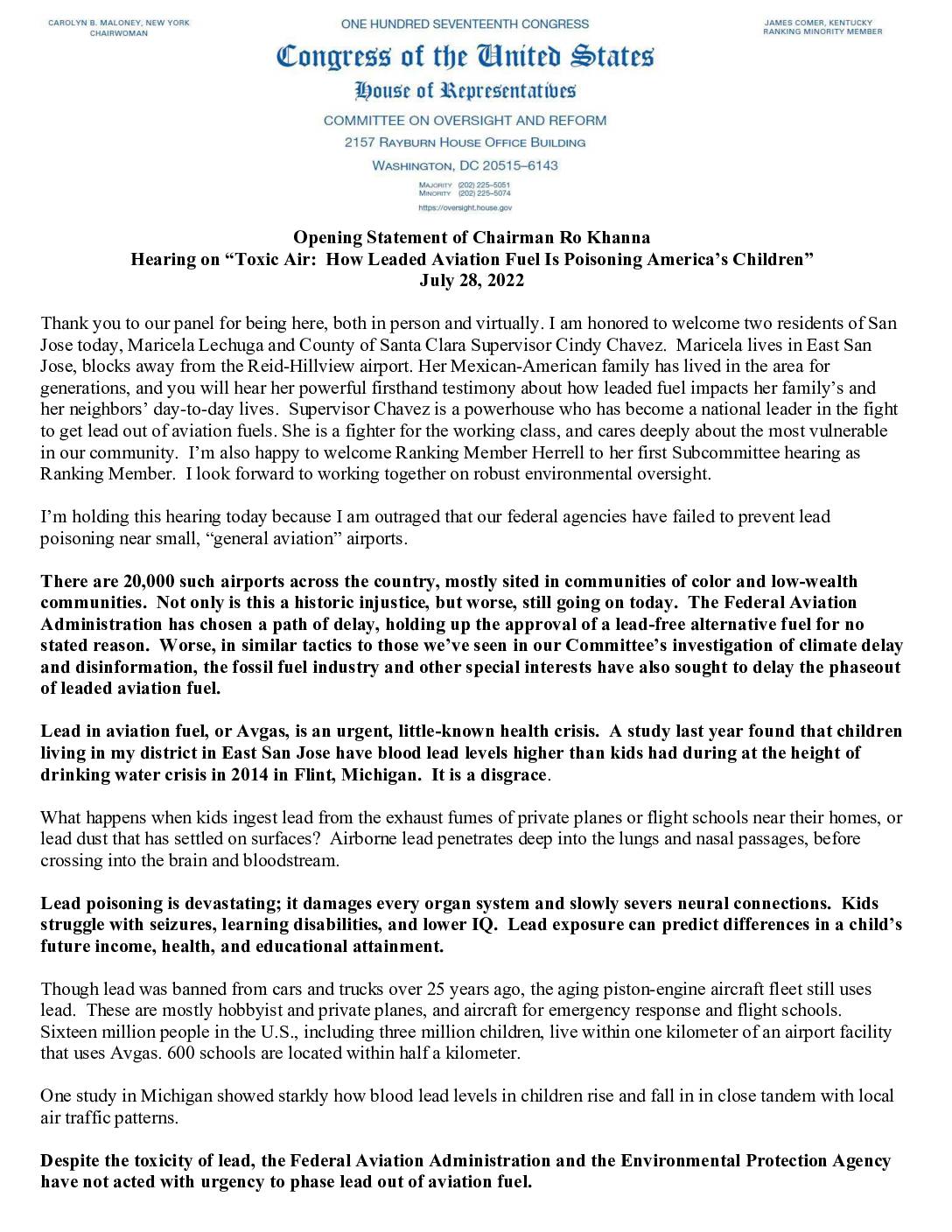
Opening Statement of Chairman Ro Khanna: Hearing on “Toxic Air: How Leaded Aviation Fuel Is Poisoning America’s Children”
In a July 2022 congressional hearing, Chairman Ro Khanna highlighted the health dangers of leaded aviation fuel (Avgas) still used in small general aviation aircraft, noting that children near airports in communities of color face blood lead levels exceeding those seen during the Flint water crisis. The statement criticizes the FAA and EPA for failing to act urgently on phasing out leaded fuel, despite the existence of viable unleaded alternatives, and accuses oil companies and aviation industry groups of deliberately delaying the transition. Khanna calls on federal agencies to accelerate approval of lead-free fuel options, involve affected communities in decision-making, and use infrastructure funding to support the switch to unleaded aviation fuel.