TagWAC(40)
-
 2026-05-28
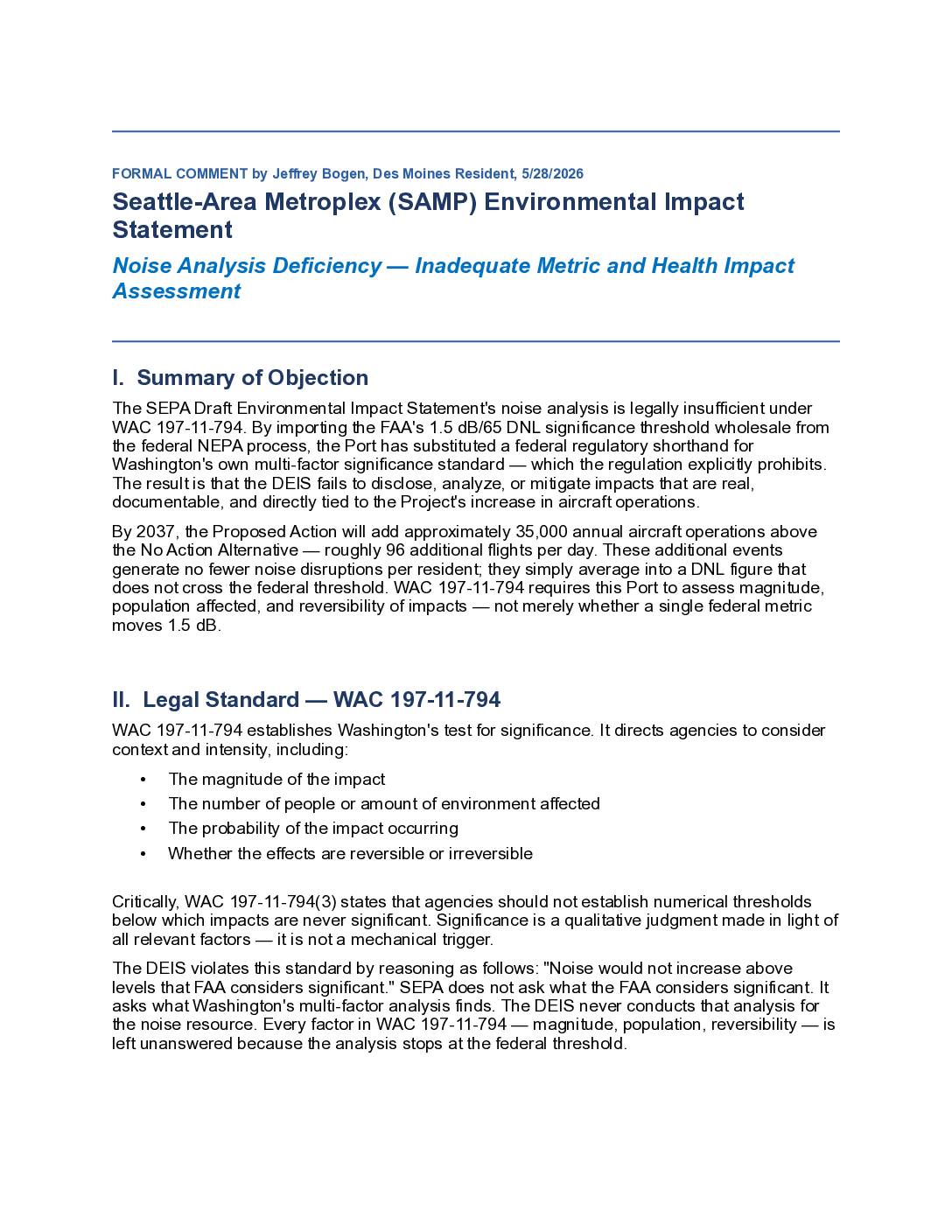
Formal Comment of Jeffrey Bogen: SAMP Draft EIS Noise Analysis Deficiency — Inadequate Metric and Health Impact Assessment
A Des Moines resident's formal comment argues that the Seattle-Area Metroplex Environmental Impact Statement's noise analysis is legally inadequate because it relies solely on a federal FAA noise threshold rather than Washington State's own multi-factor significance standard. The comment contends that the standard noise metric used (DNL) masks the real impact of roughly 96 additional daily flights projected by 2037, since it averages out individual disturbance events rather than counting them. The commenter calls for supplemental analysis using alternative metrics—such as single-event sound levels and nighttime averages—supported by peer-reviewed health studies linking aircraft noise to sleep disruption and cardiovascular harm. -
 2026-05-28
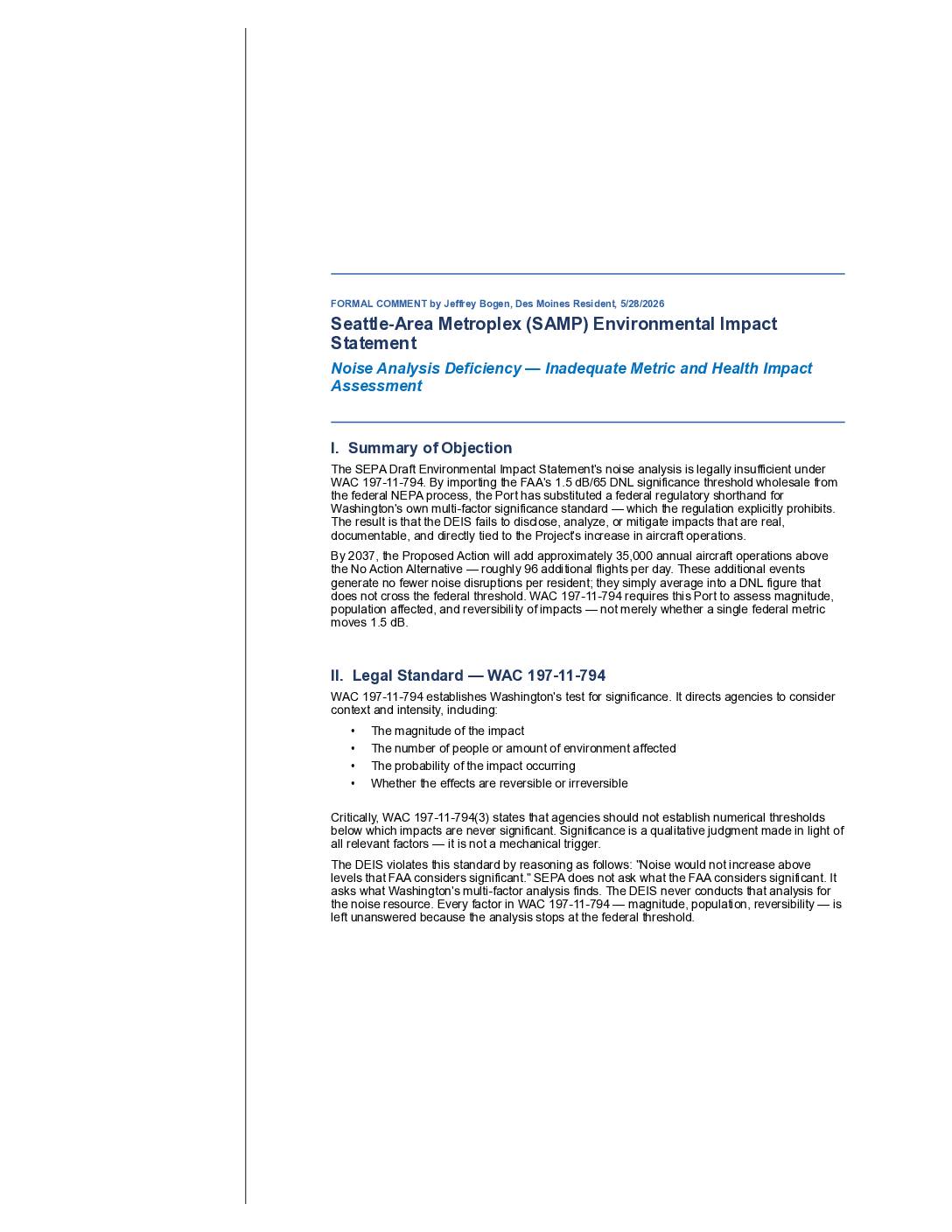
Formal Comment by Jeffrey Bogen: SAMP SEPA Draft EIS Noise Analysis Deficiency — Inadequate Metric and Health Impact Assessment
Des Moines resident Jeffrey Bogen submitted a formal comment arguing that the Seattle-Area Metroplex Environmental Impact Statement's noise analysis is legally inadequate because it relies solely on a federal average-noise metric (DNL) rather than Washington State's broader, multi-factor significance standard. Bogen contends that with roughly 96 additional flights per day projected by 2037, residents will experience more frequent individual noise disruptions — including sleep disturbance and cardiovascular stress — that the DNL metric is mathematically incapable of detecting. He calls on the Port of Seattle to supplement its Final EIS with event-level and nighttime noise metrics supported by peer-reviewed health research, including the FAA's own National Sleep Study. -
 2020-11-12
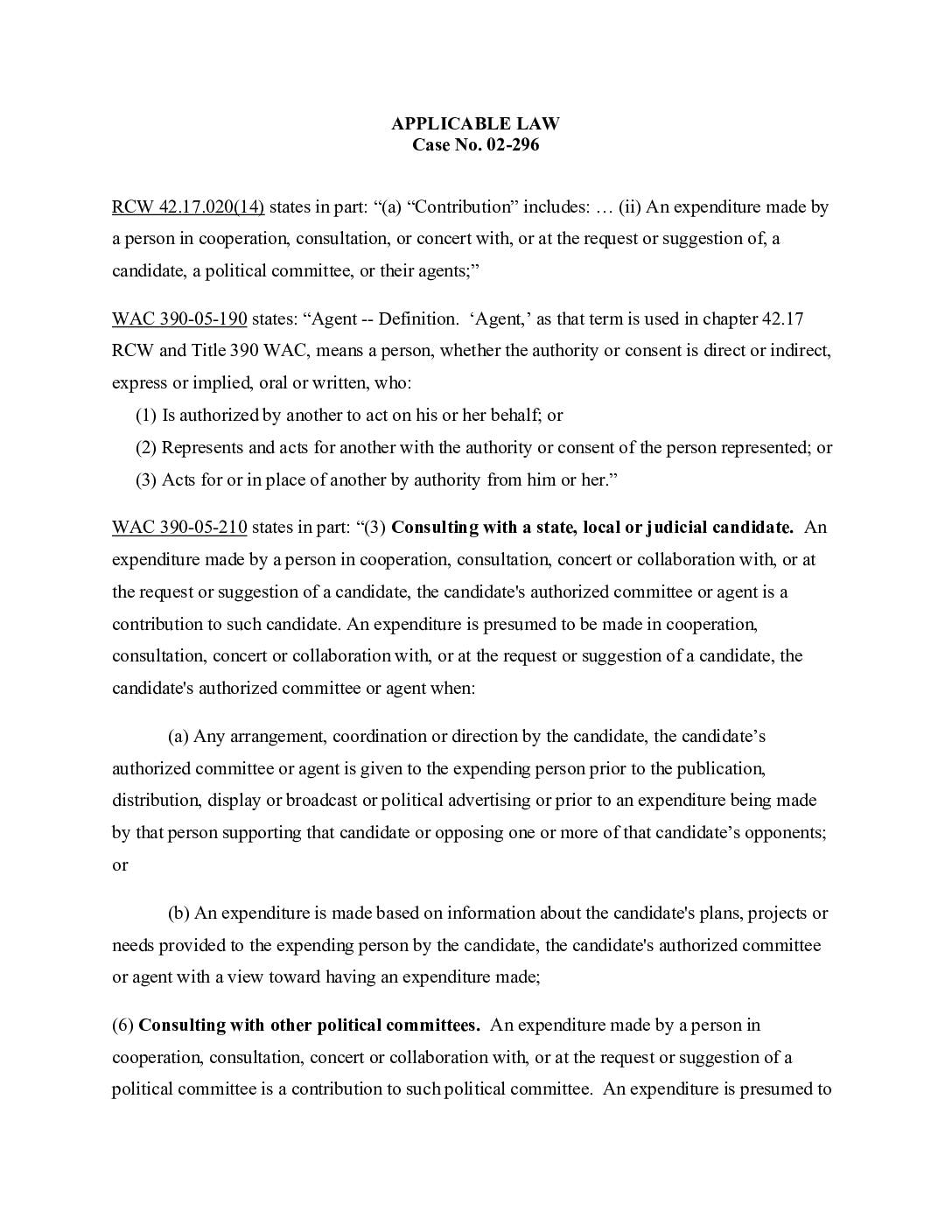
Applicable law, case no. 02-296
This document outlines Washington State campaign finance laws related to political contributions, coordination, and reporting requirements. It defines when an expenditure made by a third party counts as a campaign contribution — particularly when made in coordination with a candidate or political committee — and sets out registration and disclosure deadlines for political committees. These rules govern how campaigns and political organizations must track and report donations and spending. -
 2002-11-14
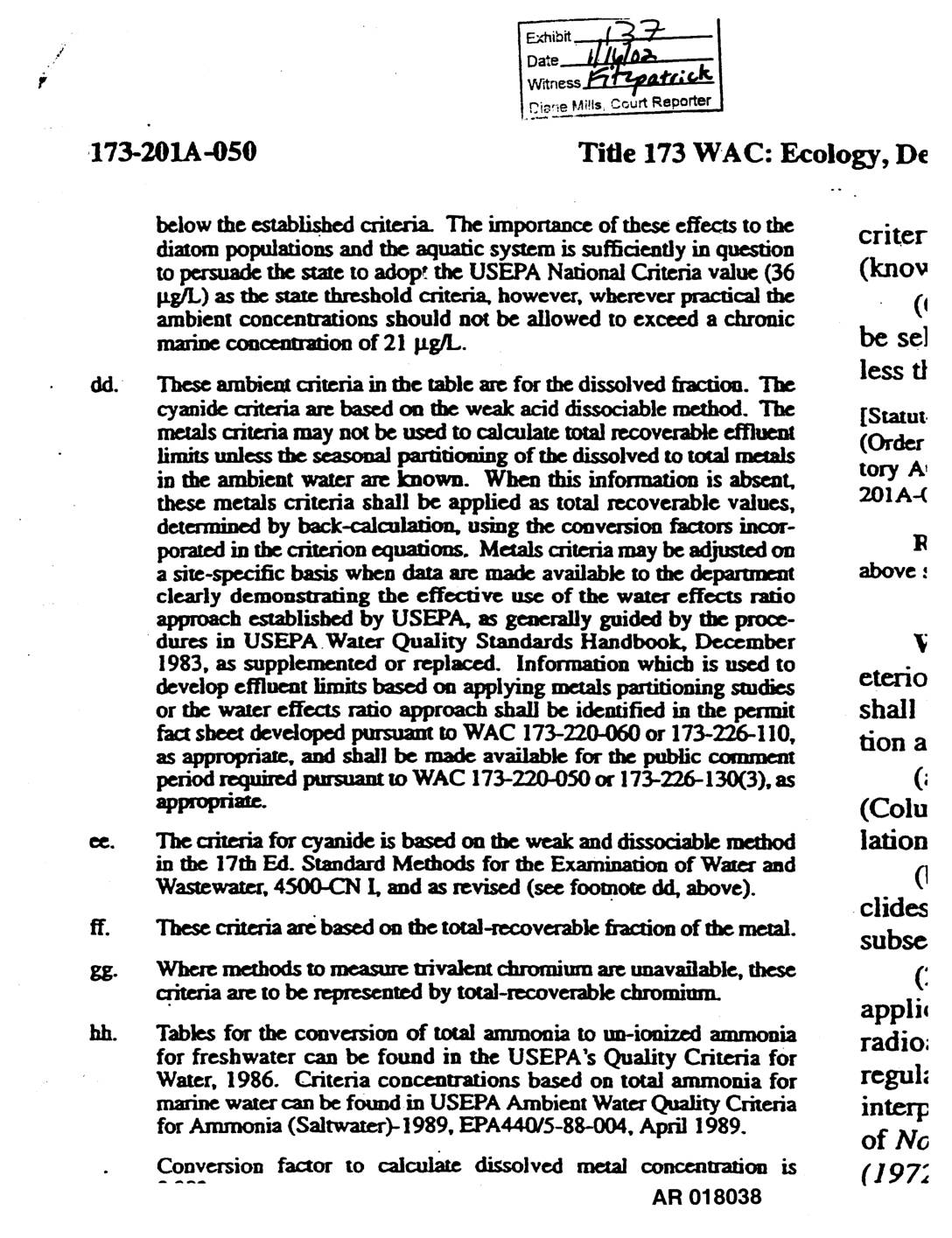
Exhibit 137: WAC 173-201A-050 Title 173 — Ecology, Department of — Ambient Water Quality Criteria Footnotes (Dissolved Metals, Cyanide, Ammonia)
Exhibit 137 (AR 018038), WAC 173-201A-050, Title 173 Washington Administrative Code, Washington State Department of Ecology ambient water quality criteria footnotes. Covers dissolved metals criteria, weak acid dissociable cyanide method (Standard Methods 4500-CN I), total recoverable effluent limits, conversion factors, water effects ratio approach (USEPA Water Quality Standards Handbook December 1983), site-specific metals adjustment, seasonal -
 2002-10-23
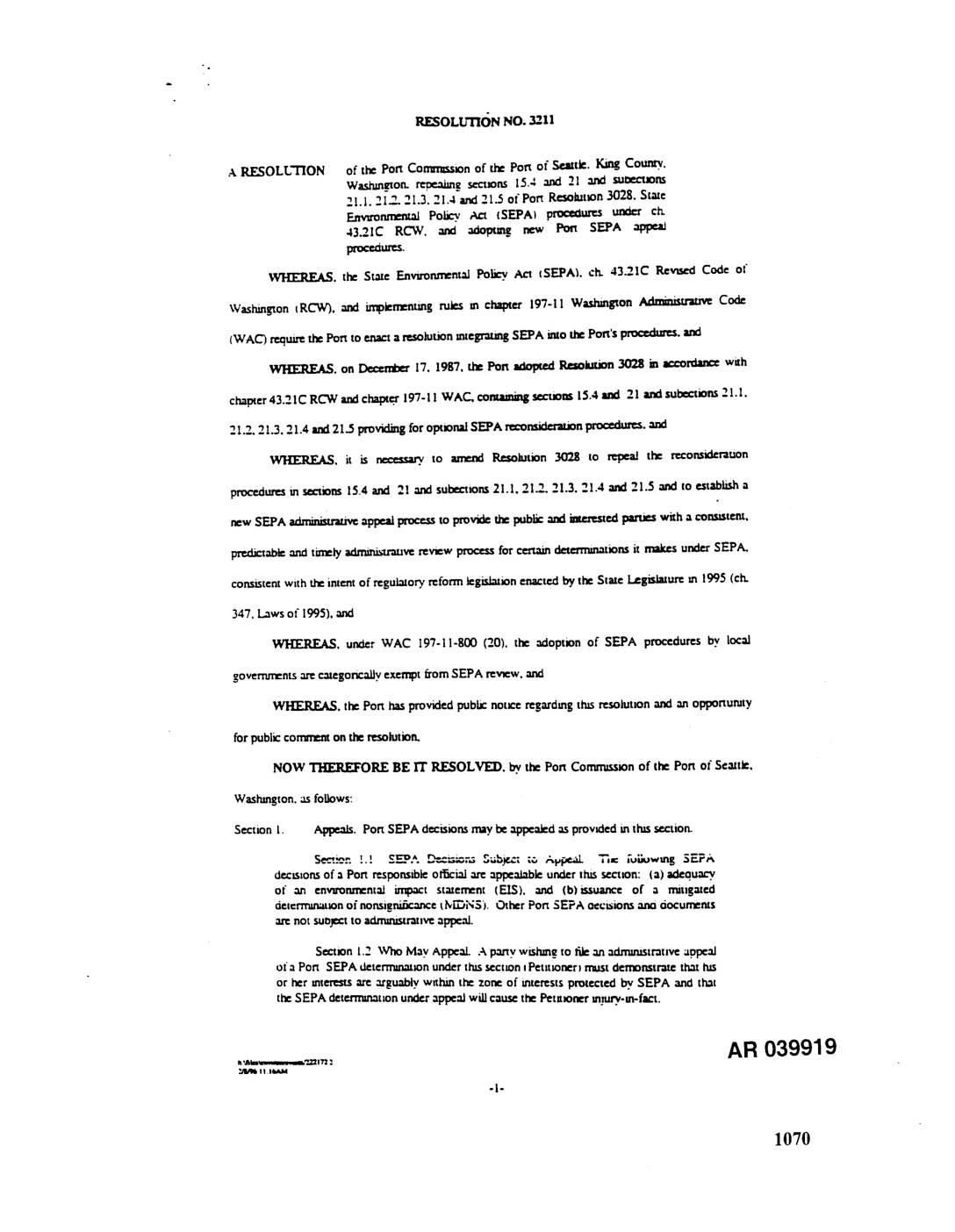
EXH AR039919: Resolution No. 3211 — Port Of Seattle SEPA Appeal Procedures
Resolution No. 3211 of the Port Commission of the Port of Seattle, King County, Washington, repealing sections 15.4 and 21 and subsections 21.1, 21.2, 21.3, 21.4, and 21.5 of Port Resolution 3028, and adopting new SEPA administrative appeal procedures under ch. 43.21C RCW and chapter 197-11 WAC. Establishes appealable SEPA decisions (EIS adequacy and issuance -
 2002-10-22
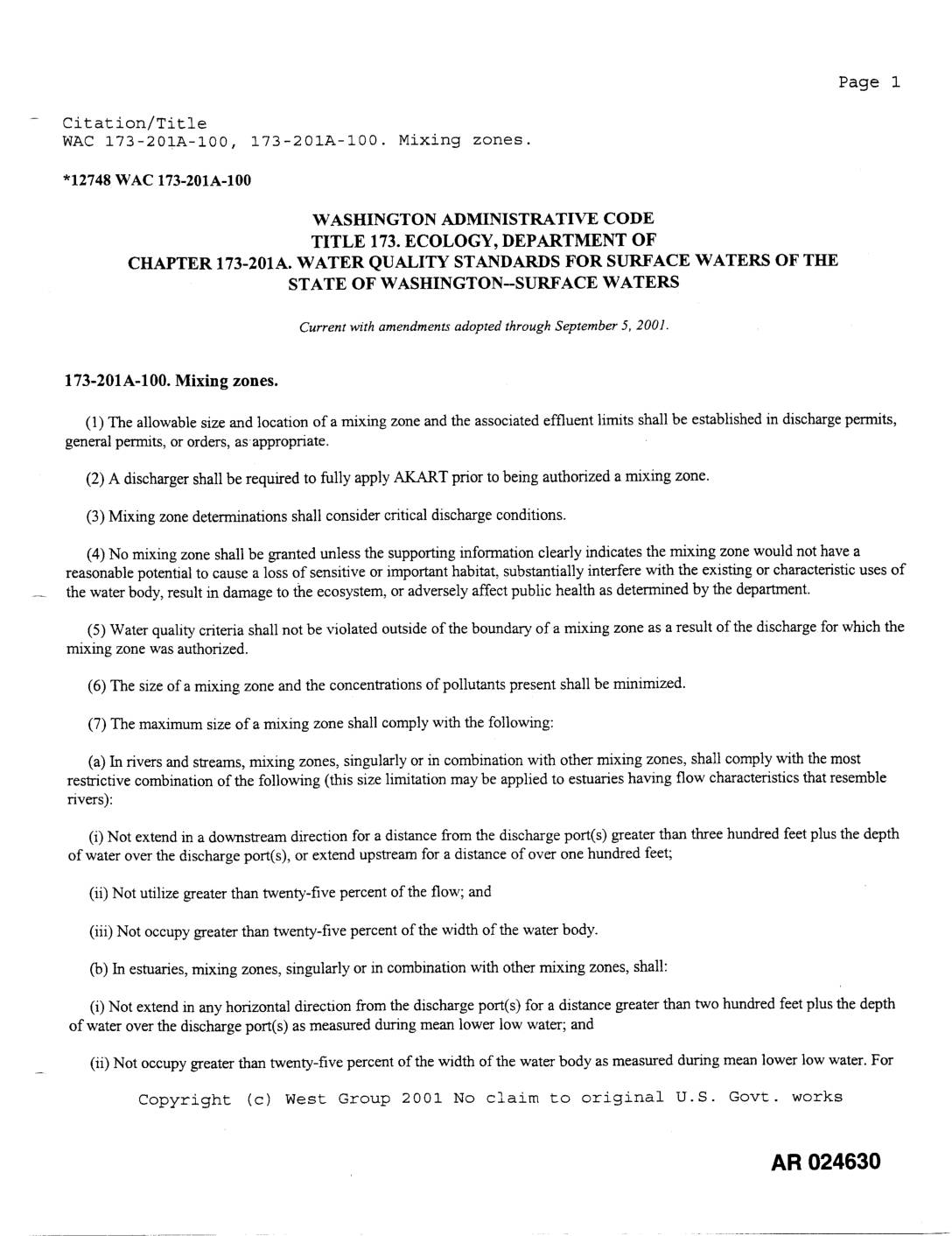
EXH AR024630: WAC 173-201A-100 Mixing Zones WA Water Quality Standards Surface Waters
This Washington State administrative regulation establishes rules for 'mixing zones,' which are designated areas in bodies of water where pollutant discharges are allowed to mix and dilute before meeting water quality standards. The rules set strict size limits for mixing zones in rivers, estuaries, lakes, and ocean waters, and require that dischargers apply all available pollution-reduction technology before a mixing zone is approved. Special provisions are also included for storm water discharges and combined sewer overflows. -
 2002-10-22
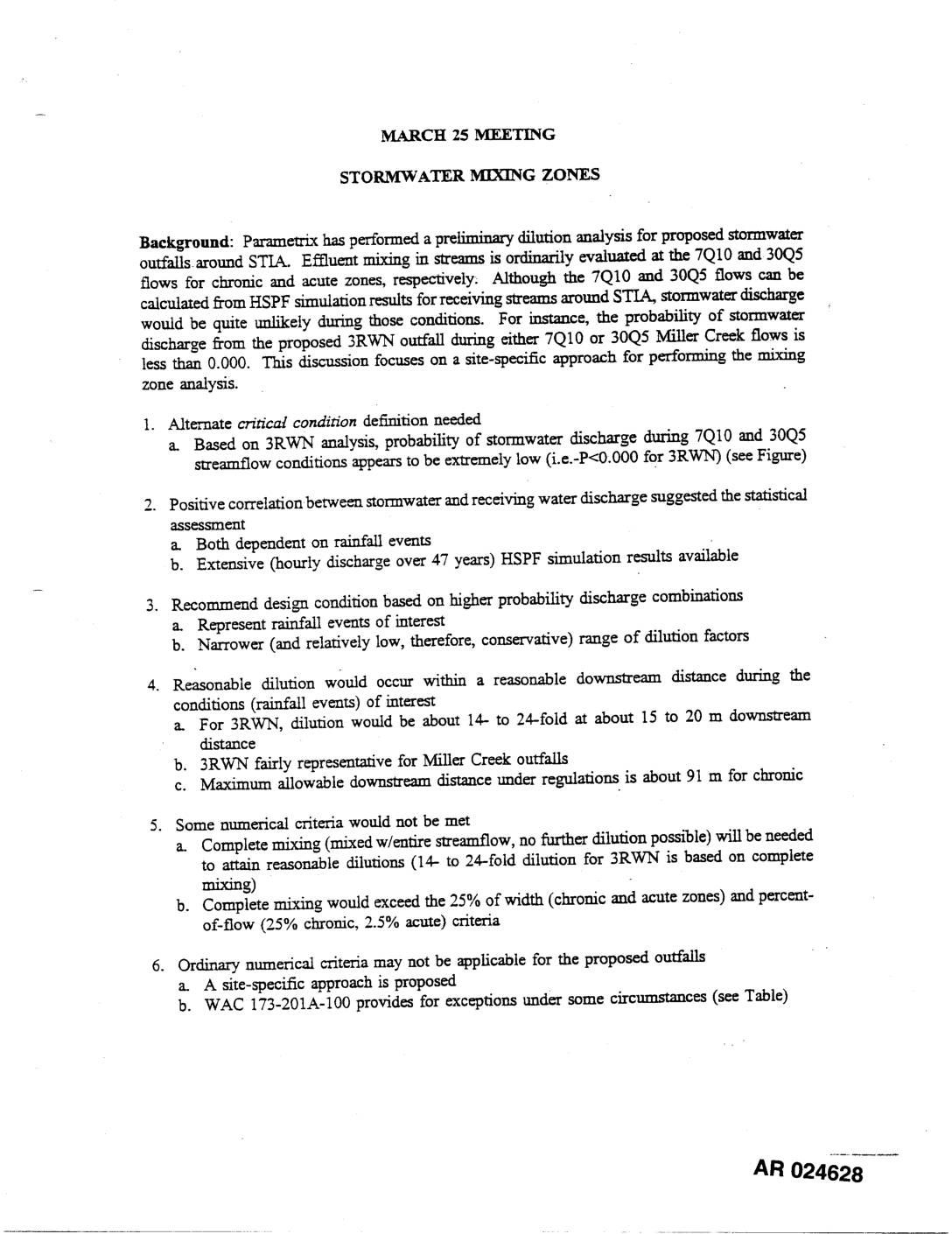
EXH AR024628: Stormwater Mixing Zones Mar 25 Meeting Discussion Doc STIA Third Runway EIS
This technical document from a March 25 meeting discusses stormwater mixing zone analysis for proposed outfalls around Seattle-Tacoma International Airport (STIA). Because standard stream flow conditions (7Q10 and 30Q5) are extremely unlikely to coincide with stormwater discharge events, Parametrix proposed a site-specific approach using higher-probability rainfall-based discharge combinations instead. The analysis found that reasonable dilution of 14- to 24-fold could occur within about 15 to 20 meters downstream, though complete mixing requirements would exceed standard regulatory width and flow percentage criteria, prompting a request for exceptions under WAC 173-201A-100. -
 2002-10-22
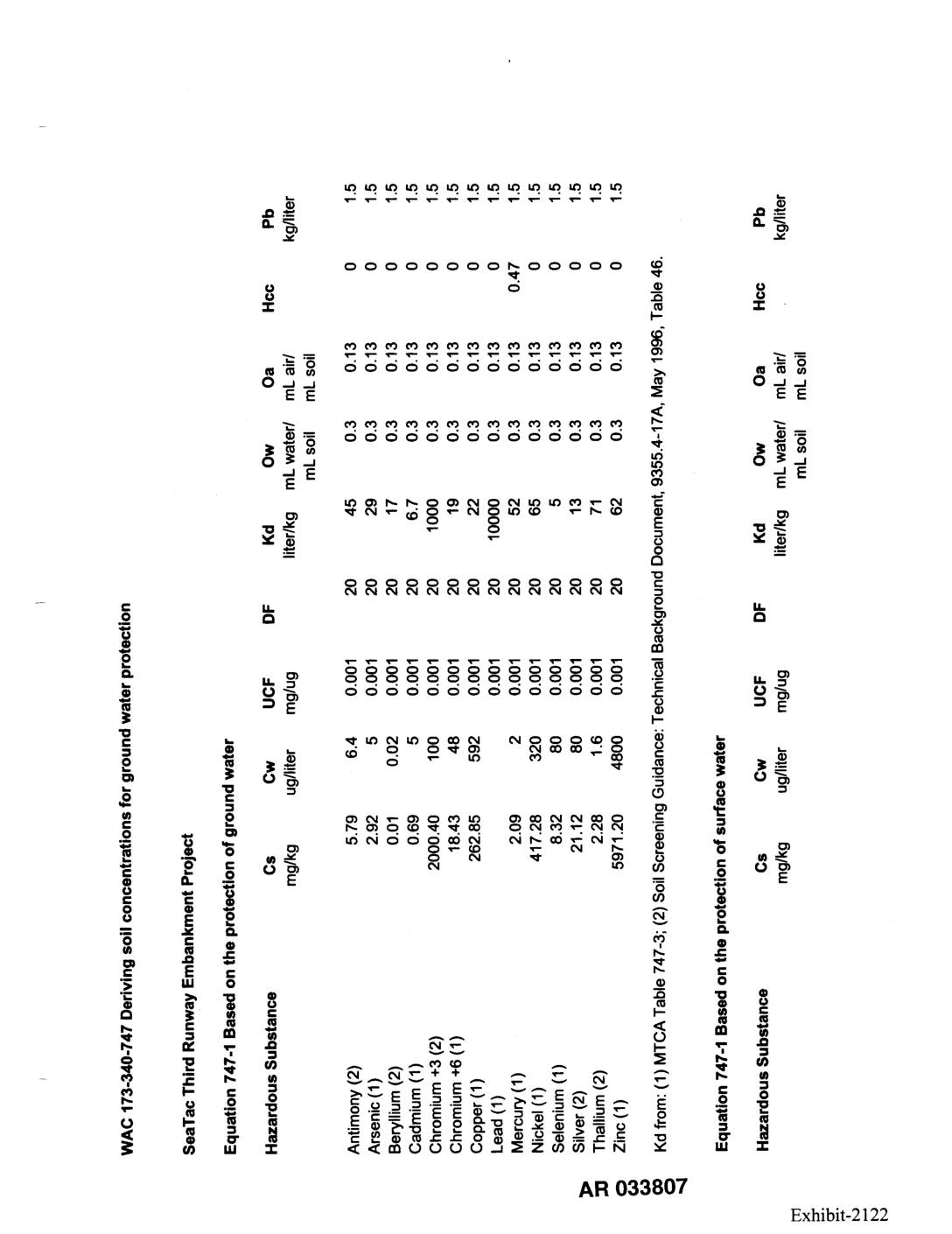
EXH AR033807: WAC 173-340-747 Deriving Soil Concentrations for Ground Water Protection — Sea-Tac Third Runway Embankment Project
Exhibit AR033807, WAC 173-340-747 soil concentration calculations for ground water and surface water protection under the Model Toxics Control Act (MTCA), SeaTac Third Runway Embankment Project. Tables derive cleanup levels for hazardous substances including antimony, arsenic, beryllium, cadmium, chromium +3, chromium +6, copper, mercury, nickel, selenium, silver, thallium, zinc, and lead using Equations 747-1 and -
 2002-10-22
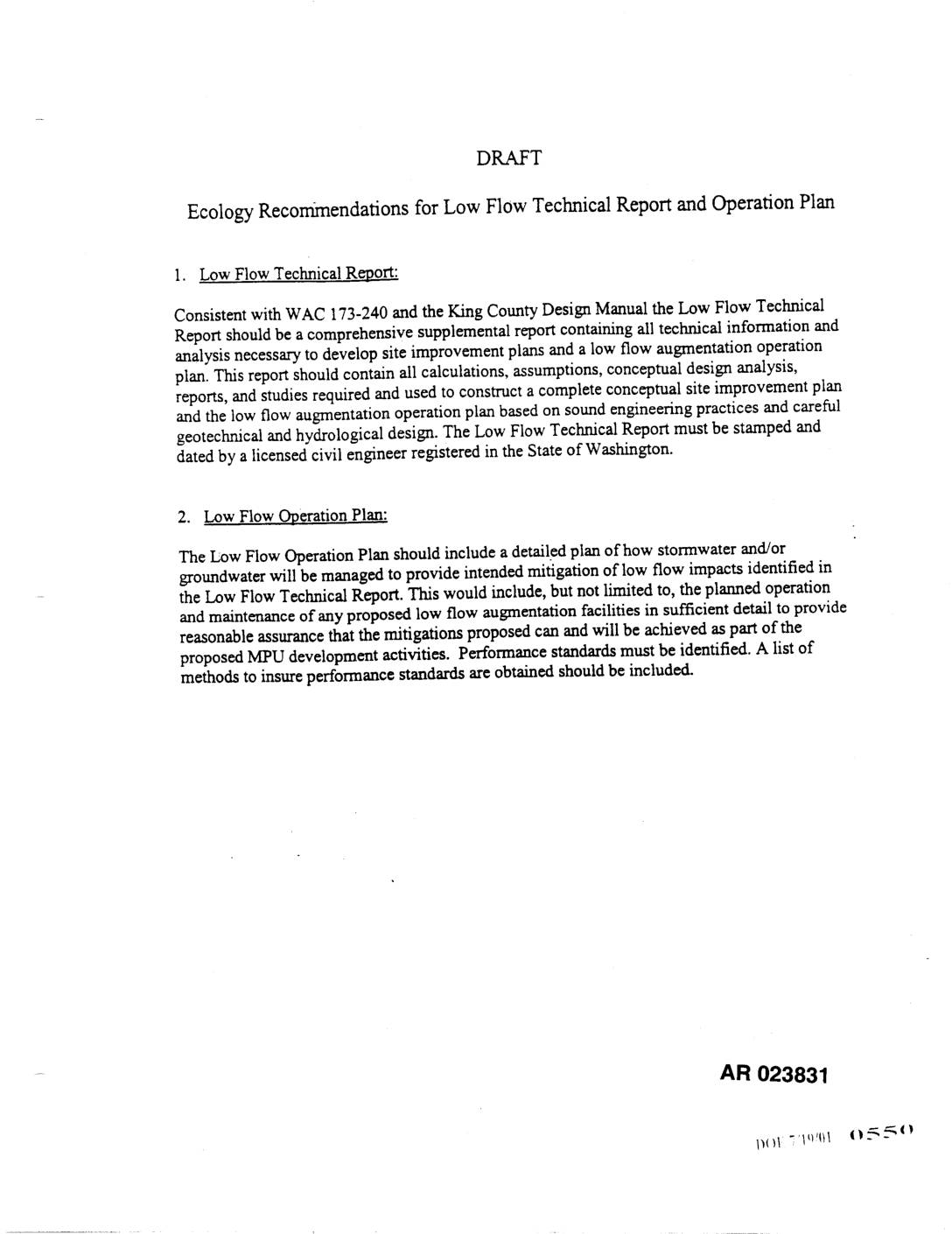
EXH AR023831: Ecology Draft Recommendations Low Flow Technical Report & Operation Plan
This draft document from Washington State's Department of Ecology outlines requirements for a Low Flow Technical Report and a Low Flow Operation Plan related to MPU development activities. The Technical Report must include all calculations, engineering analyses, and hydrological studies needed to address low flow impacts, and must be stamped by a licensed Washington civil engineer. The Operation Plan must detail how stormwater and groundwater will be managed to mitigate those impacts, including maintenance procedures, performance standards, and methods to ensure those standards are met. -
 2002-10-21
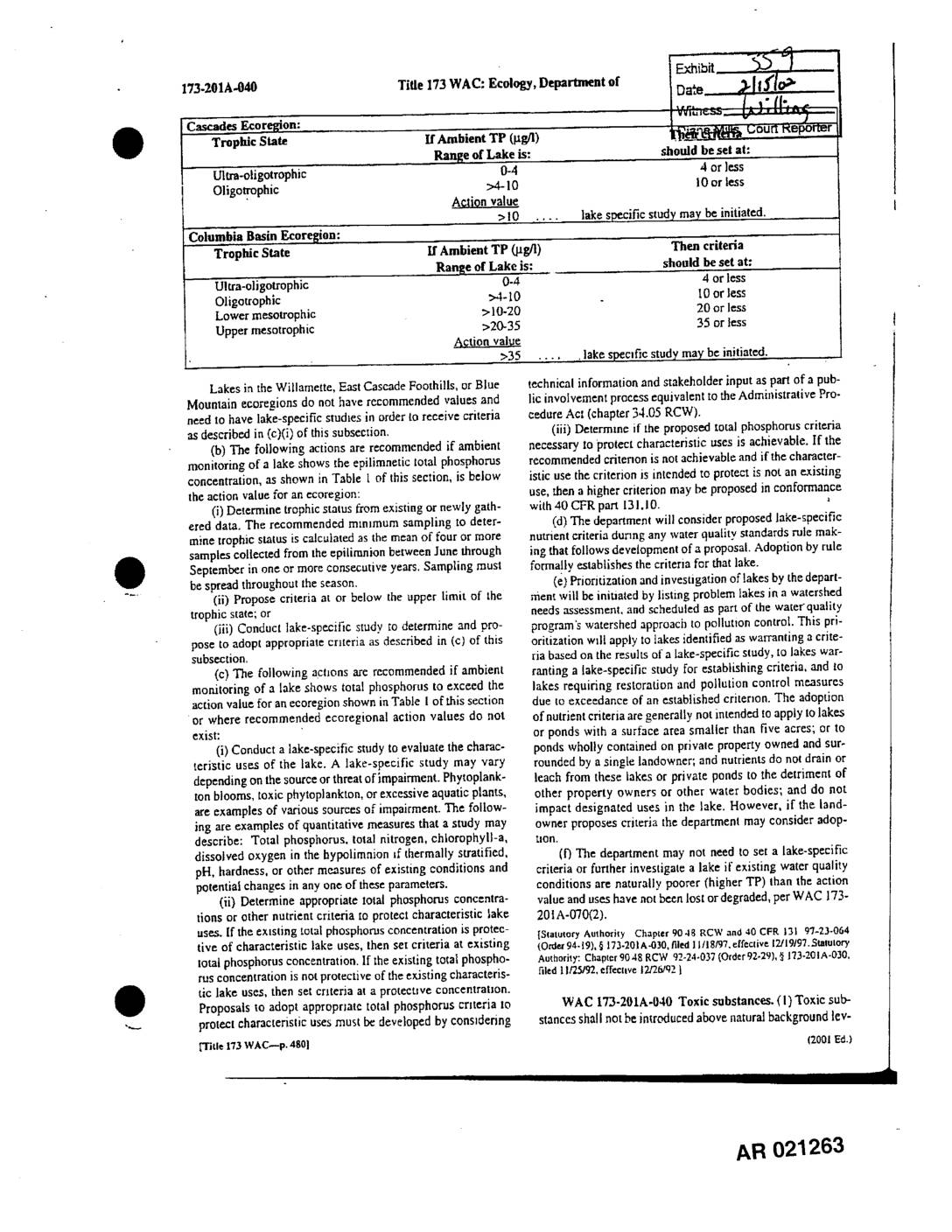
EXH AR021263: WAC 173-201A WA Water Quality Standards — Toxic, Radioactive, Lake Nutrient
This document outlines Washington State water quality standards for surface waters, including criteria for total phosphorus levels in lakes across different ecoregions (Cascades and Columbia Basin) and limits for toxic substances such as heavy metals, pesticides, and radioactive materials. It establishes trophic state classifications and action values that trigger lake-specific studies when exceeded, and sets numerical criteria for aquatic life protection in both freshwater and marine environments.