TagHMMH(15)
-
 2026-06-05
Acoustical Testing Results for SIRRPP — June 2026
This technical memorandum from Harris Miller Miller & Hanson Inc. (HMMH), dated June 5, 2026, presents the results of interior sound insulation testing conducted in April 2026 for 30 homes near Seattle-Tacoma International Airport as part of the SEA Repair and Replacement Program. Acoustical engineers measured how well each room in these homes reduces outside aircraft noise, finding that only 4 of the 30 structures met the FAA's minimum threshold of 45 decibels of interior noise to qualify for sound insulation treatments. An additional 16 homes had at least one room exceeding that threshold, suggesting potential benefit from window and door upgrades, though current FAA policy does not require treatment based on individual room results alone. -
 2026-05-04
Acoustical Testing Results for SIRRPP — May 2026
Harris Miller Miller & Hanson Inc. (HMMH) conducted sound insulation testing at 30 homes near Seattle-Tacoma International Airport (SEA) in March 2026 to measure how much aircraft noise penetrates indoors. The study found that none of the 30 homes exceeded the FAA's 45-decibel interior noise threshold required to qualify for sound insulation treatments under current federal policy. However, nine homes had at least one individual room where interior noise levels surpassed 45 decibels, suggesting those specific rooms could benefit from upgraded windows or doors. -
 2025-10-10
Acoustical Testing Results for SIRRPP — October 2025
In September 2025, acoustical engineers tested 29 homes near Seattle-Tacoma International Airport to measure how much aircraft noise penetrates indoors. The study found that none of the homes exceeded the 45-decibel interior noise threshold required to qualify for federally funded soundproofing treatments, though 10 homes had at least one room above that level. The findings are part of SEA's Repair and Replacement Program, which evaluates whether previously soundproofed homes need updated windows and doors. -
 2025-09-12
Acoustical Testing Results for SIRRPP — September 2025
In August 2025, acoustical engineering firm HMMH measured indoor noise levels at 31 homes near Seattle-Tacoma International Airport to assess eligibility for the airport's Sound Insulation Repair and Replacement Program. Testing found that only one of the 31 homes met the FAA's minimum threshold of 45 decibels interior Day-Night Average Sound Level required to qualify for full sound insulation treatment, while seven additional homes had at least one room exceeding that level. The study used FAA-approved methods, including a Boeing 737-800 aircraft noise spectrum, to calculate how much airport noise penetrates each habitable room with windows closed. -
 2025-08-08
Acoustical Testing Results for SIRRPP — August 2025
This August 2025 technical report by Harris Miller Miller & Hanson Inc. (HMMH) presents the results of interior sound insulation testing conducted at 28 homes near Seattle-Tacoma International Airport (SEA) in July 2025. Using FAA-approved measurement methods, acoustical engineers tested every habitable room in each home to determine how much aircraft noise penetrates indoors, with a threshold of 45 decibels (dB) required for a home to qualify for sound insulation assistance. Of the 28 structures tested, only two met the 45 dB qualification threshold, while nine others had at least one room exceeding that level but did not qualify under current FAA policy. -
 2025-07-16
Acoustical Testing Results for SIRRPP — July 2025
Harris Miller Miller & Hanson Inc. (HMMH) conducted sound insulation measurements at 30 homes near Seattle-Tacoma International Airport in June 2025 to determine whether interior noise levels meet the federal threshold for sound insulation assistance. Using FAA-approved testing methods, the study found that only 3 of the 30 homes had median interior Day-Night Average Sound Levels (DNL) at or above the qualifying 45 dB threshold, while an additional 3 homes had individual rooms exceeding that level. The results inform eligibility decisions under the SEA Repair and Replacement Program, which is governed by FAA Advisory Circular 150/5000-9B and the Airport Improvement Program Handbook. -
 2021-02-01
Analysis of the Neighborhood Environmental Survey
This 2021 FAA report analyzes the Neighborhood Environmental Survey (NES), a large-scale study examining how aircraft noise affects communities around 20 U.S. commercial airports. Researchers surveyed over 10,000 residents and found that annoyance with aircraft noise increases steadily as noise levels rise, with significantly more people reporting high annoyance than older studies had suggested. The findings provide an updated national curve showing the relationship between measured noise exposure (DNL) and community annoyance, which can inform airport noise policy decisions. -
 2021-01-01
Neighborhood Environmental Survey fact sheet
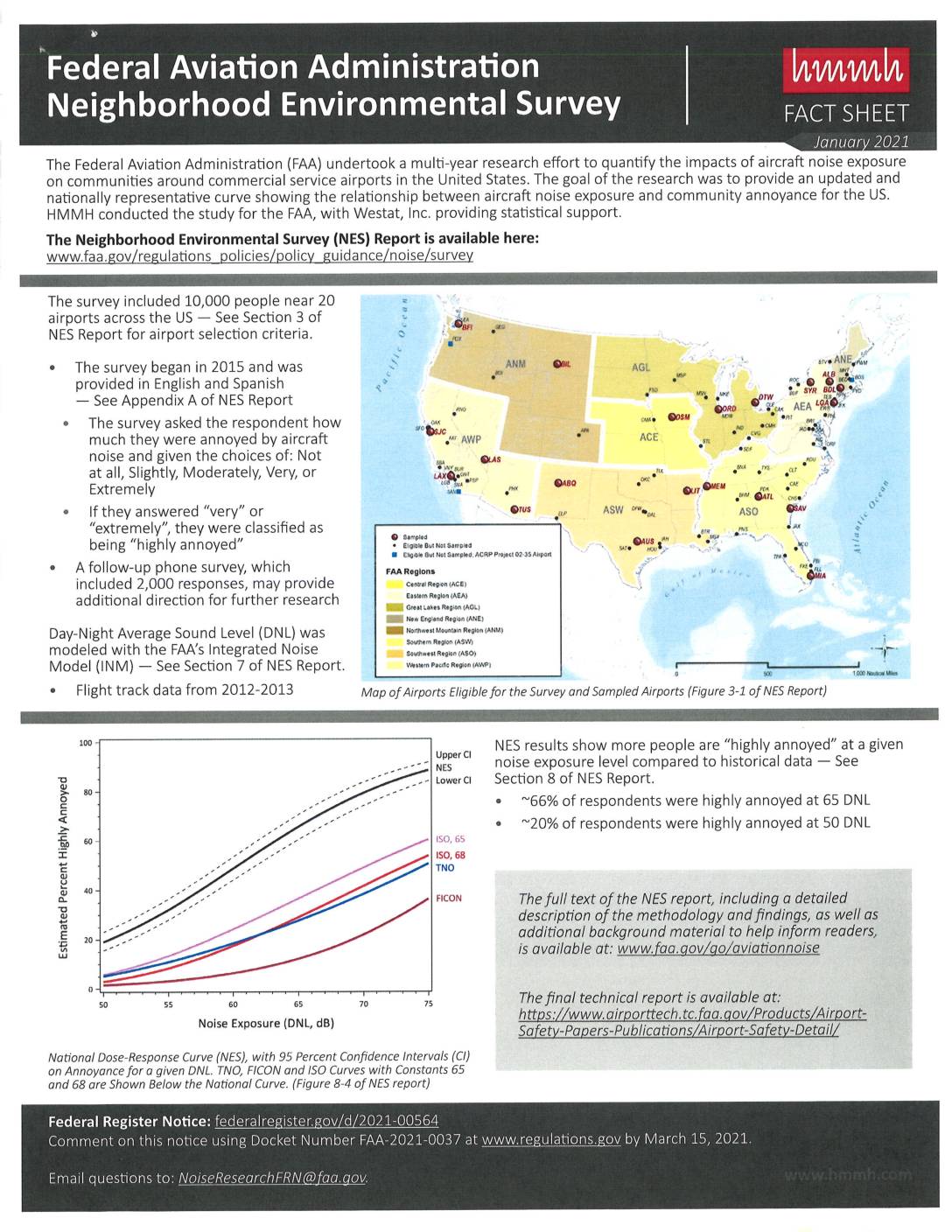
The FAA conducted a large-scale Neighborhood Environmental Survey (NES) of 10,000 people near 20 U.S. airports to measure how aircraft noise affects community annoyance, finding that significantly more people are bothered by noise than older studies suggested — about 66% of respondents were highly annoyed at 65 decibels (DNL) and 20% at 50 decibels. The agency uses the Day-Night Average Sound Level (DNL) metric to measure noise exposure and is reviewing whether its longstanding 65 DNL threshold for 'significant' noise impact should be updated. The FAA is seeking public comment on these research findings before making any changes to official noise policy. -
 2019-11-20
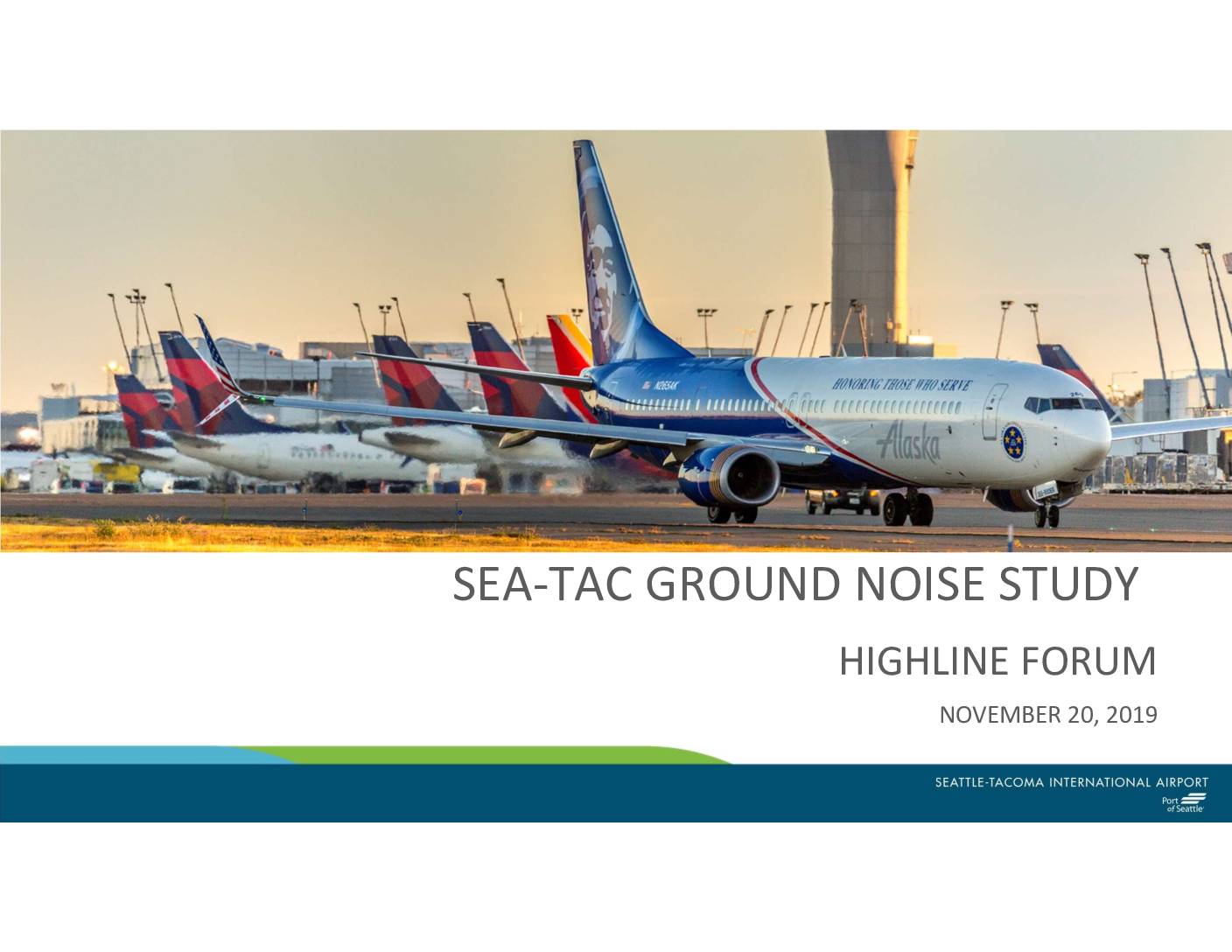
Sea-Tac ground noise study: Highline Forum
This document presents findings from a Sea-Tac Airport Ground Noise Study, shared at the Highline Forum on November 20, 2019. It explains how aircraft ground noise travels and changes with distance, noting that sound levels drop by 6 dB every time the distance doubles and are further reduced by atmospheric absorption and soft ground surfaces. The study also covers how temperature gradients affect noise, with sound bending upward in normal conditions and downward during temperature inversions, potentially increasing noise impacts on nearby communities. -
 2019-10-27
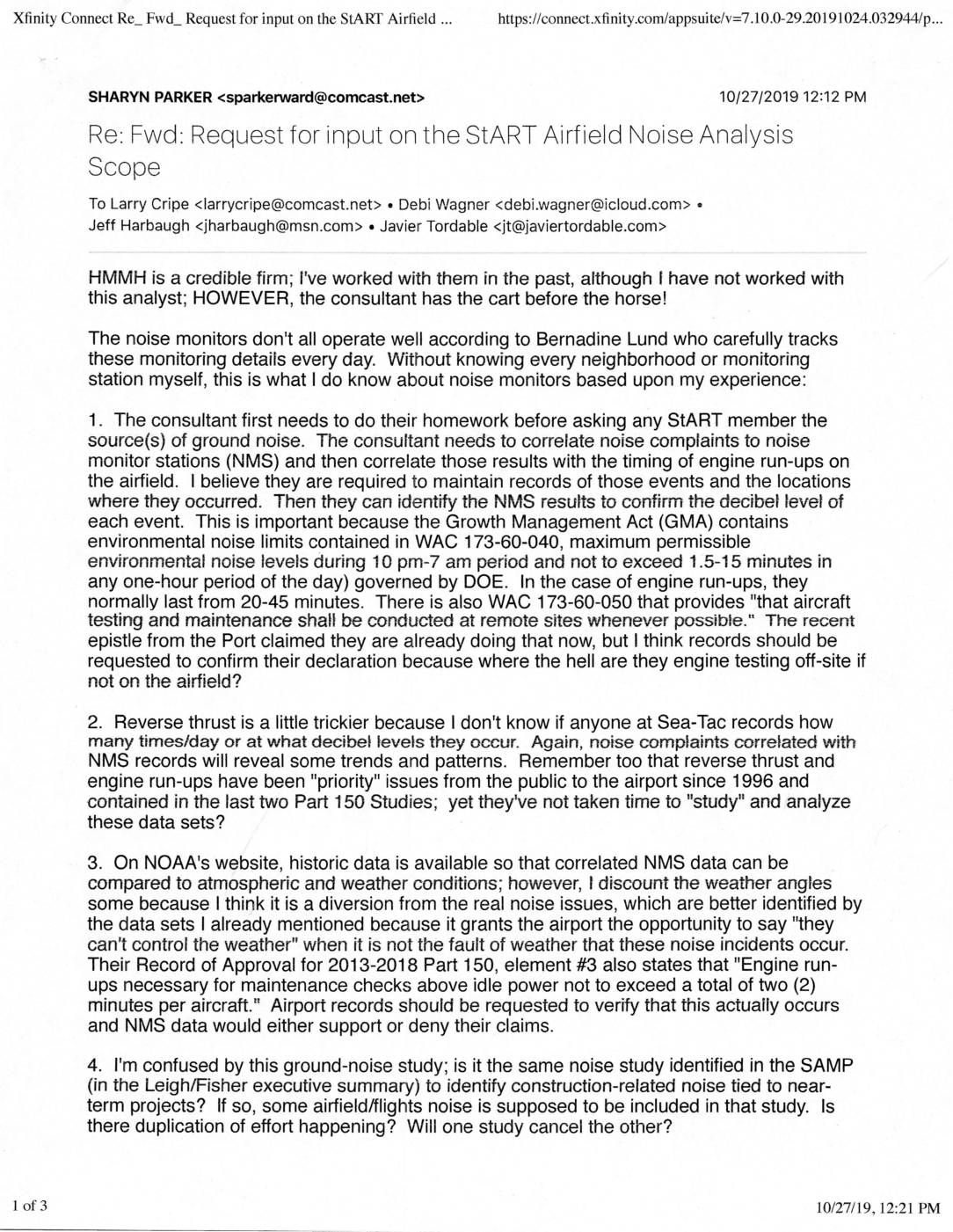
Re: Fwd: Request for input on the StART Airfield Noise Analysis Scope
In October 2019, community advocate Sharyn Parker responded to a request for public input on a Sea-Tac Airport airfield ground noise study being conducted by consulting firm HMMH. Parker argued that the consultant should first analyze existing noise monitor station data, correlate it with engine run-up records and resident complaints, and review compliance with Washington State noise regulations (WAC 173-60) before seeking community feedback. She also raised concerns about non-functioning noise monitors, the airport's unverified claims about off-site engine testing, and potential overlap with a separate noise study tied to the airport's master planning process.