TagGAO(10)
-
 2025-09-16
GAO: Aviation Meteorologists: Urgent Actions Needed to Address Staffing Concerns
GAO-25-108597 Published: Aug 28, 2025. Publicly Released: Aug 28, 2025. Fast Facts Bad weather can snarl air travel. Air traffic controllers make weather-related decisions, like changing a plane’s route, for safety and efficiency. The National Weather Service puts aviation meteorologists on-site at the Federal Aviation Administration’s air traffic control centers to help. They give regular -
 2025-08-28
Aviation meteorologists: Urgent actions needed to address staffing concerns
A August 2025 U.S. Government Accountability Office report warns that staffing shortages among National Weather Service meteorologists embedded at FAA air traffic control centers may pose risks to the safety and efficiency of the National Airspace System. These meteorologists provide critical real-time weather briefings to air traffic controllers to help route flights safely around severe weather, but a February 2025 amendment to the FAA-NWS interagency agreement reduced the required staffing level from 90 to 81 positions. The GAO urges urgent action from the Departments of Transportation and Commerce before the interagency agreement expires in September 2025. -
 2025-05-11
Key Provisions in the 2024 FAA Reauthorization Act and Related GAO Work
GAO-25-108502 Published: May 15, 2025. Publicly Released: May 15, 2025. Fast Facts The U.S. national airspace system is the busiest and most complex in the world, with over 45,000 flights per day. The Federal Aviation Administration Reauthorization Act of 2024 directs FAA on how the agency is to ensure its safety and efficiency. We testified -
 2024-09-01
GAO 24-107001: FAA Actions Are Urgently Needed to Modernize Aging Systems
A September 2024 U.S. Government Accountability Office report found that the FAA's air traffic control systems are critically outdated, with 37% rated unsustainable and 39% potentially unsustainable out of 138 total systems reviewed. The agency has been slow to modernize the most at-risk systems, with some upgrades not planned for completion until 2030–2035, and four critical systems lacking any modernization plans at all. The GAO made seven recommendations to improve FAA oversight and accelerate upgrades to protect the safety and efficiency of the national airspace. -
 2024-05-11
Sharyn Parker’s notes prepared for interview with GAO representatives
Former King County International Airport (BFI) Noise Officer Sharyn Parker's prepared notes for a GAO interview outline significant concerns about FAA regulatory failures and Sea-Tac Airport's inadequate noise mitigation practices in the Seattle region. Parker argues that the FAA has consistently failed to require Sea-Tac to update noise exposure maps, enforce timely sound mitigation programs, or conduct meaningful public outreach — particularly for minority communities disproportionately affected by flight path changes like the Greener Skies/RNP initiative. The notes also highlight contradictions between Sea-Tac's deliberately low flight-operation projections in its Part 150 noise studies and the far higher growth figures used in its capital development plans. -
 2020-09-15
Letter to Ms. Hamer regarding GAO study 103933: Community impacts from NextGen noise
A community member wrote to a GAO researcher studying NextGen aviation noise impacts near Seattle-Tacoma International Airport, urging that community complaints be paired with responses from the FAA and Port of Seattle to ensure credibility. Key concerns raised include an outdated noise exposure map that has not been updated despite significant growth in air traffic, and the FAA's alleged refusal to answer questions submitted as far back as April 2018. The letter argues that without official rebuttals or supporting documentation, community perceptions risk appearing unsubstantiated and could undermine the integrity of the GAO study. -
New aircraft-noise rule would do little to quiet the skies: government report
By Jon Hemmerdinger 24 August 2020 A ban on aircraft that do not meet new noise standards would do little to reduce overall aircraft noise and would impose costly requirements on airlines and aerospace manufacturers. That is according to a 20 August report from the US Government Accountability Office into the likely impact of a -
 2013-04-01
NextGen air transportation system: FAA has made some progress in midterm implementation, but ongoing challenges limit expected benefits
A 2013 U.S. Government Accountability Office report found that the FAA made limited progress in modernizing the air transportation system through its NextGen initiative, with ongoing challenges reducing expected benefits. The report highlights the FAA's Greener Skies project at Seattle-Tacoma International Airport, initiated by Alaska Airlines, which aimed to shorten flight paths and route aircraft over water to save fuel, but excluded certain eastern flight procedures due to community concerns about aviation noise. The report notes that the full benefits of new flight procedures depend heavily on how often airlines and pilots actually use them. -
 1998-12-28
Airport Improvement Program: FAA complying with requirement for local involvement in noise mitigation projects
A 1998 U.S. General Accounting Office report examined whether the FAA was required to enforce a policy mandating written declarations of local support before awarding noise mitigation grants to Seattle-Tacoma International Airport. The report found that while FAA policy called for such written declarations from affected cities and counties, neither federal law nor FAA regulations legally required them. FAA officials maintained they still met the broader statutory requirement of ensuring noise mitigation projects were consistent with local plans. -
 1998-05-27
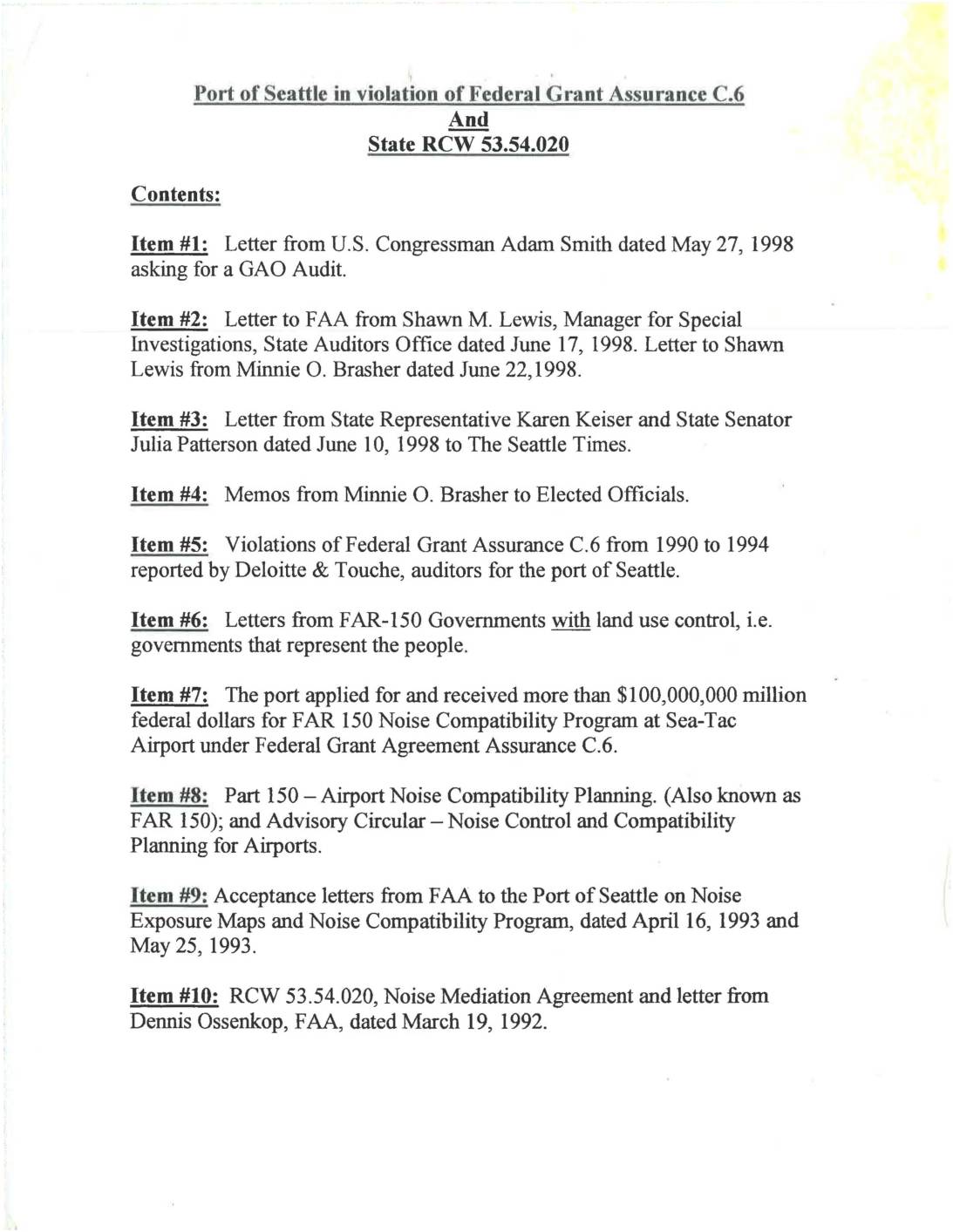
Port of Seattle in violation of Federal Grant Assurance C.6 And State RCW 53.54.020
This document compiles evidence alleging that the Port of Seattle violated Federal Grant Assurance C.6 and Washington State law RCW 53.54.020 in connection with its noise compatibility program at Sea-Tac Airport. It includes letters from elected officials, audit findings by Deloitte & Touche, and records showing the Port received over $100 million in federal funds for FAR Part 150 noise mitigation while allegedly failing to comply with the program's requirements. Supporting materials span 1990–1998 and involve Congress members, state legislators, the FAA, and the Washington State Auditor's Office.