Skip to content
  • STNI
  • Statistics
    • Ops and Passengers
      • King County International Airport (Boeing Field) Annual Operations
    • Financials
    • Aviation fuel uplift in the State of Washington 2018 – 2025
      • Aviation Fuel Uplift at Sea-Tac Airport
    • Air Quality Monitoring
    • Flight Tracking
      • Flow and Flight Tracks
      • Five Year Comparison
      • Busiest Hours and Days
    • SEL Noise Reports & Graphs
      • About The Permanent Noise Monitors
      • Minutes of Quiet by Noise Monitor
      • Noise Events mapped
      • Noise Events (SEL)
    • Runways
    • Employees
    • Real Estate
      • Port Properties and Trees mapped
    • Parking
  • Events
  • Protest
    • Regular Events
    • Legislation 2026
    • Complain about a particular flight
    • Advocacy Organizations
    • Media Outlets
    • People
    • The Port of Seattle
      • Commission Meetings
      • Public Records Requests
      • StART
      • Highline Forum
    • Contact Your Electeds
  • Resources
    • FAQs
      • FAA Occurrences/Accidents/Indents
    • The unSustainable Airport Master Plan
      • SAMP NTP: 31 projects by the numbers
      • SEPA Draft EIS (2026)
      • SAMP Record of Decision/FONSI (2025)
      • SAMP Draft EA (October 2024)
      • 2018 Scoping
    • Port Packages
      • Port Package Property Costs
      • Port Packages mapped
      • The Port Package Explainer
      • So you want a (first-time) Port Package? Start here
      • Port Package Looker Upper
      • How do I determine if I have a Port Package or Avigation Easement?
      • Progress on Port Package Update legislation
      • Having a Port Package Problem?
      • Port Package Site Visit Follow-Up
    • Document Library
    • Explainers
      • The Airport Law Cheat Sheet
      • The Grant Explainer
    • External Articles
    • History
      • Timeline
      • The Sea-Tac Communities Plan
        • Sea-Tac Communities Plan – Planning Maps
      • PSRC Third Runway Decision Process
    • Studies
    • Videos
  • Stories
  • Mission
  • Subscribe
  • Contact
Scroll down to content

Get InformedStay Informedx

I understand that you will never share my information with anyone, you will only use it to keep me updated on relevant events and that I may unsubscribe at any time.

STNI

STNISea-Tac Noise.Info

  • Solve for Sea-Tac. Solve for every airport.
  • Since 2016, working to obtain justice for everyone living under the flight path.
  • Less Noise. Cleaner Air. Better Public Health. Compensation.
  • Everything you think you know about the airport is wrong.

TagPassenger Facility Charges(9)

Advanced Search Options

  • Dates
  • Media
    • External Articles
    • Images
    • PDFs
    • Video
    • Audio
  • Order By
  • 2000-05-30

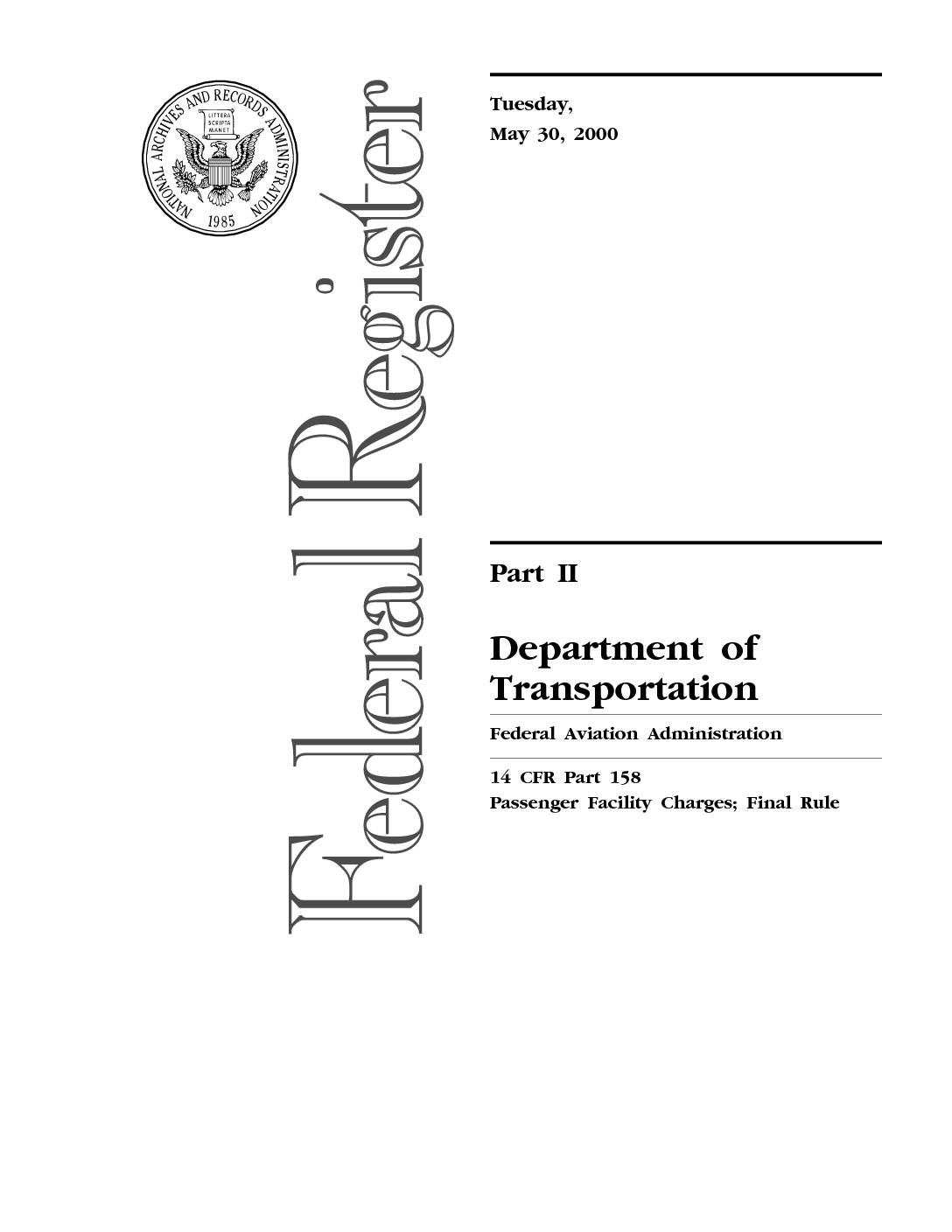
    Passenger facility charges; final rule

    ★
    In May 2000, the FAA issued a final rule updating the Passenger Facility Charge (PFC) program, allowing airports to increase per-passenger fees from a maximum of $3 to up to $4.50, as authorized by the Wendell H. Ford Aviation Investment and Reform Act for the 21st Century (AIR 21). The updated rules set eligibility requirements for projects funded at the higher fee levels, including a requirement that projects at medium and large hub airports make a significant contribution to goals such as reducing aviation noise impacts on nearby communities. Airports seeking the higher PFC levels must also demonstrate that proposed projects cannot be adequately funded through the existing Airport Improvement Program.
    CategoriesKey Documents TagsAIP, Part 158, Passenger Facility Charges, PFC
  • 2025-04-22

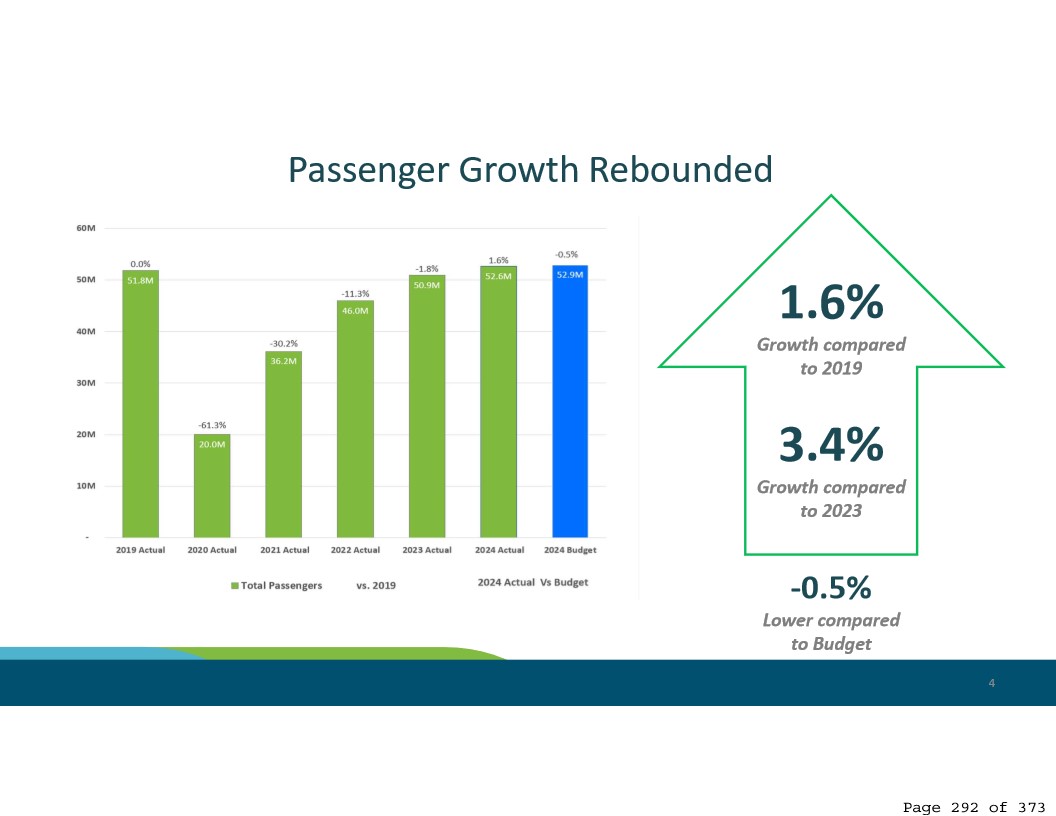
    Sea-Tac Airport Passenger Growth Rebounded — 2024 Actuals vs. Budget (Page 292)

    A presentation slide titled 'Passenger Growth Rebounded' showing total passenger figures from 2019 through 2024 for what is identified as Sea-Tac Airport (page 292 of 373). The 2024 actual passenger count was 52.6M, representing 1.6% growth compared to 2019 and 3.4% growth compared to 2023, but 0.5% below the 2024 budget of 52.9M.
    TagsForecast, Passenger Facility Charges, Port Of Seattle, Sea-Tac Airport
  • Show Me The Money!

    The problem with all airport community issues come down to M-O-N-E-Y. There are currently some programs that try to account for noise. There are almost no programs that account for pollution; or lower property values; or an array of socio-economic harms. If you look at the galaxy of Federal Regs that have sprouted from ANCA,
    CategoriesLegislation TagsANCA, Part 158, Passenger Facility Charges
  • 2019-06-01

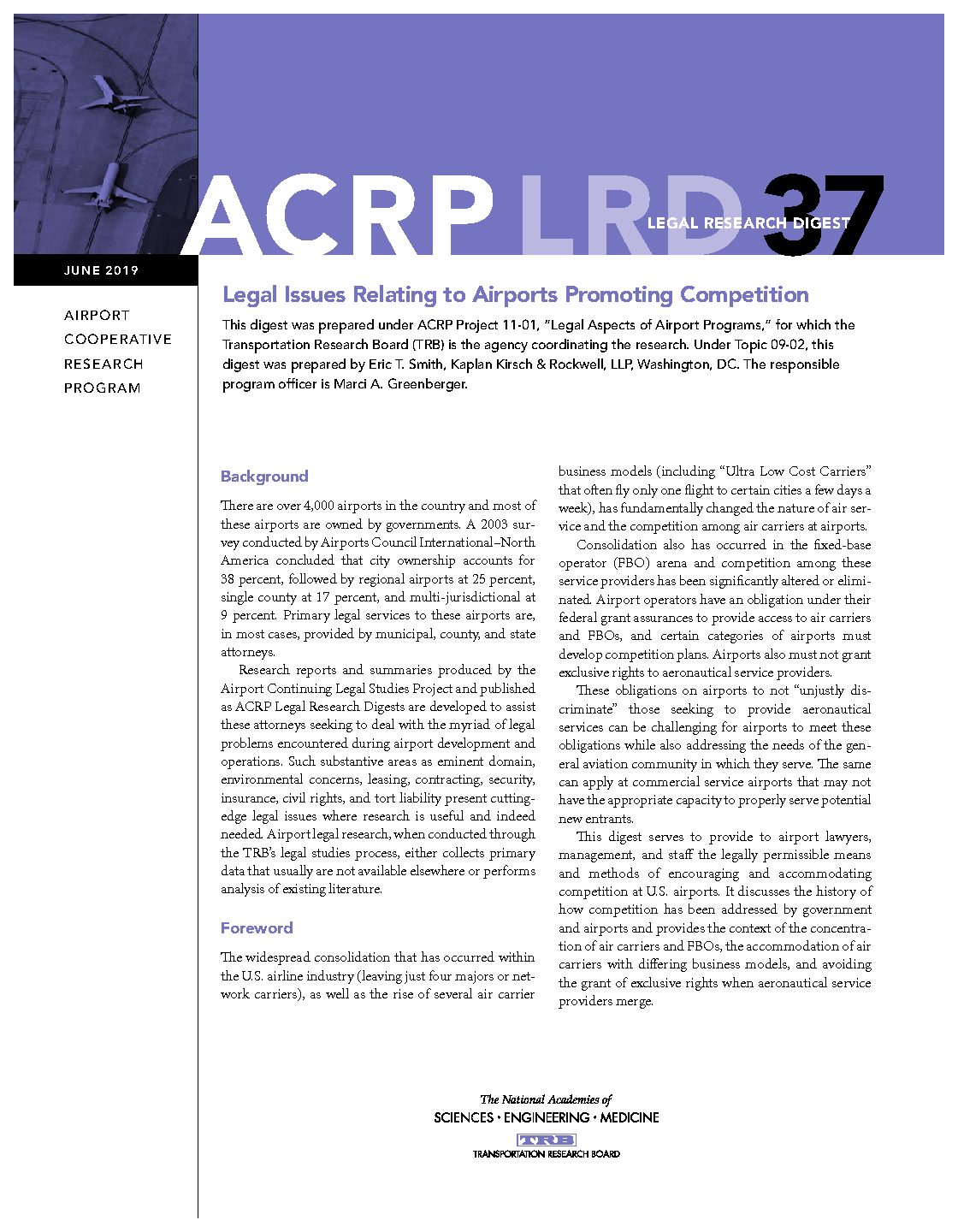
    ACRP Legal Research Digest 37: Legal Issues Relating to Airports Promoting Competition

    This 2019 legal research digest examines how U.S. airports can legally encourage competition among airlines and fixed-base operators (FBOs) while complying with federal grant requirements. It covers the impact of airline industry consolidation, the rules airports must follow to avoid unfair discrimination or granting exclusive rights, and practical strategies for accommodating carriers with different business models.
    TagsAIP, Airline Deregulation Act, Airport Cooperative Research Program, Airport Law, Passenger Facility Charges
  • Passenger Facility Charge (PFC)

    The Passenger Facility Charge (PFC) Program allows the collection of PFC fees up to $4.50 for every enplaned passenger at commercial airports controlled by public agencies. PFCs are capped at $4.50 per flight segment with a maximum of two PFCs charged on a one-way trip or four PFCs on a round trip, for a maximum
    CategoriesFrom The Web TagsFAA, Noise Mitigation, Passenger Facility Charges, PFC
  • 2018-02-01

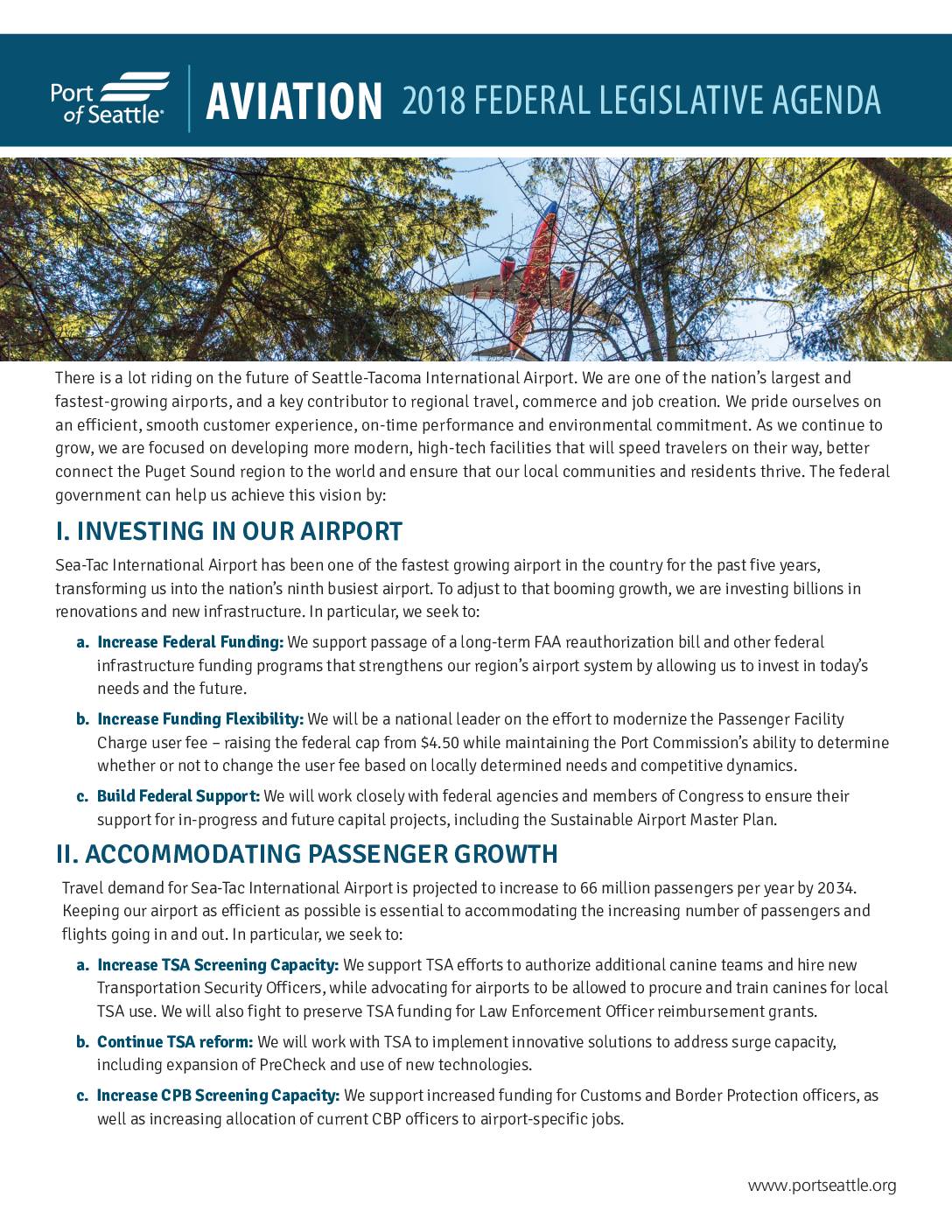
    Aviation 2018 federal legislative agenda

    The Port of Seattle's 2018 Federal Legislative Agenda outlines priorities for Seattle-Tacoma International Airport, including securing federal funding for infrastructure, expanding TSA and customs screening capacity, and addressing the airport's impact on surrounding communities. On noise and environmental issues, the Port sought greater FAA authority to engage local communities on flight path changes and noise concerns, supported studies on ultrafine particulate emissions, and pledged to monitor any proposed changes to the 65 DNL noise mitigation standard. The agenda also emphasized promoting sustainable aviation fuels, protecting immigrant workers, and improving quality of life for residents near the airport.
    TagsFAA Reauthorization, Passenger Facility Charges, Port Of Seattle, Sea-Tac Airport, TSA
  • 1998-01-01

    MAC Part 150 Residential Sound Insulation Program: 1992–1997 Completion & Funding Summary

    The MAC Part 150 Residential Sound Insulation Program completed sound insulation work on 3,673 homes near Minneapolis-St. Paul International Airport between 1992 and 1997, at a total cost of $76.6 million. Funding came from two sources: $28.7 million in FAA Airport Improvement Program (AIP) grants and $48.6 million in MSP Passenger Facility Charges (PFC). The program grew significantly over its six-year run, peaking in 1996 with 1,002 homes insulated at a cost of $20.7 million.
    TagsAIP, Noise Mitigation, Part 150, Passenger Facility Charges, Sound Insulation
  • 1992-09-01

    Approval of passenger facility charges of Seattle-Tacoma International Airport

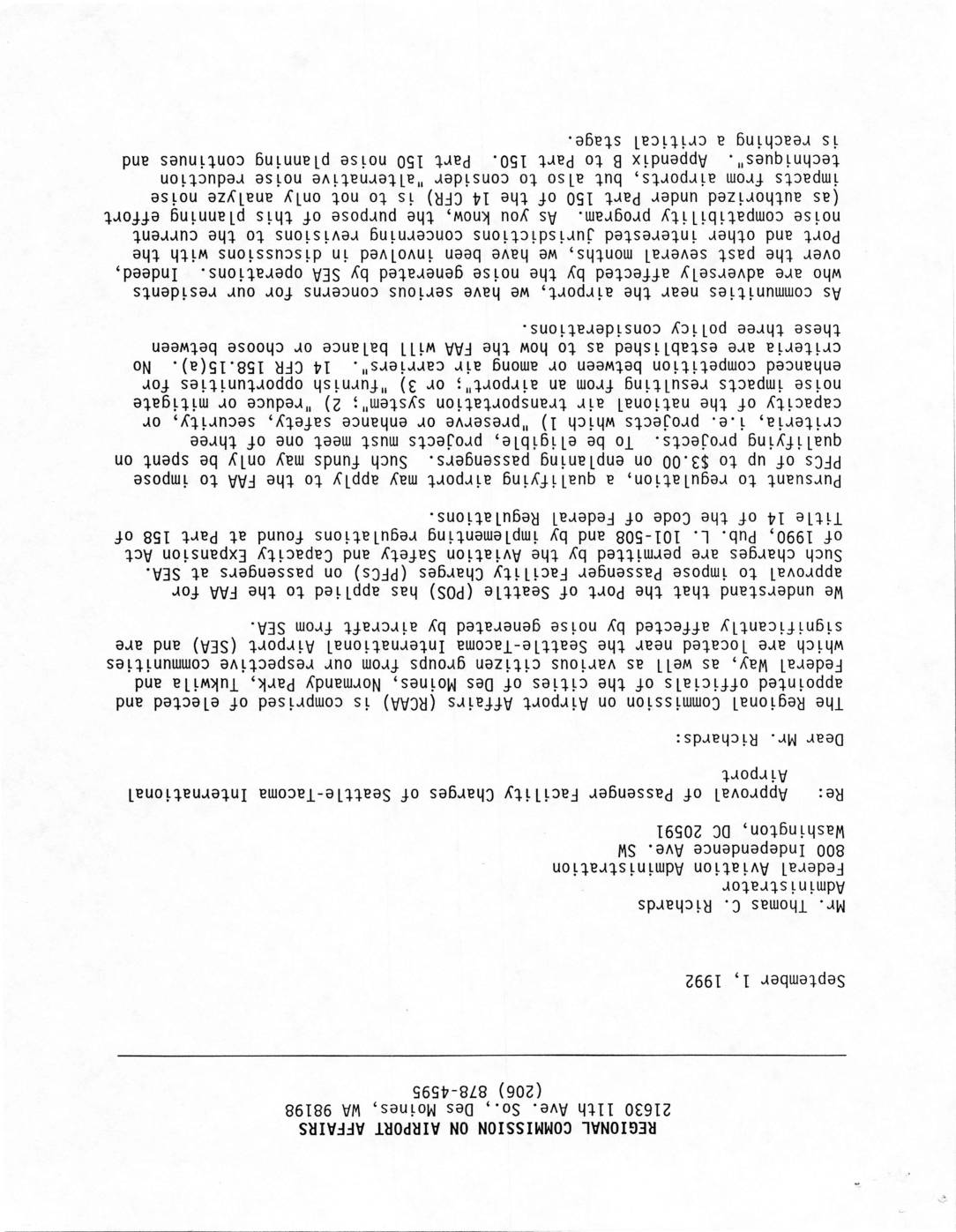
    In a September 1, 1992 letter to the FAA Administrator, the Regional Commission on Airport Affairs formally requests reconsideration of the FAA's August 14, 1992 decision approving Passenger Facility Charges (PFCs) at Seattle-Tacoma International Airport. The Commission, representing communities near Sea-Tac severely impacted by aircraft noise, argues that PFC funds should be redirected toward noise mitigation efforts rather than security improvements and preliminary studies, and that local governments were not properly notified or consulted during the PFC application process. The letter calls for increased funding levels for noise mitigation, cancellation of certain approved expenditures deemed inappropriate or excessive, and greater consideration of local government views in future PFC allocation decisions.
    CategoriesCorrespondence TagsNoise Mitigation, Part 150, Passenger Facility Charges, PFC, RCAA
  • Stcp chapter unk pg 431 ultimate passenger origin destination patterns
    1971-01-01

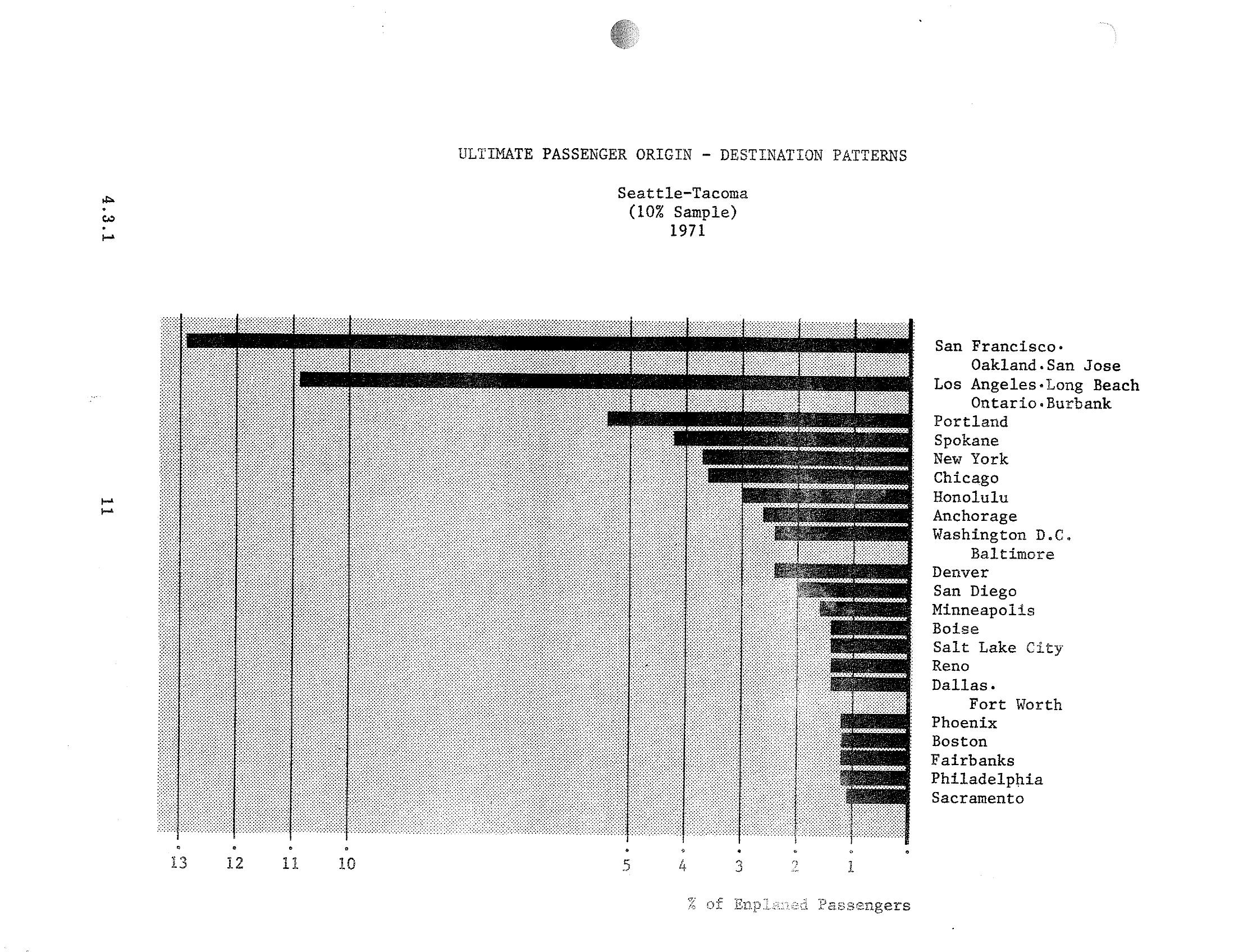
    Sea-Tac Airport STCP: Top Passenger Origin-Destination City Pairs by Percentage of Enplaned Passengers, 1971

    A horizontal bar chart from a Sea-Tac Airport document (section 4.3.1) showing the top passenger origin-destination city pairs by percentage of enplaned passengers for 1971, based on a 10% sample. San Francisco/Oakland/San Jose and Los Angeles/Long Beach/Ontario/Burbank are the dominant destinations, each exceeding 10% of enplaned passengers, followed by Portland, Spokane, New York, and Chicago.
    TagsHistory, Passenger Facility Charges, Sea-Tac Airport, STCP
Sidebar On/Off

Upcoming Events

  • KCIA 2026 FOD Walk
    Add to CalendarMSaturday Aug 15, 7:30am - 10:00am
    9404 East Marginal Way South, Seattle, WA 98108
    Event image 2

    Join Us for the KCIA 2026 FOD Walk! Get ready to step out and enjoy an awesome in-person event all about keeping our spaces clean and safe! The FOD Walk is a great chance to connect, learn, and have fun while helping out. Whether you’re a pro or just curious, everyone’s welcome to join the

    [...]
  • Joint Burien Airport Committee & Des Moines Airport Advisory Committee Meeting August 18, 2026
    Add to CalendarMTuesday Aug 18: 6:00pm
    400 SW 152nd St, Burien, WA 98166

    1. Call to Order 2. Public Comment 3. Business Agenda a) Discussion with Sen. Tina Orwall (35 minutes) • Legislative Agenda • Funding Sources for Mitigation b) SAMP DEIS Updates (15 minutes) 4. Next Meeting Date The next regular meeting of the Burien Airport Committee will be September 15, 2026, at 6 p.m. 5. Adjournment

    [...]

[See all...]


Help study childhood asthma. Get free HEPA filter!

read more...

Issues

Sea-Tac Airport is currently undergoing the largest and longest expansion in its history, collectively known as the Sustainable Airport Master Plan (SAMP). Some of it you can already hear, but you’re probably not aware of what it all means. Here’s what you need to know.
read more...

Read This!

As the source for federal transportation grants, the Puget Sound Regional Council was charged with developing a system to meet the growing need for commercial aviation. When the search for a second airport failed, they authorized the Port of Seattle to build the Third Runway, with a mandate to develop a noise abatement and mitigation program. In their effort to stop the Third Runway, the ACC argued over every detail of the Port's efforts--including property buyouts and sound insulation. The dispute was meant to be settled by a three member Expert Arbitration Panel. This is their final report. It finds 2-1, that the Port's program was insufficient in several respects. Despite that, funding for the Third Runway was approved by the PSRC, and the 'Port Package' program, proceeded largely unchanged. Expert Arbitration Panel's final decision finding that the Port of Seattle had not shown sufficient reduction in real on-the-ground noise impacts to satisfy noise reduction conditions required for approval of a third runway at Sea-Tac International Airport. The majority decision concluded the Port's noise abatement programs were insufficient despite being impressive in scope.
continue...

The Podcast!

Subscribe to the only podcast devoted to policies, politics, history, impacts for people living under the flight path everywhere. It’s definitely not just about noise!
  • Sea-Tac Noise.Info
  • Connect with STNI

    • Subscribe
    • Port Package Problem?
    • Donate
    • Podcast
    • Socials
      • Facebook
      • X (Twitter)
      • Bluesky
      • Instagram

    "Justia: Peterson v. Port of Seattle" — , 1980

  • Learn

    • Frequently Asked Questions
    • Explainers
    • Youtube
    • Research Requests
    • Make a complaint
  • Goals

    Fulfill the promises of 1976:
    • Compensation
    • Reduced noise
    • Improved air quality
    • Environmental remediation
Login/Register
©2026•Data Privacy

Message

We use cookies to provide basic functionality. We also provide access to search engines in order to provide site analytics. We do not sell or share your data.
V V