TagRunway Use Agreement(8)
-
 2019-09-12
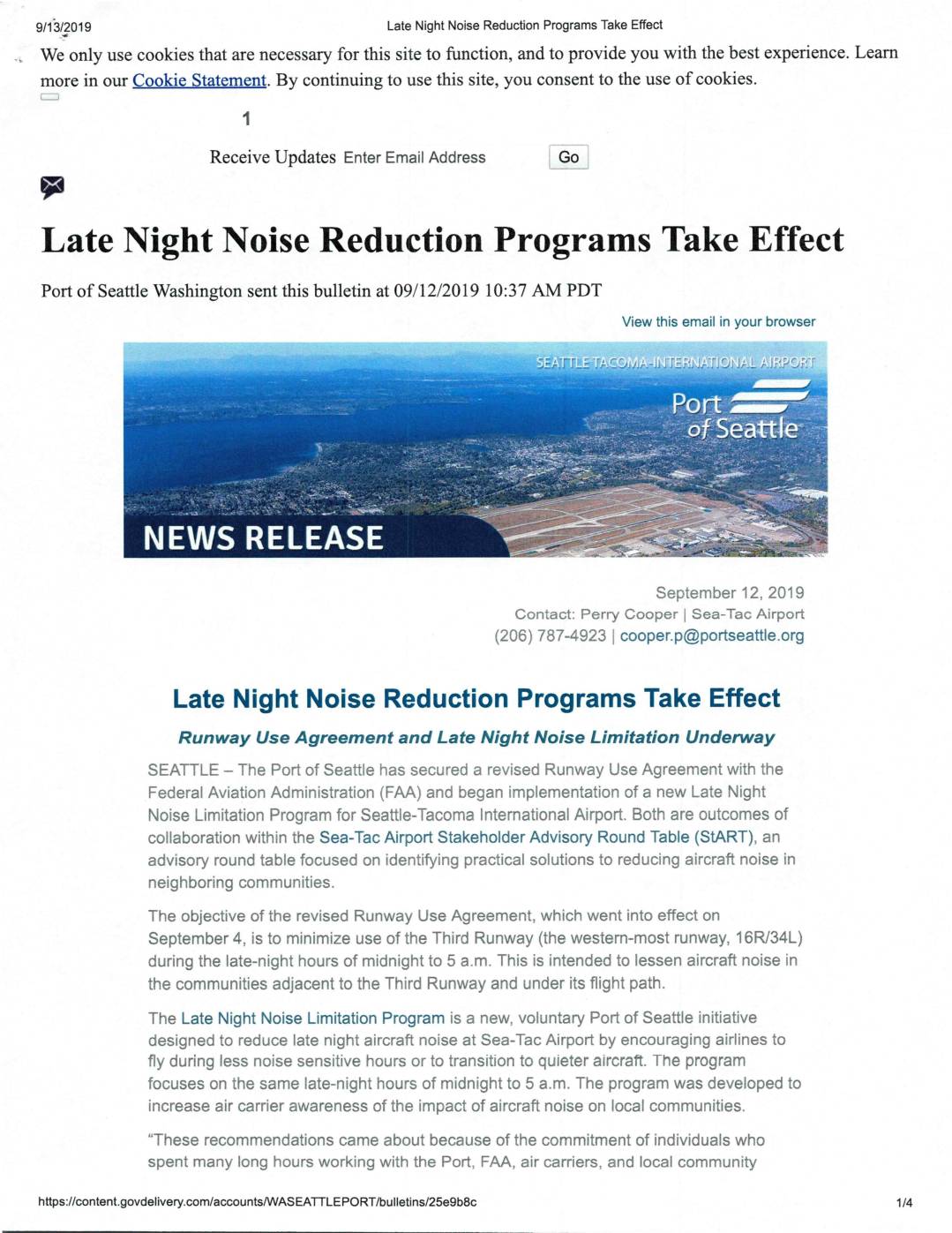
Late night noise reduction programs take effect
In September 2019, the Port of Seattle announced two new programs to reduce late-night aircraft noise at Seattle-Tacoma International Airport. A revised Runway Use Agreement with the FAA took effect on September 4, limiting use of the Third Runway (16R/34L) between midnight and 5 a.m., while a new voluntary Late Night Noise Limitation Program encourages airlines to schedule flights during less noise-sensitive hours or switch to quieter aircraft during the same period. Both initiatives stemmed from recommendations by the Sea-Tac Airport Stakeholder Advisory Round Table (StART). -
Why Can’t We Have A Curfew?
Blame it on ANCA , the Airport Noise And Capacity Act Of 1990. Airport law–specifically the history of how communities lost their rights–is long. You can read a short history at our Airport Law Cheat Sheet. But one question people have is WHY CAN’T WE SLEEP AT NIGHT? So here is a summary of. The -
 2019-02-27
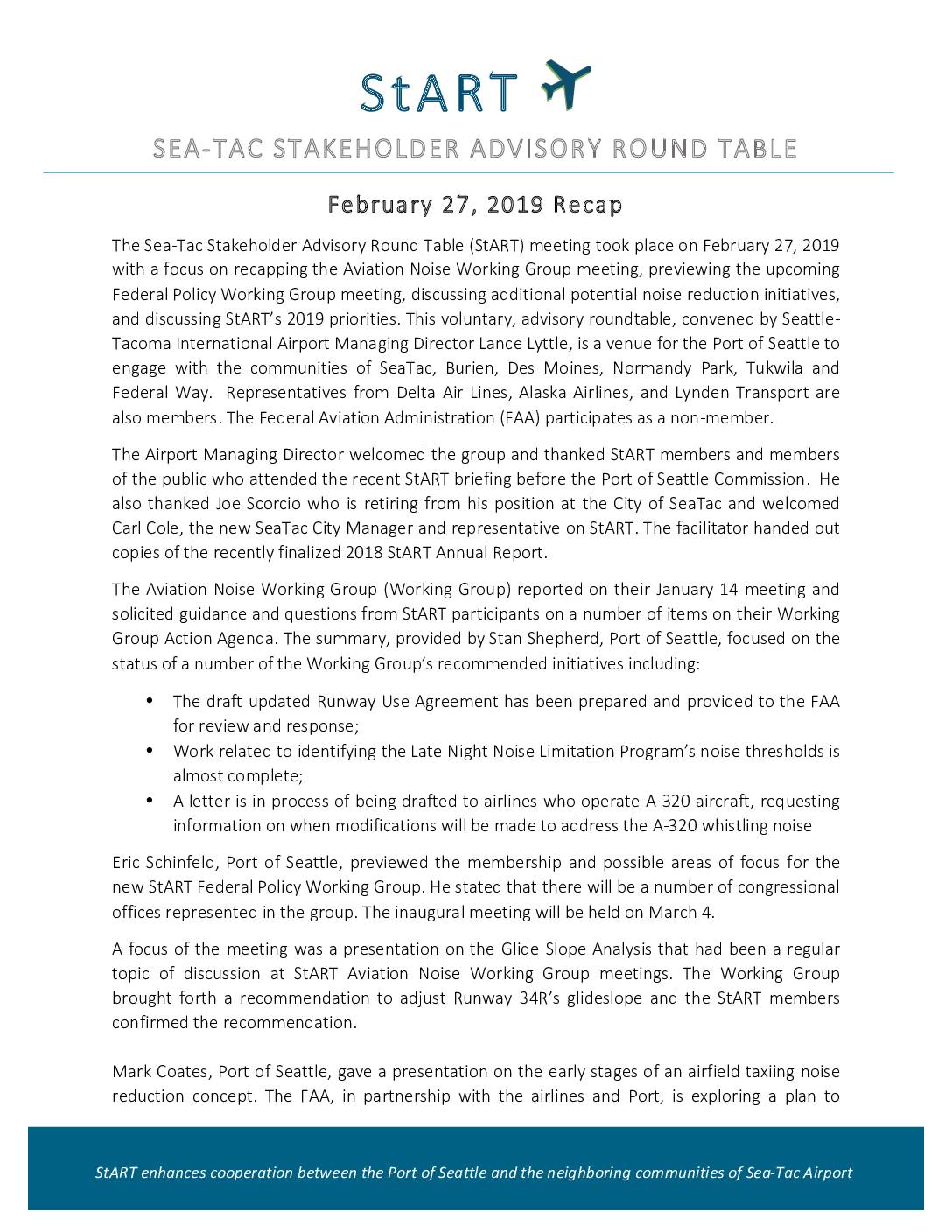
StART Meeting Recap: February 27, 2019
The Sea-Tac Stakeholder Advisory Round Table (StART) met on February 27, 2019 to discuss ongoing efforts to reduce aircraft noise around Seattle-Tacoma International Airport, including a recommended adjustment to Runway 34R's glideslope and a proposed new taxiing approach to minimize engine noise from arriving aircraft. The group also reviewed the status of the Late Night Noise Limitation Program, a draft updated Runway Use Agreement, and efforts to address the A-320 whistling noise issue. Members held small group discussions to identify StART's priorities for 2019, with the next public meeting scheduled for April 24 at the airport's Conference Center. -
 2019-02-27
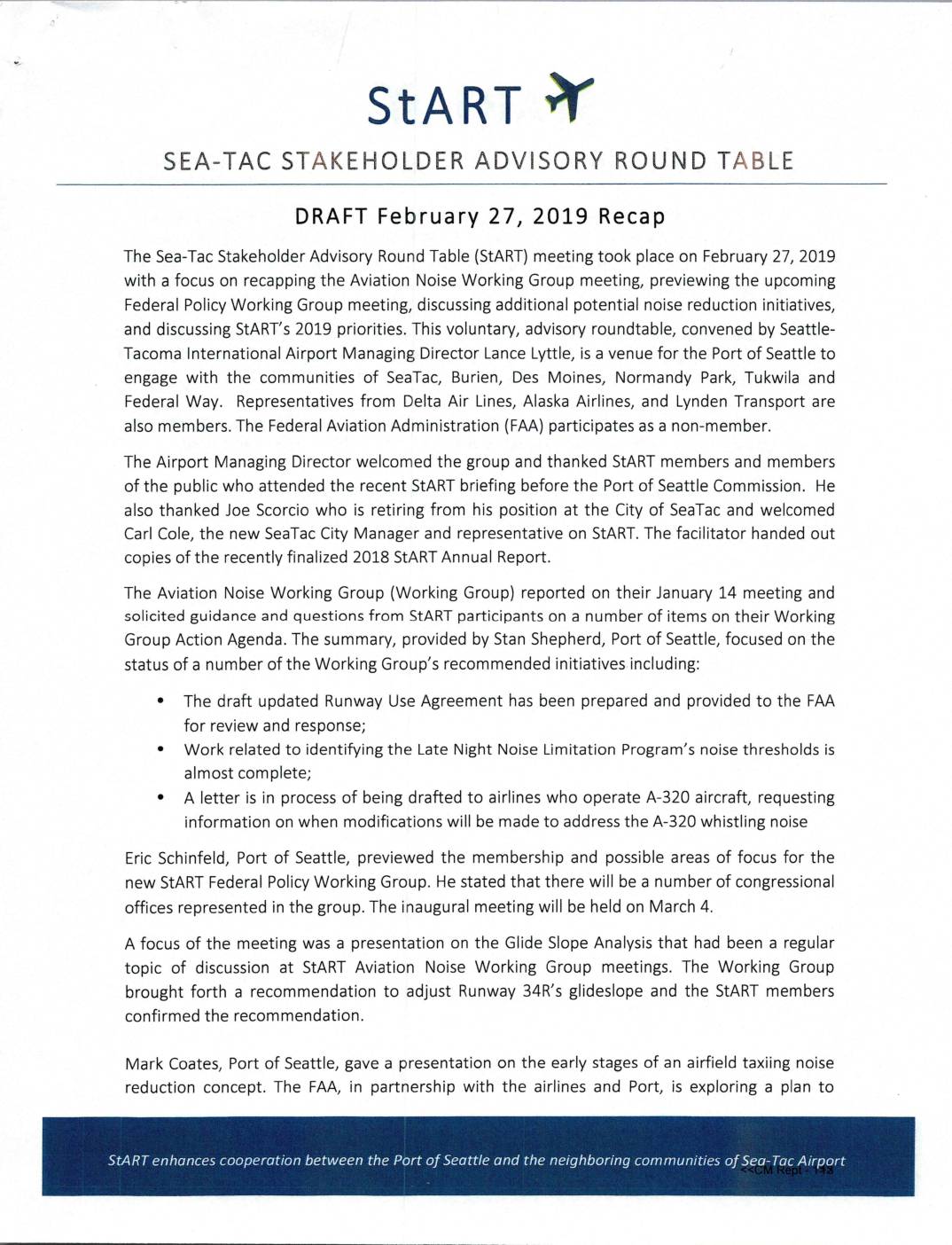
StART Sea-Tac Stakeholder Advisory Round Table draft February 27, 2019 recap
The Sea-Tac Stakeholder Advisory Round Table (StART) met on February 27, 2019 to discuss ongoing airport noise reduction efforts, including updates to the Runway Use Agreement, late-night noise limits, and a recommendation to adjust Runway 34R's glideslope to reduce noise impacts on neighboring communities. The meeting also previewed the newly formed Federal Policy Working Group and introduced a concept for reducing taxiing noise by changing how arriving aircraft move to the terminal. Community members and city representatives from SeaTac, Burien, Des Moines, Normandy Park, Tukwila, and Federal Way participated in small group discussions to help set StART's priorities for 2019. -
 2018-08-16
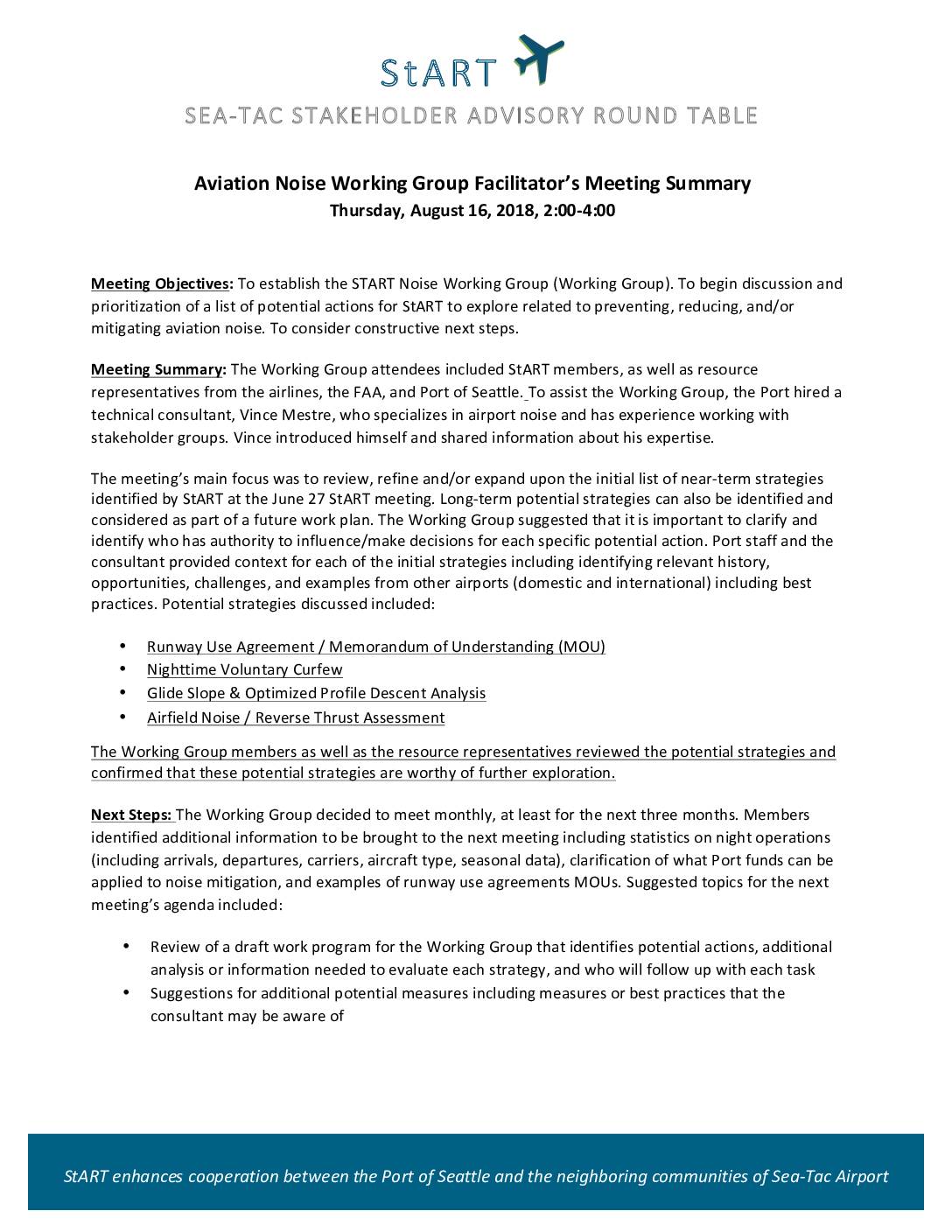
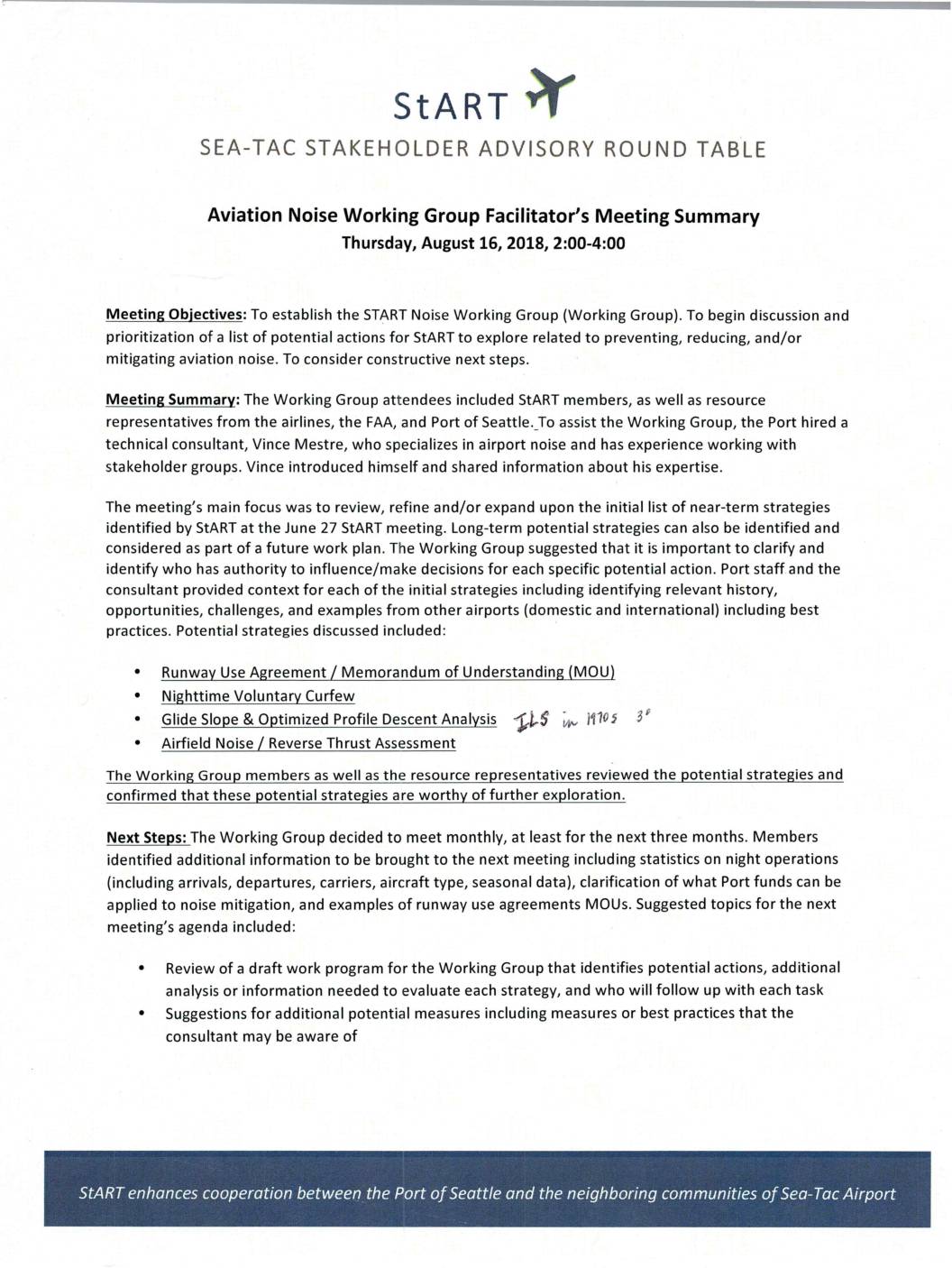
Aviation Noise Working Group facilitator’s meeting summary
The StART Aviation Noise Working Group held its first meeting on August 16, 2018, bringing together community stakeholders, airlines, the FAA, and Port of Seattle representatives to discuss strategies for reducing aircraft noise around Sea-Tac Airport. The group reviewed four potential near-term approaches—including a Runway Use Agreement, a Nighttime Voluntary Curfew, Glide Slope and Optimized Profile Descent Analysis, and an Airfield Noise/Reverse Thrust Assessment—all of which were deemed worthy of further exploration. The group agreed to meet monthly and outlined next steps, including gathering night-operations data and drafting a formal work program to guide future action. -
 2018-08-16
Aviation Noise Working Group facilitator’s meeting summary
The StART Aviation Noise Working Group held its first meeting on August 16, 2018, bringing together community stakeholders, airlines, the FAA, and Port of Seattle representatives to discuss strategies for reducing noise around Sea-Tac Airport. The group reviewed potential near-term actions including a Runway Use Agreement, a Nighttime Voluntary Curfew, Glide Slope and Optimized Profile Descent Analysis, and an Airfield Noise/Reverse Thrust Assessment. Members agreed to meet monthly and identified next steps such as gathering night operations data and drafting a work program to evaluate each noise-reduction strategy. -
2013-10-15
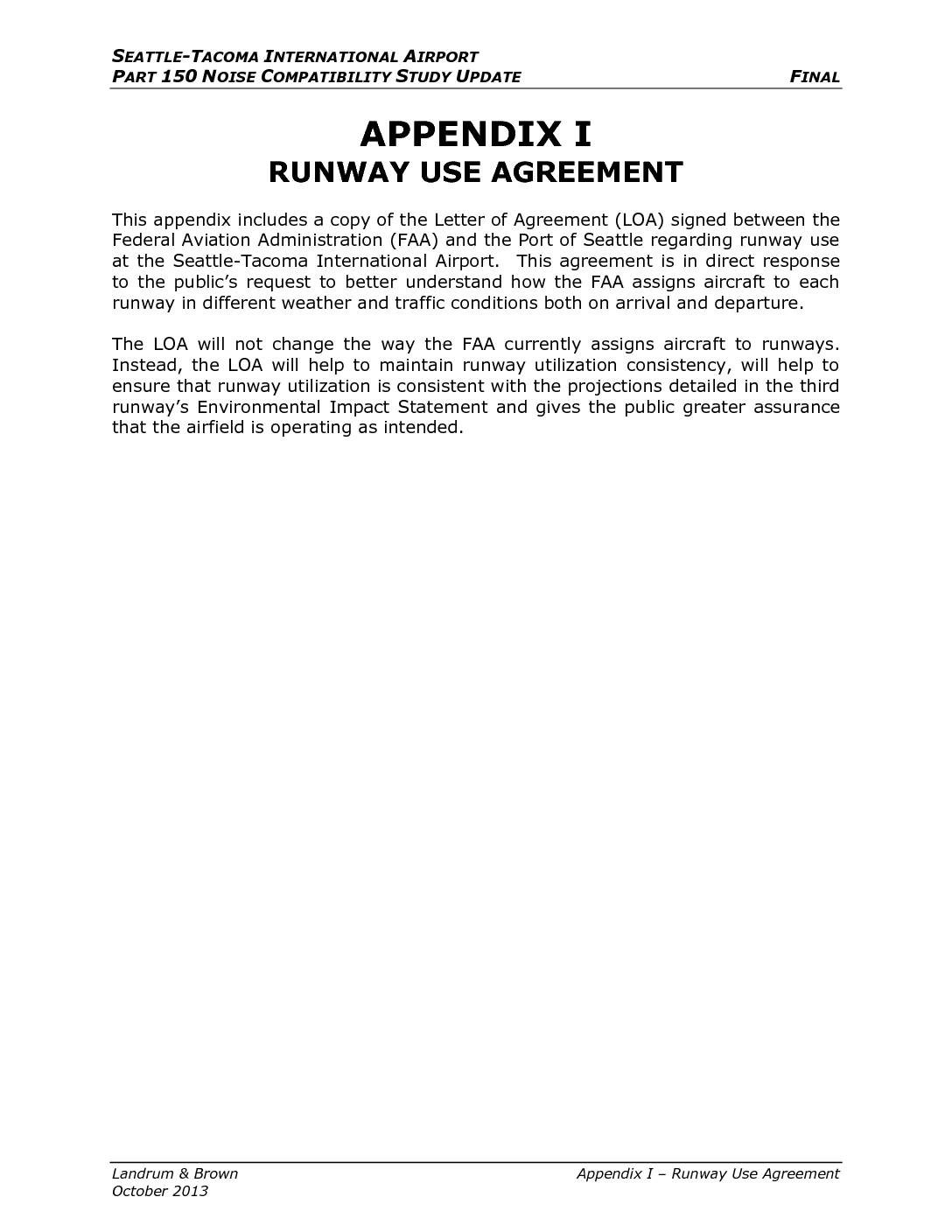
Informal Runway Use Agreement (Appendix I 2013 Part 150 Study)
★ 32Appendix I from the 2013 Part 150 Study by Landrum & Brown. A Letter Of Agreement (LOA) where the Port Of Seattle agrees to using the Third Runway primarily for overflows and bad weather. Note the very official looking signature of the Port CEO, Tay Yoshitani. Also note that it is described as an ‘informal -
 2010-12-06
Letter of agreement: Informal runway use program, Seattle-Tacoma International Airport
This document outlines the Runway Use Agreement between the FAA and the Port of Seattle at Seattle-Tacoma International Airport (Sea-Tac), effective December 6, 2010. It establishes preferred runway assignments for arrivals and departures under various weather and traffic conditions, while making clear that safety and air traffic management always take priority. The agreement does not change existing FAA practices but aims to provide consistency and transparency for the public regarding how runways are used.