TagStantec(27)
-
 2021-01-07
Post-report update from the Technical Advisory Committee
The Washington State Department of Commerce's Technical Advisory Committee (TAC) reviewed 72 recommendations from a study on Sea-Tac Airport's impacts on neighboring cities, ultimately prioritizing 13 key next steps. These priorities span public health, air quality, noise and vibration, mobility, and environmental concerns, including expanding late-night noise limits, improving air quality monitoring, and developing alternative noise metrics beyond standard day-night average (DNL) contours. The TAC also recommended revising the report's language around the Port of Seattle's airport expansion plans to reflect that the proposal was still under FAA review at the time of publication. -
 2021-01-07
Stantec: Post-Report Update from the Technical Advisory Committee
Washington State Department of Commerce Technical Advisory Committee (TAC) post-report update dated January 7, 2021, summarizing priority next steps from the Stantec-developed 72-recommendation study on current and ongoing effects of Seattle-Tacoma International Airport operations on neighboring cities (Sea Tac, Tukwila, Burien, Normandy Park, Federal Way, Des Moines). TAC prioritized 13 recommendations across Public Health, Air -
 2020-05-29
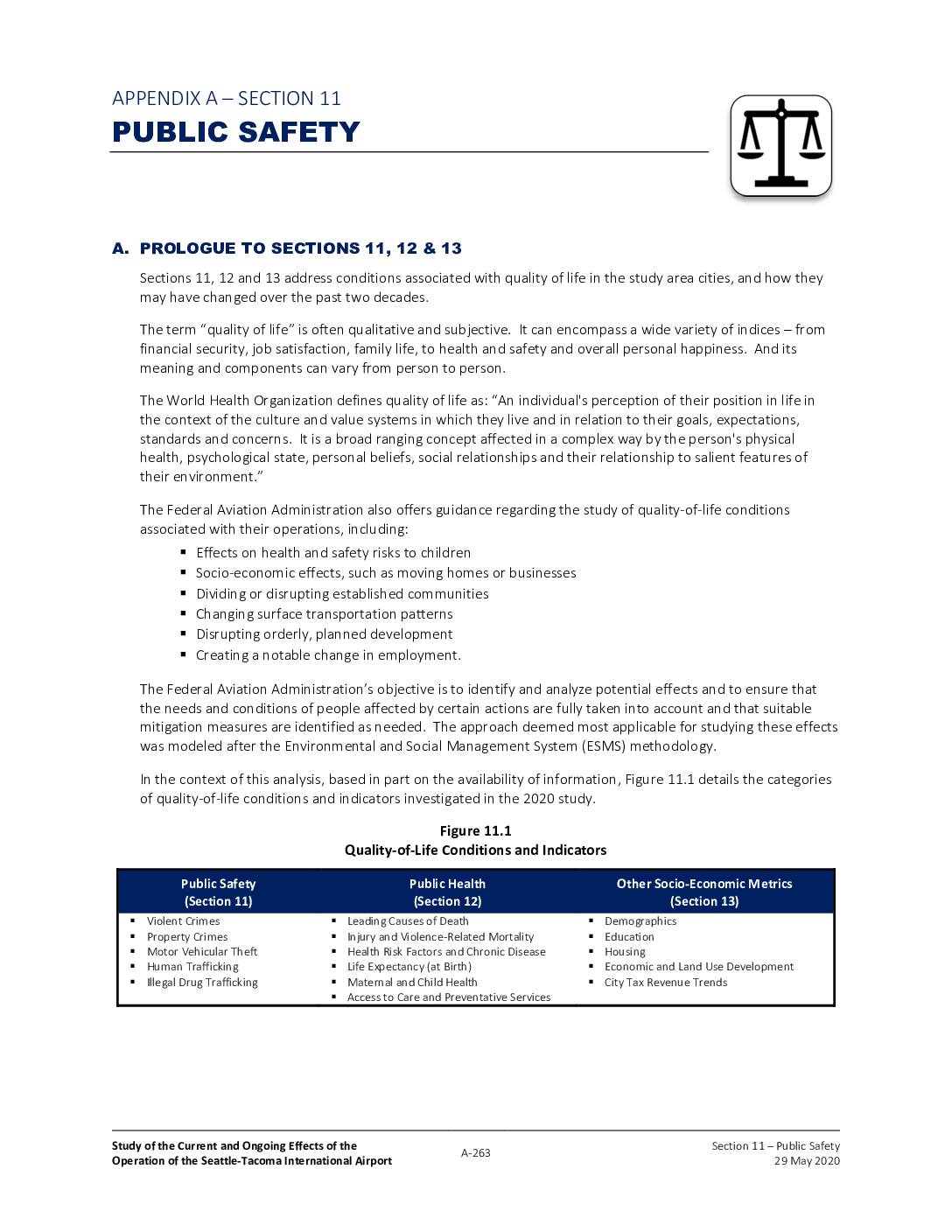
Section 11: Public Safety — Study of the Current and Ongoing Effects of the Operation of the Seattle-Tacoma International Airport
A 2020 study examined how Seattle-Tacoma International Airport has affected quality of life in nearby communities over the past two decades, looking at public safety, health, and socioeconomic conditions across three time periods: 1997, 2009, and 2019. The study built on a 1997 report that found airport neighbors bore disproportionate burdens—including lower property values, higher social service demand, and increased noise and pollution—while regional benefits largely bypassed them. Key findings confirm that many of those predicted adverse effects, such as shifts from owner-occupied to rental housing and rising service costs, have continued to materialize in communities closest to the airport. -
 2020-05-29
Study of the Current and Ongoing Effects of the Operation of the Seattle-Tacoma International Airport: Appendix A, Section 10 – Light
This section of a 2020 study examines how the operation of Seattle-Tacoma International Airport affects nighttime light conditions in surrounding communities, using satellite imagery data collected between 1998 and 2018. Researchers analyzed 'skyglow' — light pollution caused by electric fixtures and light reflected off surfaces like roads and parking lots — across the broader Central Puget Sound region. The study notes that nighttime light emission readings can vary by 15–20% due to factors such as weather, seasonal vegetation, and imaging conditions, and it identifies specific light fixture types that contribute most to sky glow. -
 2020-05-29
Appendix A, Section 9: Groundwater and Soil Quality — Study of the Current and Ongoing Effects of the Operation of the Seattle-Tacoma International Airport
This 2020 environmental study examines groundwater and soil quality at and around Seattle-Tacoma International Airport from 1997 to 2019, tracking changes in contamination levels and evaluating whether they stem from airport operations, other pollution sources, or stormwater runoff. The report draws on data from the Port of Seattle, surrounding cities, and state environmental agencies to assess the effectiveness of the airport's cleanup efforts and identify any contamination that may have spread beyond airport property. The underlying geology—dense glacial till soils—generally slows the movement of contaminants through the ground in the area. -
 2020-05-29
Surface water quality: Study of the current and ongoing effects of the operation of the Seattle-Tacoma International Airport
This report examines how Seattle-Tacoma International Airport has affected nearby surface water quality from 1997 to 2019, focusing on streams, wetlands, and stormwater systems that receive runoff from airport property. Researchers analyzed water quality data from multiple airport drainage outfalls — measuring pollutants such as copper, zinc, glycols, and turbidity — using records submitted to Washington State environmental regulators. The study also tracks how major airport developments, including the construction of a third runway, have influenced local waterways like Miller Creek, Walker Creek, and Des Moines Creek. -
 2020-05-29
Sea-Tac Airport Communities Impact Study: Appendix A, Section 7 – Mobility
This 2020 report examines how Seattle-Tacoma International Airport has affected mobility in surrounding communities between 1997 and 2019, focusing on traffic congestion, residential parking, and pedestrian access. It documents major infrastructure changes such as the 2010 consolidation of rental car facilities to an off-site location 1.5 miles from the terminal and the expansion of the main parking garage from 10,000 to roughly 13,000 spaces. The analysis draws on data from government agencies including the Port of Seattle, WsDOT, Sound Transit, and King County Metro to identify transportation impacts and recommend future tracking measures. -
 2020-05-29
Sea-Tac Airport Communities Impact Study: Air Quality Analysis (Section 6, Appendix A)
This 2020 study examines how Seattle-Tacoma International Airport affects regional air quality, reviewing data from 1997 to 2018 collected across 13 monitoring stations within a 15-mile radius of the airport. It finds that King County consistently meets federal, state, and regional air quality standards for pollutants such as ozone, carbon monoxide, nitrogen dioxide, and particulate matter. In fact, pollution levels have generally decreased over time, leading authorities to shut down some monitoring stations near SeaTac due to consistently low readings. -
 2020-05-29
Stantec Sea-Tac Airport Communities Impact Study: Appendix A, Section 5 – Noise & Vibration
This 2020 report examines how noise from Seattle-Tacoma International Airport has changed between 1997 and 2019, focusing on the impact of aircraft takeoffs, landings, and overflights on nearby communities. It explains key noise measurement concepts—including decibels, Sound Exposure Level (SEL), and the Day-Night Average Sound Level (DNL)—and notes that while DNL is the federal regulatory standard used by the FAA, individual SEL events are often what residents find most disruptive. The report highlights a growing tension between how federal agencies measure and regulate aircraft noise and the real-world experience of people living under flight paths. -
 2020-05-29
Study of the current and ongoing effects of the operation of the Seattle-Tacoma International Airport
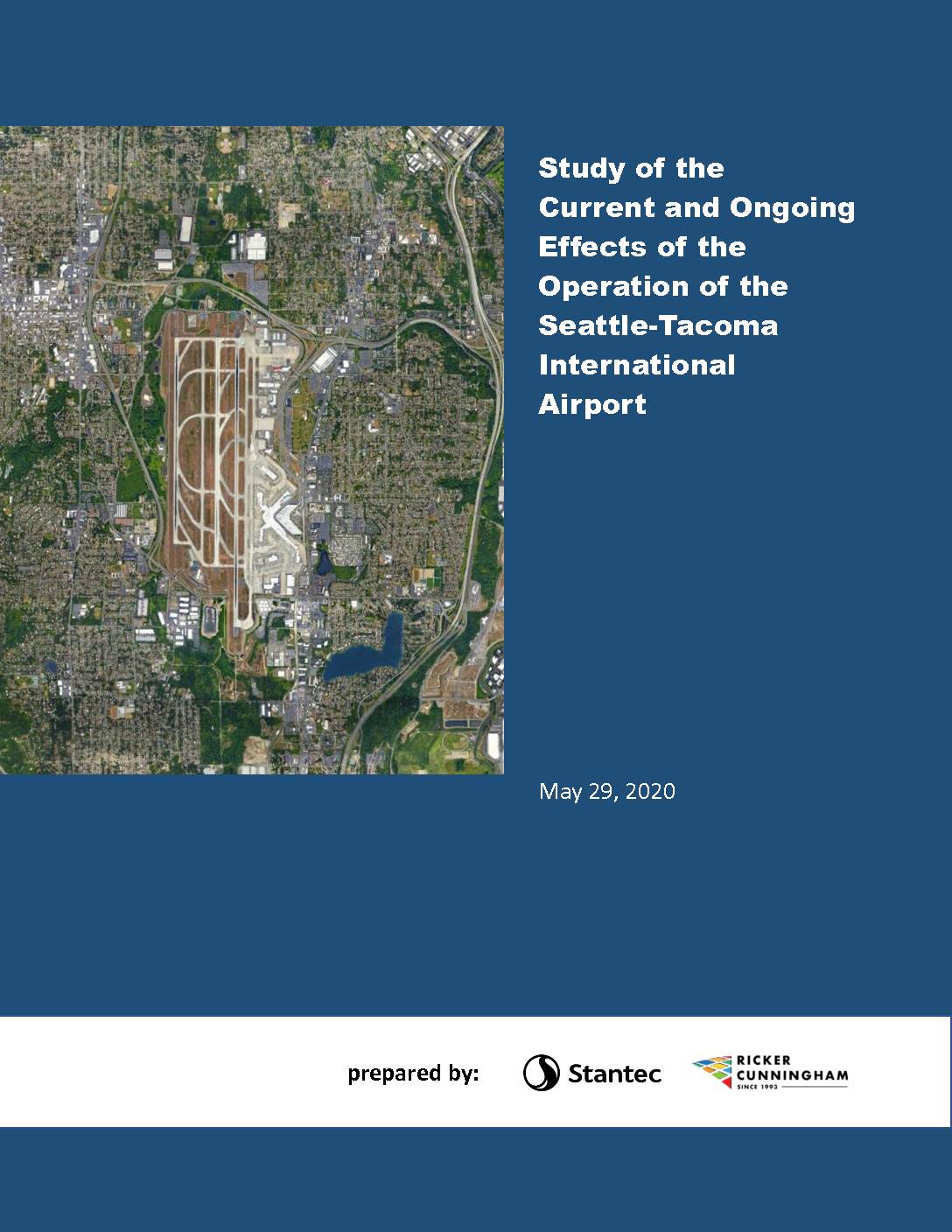
This May 2020 report, prepared by Stantec for the Washington State Department of Commerce under legislative authorization ESSB 6032, examines the current and ongoing effects of operating Seattle-Tacoma International Airport (Sea-Tac). It assesses a range of impacts on surrounding communities resulting from airport operations. The study serves as a key resource for policymakers evaluating noise and other environmental effects associated with Sea-Tac's continued operation.