TagNPDES(130)
-
 2024-03-13
IWS Alternatives Analysis Technical Memorandum: Seattle-Tacoma International Airport
Gresham Smith engineers prepared this March 2024 technical memo for the Port of Seattle, analyzing cost-saving alternatives for planned upgrades to Seattle-Tacoma International Airport's Industrial Wastewater Treatment Plant (IWTP). The study evaluated options for managing airport deicer runoff while maintaining compliance with water discharge permits, using 52 years of historical weather data to simulate system performance. Note: despite its placement in an airport policy archive, this document addresses industrial wastewater and stormwater management rather than noise policy. -
2024-03-13
IWS Alternatives Analysis Technical Memorandum: Seattle-Tacoma International Airport
Gresham Smith engineers prepared this March 2024 technical memo for the Port of Seattle, analyzing cost-saving alternatives for planned upgrades to Seattle-Tacoma International Airport's Industrial Wastewater Treatment Plant (IWTP). The study evaluated options for managing airport deicer runoff while maintaining compliance with water discharge permits, using 52 years of historical weather data to simulate system performance. Note: despite its placement in an airport policy archive, this document addresses industrial wastewater and stormwater management rather than noise policy. -
 2023-06-07
Final Engineering Report: SEA IWTP Expansion
This final engineering report, prepared by Gresham Smith for the Port of Seattle, details the planned expansion of the Industrial Wastewater Treatment Plant (IWTP) at Seattle-Tacoma International Airport. Dated June 7, 2023, the report was developed in compliance with Washington Administrative Code 173-240-130 to satisfy permit requirements under Waste Discharge Permit #7810-05. It outlines technical plans for upgrading the airport's wastewater treatment infrastructure to meet current regulatory standards. -
2023-06-07
Final Engineering Report: SEA IWTP Expansion
This final engineering report, prepared by Gresham Smith for the Port of Seattle, details the planned expansion of the Industrial Wastewater Treatment Plant (IWTP) at Seattle-Tacoma International Airport. Dated June 7, 2023, the report was developed in compliance with Washington Administrative Code 173-240-130 to satisfy permit requirements under Waste Discharge Permit #7810-05. It outlines technical plans for upgrading the airport's wastewater treatment infrastructure to meet current regulatory standards. -
 2022-12-01
Seattle-Tacoma International Airport Stormwater Pollution Prevention Plan (SWPPP) December, 2022
Stormwater Pollution Prevention Plan (SWPPP) for Seattle-Tacoma International Airport (Sea-Tac Airport), published by Port Of Seattle in December 2022, in accordance with NPDES Permit No. WA-0024651. Covers facility assessment, IWS and SDS drainage areas, receiving waters, industrial activities, materials inventory, spills and leaks, monitoring plan, illicit non-stormwater discharges, best management practices (BMPs) including operational source -
 2022-09-12
Discharge Monitoring Reports (DMR’s) and water pollution historical documents
This archive documents a long history of water pollution discharged from Seattle-Tacoma (Sea-Tac) Airport into nearby waterways, dating back to 1948. It includes Discharge Monitoring Reports filed by the Port of Seattle showing high concentrations of glycol and other chemicals flowing into local stormwater systems and ultimately Puget Sound, as well as historical letters from the 1950s describing fish kills in Miller Creek and Des Moines Creek caused by airport runoff. The records reveal decades of regulatory correspondence between the Port of Seattle and Washington State pollution authorities over inadequate waste disposal practices. -
 2022-09-12
Puget Soundkeeper Alliance’s pre-hearing brief
The Puget Soundkeeper Alliance challenged the 2003 water discharge permit issued to Seattle-Tacoma International Airport, arguing that the Port of Seattle had been releasing harmful pollutants — including aircraft de-icing fluids — into Puget Sound without proper treatment or enforceable limits for nearly a decade. The group contended that Washington State's Department of Ecology improperly extended the airport's compliance deadline beyond the legally allowed 10-year period, pushing it from 2004 to 2007. The case centered on whether the permit violated both Washington State law and the federal Clean Water Act. -
 2022-09-12
Findings of fact, conclusions of law, and order: Port Of Seattle v. State of Washington, Department of Ecology
In 2003, Washington State's Department of Ecology issued a water pollution permit (NPDES No. 002465-1) for Sea-Tac International Airport, which was then challenged by multiple parties including the Port of Seattle and several community groups. The appeals, heard in July 2004, centered largely on concerns about aircraft deicing and anti-icing chemicals being discharged into Puget Sound and nearby waterways, where they can deplete dissolved oxygen levels critical to aquatic life. The Pollution Control Hearings Board reviewed the permit's terms and conditions to determine whether adequate environmental protections were in place. -
 2022-09-12
Fact sheet for NPDES permit WA-002465-1, Sea-Tac International Airport
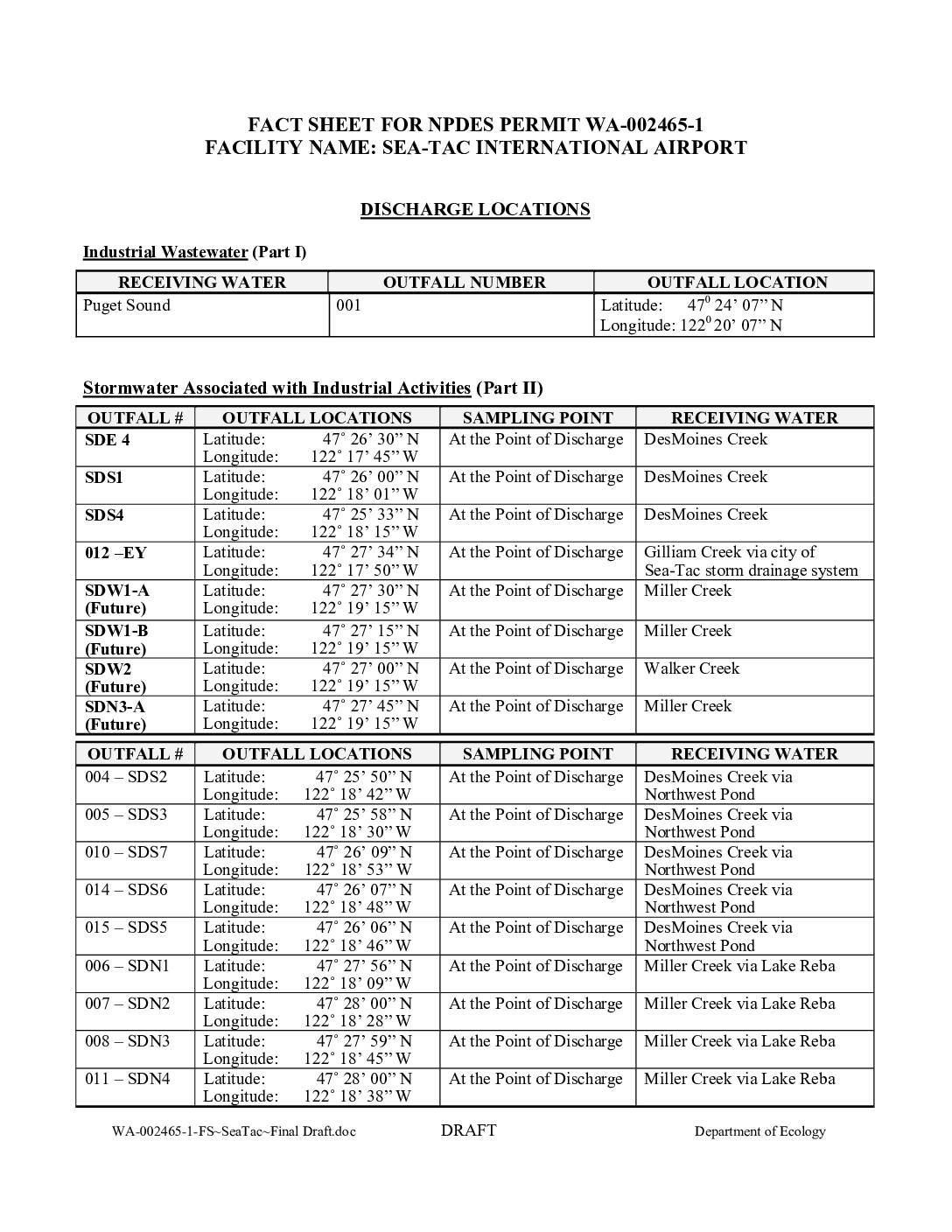
This document is an NPDES (National Pollutant Discharge Elimination System) permit fact sheet for Sea-Tac International Airport, issued by the Washington State Department of Ecology. It details the locations of numerous water discharge outfalls across the airport property, covering industrial wastewater, stormwater from industrial activities, and stormwater from construction activities. The discharges flow into several local waterways including Des Moines Creek, Miller Creek, Walker Creek, Gilliam Creek, and Puget Sound. -
 2022-09-12
Port Of Seattle’s pre-hearing brief
The Port of Seattle filed a pre-hearing brief challenging aspects of a 2003 water pollution permit issued by Washington State's Department of Ecology for Seattle-Tacoma International Airport (Sea-Tac). The permit, considered one of the most stringent stormwater permits in the country, sets numeric water quality limits, requires extensive toxicity testing, and mandates upgrades to the airport's stormwater and wastewater management systems. The brief addresses a range of contested issues, including effluent limits, sampling requirements, and construction stormwater controls.