Skip to content
  • STNI
  • Statistics
    • Ops and Passengers
      • King County International Airport (Boeing Field) Annual Operations
    • Financials
    • Aviation fuel uplift in the State of Washington 2018 – 2025
      • Aviation Fuel Uplift at Sea-Tac Airport
    • Air Quality Monitoring
    • Flight Tracking
      • Flow and Flight Tracks
      • Five Year Comparison
      • Busiest Hours and Days
    • SEL Noise Reports & Graphs
      • About The Permanent Noise Monitors
      • Minutes of Quiet by Noise Monitor
      • Noise Events mapped
      • Noise Events (SEL)
    • Runways
    • Employees
    • Real Estate
      • Port Properties and Trees mapped
    • Parking
  • Events
  • Protest
    • Regular Events
    • Legislation 2026
    • Complain about a particular flight
    • Advocacy Organizations
    • Media Outlets
    • People
    • The Port of Seattle
      • Commission Meetings
      • Public Records Requests
      • StART
      • Highline Forum
    • Contact Your Electeds
  • Resources
    • FAQs
      • FAA Occurrences/Accidents/Indents
    • The unSustainable Airport Master Plan
      • SAMP Public Comment Template
        • Two versions of Appendix K: NEPA/SEPA 2018 vs 2023
      • SAMP NTP: 31 projects by the numbers
      • SEPA Draft EIS (2026)
      • SAMP Record of Decision/FONSI (2025)
      • SAMP Draft EA (October 2024)
      • 2018 Scoping
    • Port Packages
      • Port Package Property Costs
      • Port Packages mapped
      • The Port Package Explainer
      • So you want a (first-time) Port Package? Start here
      • Port Package Looker Upper
      • How do I determine if I have a Port Package or Avigation Easement?
      • Progress on Port Package Update legislation
      • Having a Port Package Problem?
      • Port Package Site Visit Follow-Up
    • Document Library
    • Explainers
      • The Airport Law Cheat Sheet
      • The Grant Explainer
    • External Articles
    • History
      • Timeline
      • The Sea-Tac Communities Plan
        • Sea-Tac Communities Plan – Planning Maps
      • PSRC Third Runway Decision Process
    • Studies
    • Videos
  • Stories
  • Mission
  • Subscribe
  • Contact
Scroll down to content

Get InformedStay Informedx

I understand that you will never share my information with anyone, you will only use it to keep me updated on relevant events and that I may unsubscribe at any time.

STNI

STNISea-Tac Noise.Info

  • Solve for Sea-Tac. Solve for every airport.
  • Since 2016, working to obtain justice for everyone living under the flight path.
  • Less Noise. Cleaner Air. Better Public Health. Compensation.
  • Everything you think you know about the airport is wrong.

TagUFP(27)

Advanced Search Options

  • Dates
  • Media
    • External Articles
    • Images
    • PDFs
    • Video
    • Audio
  • Order By
  • 2019-12-01

    Mobile ObserVations of Ultrafine Particles: The MOV-UP study report

    ★ 32
    The MOV-UP (Mobile ObserVations of Ultrafine Particles) study was a two-year University of Washington research project, funded by the State of Washington, that measured air quality impacts from aircraft traffic on communities living near and beneath the flight paths of Seattle-Tacoma International Airport. Researchers used mobile monitoring methods to collect ultrafine particle data across the affected neighborhoods, working alongside local governments, community members, and an advisory group of agency and city representatives. The findings are intended to inform policymakers and the public about the air pollution risks associated with airport operations in the Seattle-Tacoma region.
    CategoriesKey Documents TagsDEOHS, pollution, UFP, Ultrafine Particulates, University Of WashingtonStudy TopicsAir Quality, Ultrafine Particles
  • 2026-05-28

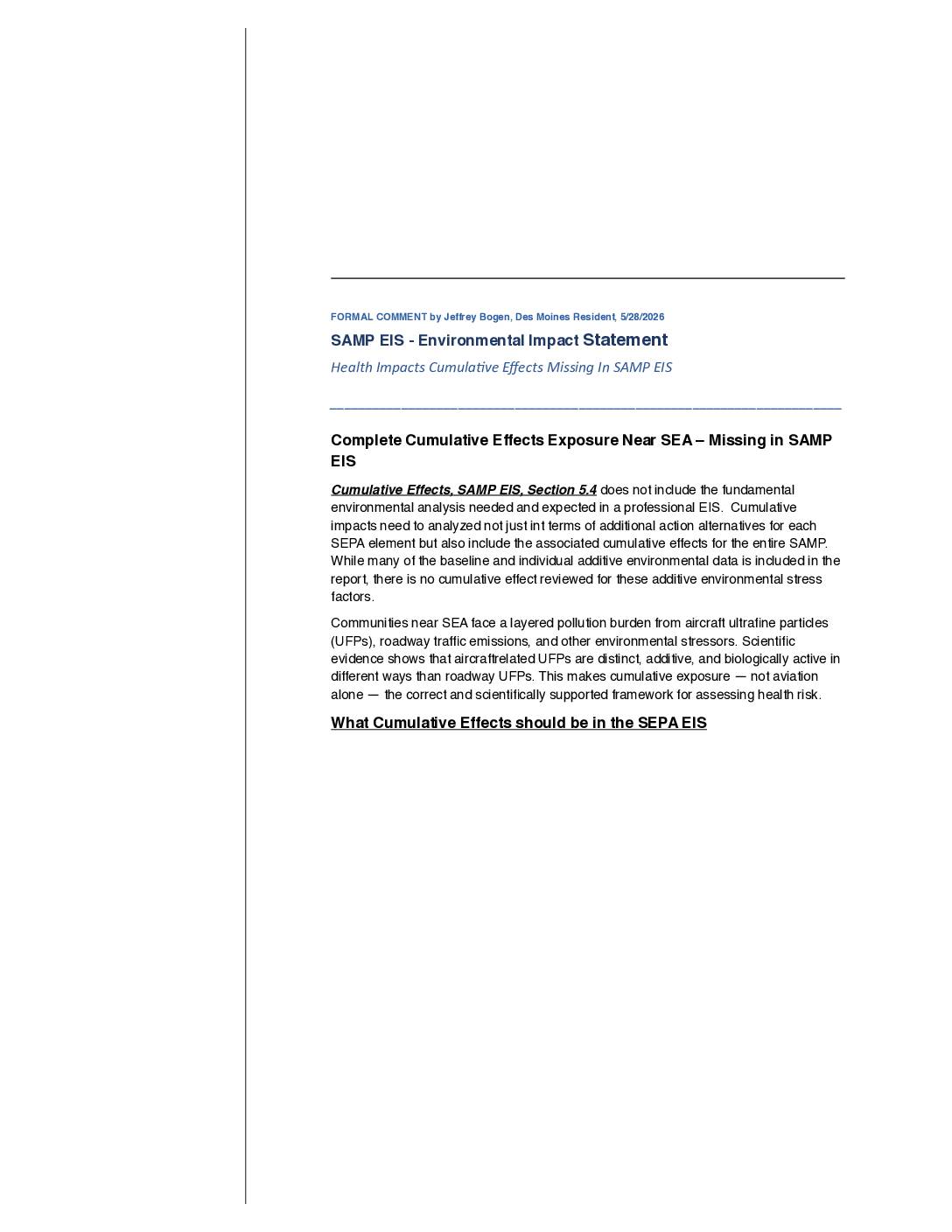
    Formal Comment by Jeffrey Bogen: Cumulative Health Effects Missing in SAMP EIS

    Des Moines resident Jeffrey Bogen submitted a formal comment arguing that the Sea-Tac Airport Master Plan (SAMP) Environmental Impact Statement fails to adequately analyze cumulative health effects on nearby communities. He contends that the EIS must go beyond examining individual pollution sources and instead assess the combined burden of aircraft ultrafine particles, roadway traffic emissions, chronic noise, and other stressors together, since scientific research shows these exposures interact and compound one another. Bogen calls for a comprehensive cumulative-risk framework, backed by ten peer-reviewed studies, to be incorporated into the EIS before any accurate public health or policy conclusions can be drawn.
    TagsEnvironmental Impact Statement, SAMP, SEPA, UFP, Ultrafine Particulates
  • Cumulative effect ver1 pdf
    2026-05-28

    Formal Comment by Jeffrey Bogen: Cumulative Health Effects Missing in SAMP EIS

    Formal public comment submitted by Jeffrey Bogen, Des Moines resident, dated May 28, 2026, regarding the Sea-Tac Airport (SEA) Sustainable Airport Master Plan (SAMP) Environmental Impact Statement (EIS). Argues that SAMP EIS Section 5.4 fails to include a cumulative effects analysis under SEPA, specifically omitting combined health impacts from aircraft ultrafine particles (UFPs), roadway traffic
    TagsEnvironmental Impact Statement, SAMP, SEPA, UFP, Ultrafine Particulates
  • 2024-10-24

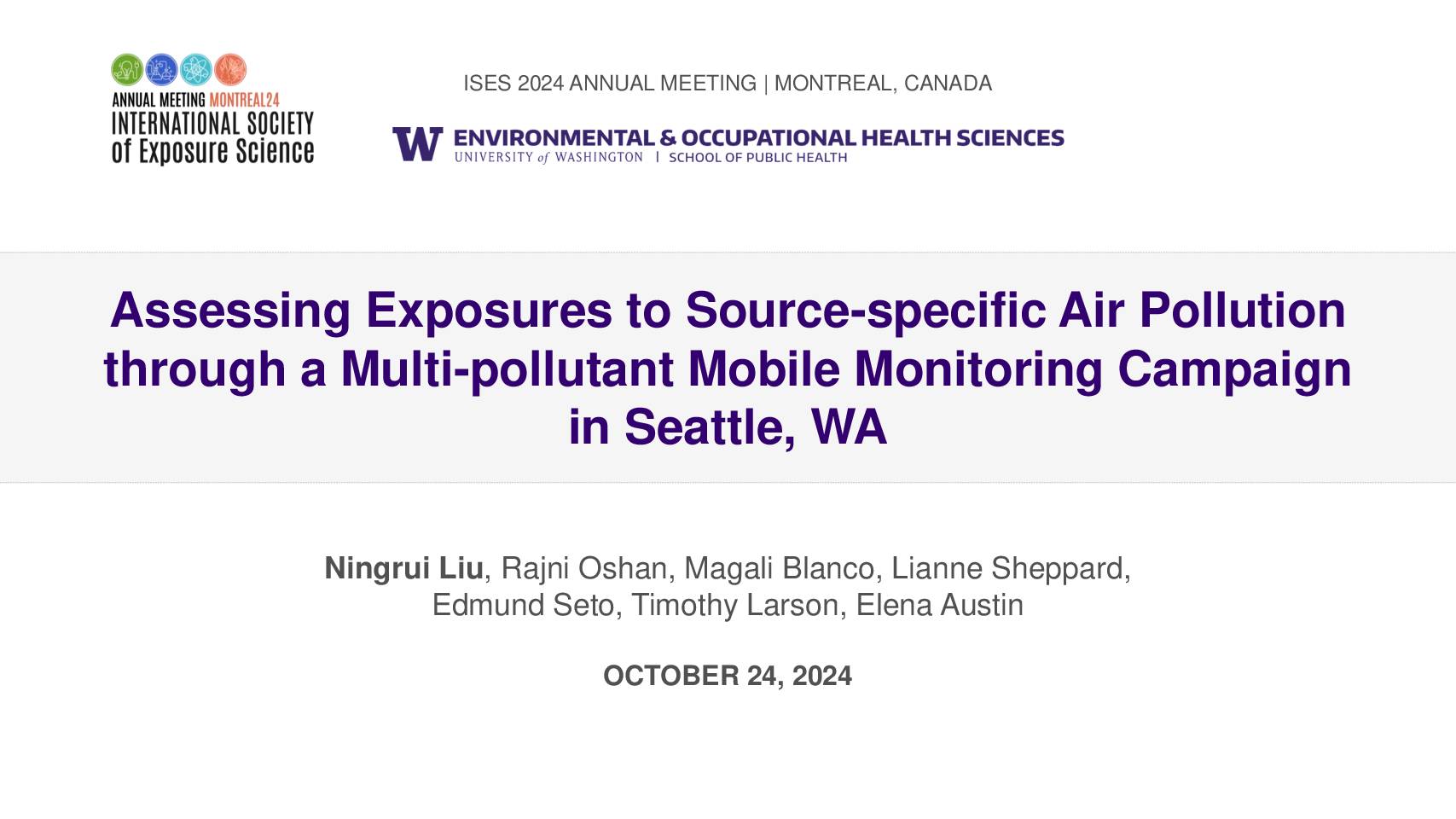
    Assessing exposures to source-specific air pollution through a multi-pollutant mobile monitoring campaign in Seattle, WA

    This presentation from the 2024 International Society of Exposure Science annual meeting describes a mobile air quality monitoring study conducted in Seattle, Washington, examining exposure to pollutants from specific sources such as traffic and industry. Researchers from the University of Washington used a multi-pollutant mobile monitoring campaign to measure and assess how people in the Seattle area are exposed to different types of air pollution across various locations. The study covers introduction, methods, results, and conclusions related to source-specific air pollution exposure assessment.
    TagsUFP, Ultrafine Particulates, UWDEOHS
  • 2024-10-01

    Update on Our Ongoing Ultrafine Monitoring

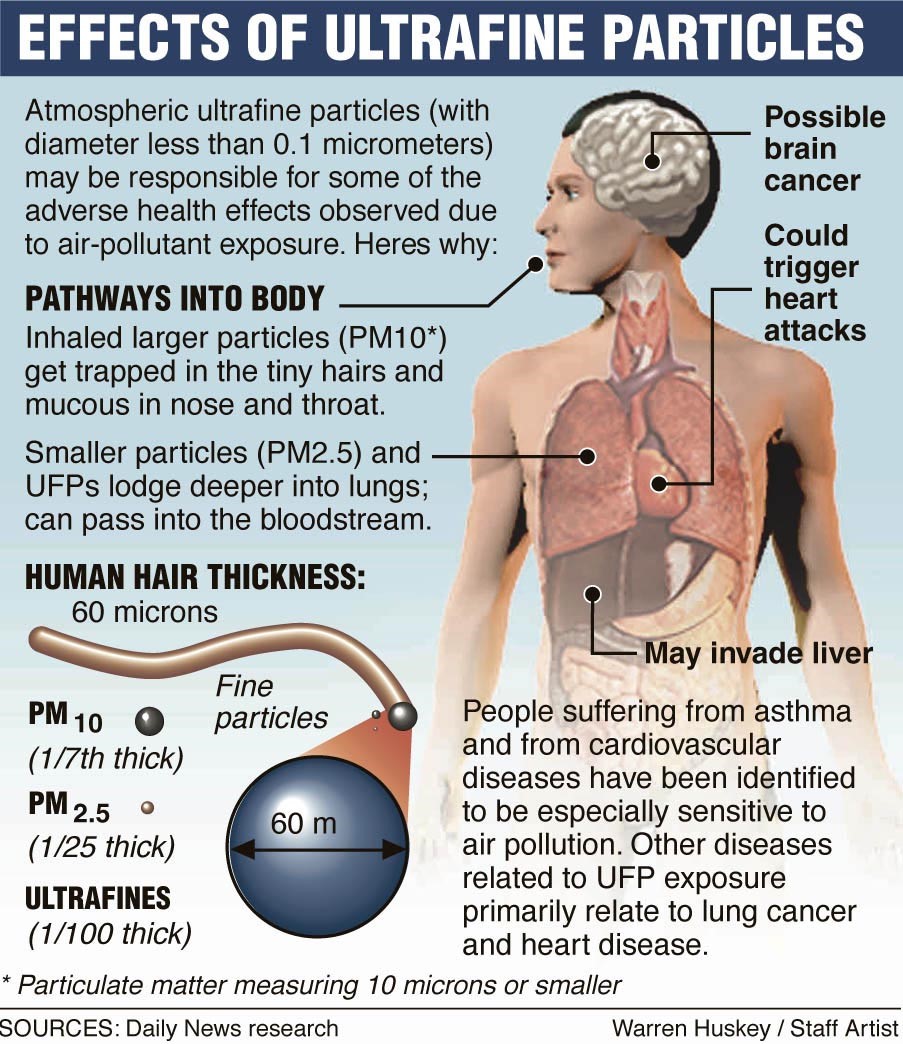
    The Puget Sound Clean Air Agency's Monitoring Team provides an October 2024 update on their ongoing ultrafine particle (UFP) monitoring program, explaining that UFPs are extremely tiny particles smaller than 0.1 microns that are not currently regulated under air quality standards. The presentation covers key concepts such as particle number concentration (PNC), monitoring instrumentation, and WHO good practice recommendations for UFP measurement. While not specific to noise policy, this monitoring effort is relevant to understanding air quality impacts near high-traffic areas such as airports.
    TagsAir Quality Monitors, PSCAA, UFP, Ultrafine
  • 2024-10-01

    Update on Our Ongoing Ultrafine Monitoring

    Puget Sound Clean Air Agency (PSCAA) Monitoring Team October 2024 presentation on ongoing ultrafine particle (UFP) monitoring. Covers key acronyms and facts: UFP defined as particles less than 100 nm or 0.1 microns, particle number concentration (PNC), SMPS (Scanning Mobility Particle Size Spectrometer), and the fact that UFPs account for more than 80% of PNC.
    TagsAir Quality Monitors, PSCAA, UFP, Ultrafine
  • Airport workers asking Sacramento to mandate airlines report jet fuel emissions

    Sid Garcia  Wednesday, June 5, 2024 12:57PM A new study has detailed the health effects of jet fuel emissions on airport workers and people living near an airport or flight path. A new study has detailed the health effects of jet fuel emissions on airport workers and people living near an airport or flight path.
    CategoriesFrom The Web TagsCARB, SAF, Sustainable Aviation Fuels, UFP, Ultrafine Particulates
  • UW study shows Seattle’s historically redlined communities have worse air quality

    By Isabella Breda  Seattle Times staff reporter As Seattleites awoke to a hazy concoction of wildfire and Fourth of July firework smoke Wednesday morning, a new study dropped, revealing that some neighborhoods in the city are regularly subject to worse air pollution, reflective of historic racist policies. Those neighborhoods, according to research published Wednesday from the University of Washington,
    CategoriesFrom The Web TagsEnvironment, Seattle Times, UFP, UWDEOHS
  • 2023-07-05

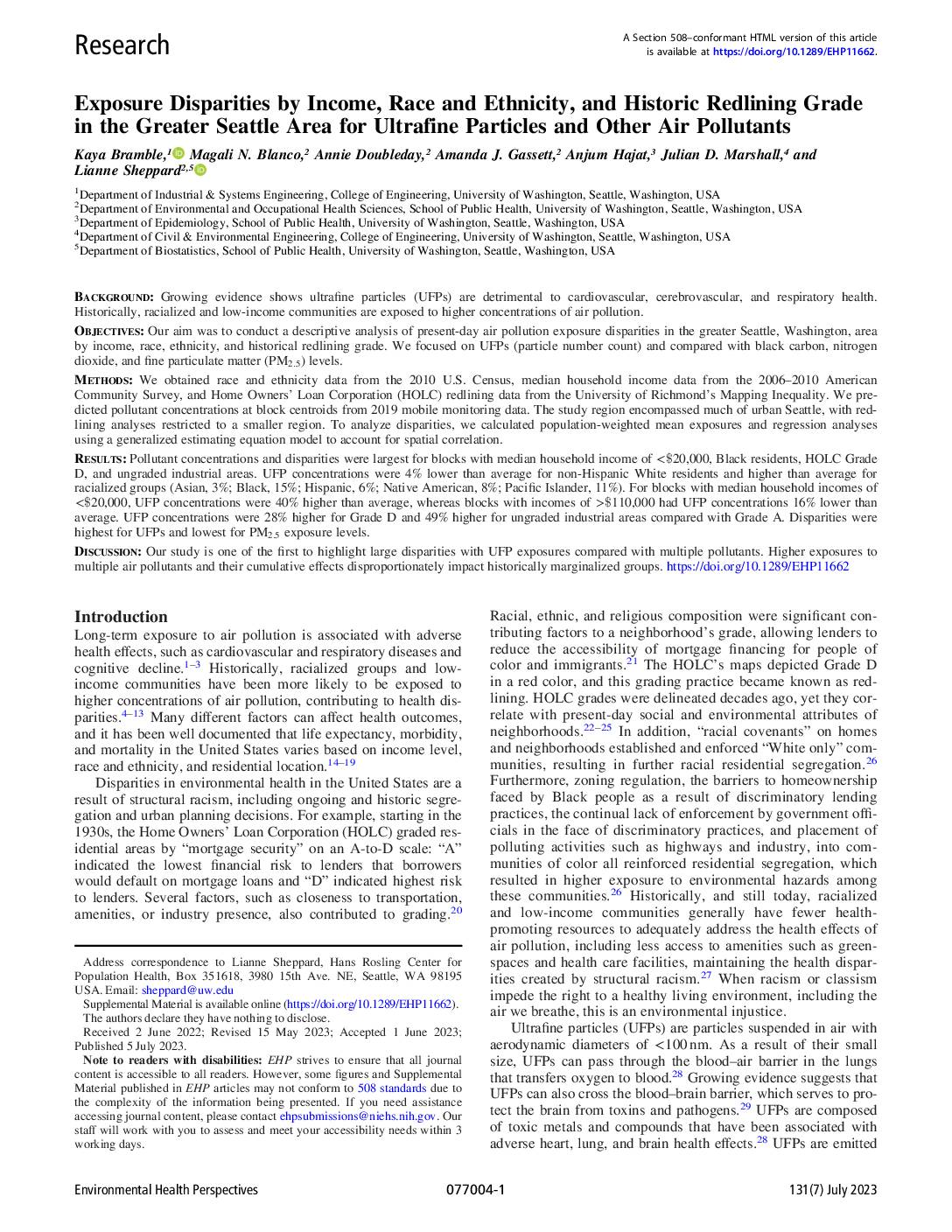
    Exposure disparities by income, race and ethnicity, and historic redlining grade in the greater Seattle area for ultrafine particles and other air pollutants

    A University of Washington study found that low-income and minority communities in the greater Seattle area are exposed to significantly higher levels of ultrafine particles (UFPs) and other air pollutants compared to wealthier, predominantly white neighborhoods. The research also revealed that neighborhoods historically designated as 'hazardous' under 1930s redlining practices continue to experience disproportionately poor air quality today. Disparities were most pronounced for UFPs, which are tiny particles linked to heart, lung, and brain health problems, and least pronounced for fine particulate matter (PM2.5).
    TagsAcademic Journals, Environmental Justice, UFP, Ultrafine Particulates
  • 2023-05-08

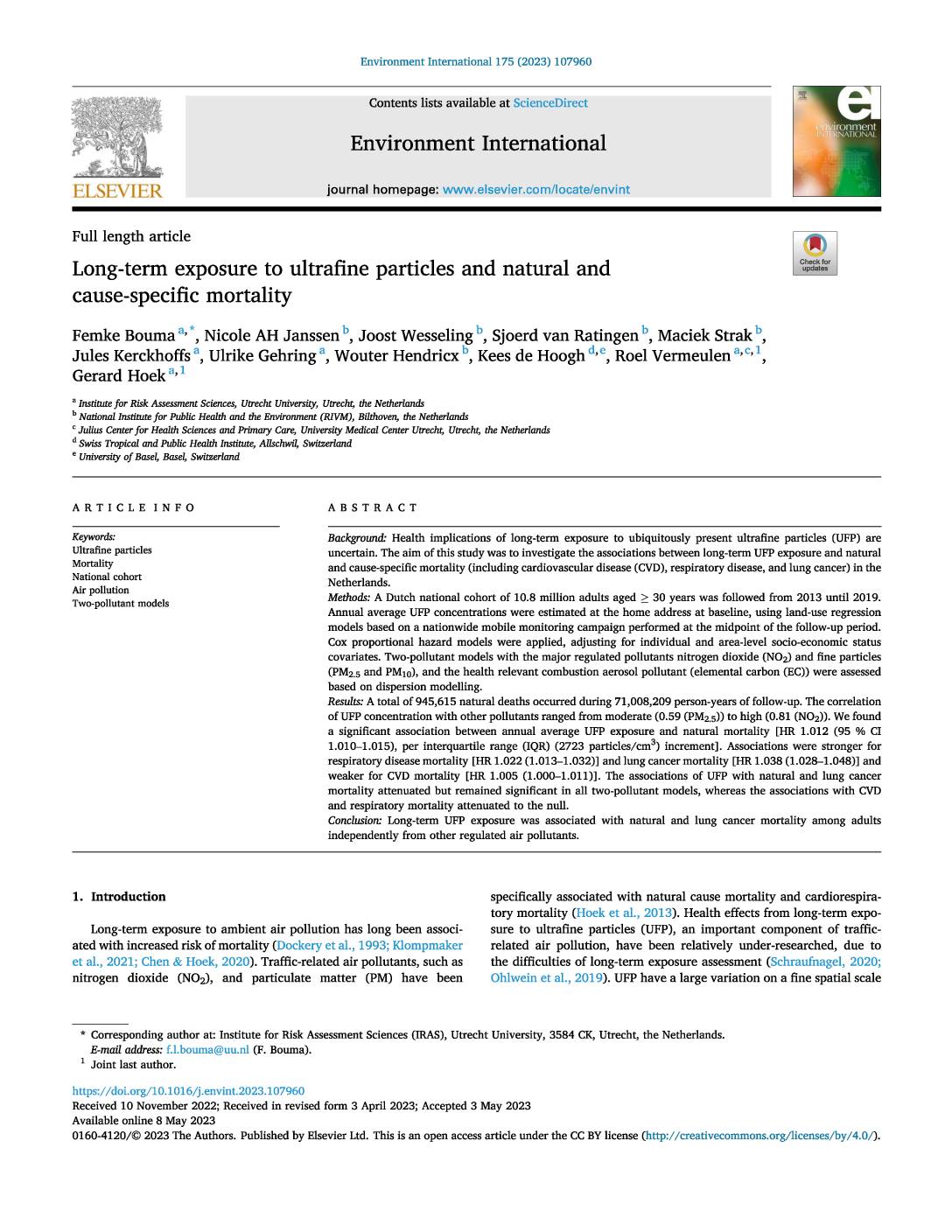
    Long-term exposure to ultrafine particles and natural and cause-specific mortality

    This study examined whether long-term exposure to ultrafine air particles (UFP) is linked to higher death rates among 10.8 million Dutch adults followed from 2013 to 2019. Researchers found that higher UFP exposure was significantly associated with increased risk of natural cause, lung cancer, and respiratory disease mortality, even after accounting for other air pollutants like nitrogen dioxide and fine particles. The findings suggest UFP pose health risks independent of other regulated air pollutants, though this research is unrelated to airport noise policy.
    TagsAcademic Journals, Atmospheric Science, Environment, Health, UFP

Posts pagination

Page 1 Page 2 Page 3
Sidebar On/Off

Upcoming Events

  • StART SEA Stakeholder Advisory Round Table
    Add to CalendarMWednesday Aug 26, 5:00pm - 7:00pm
    Zoom (Virtual Meeting)
    START meetingagenda 2026826 final 0 pdf

    Meeting Objectives Introduce the primary feedback themes identified by StART members regarding StART’s Operating Procedures and determine areas that may warrant future discussion. 5:00 PM – Welcome Meeting Management Welcome Lead: Andrés Mantilla, Facilitator, Uncommon Bridges; Wendy Reiter, Airport Managing Director, POS 5:15 PM – Dinner: All participants eat. 5:30 PM – StART Operating Procedures

    [...]
  • Commercial Aviation Work Group
    Add to CalendarMThursday Sep 3, 10:00am - 1:30pm
    Virtual Meeting (Zoom)
    Cawg agenda sep 3 26 virtual pdf

    Meeting Agenda 10:00 a.m. – 10:15 a.m. | Welcome – Evan Nordby, Chair a. Introductions and Agenda Reviewb. Status of appointments and non-voting member invitationsc. Other updates as necessary 10:15 a.m. – 11:00 a.m. | Is it practical and legal to operate the western Washington [Puget Sound] airports as a single airport system? – Consultant

    [...]

[See all...]


Help study childhood asthma. Get free HEPA filter!

read more...

Issues

Sea-Tac Airport is currently undergoing the largest and longest expansion in its history, collectively known as the Sustainable Airport Master Plan (SAMP). Some of it you can already hear, but you’re probably not aware of what it all means. Here’s what you need to know.
read more...

Read This!

As the source for federal transportation grants, the Puget Sound Regional Council was charged with developing a system to meet the growing need for commercial aviation. When the search for a second airport failed, they authorized the Port of Seattle to build the Third Runway, with a mandate to develop a noise abatement and mitigation program. In their effort to stop the Third Runway, the ACC argued over every detail of the Port's efforts--including property buyouts and sound insulation. The dispute was meant to be settled by a three member Expert Arbitration Panel. This is their final report. It finds 2-1, that the Port's program was insufficient in several respects. Despite that, funding for the Third Runway was approved by the PSRC, and the 'Port Package' program, proceeded largely unchanged. Expert Arbitration Panel's final decision finding that the Port of Seattle had not shown sufficient reduction in real on-the-ground noise impacts to satisfy noise reduction conditions required for approval of a third runway at Sea-Tac International Airport. The majority decision concluded the Port's noise abatement programs were insufficient despite being impressive in scope.
continue...

The Podcast!

Subscribe to the only podcast devoted to policies, politics, history, impacts for people living under the flight path everywhere. It’s definitely not just about noise!
  • Sea-Tac Noise.Info
  • Connect with STNI

    • Subscribe
    • Port Package Problem?
    • Donate
    • Podcast
    • Socials
      • Facebook
      • X (Twitter)
      • Bluesky
      • Instagram

    "North Sea-Tac Park Master Plan 1979 Pg 58" — , 1979

  • Learn

    • Frequently Asked Questions
    • Explainers
    • Youtube
    • Research Requests
    • Make a complaint
  • Goals

    Fulfill the promises of 1976:
    • Compensation
    • Reduced noise
    • Improved air quality
    • Environmental remediation
Login/Register
©2026•Data Privacy

Message

We use cookies to provide basic functionality. We also provide access to search engines in order to provide site analytics. We do not sell or share your data.
V V