TagWashington State Department Of Health(16)
-
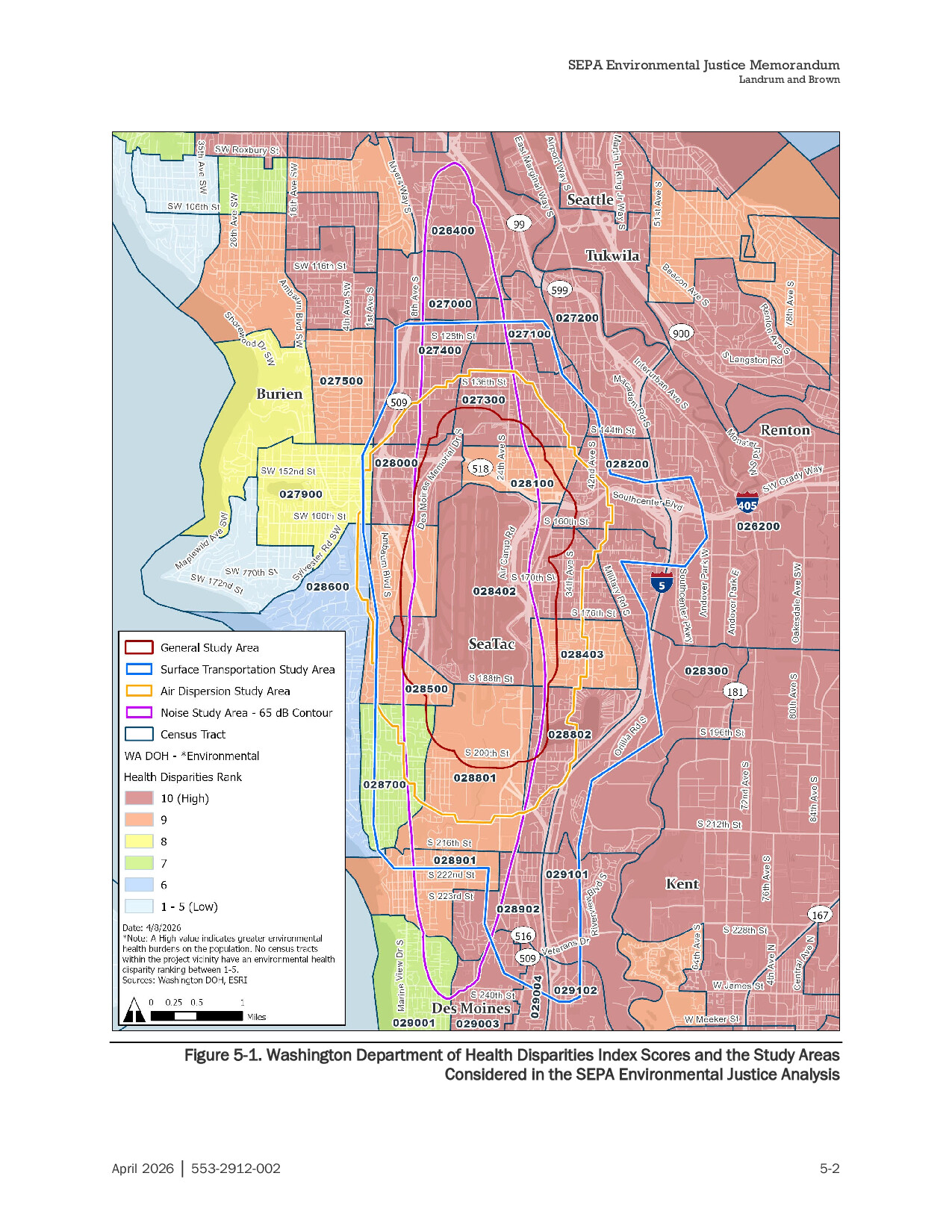
Appendix K SEPA Environmental Justice Disparities Map page 124
Figure 5-1 from a SEPA Environmental Justice Memorandum prepared by Landrum and Brown (document no. 553-2912-002, dated April 2026) maps Washington Department of Health Environmental Health Disparities Index scores across census tracts in the Sea-Tac Airport vicinity, including Seattle, Tukwila, Burien, SeaTac, Renton, Kent, and Des Moines. The map delineates four overlapping study areas—General Study Area, Surface Transportation Study Area, Air Dispersion Study Area, and Noise Study Area (65 dB contour)—over a background showing health disparity rankings ranging from 1–5 (Low) to 10 (High), with most tracts in the project vicinity ranked 9–10. -
 2025-06-01
2025 Ambient Air Monitoring Network Plan
This 2025 Ambient Air Monitoring Network Plan, published by the Washington State Department of Ecology's Air Quality Program, outlines the state's ambient air quality monitoring network across Washington. Authored by Jill Schulte and released in June 2025, it provides regional office contact information and details the counties served by each of Ecology's four regional offices. Note: this document covers air quality monitoring statewide and does not contain content specifically related to Sea-Tac Airport noise policy. -
 2025-01-28
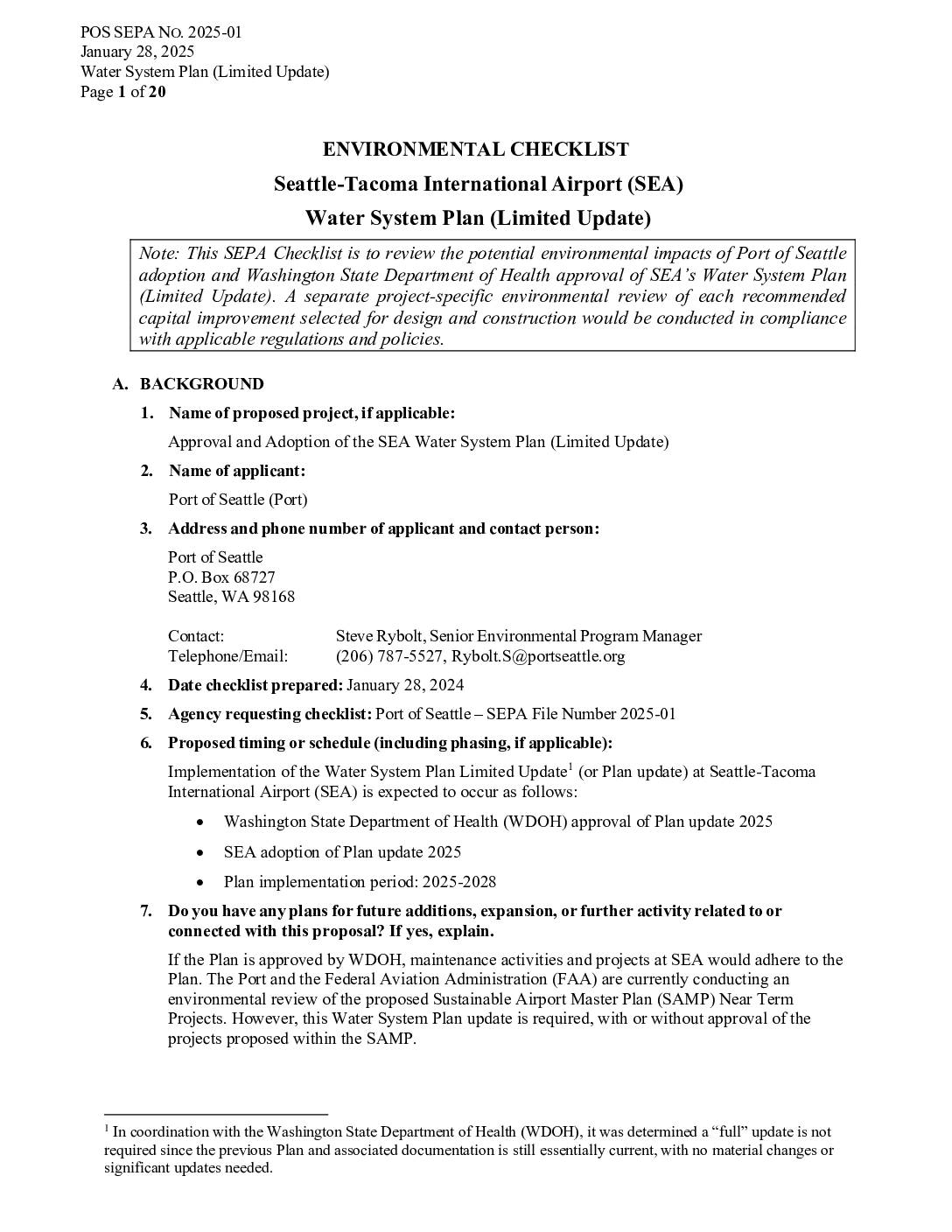
Environmental checklist: Seattle-Tacoma International Airport (SEA) Water System Plan (Limited Update)
The Port of Seattle submitted an environmental checklist in January 2025 for a limited update to Seattle-Tacoma International Airport's Water System Plan, covering the period 2025–2028. The update addresses routine maintenance and infrastructure improvements to SEA's drinking water and fire protection system, including pipe replacements, new surge tanks, additional water storage, and a backup water supply connection to Highline Water District. Washington State Department of Health approval and Port of Seattle Commission adoption are required before the plan can be implemented. -
 2024-09-04
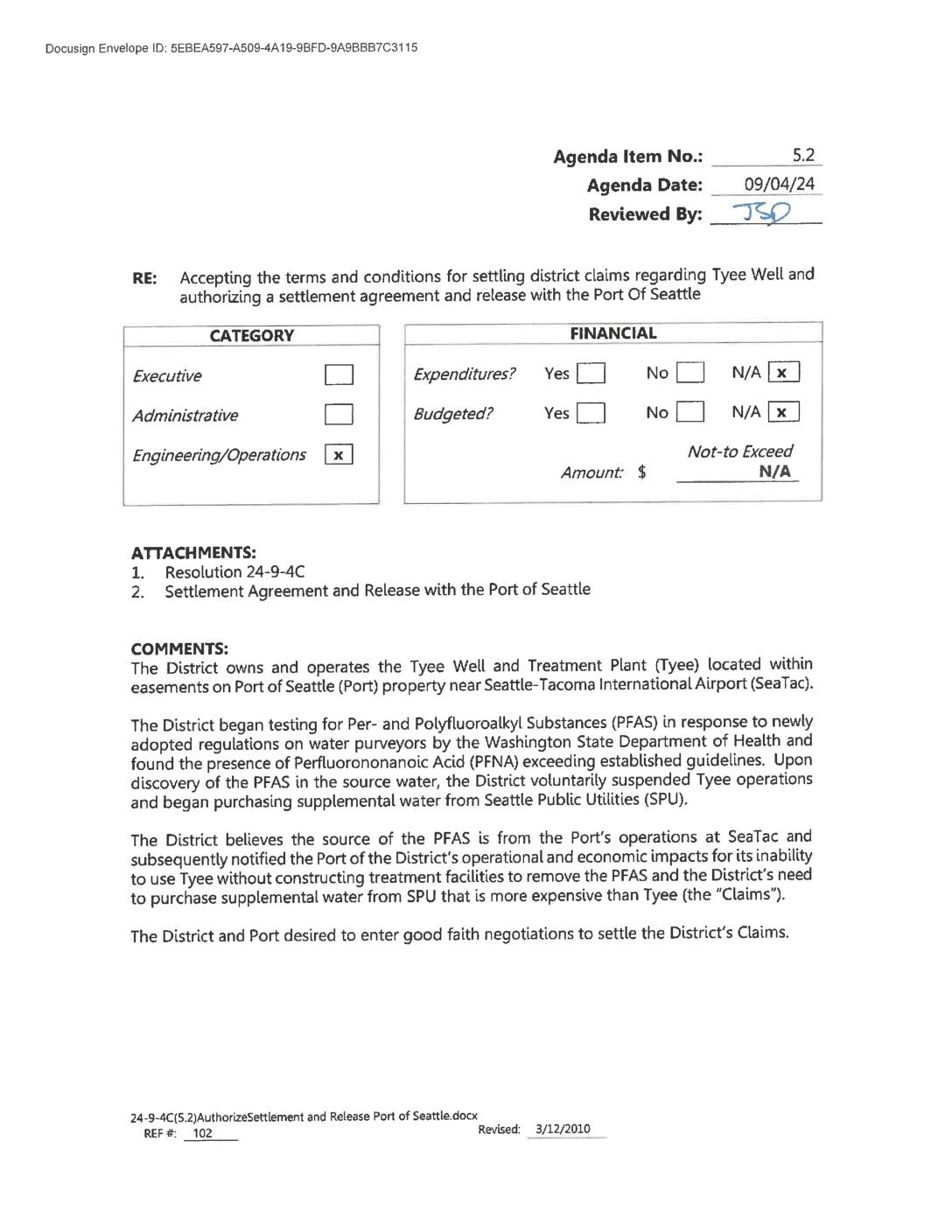
Resolution 24-9-4C: Settlement Agreement and Release — Highline Water District and Port Of Seattle Regarding Tyee Well PFAS Contamination
Highline Water District reached a settlement with the Port of Seattle after PFAS chemicals, likely originating from Seattle-Tacoma International Airport operations, were found to have contaminated the District's Tyee Well, forcing the District to suspend well operations in June 2022. The contamination required the District to purchase more expensive replacement water from Seattle Public Utilities, and new EPA regulations finalized in 2024 further prohibited resuming well use without installing costly treatment facilities. The two parties negotiated a mutual release of claims to resolve the District's operational and financial losses resulting from the contamination. -
 2023-12-01
Improving air quality in overburdened communities highly impacted by air pollution: 2023 report
This 2023 report from the Washington State Department of Ecology focuses on improving air quality in overburdened communities that are highly impacted by air pollution across Washington State. It outlines regional office contacts, accessibility services, and language assistance resources available to affected residents. Note: This document does not specifically address Sea-Tac Airport noise policy and may not be directly relevant to airport noise concerns. -
 2022-01-01
Consumer Confidence Report on Water Quality 2022
The Highline Water District's 2022 Consumer Confidence Report details the sources, treatment, and quality testing of drinking water served to customers in the Kent and SeaTac, Washington area. Approximately 75% of the district's water comes from Seattle Public Utilities' Cedar River Watershed, with the remaining 25% drawn from local groundwater wells, all of which are treated and tested for over 200 contaminants before reaching customers. The report confirms that Highline Water District's water meets all state and federal safety standards and is significantly below EPA maximum contaminant levels. -
 2021-12-31
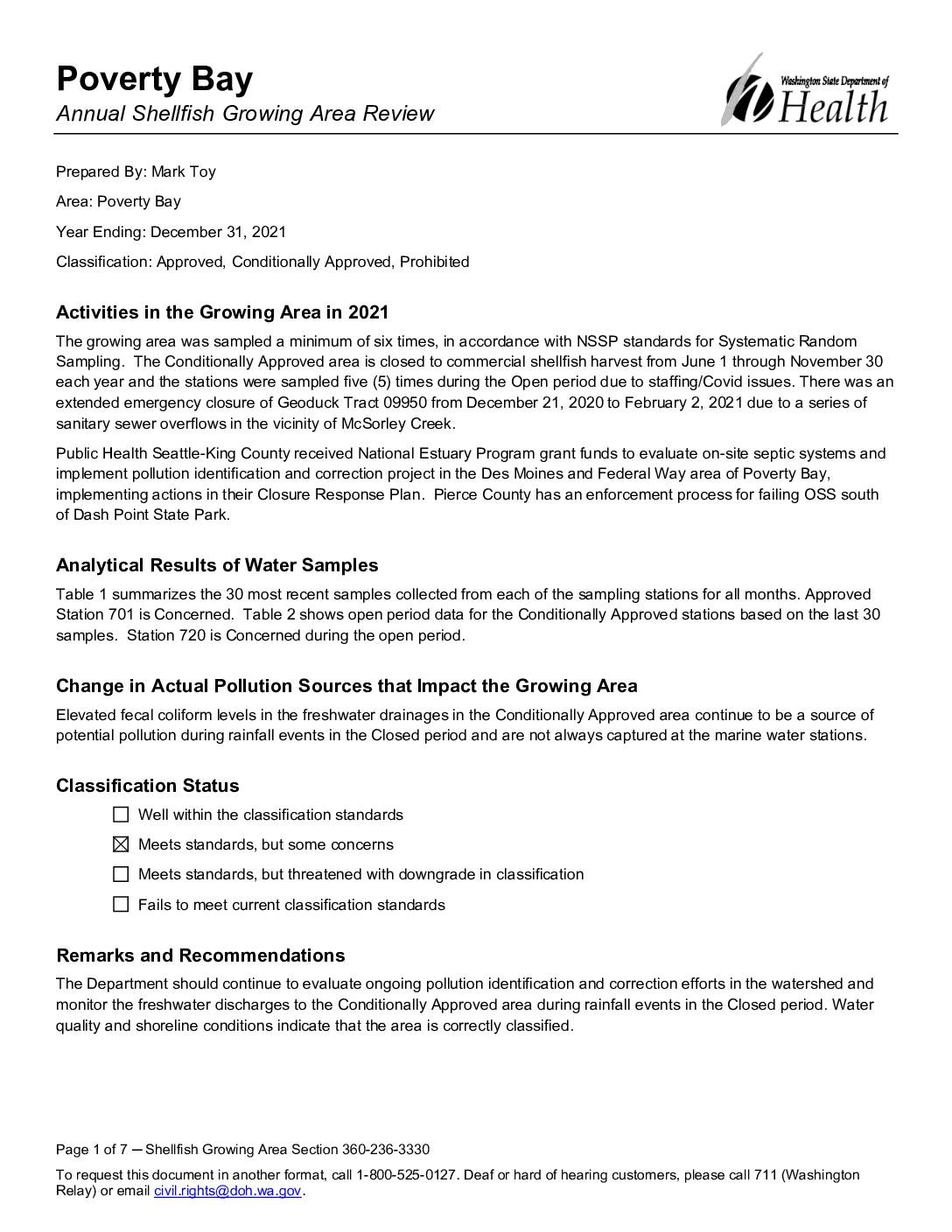
Poverty Bay annual shellfish growing area review
This 2021 annual review by the Washington State Department of Health assesses water quality and shellfish harvesting conditions in Poverty Bay, located near Des Moines and Federal Way. The area holds a mix of Approved, Conditionally Approved, and Prohibited classifications, with most stations meeting bacteriological standards, though Station 701 and Station 720 raised concerns due to elevated fecal coliform levels. Pollution sources such as stormwater runoff and past sanitary sewer overflows continue to be monitored, with ongoing correction efforts supported by Public Health Seattle-King County grant funding. -
Washington Tracking Network
Welcome to WTN, a Washington State Department of Health program focused on making public health data more accessible. WTN staff keep data in all tools up to date and develop additional data based on need and availability. Data are available for download and exploration using our four tools. -
 2021-03-12
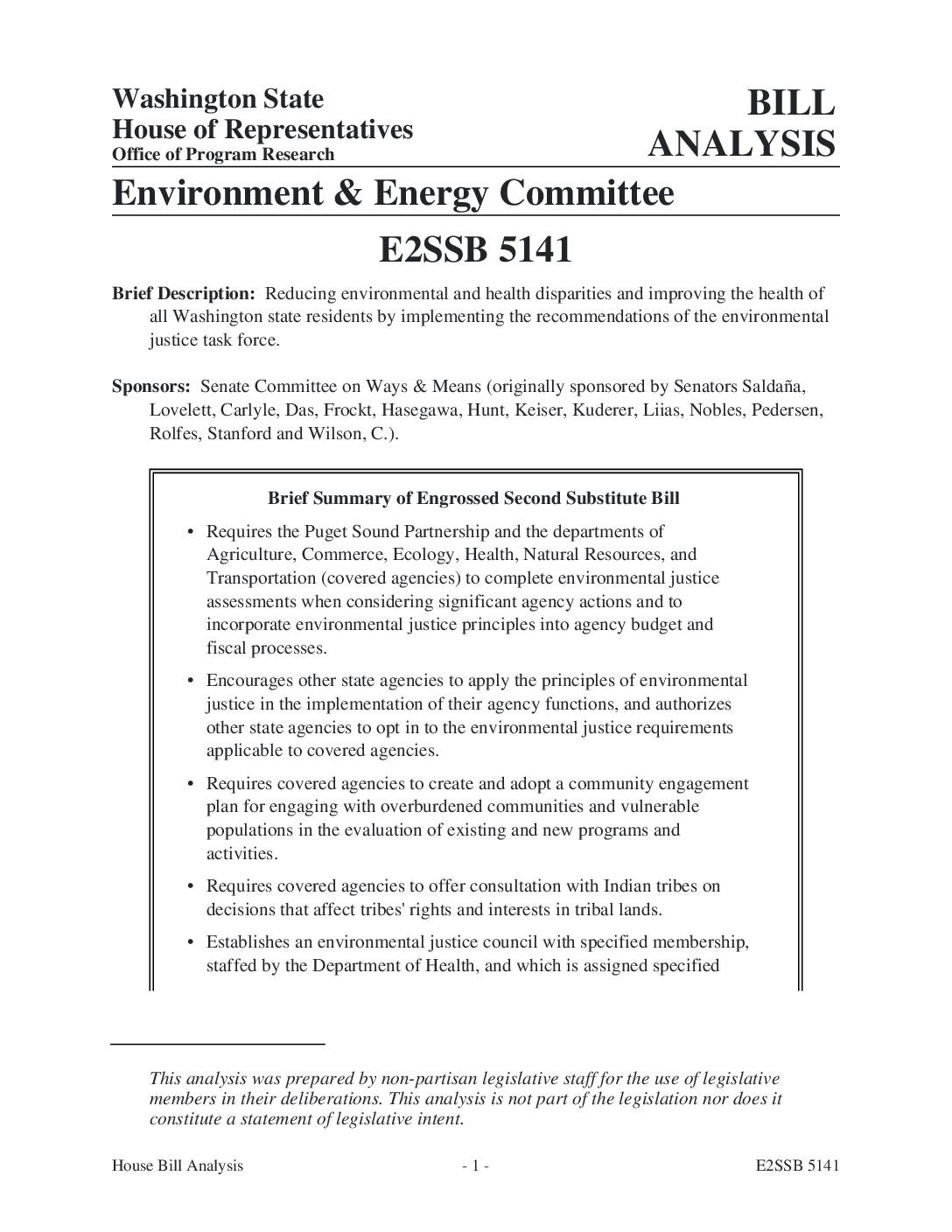
E2SSB 5141: House Bill Analysis — Reducing Environmental and Health Disparities (HEAL Act)
Washington State Senate Bill 5141 requires several state agencies, including the departments of Ecology, Health, Transportation, and others, to incorporate environmental justice principles into their planning and decision-making processes. The bill mandates that these agencies complete environmental justice assessments for significant actions, create community engagement plans for overburdened communities, and consult with Indian tribes on decisions affecting tribal lands. An environmental justice council would be established to oversee implementation, and the Department of Health would maintain an environmental health disparities map tracking conditions across Washington communities. -
 2021-01-01
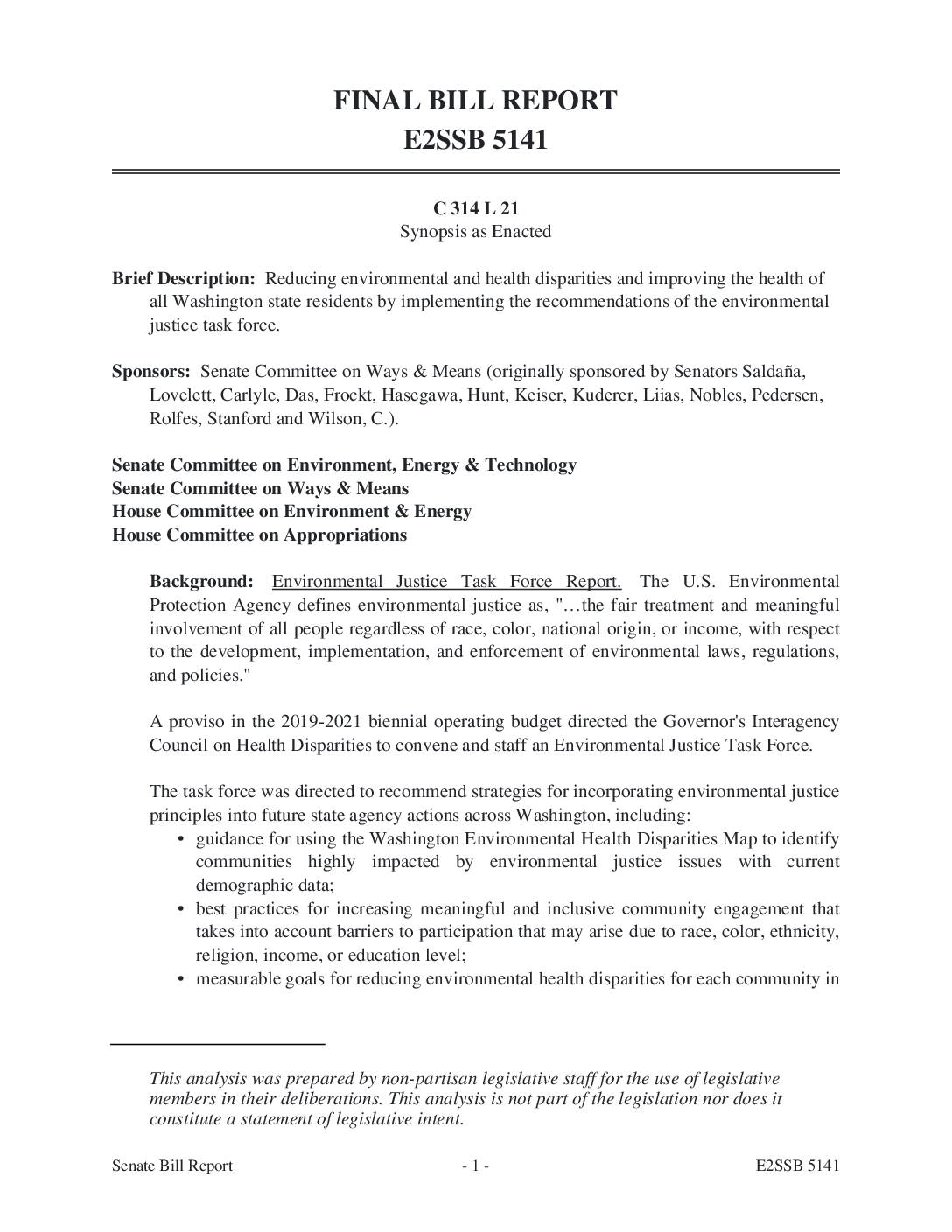
Final Bill Report: E2SSB 5141 — Washington Environmental Justice Act (HEAL Act)
Washington State's E2SSB 5141, enacted in 2021, requires key state agencies including Transportation and Ecology to incorporate environmental justice principles into their planning and decision-making processes, with a focus on protecting overburdened communities from disproportionate environmental and health harms. Agencies must develop community engagement plans by 2022, environmental justice implementation plans by 2023, and conduct formal environmental justice assessments for significant actions such as new rules, grants, and capital investments. Note: this legislation addresses statewide environmental justice policy broadly and does not specifically address Sea-Tac Airport noise issues.