TagWake Recat(4)
-
 2024-11-08
RECAT-EU European Wake Turbulence Categorisation and separation minima on approach and departure
This document presents the European Wake Turbulence Categorisation and Separation Minima on Approach and Departure (RECAT-EU) system, available for operational deployment. It provides information about deployment benefits, including the possibility to operate partial or hybrid versions combining RECAT-EU with ICAO legacy minima. -
 2019-09-28
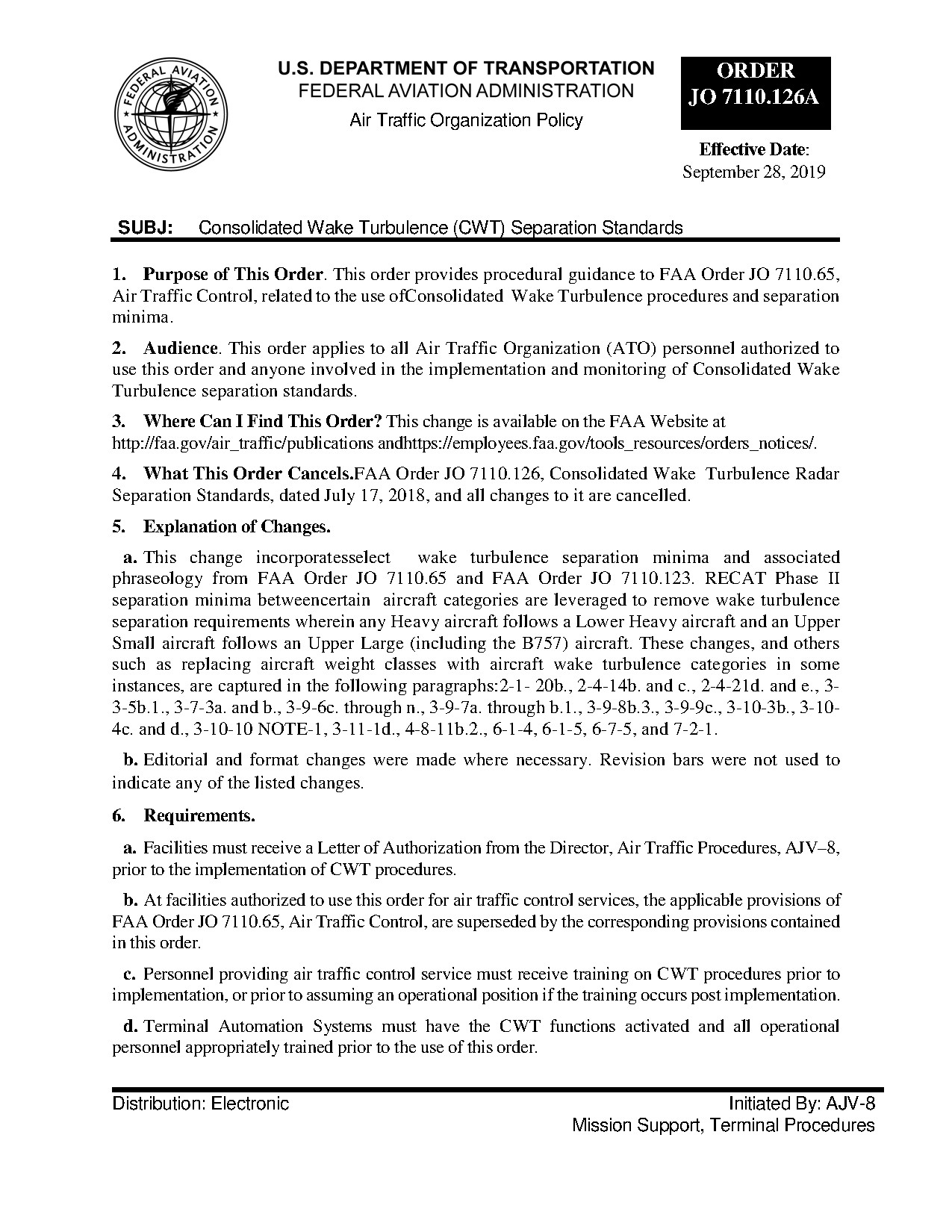
FAA Order JO 7110.126A: Consolidated Wake Turbulence (CWT) Separation Standards
FAA Order JO 7110.126A, effective September 28, 2019, updates the rules air traffic controllers use to maintain safe distances between aircraft to avoid wake turbulence. The order introduces a nine-category system for classifying aircraft by their wake turbulence characteristics, replacing older weight-based separation standards with more precise, data-driven minimums that can reduce unnecessary spacing between certain aircraft pairs. These updated standards are designed to improve traffic flow and runway efficiency at busy airports across the national airspace system. -
 2016-02-29
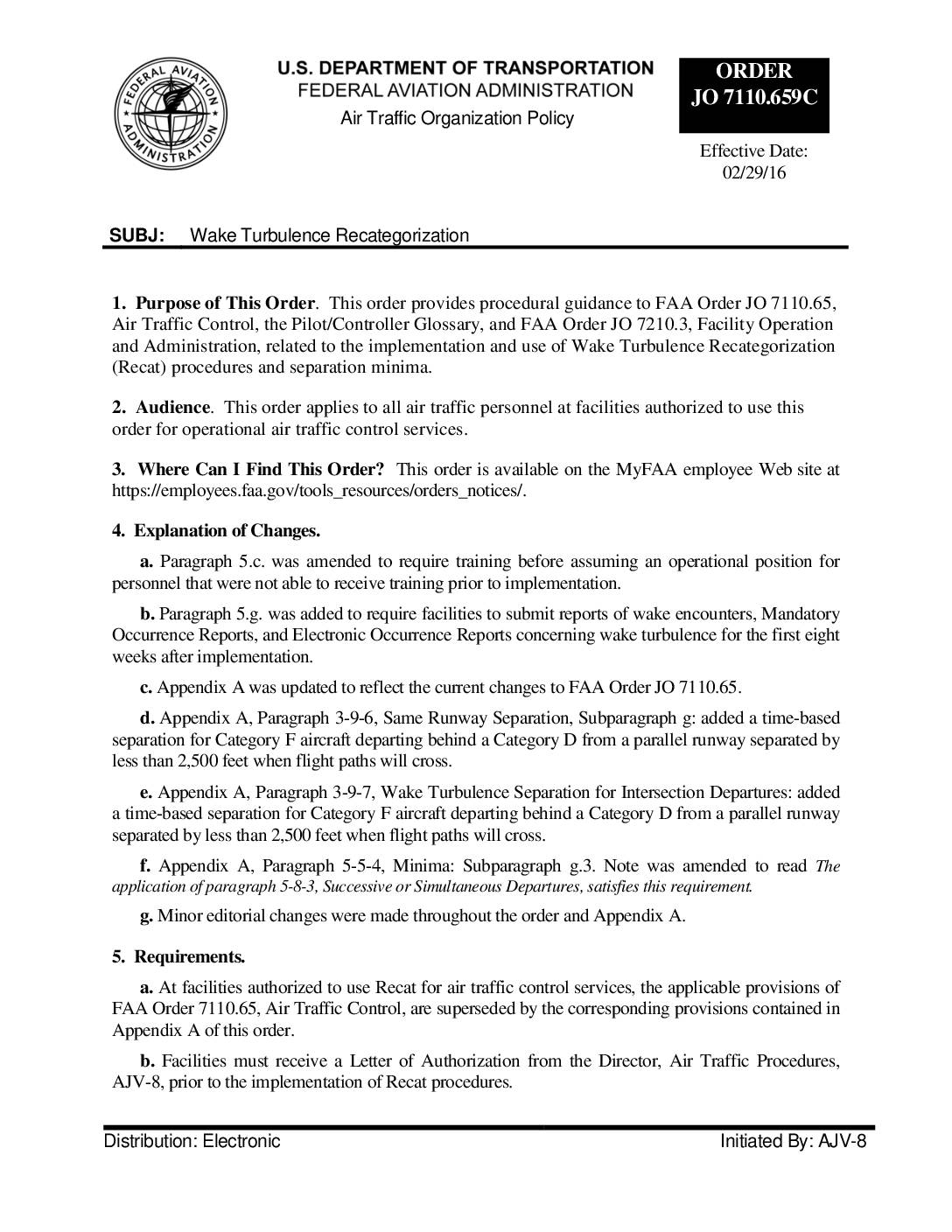
FAA Wake Recategorization JO7110659C
FAA Order JO 7110.659C, effective February 29, 2016, updates air traffic control procedures for Wake Turbulence Recategorization (Recat), which changes how aircraft are grouped for safe separation purposes. Instead of the traditional three weight classes (heavy, large, and small), Recat introduces six categories based on wingspan, takeoff weight, and an aircraft's ability to withstand wake turbulence, allowing for more precise separation distances and improved airport efficiency. Facilities must obtain authorization, train personnel, and submit weekly wake encounter reports for the first eight weeks after implementing these new procedures. -
 2012-10-18
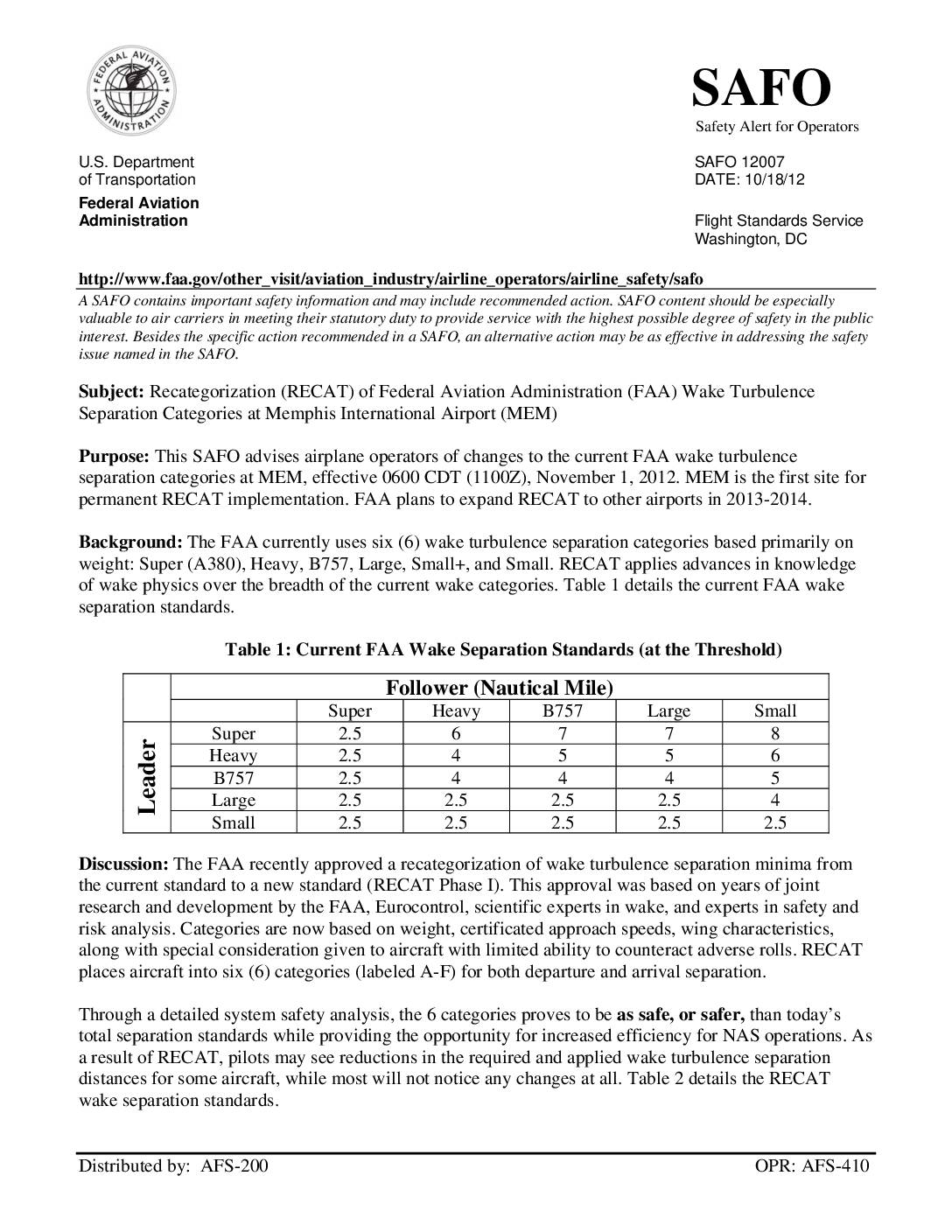
Recategorization (recat) of federal aviation administration (FAA) wake turbulence separation categories at memphis international airport (mem)
FAA Safety Alert for Operators announcing the implementation of new wake turbulence separation categories (RECAT Phase I) at Memphis International Airport, effective November 1, 2012. The document details changes from the current 6-category system to a new system based on weight, approach speeds, and wing characteristics, with specific separation standards and aircraft assignments.