TagNASA(5)
-
NASA and Boeing chase jet contrails with science of climate impact in doubt
By Dominic Gates Seattle Times aerospace reporter Scientific debate is getting heated over what to do about airplane contrails — the wispy lines of water vapor you often see trailing behind a jet. Those harmless-looking vapor trails sometimes spread out to form thin cirrus clouds. Environmental activists and nonprofits focused on climate change routinely assert -
 2023-05-03
Overview of community response test campaign with NASA’s X-59 aircraft
NASA's X-59 aircraft is being used in a community response test campaign to study how people on the ground react to sonic booms from supersonic flight. The mission, called Quesst, aims to collect data that could help regulators move from a blanket speed-based ban on supersonic flight over U.S. land to a noise-based standard. Current federal rules prohibit civil aircraft from flying faster than Mach 1 over the United States, but NASA hopes its findings could lead to updated, sound-level-focused regulations. -
 2019-12-11
Cleaner, Quieter Airplanes Act
The 'Cleaner, Quieter Airplanes Act,' introduced in the 116th Congress by Mr. Beyer, would require NASA to establish an initiative to develop and demonstrate new aircraft technologies capable of reducing both greenhouse gas emissions and noise emissions by at least 50 percent compared to the best-performing aircraft in service as of December 31, 2019. The bill responds to findings that aviation noise pollution is worsening in some communities as air traffic increases and performance-based navigation technology is adopted. It reflects a broader U.S. goal of carbon-neutral aviation growth from 2020 onward. -
 2018-12-19
Models – Aviation Environmental Tools Suite
The FAA, in collaboration with NASA and Transport Canada, has developed a suite of software tools called the Aviation Environmental Tool Suite to assess the environmental impacts of aviation, including noise, air quality, fuel burn, and greenhouse gas emissions. The suite's main components include the Aviation Environmental Design Tool (AEDT), Environmental Design Space (EDS), and the Aviation environmental Portfolio Management Tool (APMT), which together help quantify the relationships between aviation-related noise, emissions, and costs. These tools are designed to support policy, technology, and operational decision-making at local, regional, national, and international levels, and are released to the public only after rigorous validation testing. -
 2009-10-01
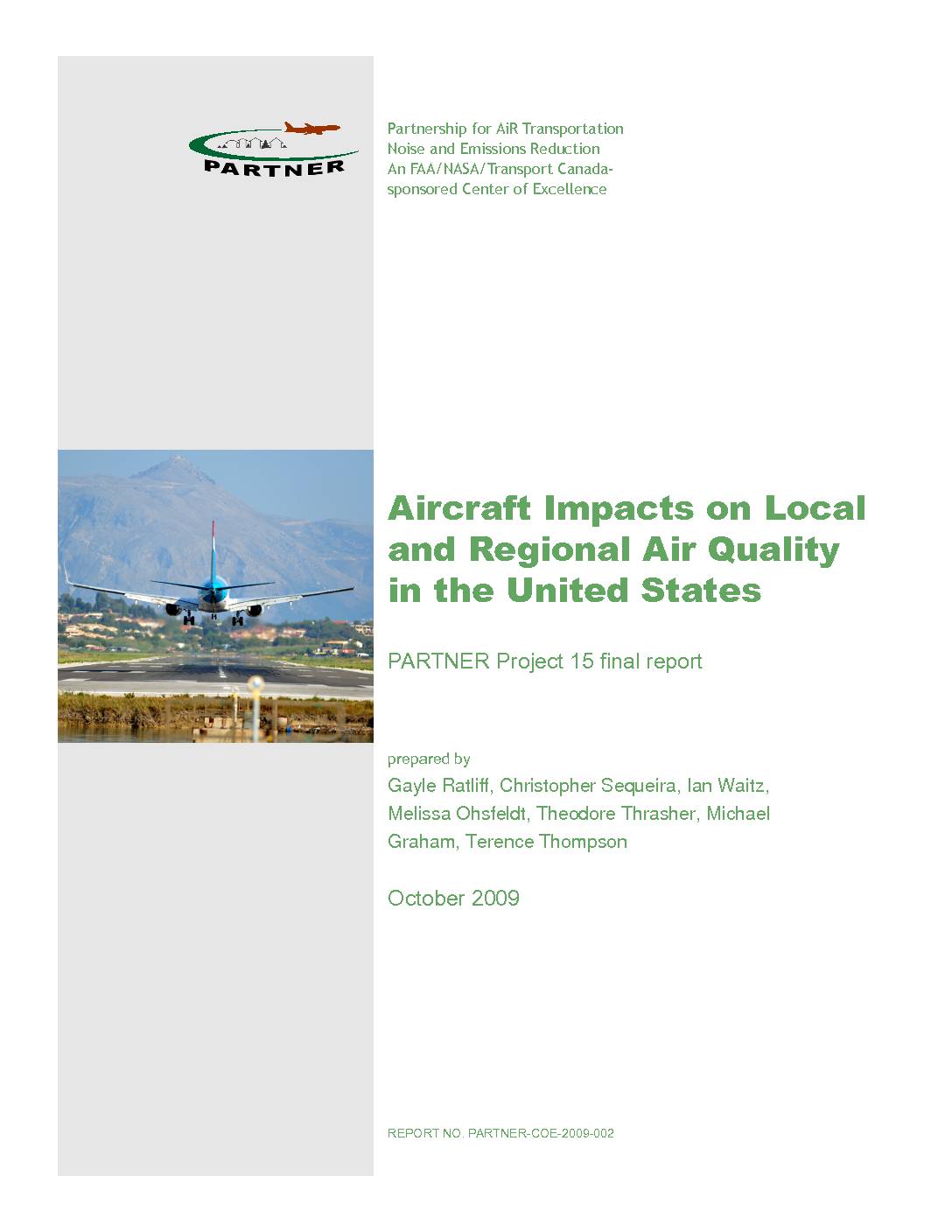
Aircraft impacts on local and regional air quality in the United States
★This 2009 research report examines how aircraft emissions affect local and regional air quality across the United States, including public health impacts near major airports. It analyzes baseline emissions inventories, the relationship between airport delays and increased fuel burn and pollution, and evaluates strategies such as continuous descent arrivals and schedule de-peaking to reduce emissions. The findings are intended to inform aviation environmental policy and air traffic efficiency improvements.