TagHOK(11)
-
2025-09-07
HOK: Des Moines Socio-Economic Impacts: $6.4 Million breakdown
Comparison of one section of the 1997 HOK TL;DR The 1997 Impacts Study covers a great deal of material. The Executive Summary makes many claims. We agree with its conclusions in the broad strokes. We created these breakdowns of specific cities, with an emphasis on how they align with the official NEPA/SEPA Sea-Tac Airport 1996 -
 1997-04-25
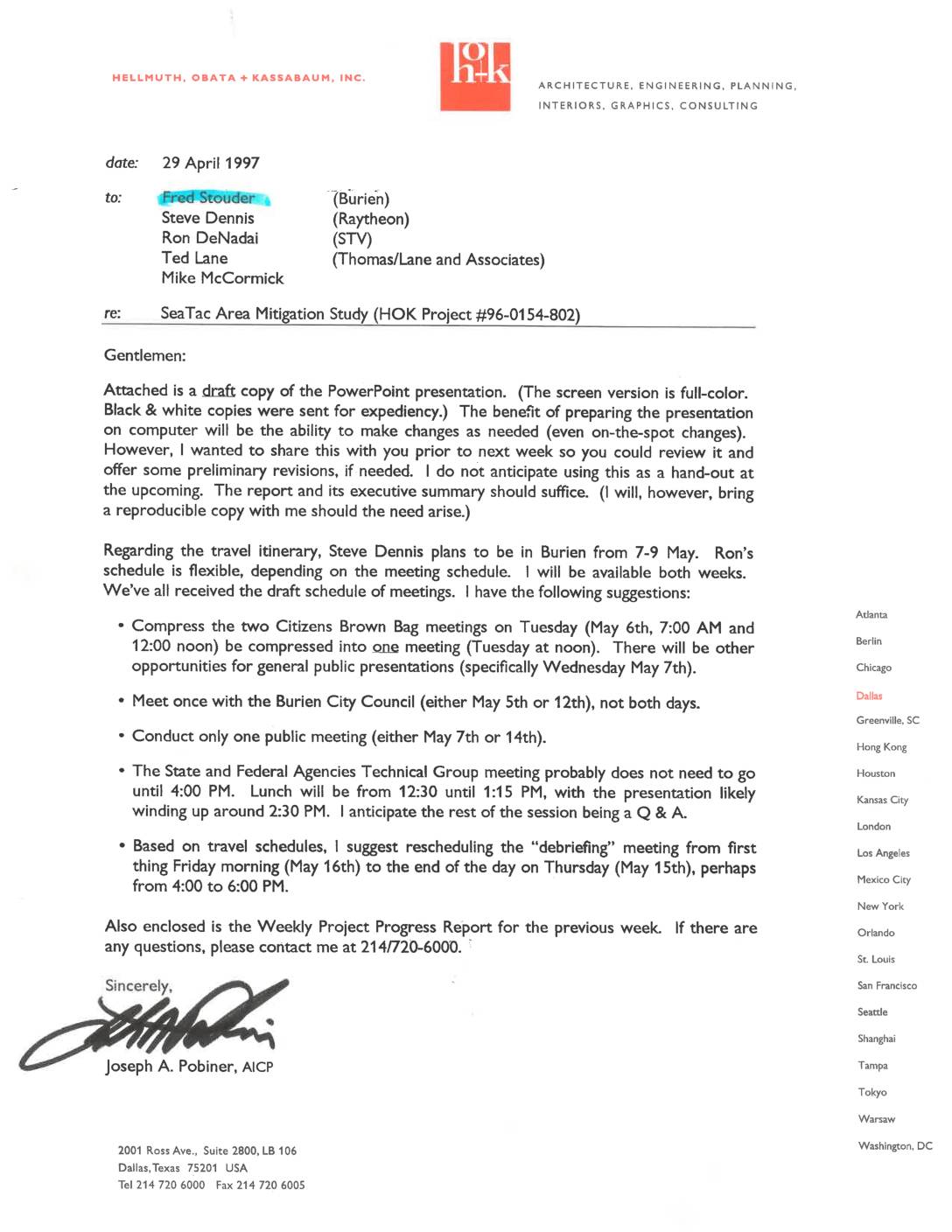
HOK Weekly Project Progress Report: Sea-Tac Impact Mitigation Study (April 25, 1997)
A April 1997 memo and progress report from Hellmuth, Obata + Kassabaum, Inc. (HOK) summarizes the near-complete Sea-Tac Area Mitigation Study, which assessed environmental, traffic, and socio-economic impacts related to Sea-Tac Airport. The memo outlines scheduling recommendations for a series of public and stakeholder meetings planned for May 1997 in Burien, Washington, including suggestions to consolidate citizen meetings and limit City Council sessions. As of the report date, all major project tasks were at 100% completion except the Mitigation Plan, which stood at 99%, with the consultant team preparing to present final findings to the community. -
 1997-02-01
Sea-Tac International Airport impact mitigation study: Initial assessment and recommendations
★ 32The HOK Study. 1997 initial assessment and recommendations report for the Sea-Tac International Airport Impact Mitigation Study, prepared by Hellmuth, Obata + Kassabaum and Raytheon Infrastructure Services. The study was funded by a State of Washington grant on behalf of the cities of Burien, Des Moines, Federal Way, Normandy Park, and Tukwila, as well as -
 1997-02-01
Sea-Tac International Airport Impact Mitigation Study: Initial Assessment and Recommendations — Section 9, Potential Socio-Economic Impacts and Mitigation
A 1997 study commissioned by cities and institutions near Seattle-Tacoma International Airport found that airport operations depress nearby property values compared to similar homes elsewhere in King County, and that properties directly under flight paths suffer additional losses from noise, visual pollution, and reduced quality of life. Researchers compared single-family homes around Sea-Tac with comparable homes in Northwest King County (Shoreline area), using strict criteria to ensure fair comparisons. The study notes that while overall regional growth means nearby home values may still rise over time, they appreciate more slowly than they would without the airport's presence. -
 1997-02-01
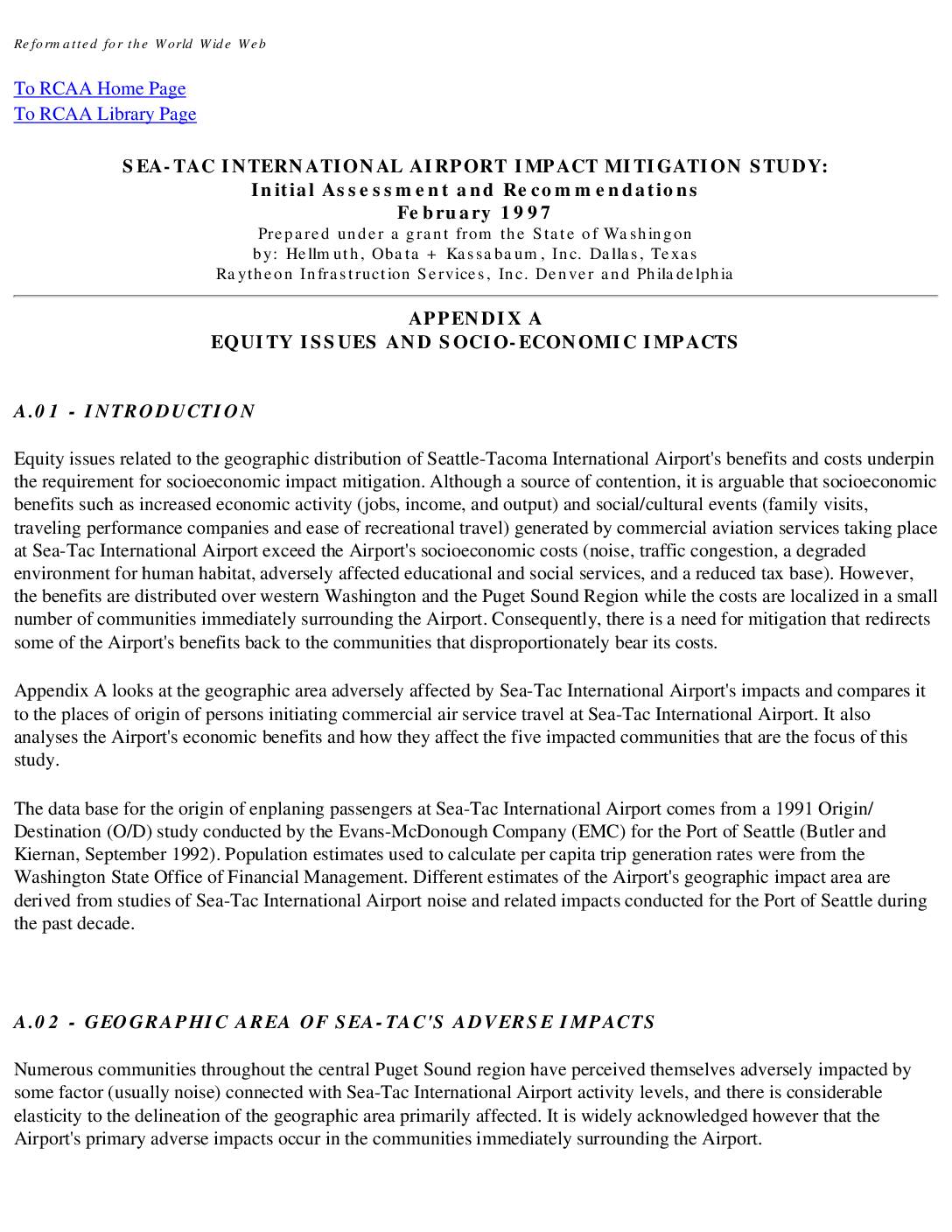
Sea-Tac International Airport impact mitigation study: Initial assessment and recommendations – Appendix A: Equity issues and socio-economic impacts
A 1997 study examined the unequal distribution of costs and benefits generated by Seattle-Tacoma International Airport, finding that while the airport's economic benefits (jobs, income, and travel services) spread across the broader Puget Sound region, its harms—including noise, traffic, and reduced property values—fell disproportionately on a small number of nearby cities: Burien, Des Moines, Federal Way, Normandy Park, and Tukwila. Data from a 1991 passenger survey showed that these five heavily impacted communities accounted for only 5.9% of home-originating enplanements, while King County as a whole contributed 57.2%. The study concluded that mitigation measures were needed to redirect some of the airport's regional benefits back to the communities bearing the greatest burden of its operations. -
 1997-02-01
Sea-Tac International Airport impact mitigation study: Initial assessment and recommendations
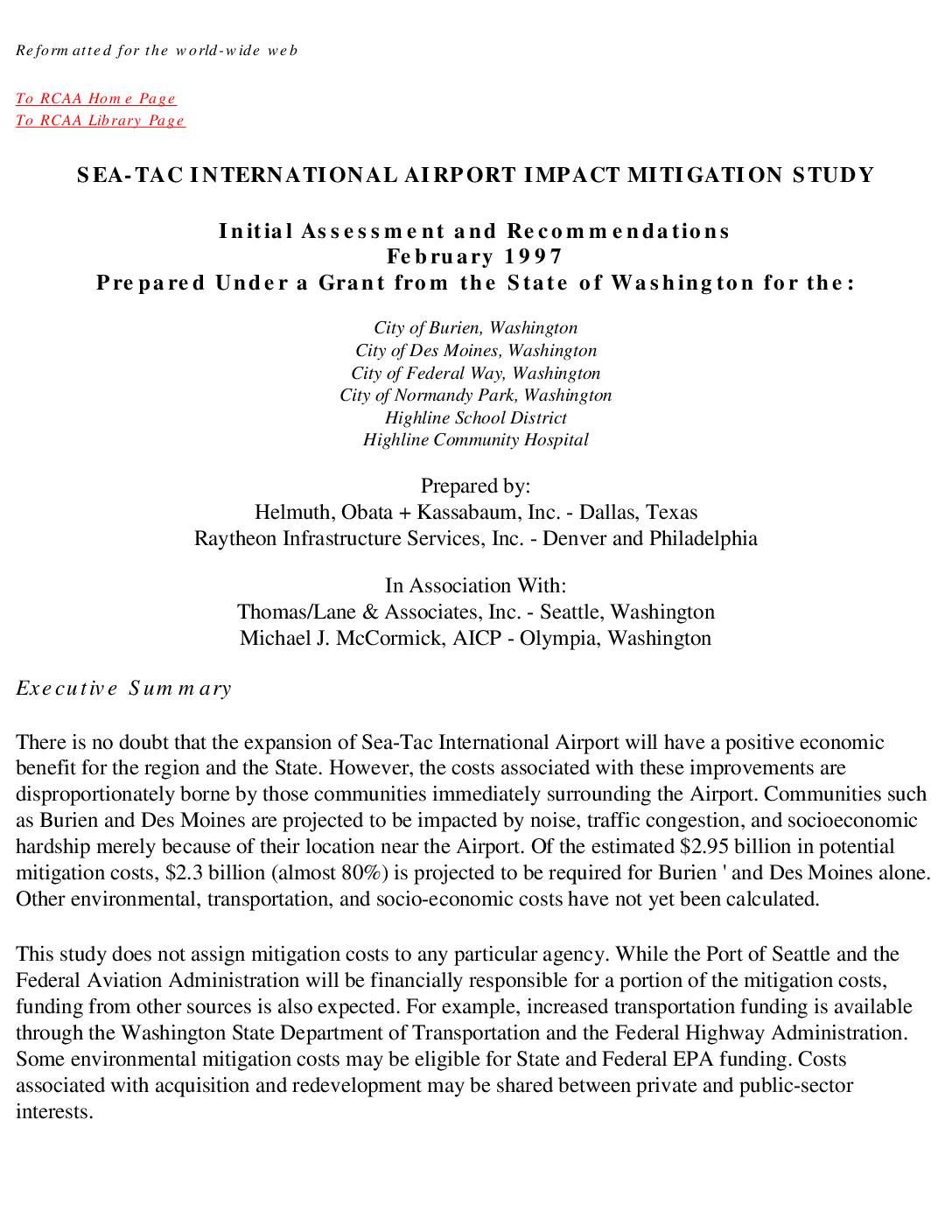
A 1997 impact mitigation study found that the expansion of Sea-Tac International Airport, including a proposed Third Runway, would impose significant costs on surrounding communities — with Burien and Des Moines alone accounting for nearly 80% of an estimated $2.95 billion in mitigation needs. The study examined 26 specific environmental impacts across areas such as noise, air quality, and water quality, and recommended establishing a permanent noise monitoring program to ensure projected noise contours are not exceeded. It also called for a comprehensive South King County planning effort to balance the needs of communities, schools, hospitals, and the airport. -
 1997-01-01
Sea-Tac Impact Mitigation Study: Section 1 Introduction and Section 1.02 Project Scope
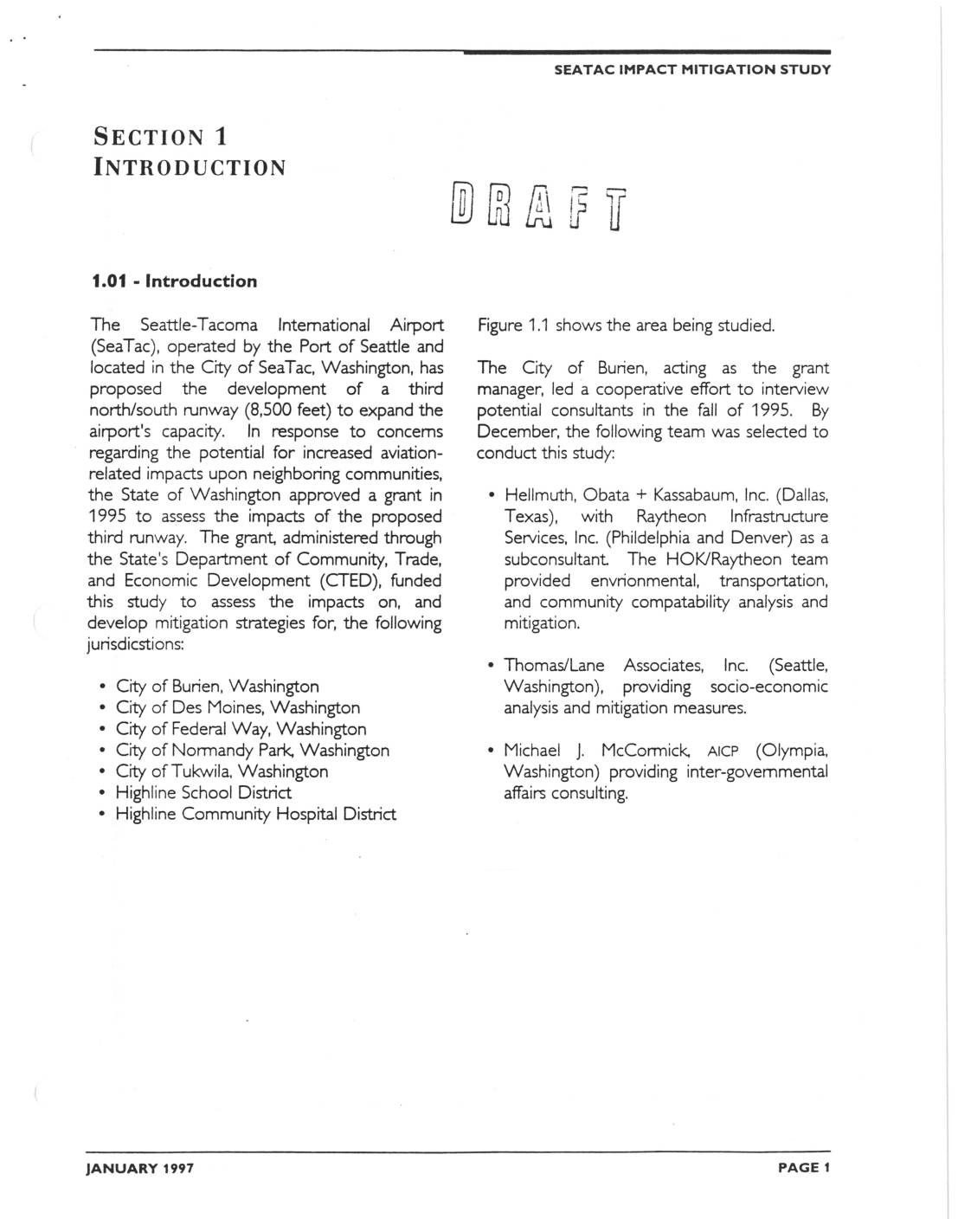
This 1997 draft study assessed the potential environmental, transportation, and socioeconomic impacts of a proposed third runway at Seattle-Tacoma International Airport on five neighboring communities—Burien, Des Moines, Federal Way, Normandy Park, and Tukwila—as well as the Highline School District and Highline Community Hospital District. Funded by a Washington State grant administered through the City of Burien, the study was conducted by a team of consultants and aimed to develop mitigation strategies and funding mechanisms to address impacts on affected jurisdictions. The report reviewed the Port of Seattle's Environmental Impact Statement and proposed independent mitigation measures, while expressly prohibited from being used to oppose the runway's construction. -
 1996-11-25
Letter from A. Brown to City of Burien: Comments on South King County Impact Assistance and Mitigation Studies Team Draft
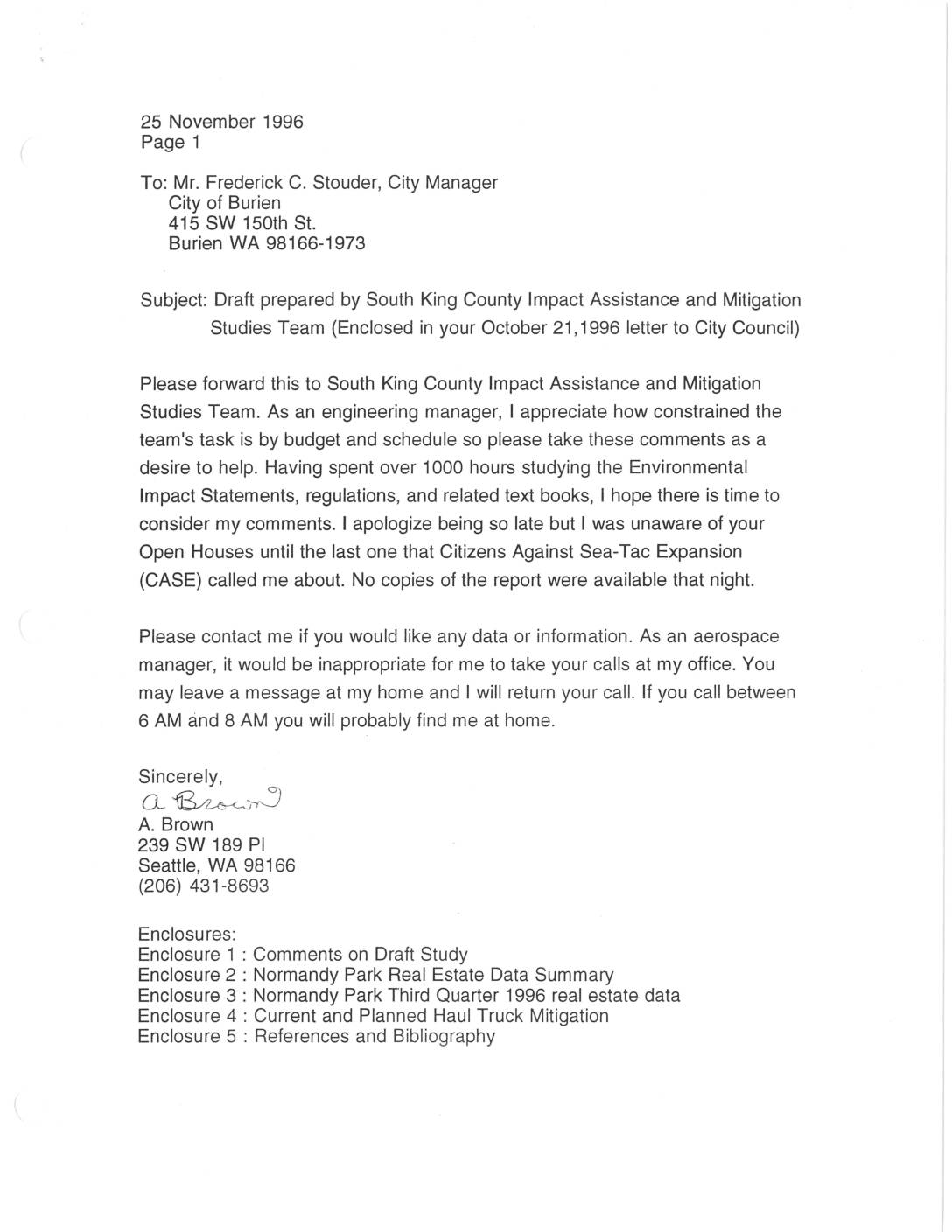
A Normandy Park resident and aerospace engineering manager submitted detailed comments in November 1996 criticizing a draft impact study related to Sea-Tac Airport's proposed Third Runway, arguing that the analysis underestimated real estate value losses, air pollution risks, and traffic disruptions caused by the project. The letter contends that home values in Normandy Park stagnated or declined after the Third Runway was publicly announced, and that any valid property value assessment must use baseline figures from before negative publicity began. The author also challenges the study's air quality modeling assumptions and traffic analysis, warning that the Port of Seattle would selectively cite favorable findings while ignoring methodological flaws. -
 1996-10-26
Review of draft mitigation cost analysis
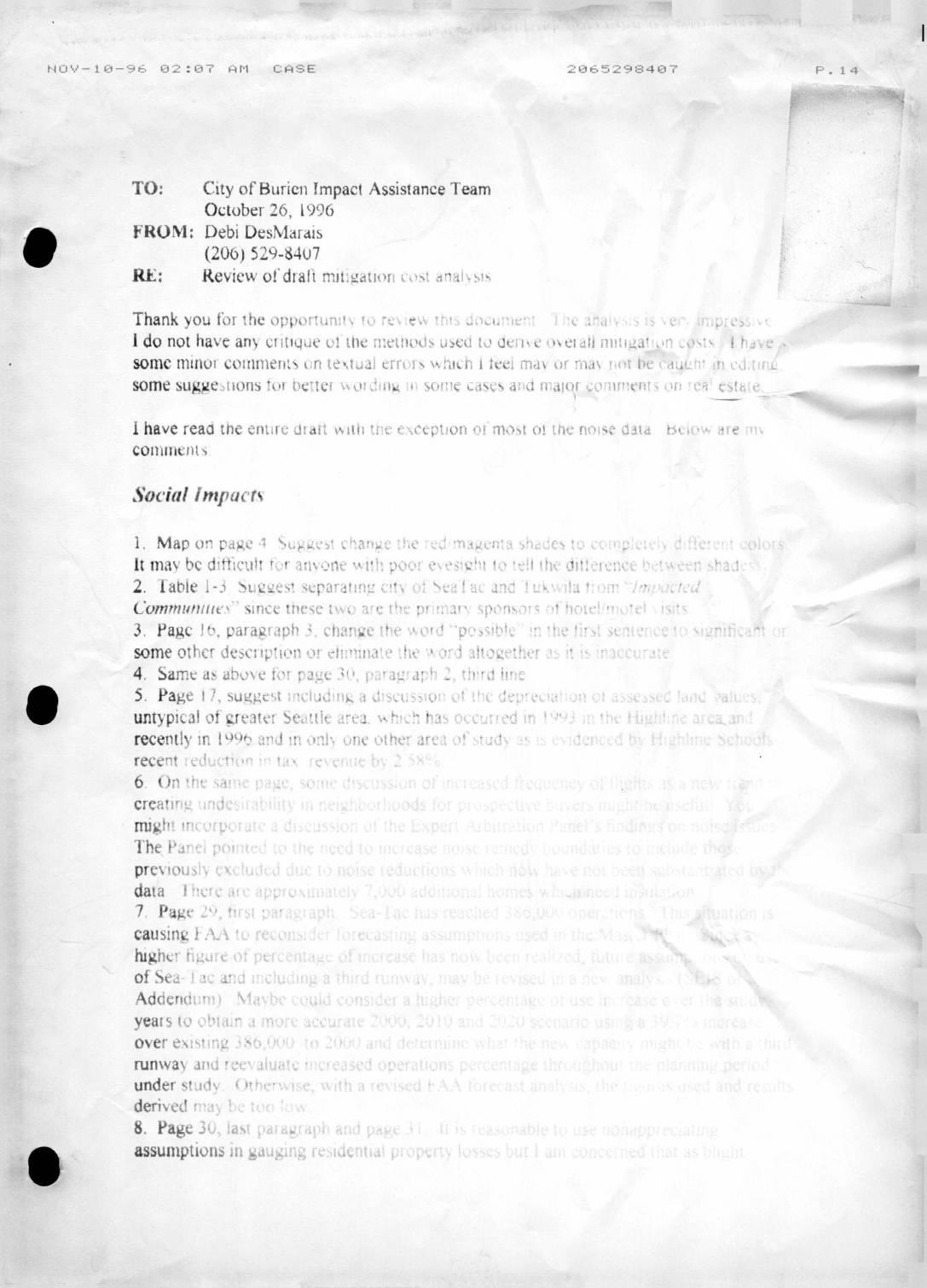
A technical review document from Debi DesMarais providing comments on a draft mitigation cost analysis for the City of Burien Impact Assistance Team. The review covers social impacts, property values, noise data, and various technical aspects of airport-related community impacts. -
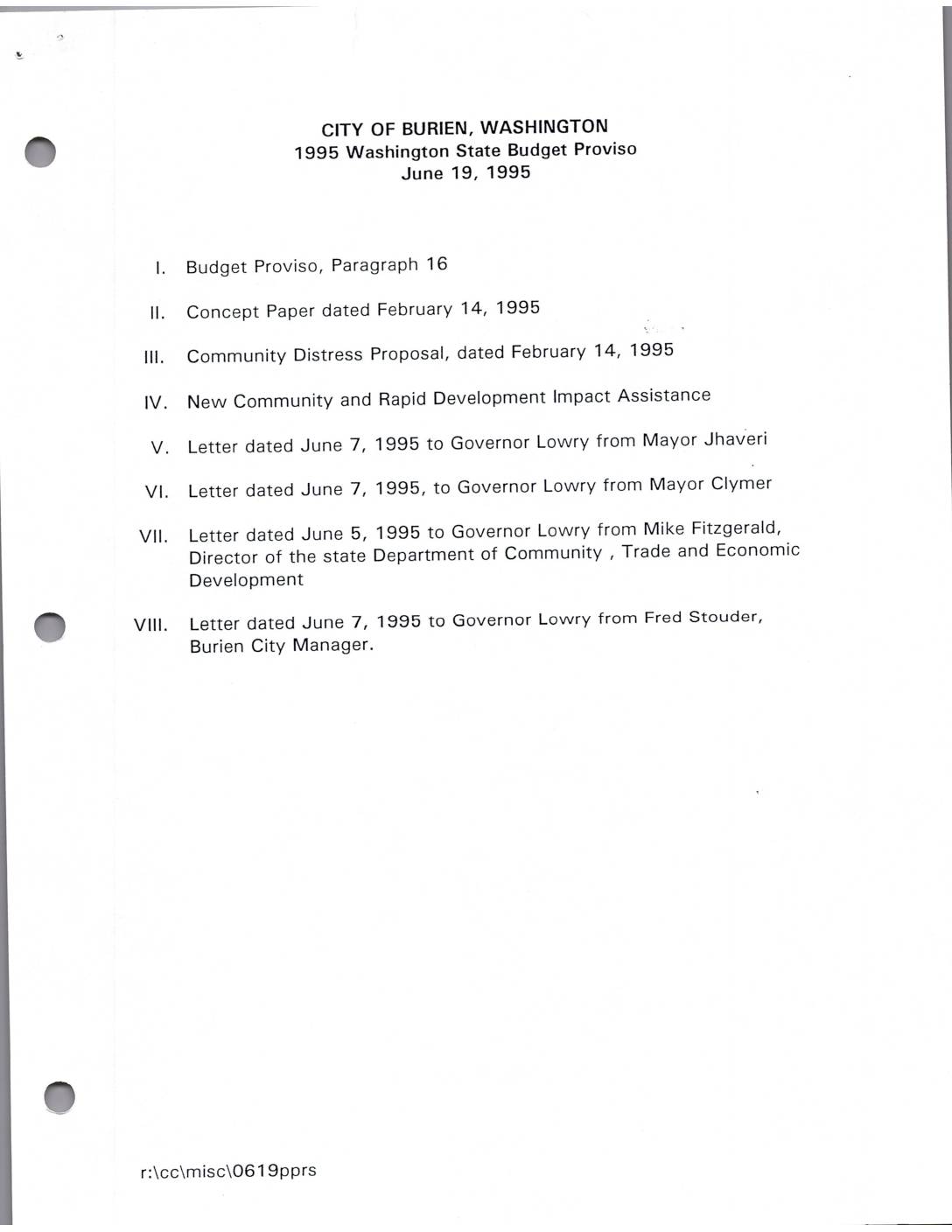 1995-06-19
City of Burien: 1995 Washington State Budget Proviso — Third Runway Impact Assistance
Background material on the 1997 HOK Study. This document packet from City of Burien, Washington dated June 19, 1995, concerns the 1995 Washington State Budget Proviso, Paragraph 16 which appropriated $500,000 of general fund-state funds solely for distribution to the City of Burien for analysis of the proposed Port of Seattle third runway at Sea-Tac