Skip to content
  • STNI
  • Statistics
    • Ops and Passengers
      • King County International Airport (Boeing Field) Annual Operations
    • Financials
    • Aviation fuel uplift in the State of Washington 2018 – 2025
      • Aviation Fuel Uplift at Sea-Tac Airport
    • Air Quality Monitoring
    • Flight Tracking
      • Flow and Flight Tracks
      • Five Year Comparison
      • Busiest Hours and Days
    • SEL Noise Reports & Graphs
      • About The Permanent Noise Monitors
      • Minutes of Quiet by Noise Monitor
      • Noise Events mapped
      • Noise Events (SEL)
    • Runways
    • Employees
    • Real Estate
      • Port Properties and Trees mapped
    • Parking
  • Events
  • Protest
    • Regular Events
    • Legislation 2026
    • Complain about a particular flight
    • Advocacy Organizations
    • Media Outlets
    • People
    • The Port of Seattle
      • Commission Meetings
      • Public Records Requests
      • StART
      • Highline Forum
    • Contact Your Electeds
  • Resources
    • FAQs
      • FAA Occurrences/Accidents/Indents
    • The unSustainable Airport Master Plan
      • SAMP Public Comment Template
        • Two versions of Appendix K: NEPA/SEPA 2018 vs 2023
      • SAMP NTP: 31 projects by the numbers
      • SEPA Draft EIS (2026)
      • SAMP Record of Decision/FONSI (2025)
      • SAMP Draft EA (October 2024)
      • 2018 Scoping
    • Port Packages
      • Port Package Property Costs
      • Port Packages mapped
      • The Port Package Explainer
      • So you want a (first-time) Port Package? Start here
      • Port Package Looker Upper
      • How do I determine if I have a Port Package or Avigation Easement?
      • Progress on Port Package Update legislation
      • Having a Port Package Problem?
      • Port Package Site Visit Follow-Up
    • Document Library
    • Explainers
      • The Airport Law Cheat Sheet
      • The Grant Explainer
    • External Articles
    • History
      • Timeline
      • The Sea-Tac Communities Plan
        • Sea-Tac Communities Plan – Planning Maps
      • PSRC Third Runway Decision Process
    • Studies
    • Videos
  • Stories
  • Mission
  • Subscribe
  • Contact
Scroll down to content

Get InformedStay Informedx

I understand that you will never share my information with anyone, you will only use it to keep me updated on relevant events and that I may unsubscribe at any time.

STNI

STNISea-Tac Noise.Info

  • Solve for Sea-Tac. Solve for every airport.
  • Since 2016, working to obtain justice for everyone living under the flight path.
  • Less Noise. Cleaner Air. Better Public Health. Compensation.
  • Everything you think you know about the airport is wrong.

TagNational Academies of Sciences(10)

Advanced Search Options

  • Dates
  • Media
    • External Articles
    • Images
    • PDFs
    • Video
    • Audio
  • Order By
  • 2025-01-07

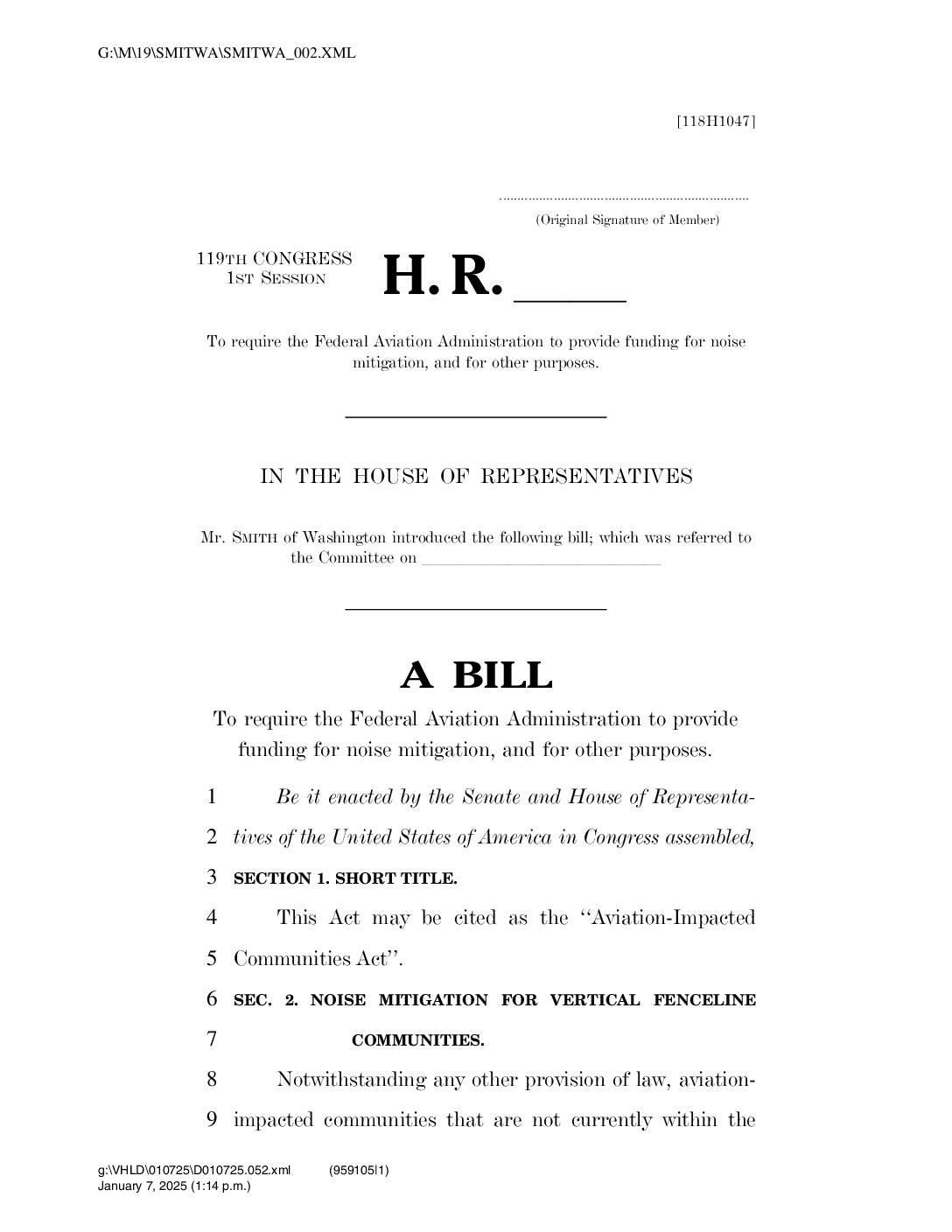
    Aviation-Impacted Communities Act: House Bill Text (119th Congress, 1st Session)

    The Aviation-Impacted Communities Act, introduced in the 119th Congress by Rep. Smith of Washington, would require the FAA to provide noise mitigation funding to communities affected by airport noise even if they fall outside the current 65 DNL sound threshold. The bill would make these communities eligible for Airport Improvement Program funds, allow them to establish local boards to address airport noise, and direct the National Academy of Sciences to study aviation impacts at major hub airports — including King County, WA (Sea-Tac) — across the country.
    TagsAdam Smith, Airport Improvement Program, FAA, Highline Forum, National Academies of Sciences, Noise Mitigation
  • Aviation impacted communities act 119th congress smith wa house bill 2025 01 07 pdf
    2025-01-07

    Aviation-Impacted Communities Act: House Bill Text (119th Congress, 1st Session)

    House bill text introduced by Rep. Adam Smith of Washington (119th Congress, 1st Session) titled the ‘Aviation-Impacted Communities Act.’ Requires the FAA to provide Airport Improvement Program (AIP) noise mitigation funding to aviation-impacted communities outside the 65 DNL contour (vertical fenceline communities). Mandates the FAA Administrator contract with the National Academy of Sciences to study
    TagsAdam Smith, Airport Improvement Program, FAA, Highline Forum, National Academies of Sciences, Noise Mitigation
  • 2024-05-11

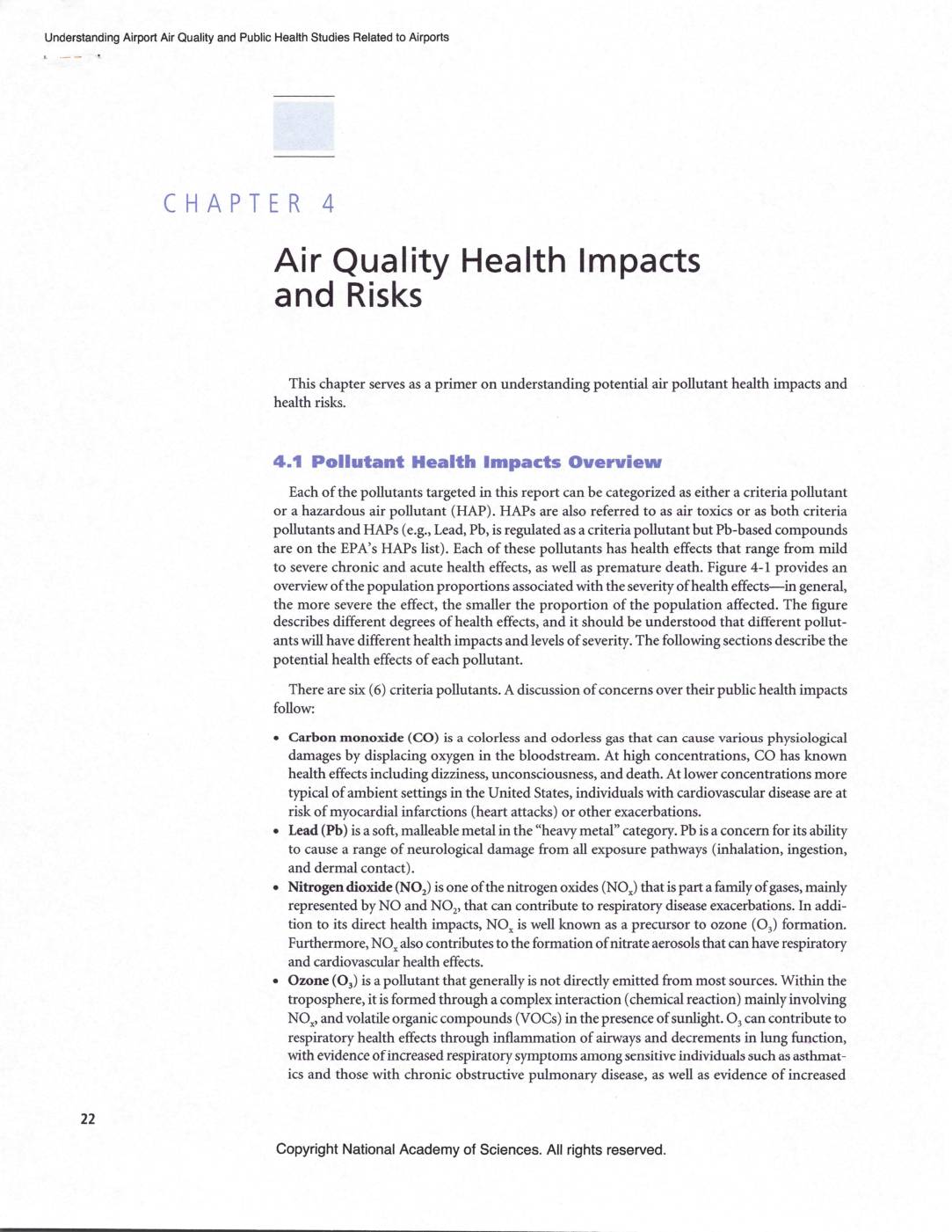
    Understanding airport air quality and public health studies related to airports: Chapter 4 – Air quality health impacts and risks

    This chapter explains the health risks associated with air pollutants commonly found near airports, including both criteria pollutants like carbon monoxide, lead, and particulate matter, and hazardous air pollutants like volatile organic compounds and polycyclic aromatic hydrocarbons. It describes how these pollutants can cause a range of health effects, from mild irritation to serious conditions such as respiratory disease, cardiovascular illness, and cancer. Smaller particulate matter is highlighted as a particular concern near airports, as it can penetrate deeper into the lungs and occurs at higher concentrations near aircraft operations.
    TagsAirport Cooperative Research Program, EPA, Health, National Academies of Sciences
  • 2009-01-01

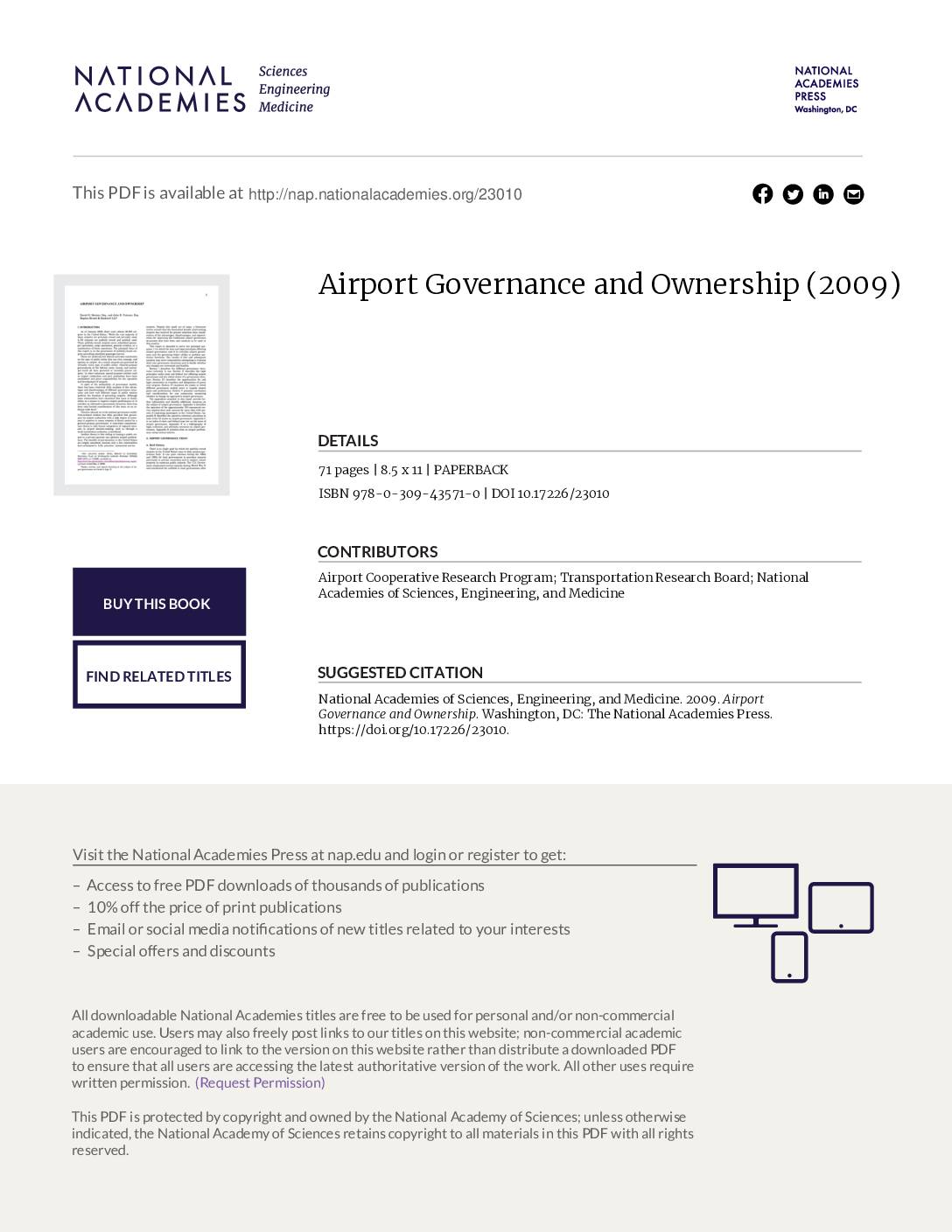
    Airport Governance and Ownership

    This 2009 report from the National Academies examines how publicly-owned airports in the United States are governed and owned, covering the range of entities—from city governments to special airport authorities—that oversee the country's approximately 4,150 public-use airports. It analyzes the legal principles and state and federal laws that shape airport governance structures, and evaluates the advantages and disadvantages of different models, including privatization. The findings are intended to help communities assess whether their current airport governance arrangements are working effectively or could benefit from change.
    TagsAirport Cooperative Research Program, Airport Law, Airports, National Academies of Sciences, Transportation Research Board
  • Airport governance and ownership 2009 national academies pdf
    2009-01-01

    Airport Governance and Ownership

    Report by Daniel S. Reimer and John E. Putnam of Kaplan Kirsch & Rockwell LLP, published by the Airport Cooperative Research Program, Transportation Research Board, and National Academies of Sciences, Engineering, and Medicine. Covers airport governance structures in the United States as of 2008, including general-purpose governments (city, county, state) and special-purpose entities (airport authorities,
    TagsAirport Cooperative Research Program, Airport Law, Airports, National Academies of Sciences, Transportation Research Board
  • 2008-01-01

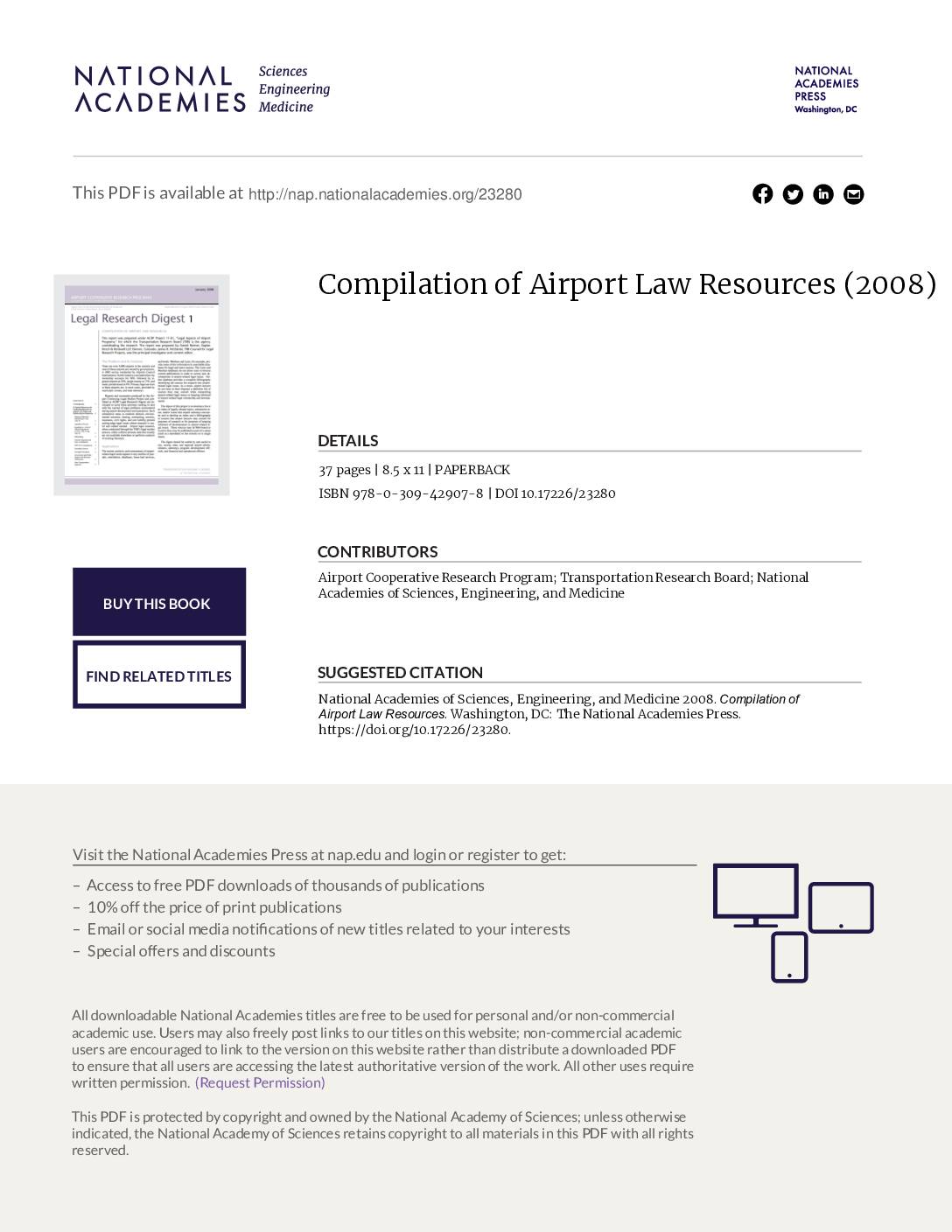
    Compilation of Airport Law Resources

    A comprehensive legal research digest that compiles and indexes airport law resources for attorneys and administrators. It provides a bibliography of federal resources, statutory materials, regulations, case law, and secondary sources related to airport legal issues including topics like eminent domain, environmental concerns, leasing, contracting, security, and liability.
    CategoriesResources TagsAirport Cooperative Research Program, Airport Improvement Program, Airport Law, Airport Law Digest, Federal Aviation Administration, National Academies of Sciences, NEPA, Transportation Research Board
  • 2002-10-22

    EXH AR034586: Compensating for Wetland Losses Under the Clean Water Act

    National Research Council publication by the Committee on Mitigating Wetland Losses, Board on Environmental Studies and Toxicology, and Water Science and Technology Board titled ‘Compensating for Wetland Losses Under the Clean Water Act.’ AR034586, Exhibit-2178. Covers mitigation compliance standards including jurisdictional hydrology, wetland delineation, hydrological performance standards, design standards for mitigation sites, USACE wetland filling
    TagsACC, Army Corp of Engineers, Clean Water Act, Environment, National Academies of Sciences, Pollution Control Hearings Board, Water Quality
  • 2002-03-29

    EXH AR054467: Compensating for Wetland Losses Under the Clean Water Act — National Academy Press Order Card

    National Academy Press promotional order card for the publication ‘Compensating for Wetland Losses Under the Clean Water Act’ (item code WETLOS, price $49.95), received by the Environmental Hearings Office on March 29, 2002. AR numbers 054467, 054468, 054469. Includes order form for North America customers with mailing address National Academy Press, 2101 Constitution Avenue NW,
    TagsACC, Clean Water Act, Environment, National Academies of Sciences, PCHB, Pollution Control Hearings Board
  • 2002-02-14

    EXH 334: Compensating Wetland Losses Clean Water Act — App. H, 40 Common Wetland Functional Assessment Procedures

    This document, Appendix H from a National Research Council publication titled 'Compensating for Wetland Losses Under the Clean Water Act,' presents a comparative table of 40 common wetland functional assessment procedures. The table summarizes key attributes of each method, including habitat type, scale, functions assessed, and whether social values or weighting factors were applied. It serves as a reference for evaluating and comparing tools used to measure wetland functions in the context of Clean Water Act mitigation and compensation requirements.
    TagsACC, Clean Water Act, National Academies of Sciences, PCHB, Pollution Control Hearings Board, Third Runway
  • 1995-01-01

    EXH AR034578: Wetlands: Characteristics and Boundaries (1995) — Chapter 6, Especially Controversial Wetlands

    National Research Council publication ‘Wetlands: Characteristics and Boundaries’ (1995), Committee on Characterization of Wetlands, Water Science and Technology Board, Board on Environmental Studies and Toxicology, Commission on Geosciences, Environment, and Resources. Exhibit AR034578. Chapter 6 covers especially controversial wetlands including permafrost wetlands, riparian ecosystems, isolated and headwater wetlands, shallow wetlands, agricultural wetlands, nonagricultural altered sites,
    TagsAcademic Journals, ACC, Environment, Land, National Academies of Sciences, Pollution Control Hearings Board
Sidebar On/Off

Upcoming Events

  • StART SEA Stakeholder Advisory Round Table
    Add to CalendarMWednesday Aug 26, 5:00pm - 7:00pm
    Zoom (Virtual Meeting)
    START meetingagenda 2026826 final 0 pdf

    Meeting Objectives Introduce the primary feedback themes identified by StART members regarding StART’s Operating Procedures and determine areas that may warrant future discussion. 5:00 PM – Welcome Meeting Management Welcome Lead: Andrés Mantilla, Facilitator, Uncommon Bridges; Wendy Reiter, Airport Managing Director, POS 5:15 PM – Dinner: All participants eat. 5:30 PM – StART Operating Procedures

    [...]
  • Commercial Aviation Work Group
    Add to CalendarMThursday Sep 3, 10:00am - 1:30pm
    Virtual Meeting (Zoom)
    Cawg agenda sep 3 26 virtual pdf

    Meeting Agenda 10:00 a.m. – 10:15 a.m. | Welcome – Evan Nordby, Chair a. Introductions and Agenda Reviewb. Status of appointments and non-voting member invitationsc. Other updates as necessary 10:15 a.m. – 11:00 a.m. | Is it practical and legal to operate the western Washington [Puget Sound] airports as a single airport system? – Consultant

    [...]

[See all...]


Help study childhood asthma. Get free HEPA filter!

read more...

Issues

Sea-Tac Airport is currently undergoing the largest and longest expansion in its history, collectively known as the Sustainable Airport Master Plan (SAMP). Some of it you can already hear, but you’re probably not aware of what it all means. Here’s what you need to know.
read more...

Read This!

As the source for federal transportation grants, the Puget Sound Regional Council was charged with developing a system to meet the growing need for commercial aviation. When the search for a second airport failed, they authorized the Port of Seattle to build the Third Runway, with a mandate to develop a noise abatement and mitigation program. In their effort to stop the Third Runway, the ACC argued over every detail of the Port's efforts--including property buyouts and sound insulation. The dispute was meant to be settled by a three member Expert Arbitration Panel. This is their final report. It finds 2-1, that the Port's program was insufficient in several respects. Despite that, funding for the Third Runway was approved by the PSRC, and the 'Port Package' program, proceeded largely unchanged. Expert Arbitration Panel's final decision finding that the Port of Seattle had not shown sufficient reduction in real on-the-ground noise impacts to satisfy noise reduction conditions required for approval of a third runway at Sea-Tac International Airport. The majority decision concluded the Port's noise abatement programs were insufficient despite being impressive in scope.
continue...

The Podcast!

Subscribe to the only podcast devoted to policies, politics, history, impacts for people living under the flight path everywhere. It’s definitely not just about noise!
  • Sea-Tac Noise.Info
  • Connect with STNI

    • Subscribe
    • Port Package Problem?
    • Donate
    • Podcast
    • Socials
      • Facebook
      • X (Twitter)
      • Bluesky
      • Instagram

    "Fresh 80 / 80-dB Fresh Air Ventilator Installation and Maintenance Manual" — , 2019

  • Learn

    • Frequently Asked Questions
    • Explainers
    • Youtube
    • Research Requests
    • Make a complaint
  • Goals

    Fulfill the promises of 1976:
    • Compensation
    • Reduced noise
    • Improved air quality
    • Environmental remediation
Login/Register
©2026•Data Privacy

Message

We use cookies to provide basic functionality. We also provide access to search engines in order to provide site analytics. We do not sell or share your data.
V V