Skip to content
  • STNI
  • Statistics
    • Ops and Passengers
      • King County International Airport (Boeing Field) Annual Operations
    • Financials
    • Aviation fuel uplift in the State of Washington 2018 – 2025
      • Aviation Fuel Tax Revenue in the State of Washington 1983-2025
      • Aviation Fuel Uplift at Sea-Tac Airport
    • Air Quality Monitoring
    • Flight Tracking
      • Flow and Flight Tracks
      • Five Year Comparison
      • Busiest Hours and Days
    • SEL Noise Reports & Graphs
      • About The Permanent Noise Monitors
      • Minutes of Quiet by Noise Monitor
      • Noise Events mapped
      • Noise Events (SEL)
    • Runways
    • Employees
    • Real Estate
      • Port Properties and Trees mapped
    • Parking
  • Events
  • Protest
    • Regular Events
    • Policy
      • Legislative Agenda 2027
      • Airport mitigation for the twenty first century
      • Port Dracula
    • Complain about a particular flight
    • Advocacy Organizations
    • Media Outlets
    • People
    • The Port of Seattle
      • Commission Meetings
      • Public Records Requests
      • StART
      • Highline Forum
    • Contact Your Electeds
  • Resources
    • FAQs
      • FAA Occurrences/Accidents/Indents
    • The SAMP
      • SAMP Public Comment Template
        • Two versions of Appendix K: NEPA/SEPA 2018 vs 2023
      • SAMP NTP: 31 projects by the numbers
      • SEPA Draft EIS (2026)
      • SAMP Record of Decision/FONSI (2025)
      • SAMP Draft EA (October 2024)
      • 2018 Scoping
    • Port Packages
      • Port Package Property Costs
      • Port Packages mapped
      • The Port Package Explainer
      • So you want a (first-time) Port Package? Start here
      • Port Package Looker Upper
      • How do I determine if I have a Port Package or Avigation Easement?
      • Progress on Port Package Update legislation
      • Having a Port Package Problem?
      • Port Package Site Visit Follow-Up
    • Document Library
    • Explainers
      • The Airport Law Cheat Sheet
      • The Grant Explainer
    • External Articles
    • History
      • Timeline
      • The Sea-Tac Communities Plan
        • Sea-Tac Communities Plan – Planning Maps
      • PSRC Third Runway Decision Process
    • Studies
    • Videos
  • Stories
  • Mission
  • Subscribe
  • Contact
Scroll down to content

Get InformedStay Informedx

I understand that you will never share my information with anyone, you will only use it to keep me updated on relevant events and that I may unsubscribe at any time.

STNI

STNISea-Tac Noise.Info

  • Solve for Sea-Tac. Solve for every airport.
  • Since 2016, working to obtain justice for everyone living under the flight path.
  • Less Noise. Cleaner Air. Better Public Health. Compensation.
  • Everything you think you know about the airport is wrong.

TagLandrum & Brown(52)

Advanced Search Options

  • Dates
  • Media
    • External Articles
    • Images
    • PDFs
    • Video
    • Audio
  • Order By
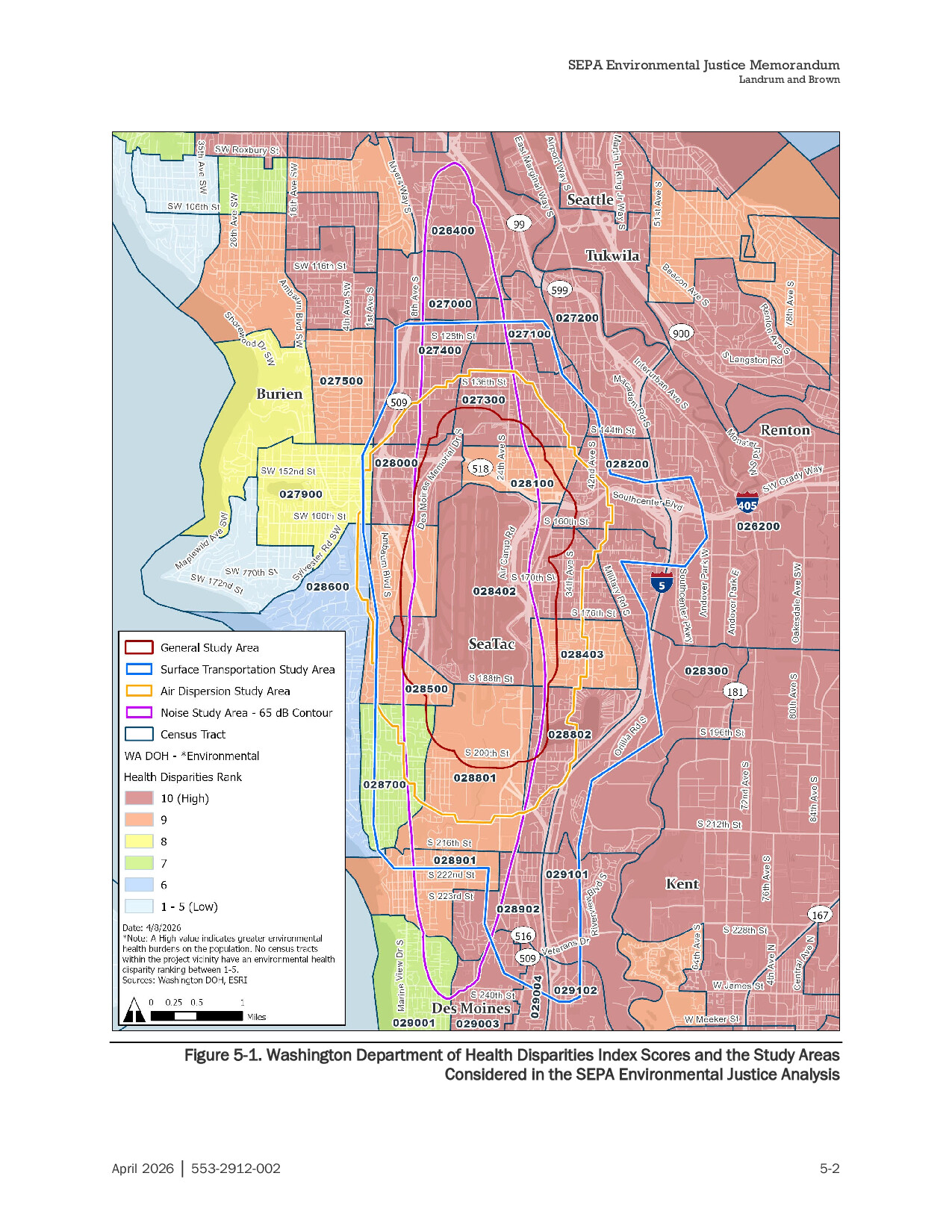
  • Appendix k children8217s environmental health and safety risks socioeconomics and environmental justice NEPA final ea and SEPA page 124

    Appendix K SEPA Environmental Justice Disparities Map page 124

    Figure 5-1 from a SEPA Environmental Justice Memorandum prepared by Landrum and Brown (document no. 553-2912-002, dated April 2026) maps Washington Department of Health Environmental Health Disparities Index scores across census tracts in the Sea-Tac Airport vicinity, including Seattle, Tukwila, Burien, SeaTac, Renton, Kent, and Des Moines. The map delineates four overlapping study areas—General Study Area, Surface Transportation Study Area, Air Dispersion Study Area, and Noise Study Area (65 dB contour)—over a background showing health disparity rankings ranging from 1–5 (Low) to 10 (High), with most tracts in the project vicinity ranked 9–10.
    TagsEnvironmental Justice, Landrum & Brown, Map, NEPA, SAMP, SEPA, Sustainable Airport Master Plan, Washington State Department Of HealthFolderAppendices
  • 2026-05-01

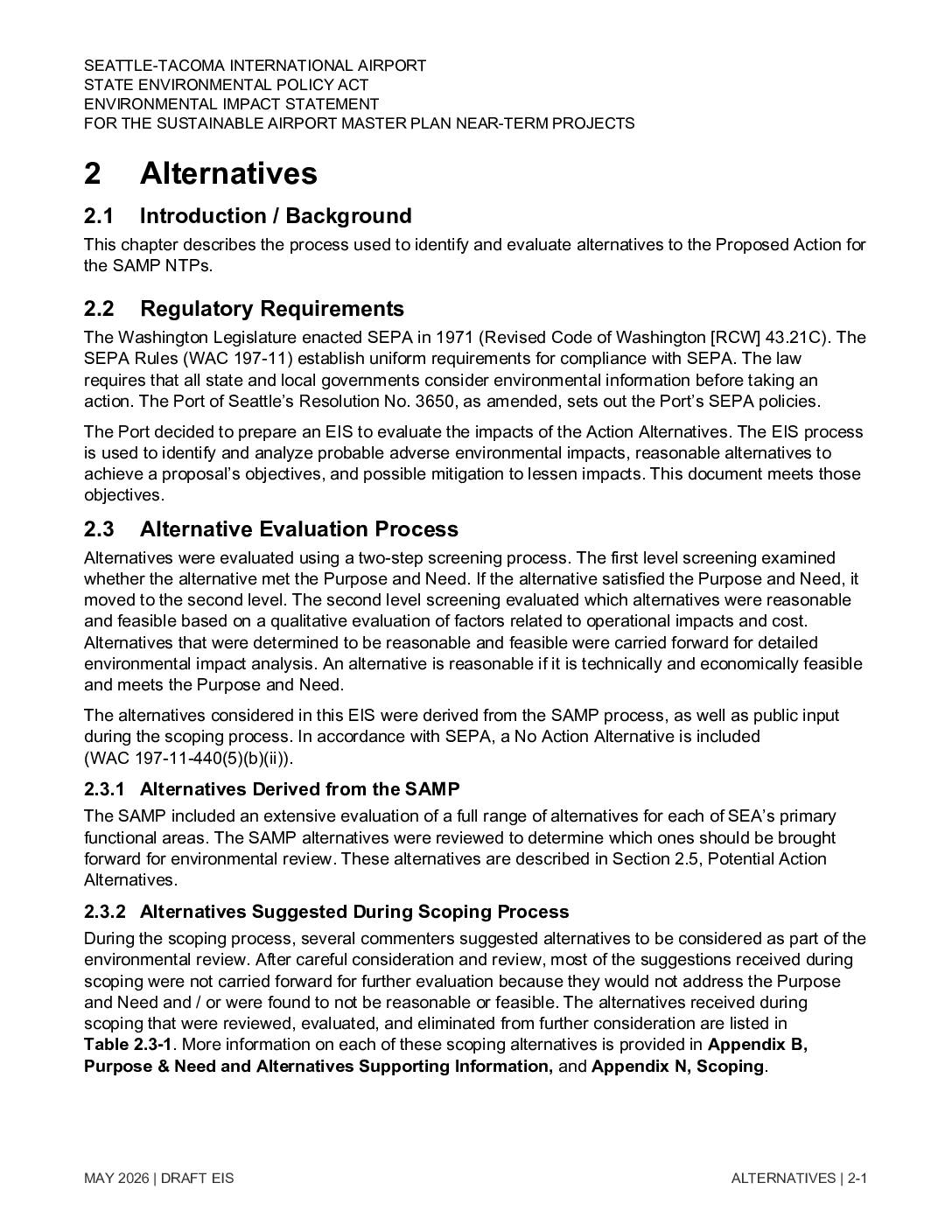
    Seattle-Tacoma International Airport SEPA Environmental Impact Statement for the Sustainable Airport Master Plan Near-Term Projects: Chapter 2 — Alternatives

    This draft Environmental Impact Statement (EIS) evaluates proposed expansion projects at Seattle-Tacoma International Airport under Washington State's Environmental Policy Act (SEPA). It outlines a two-step screening process used to assess alternatives, including suggestions from public scoping such as building a new airport, using other transportation modes, and limiting growth — most of which were rejected for failing to meet the project's purpose of serving 56 million annual passengers at an optimal level of service. A No Action Alternative is also included, representing a future baseline without the proposed physical improvements.
    TagsEnvironmental Impact Statement, Landrum & Brown, Port Of Seattle, SAMP, SEPAFolderDraft EIS
  • 2025-09-24

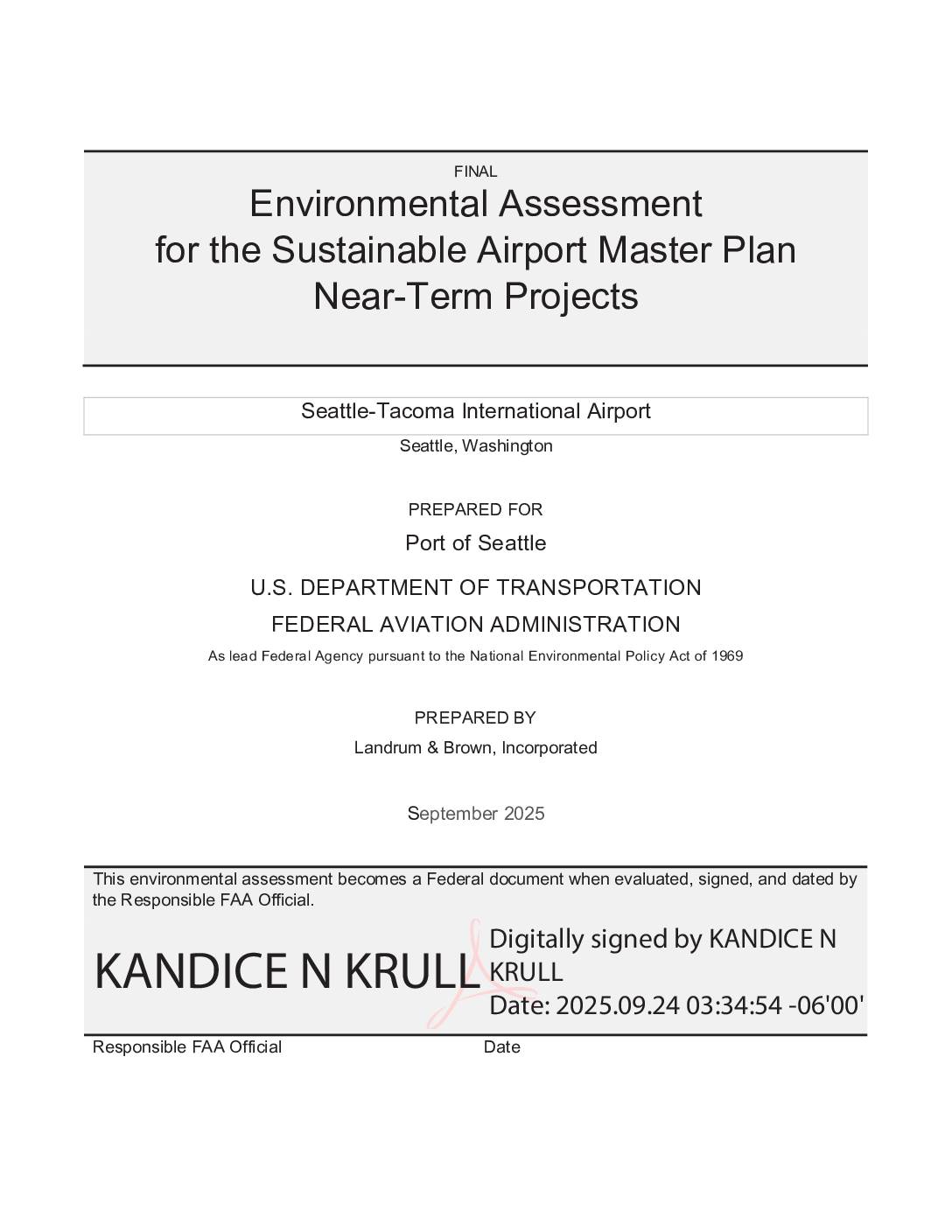
    Final Environmental Assessment for the Sustainable Airport Master Plan Near-Term Projects: Seattle-Tacoma International Airport

    ★ 33
    The Federal Aviation Administration (FAA) released a Final Environmental Assessment (EA) in September 2025 for near-term construction and development projects at Seattle-Tacoma International Airport, prepared on behalf of the Port of Seattle. The Final EA was updated from an earlier Draft EA to reflect public and agency comments, correct errors, and remove sections on climate change, environmental justice, and cumulative impacts following changes to federal executive orders, regulations, and a 2025 Supreme Court ruling. These regulatory shifts meant the FAA was no longer required to analyze how the proposed projects might affect vulnerable communities or contribute to broader environmental trends.
    CategoriesKey Documents Tagsenvironmental assessment, FAA, Landrum & Brown, NEPA, Port Of Seattle, SAMPFolder2025 NEPA ROD
  • 2025-09-01

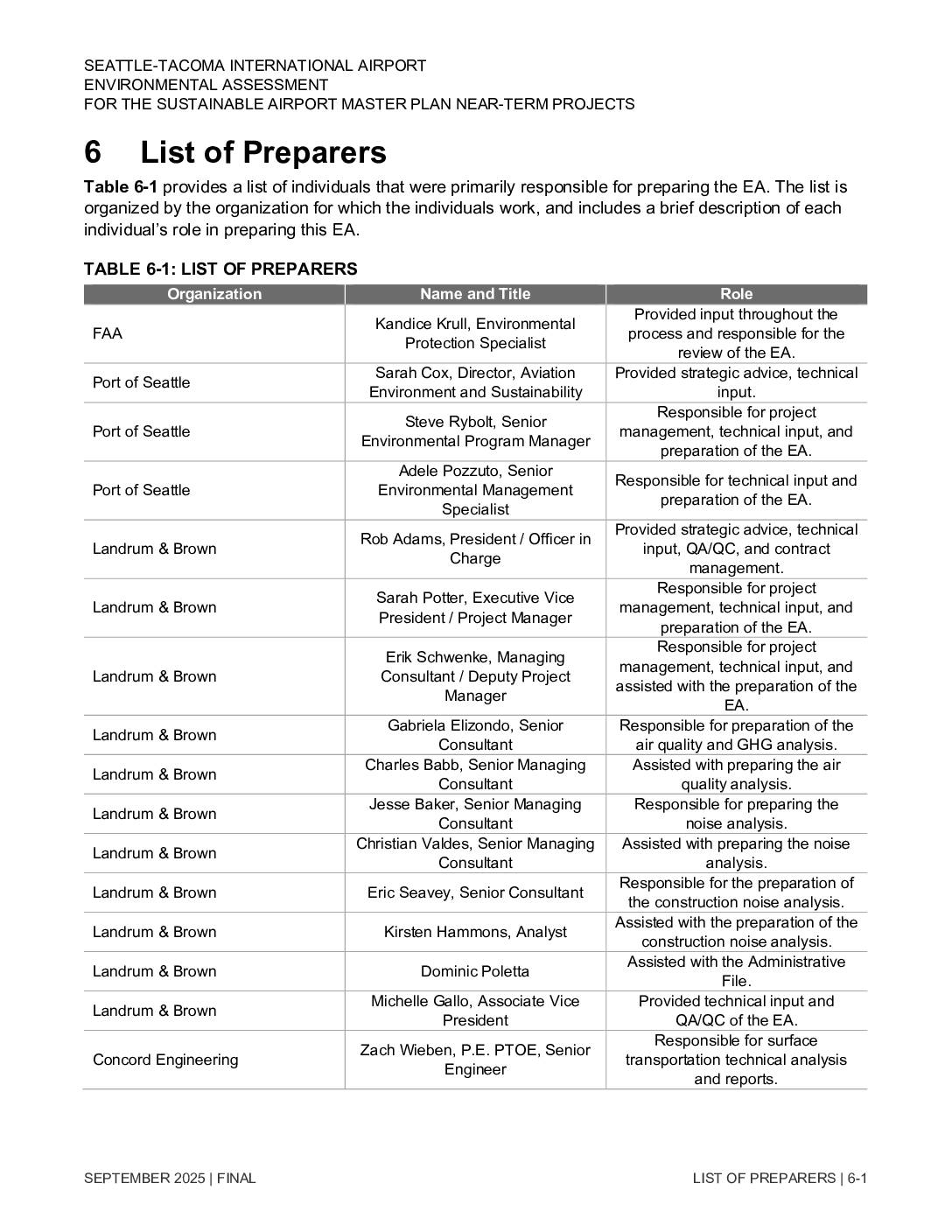
    Seattle-Tacoma International Airport Environmental Assessment for the Sustainable Airport Master Plan Near-Term Projects: List of Preparers

    This section of the Seattle-Tacoma International Airport Environmental Assessment lists the individuals and organizations responsible for preparing the EA for the Sustainable Airport Master Plan Near-Term Projects, finalized in September 2025. It includes contributors from the FAA, Port of Seattle, and multiple consulting firms covering areas such as noise analysis, air quality, surface transportation, wetlands, cultural resources, and public engagement. Key organizations involved include Landrum & Brown, Concord Engineering, Confluence Environmental Company, Parametrix, Stell Environmental, and others.
    TagsEnvironmental Impact Statement, FAA, Landrum & Brown, NEPA, Port Of Seattle, SAMPFolder2025 NEPA ROD
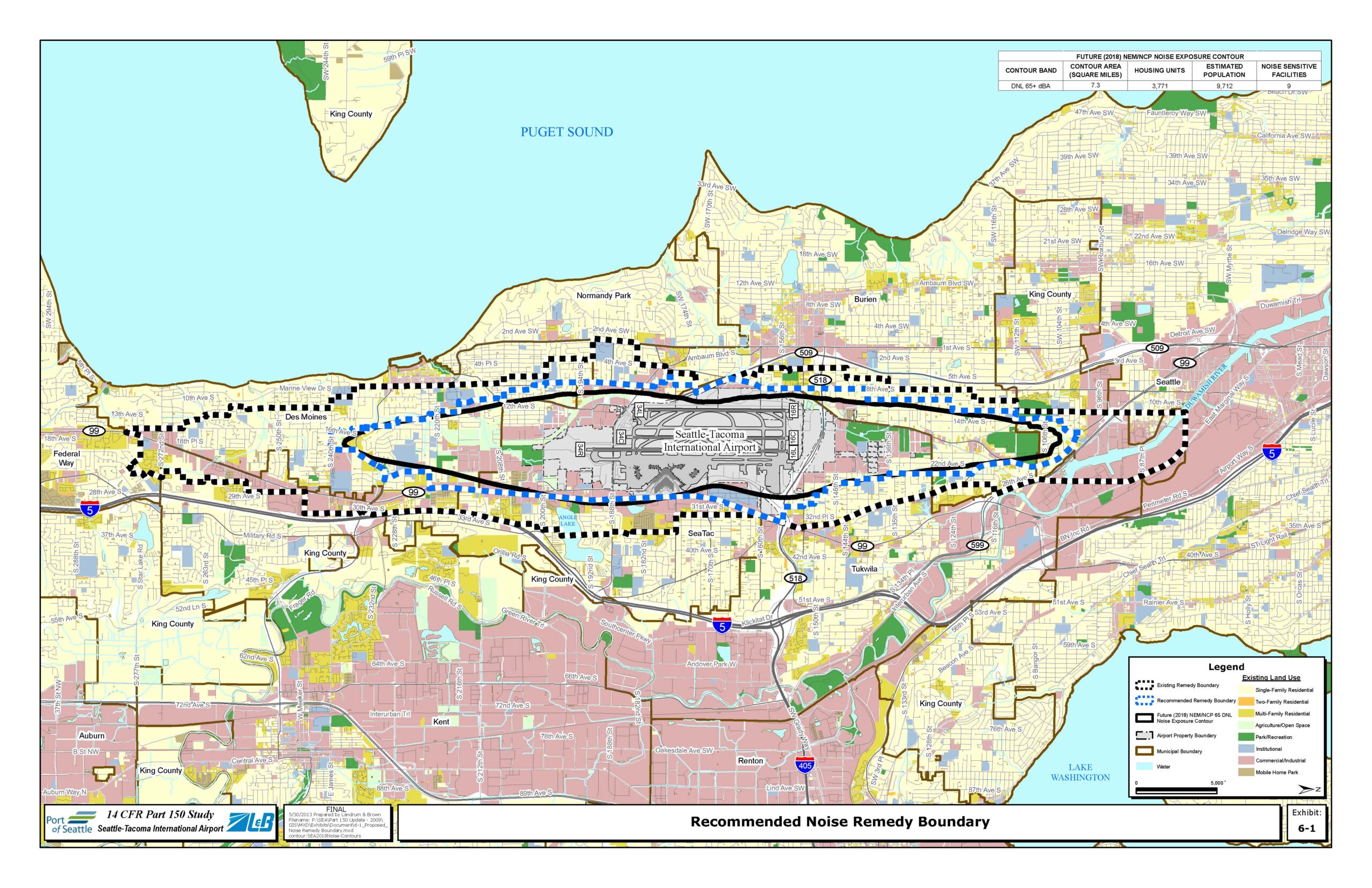
  • Recommended Noise Remedy Boundary Map — Sea-Tac Airport Part 150 Study

    This map, prepared by Landrum & Brown for the Port of Seattle's 14 CFR Part 150 Study at Seattle-Tacoma International Airport, shows the Recommended Noise Remedy Boundary (blue dashed line) alongside the Existing Remedy Boundary (black dashed line) and the Future (2018) NEM/NCP 65 DNL Noise Exposure Contour. The future noise contour covers 7.3 square miles, encompassing an estimated 3,771 housing units, 9,712 residents, and 9 noise-sensitive facilities in communities including Des Moines, Burien, SeaTac, Normandy Park, and Tukwila.
    TagsLandrum & Brown, Map, Noise Boundary, Part 150, Sea-Tac AirportFolderPart 150
  • Sarah Potter

    TagsLandrum & BrownFolderLandrum & Brown
  • Landrum & Brown (L&B) Aviation Consulting Logo

    The image shows the logo of L&B (Landrum & Brown), an aviation consulting firm that has historically been involved in airport noise studies and planning, including work related to Sea-Tac Airport. The logo features a stylized geometric design in blue alongside the 'L&B' text.
    TagsLandrum & Brown, LogoFolderLandrum & Brown
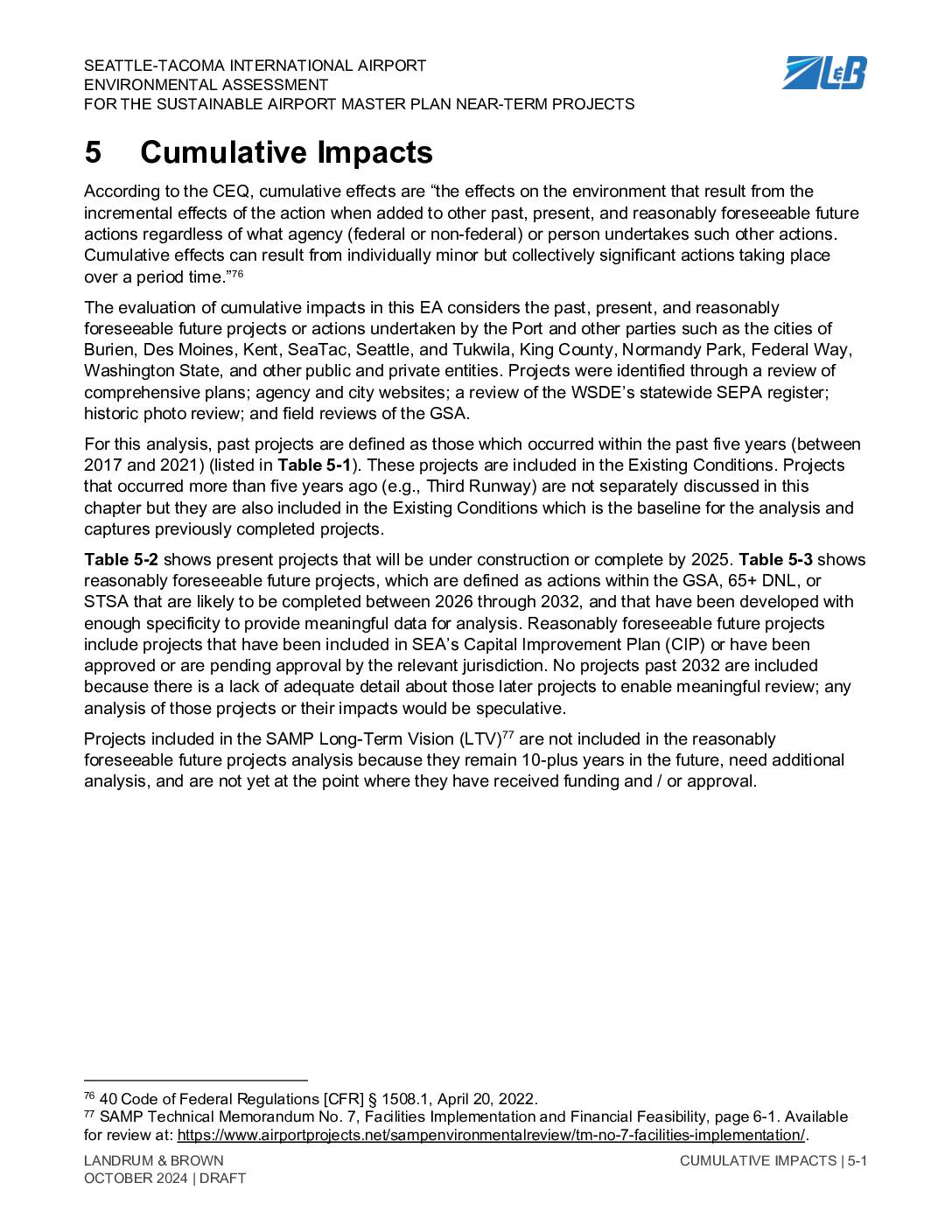
  • 2024-10-01

    Seattle-Tacoma International Airport Environmental Assessment for the SAMP Near-Term Projects: Chapter 5 — Cumulative Impacts

    This section of the Seattle-Tacoma International Airport Environmental Assessment examines cumulative impacts from past, present, and reasonably foreseeable future development projects at and around SEA airport, covering the period from 2017 through 2032. It reviews actions by the Port of Seattle and surrounding cities and agencies — including hotel construction, terminal expansions, and flight procedure changes — to assess how their combined environmental effects, such as noise, emissions, and land use changes, may affect nearby communities. Projects beyond 2032 or those in the long-term vision phase are excluded from detailed analysis due to insufficient specificity.
    TagsCEQ, environmental assessment, Landrum & Brown, NEPA, SAMP, Sustainable Airport Master PlanFolder2024 Draft EA
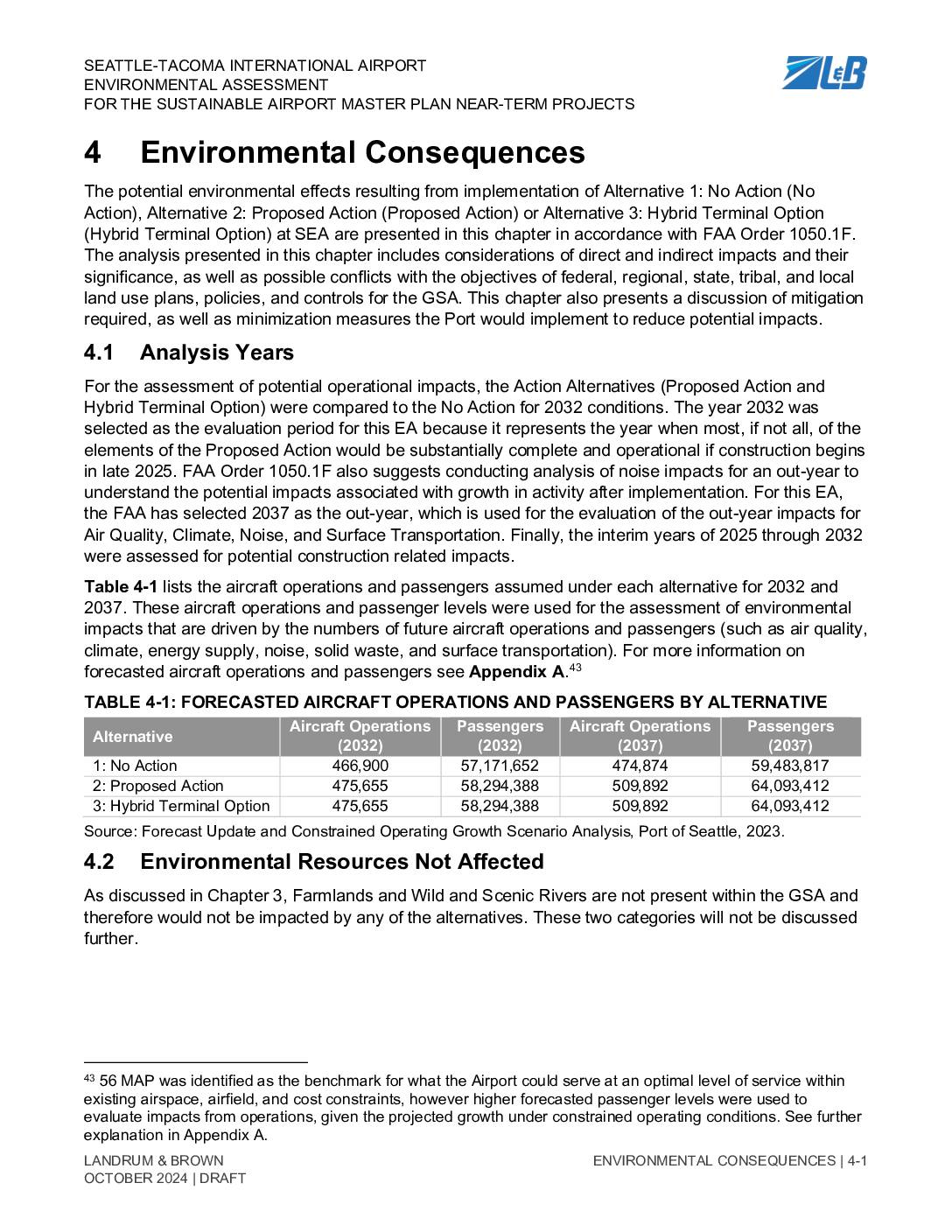
  • 2024-10-01

    Seattle-Tacoma International Airport Environmental Assessment for the SAMP Near-Term Projects: Chapter 4 — Environmental Consequences

    This October 2024 draft Environmental Assessment evaluates the potential environmental impacts of near-term construction and operational projects at Seattle-Tacoma International Airport under three alternatives: No Action, a Proposed Action, and a Hybrid Terminal Option. The analysis covers impacts through 2032 and an out-year of 2037, finding that increases in air quality emissions and effects on biological resources are not considered significant, with mitigation measures proposed for stormwater management and migratory bird nesting. Farmlands and Wild and Scenic Rivers were determined to have no presence in the study area and required no further analysis.
    Tagsenvironmental assessment, Landrum & Brown, NEPA, SAMP, SAMP Draft EA, Sea-Tac Airport, Sustainable Airport Master PlanFolder2024 Draft EA
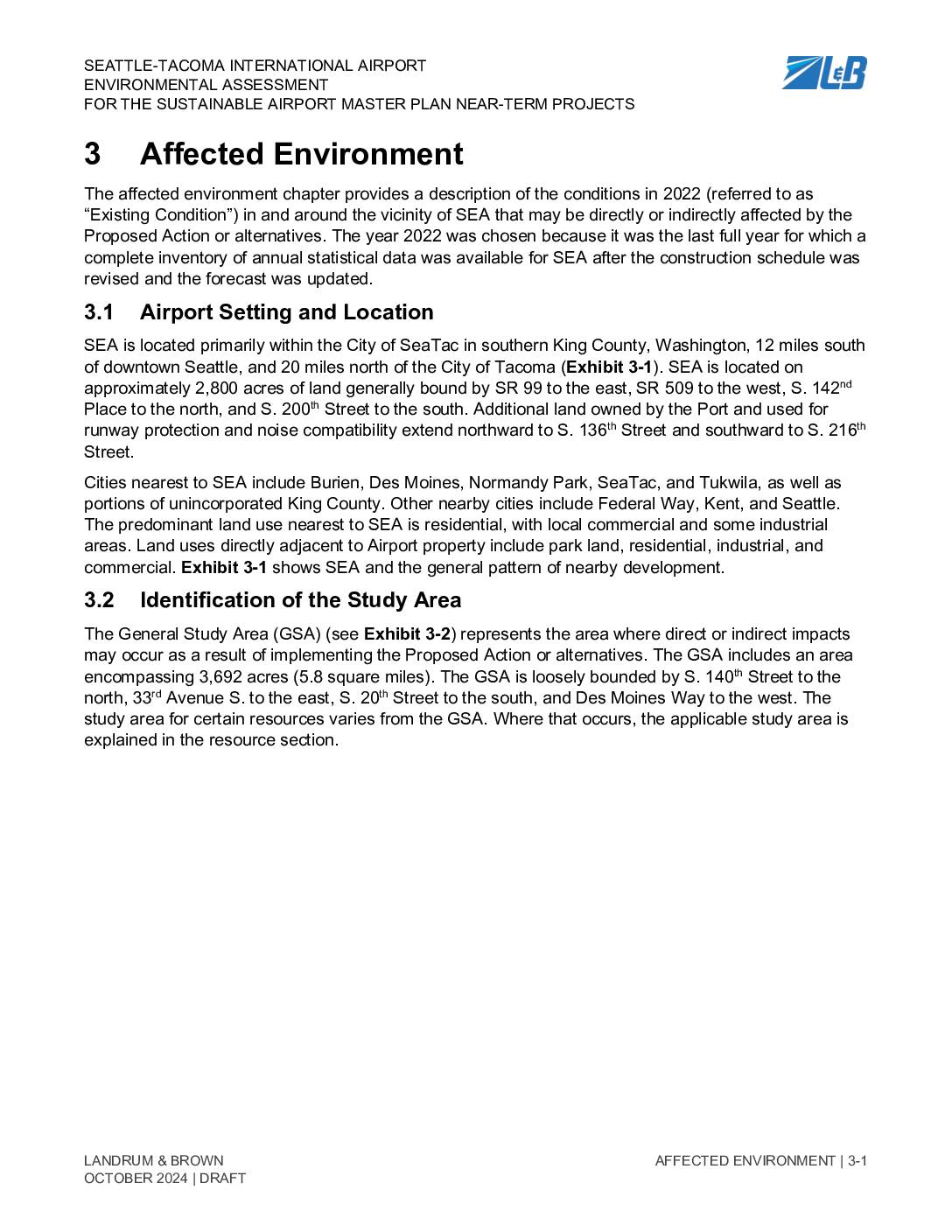
  • 2024-10-01

    Chapter 3: Affected Environment — Seattle-Tacoma International Airport Environmental Assessment for the Sustainable Airport Master Plan Near-Term Projects

    This draft Environmental Assessment from October 2024 examines the existing conditions around Seattle-Tacoma International Airport (SEA) as part of the Sustainable Airport Master Plan Near-Term Projects. Using 2022 as the baseline year, it describes SEA's location on approximately 2,800 acres in the City of SeaTac, situated 12 miles south of downtown Seattle and surrounded primarily by residential neighborhoods. The study covers a General Study Area of 3,692 acres to identify where proposed airport development actions could have direct or indirect environmental impacts on nearby communities.
    Tagsenvironmental assessment, Landrum & Brown, NEPA, SAMP, Sea-Tac Airport, Sustainable Airport Master PlanFolder2024 Draft EA

Posts pagination

Page 1 Page 2 Page 3 … Page 6
Sidebar On/Off

Upcoming Events

  • Part 150 NCP Workshop — Burien
    Add to CalendarMSaturday Oct 17: 10:00am

    Attend a Port of Seattle open house on the Part 150 Study Noise Compatibility Program (NCP). The Part 150 program determines the noise boundary around the airport and opportunities for noise mitigation such as sound insulation.

    [...]
  • Part 150 NCP Workshop — SeaTac
    Add to CalendarMMonday Oct 19: 6:00pm

    Attend a Port of Seattle open house on the Part 150 Study Noise Compatibility Program (NCP). The Part 150 program determines the noise boundary around the airport and opportunities for noise mitigation such as sound insulation.

    [...]
  • Part 150 NCP Workshop — Des Moines
    Add to CalendarMTuesday Oct 20: 6:00pm

    Attend a Port of Seattle open house on the Part 150 Study Noise Compatibility Program (NCP). The Part 150 program determines the noise boundary around the airport and opportunities for noise mitigation such as sound insulation.

    [...]

[See all...]


Issues

Sea-Tac Airport is currently undergoing the largest and longest expansion in its history, collectively known as the Sustainable Airport Master Plan (SAMP). Some of it you can already hear, but you’re probably not aware of what it all means. Here’s what you need to know.
read more...

Read This!

As the source for federal transportation grants, the Puget Sound Regional Council was charged with developing a system to meet the growing need for commercial aviation. When the search for a second airport failed, they authorized the Port of Seattle to build the Third Runway, with a mandate to develop a noise abatement and mitigation program. In their effort to stop the Third Runway, the ACC argued over every detail of the Port's efforts--including property buyouts and sound insulation. The dispute was meant to be settled by a three member Expert Arbitration Panel. This is their final report. It finds 2-1, that the Port's program was insufficient in several respects. Despite that, funding for the Third Runway was approved by the PSRC, and the 'Port Package' program, proceeded largely unchanged. Expert Arbitration Panel's final decision finding that the Port of Seattle had not shown sufficient reduction in real on-the-ground noise impacts to satisfy noise reduction conditions required for approval of a third runway at Sea-Tac International Airport. The majority decision concluded the Port's noise abatement programs were insufficient despite being impressive in scope.
continue...

  • Sea-Tac Noise.Info
  • Connect with STNI

    • Subscribe
    • Port Package Problem?
    • Donate
    • Podcast
    • Socials
      • Facebook
      • X (Twitter)
      • Bluesky
      • Instagram
  • Learn

    • Frequently Asked Questions
    • Explainers
    • Youtube
    • Research Requests
    • Complain about one flight
  • Goals

    Fulfill the promises of 1976:
    • Compensation
    • Reduced noise
    • Improved air quality
    • Environmental remediation
Login/Register
©2026•Data Privacy

Message

We use cookies to provide basic functionality. We also provide access to search engines in order to provide site analytics. We do not sell or share your data.
V V