Skip to content
  • STNI
  • Statistics
    • Ops and Passengers
      • King County International Airport (Boeing Field) Annual Operations
    • Financials
    • Aviation fuel uplift in the State of Washington 2018 – 2025
      • Aviation Fuel Tax Revenue in the State of Washington 1983-2025
      • Aviation Fuel Uplift at Sea-Tac Airport
    • Air Quality Monitoring
    • Flight Tracking
      • Flow and Flight Tracks
      • Five Year Comparison
      • Busiest Hours and Days
    • SEL Noise Reports & Graphs
      • About The Permanent Noise Monitors
      • Minutes of Quiet by Noise Monitor
      • Noise Events mapped
      • Noise Events (SEL)
    • Runways
    • Employees
    • Real Estate
      • Port Properties and Trees mapped
    • Parking
  • Events
  • Protest
    • Regular Events
    • Policy
      • Legislative Agenda 2027
      • Airport mitigation for the twenty first century
      • Port Dracula
    • Complain about a particular flight
    • Advocacy Organizations
    • Media Outlets
    • People
    • The Port of Seattle
      • Commission Meetings
      • Public Records Requests
      • StART
      • Highline Forum
    • Contact Your Electeds
  • Resources
    • FAQs
      • FAA Occurrences/Accidents/Indents
    • The SAMP
      • SAMP Public Comment Template
        • Two versions of Appendix K: NEPA/SEPA 2018 vs 2023
      • SAMP NTP: 31 projects by the numbers
      • SEPA Draft EIS (2026)
      • SAMP Record of Decision/FONSI (2025)
      • SAMP Draft EA (October 2024)
      • 2018 Scoping
    • Port Packages
      • Port Package Property Costs
      • Port Packages mapped
      • The Port Package Explainer
      • So you want a (first-time) Port Package? Start here
      • Port Package Looker Upper
      • How do I determine if I have a Port Package or Avigation Easement?
      • Progress on Port Package Update legislation
      • Having a Port Package Problem?
      • Port Package Site Visit Follow-Up
    • Document Library
    • Explainers
      • The Airport Law Cheat Sheet
      • The Grant Explainer
    • External Articles
    • History
      • Timeline
      • The Sea-Tac Communities Plan
        • Sea-Tac Communities Plan – Planning Maps
      • PSRC Third Runway Decision Process
    • Studies
    • Videos
  • Stories
  • Mission
  • Subscribe
  • Contact
Scroll down to content

Get InformedStay Informedx

I understand that you will never share my information with anyone, you will only use it to keep me updated on relevant events and that I may unsubscribe at any time.

STNI

STNISea-Tac Noise.Info

  • Solve for Sea-Tac. Solve for every airport.
  • Since 2016, working to obtain justice for everyone living under the flight path.
  • Less Noise. Cleaner Air. Better Public Health. Compensation.
  • Everything you think you know about the airport is wrong.

TagAirport Law(19)

Advanced Search Options

  • Dates
  • Media
    • External Articles
    • Images
    • PDFs
    • Video
    • Audio
  • Order By
  • 2026-01-08

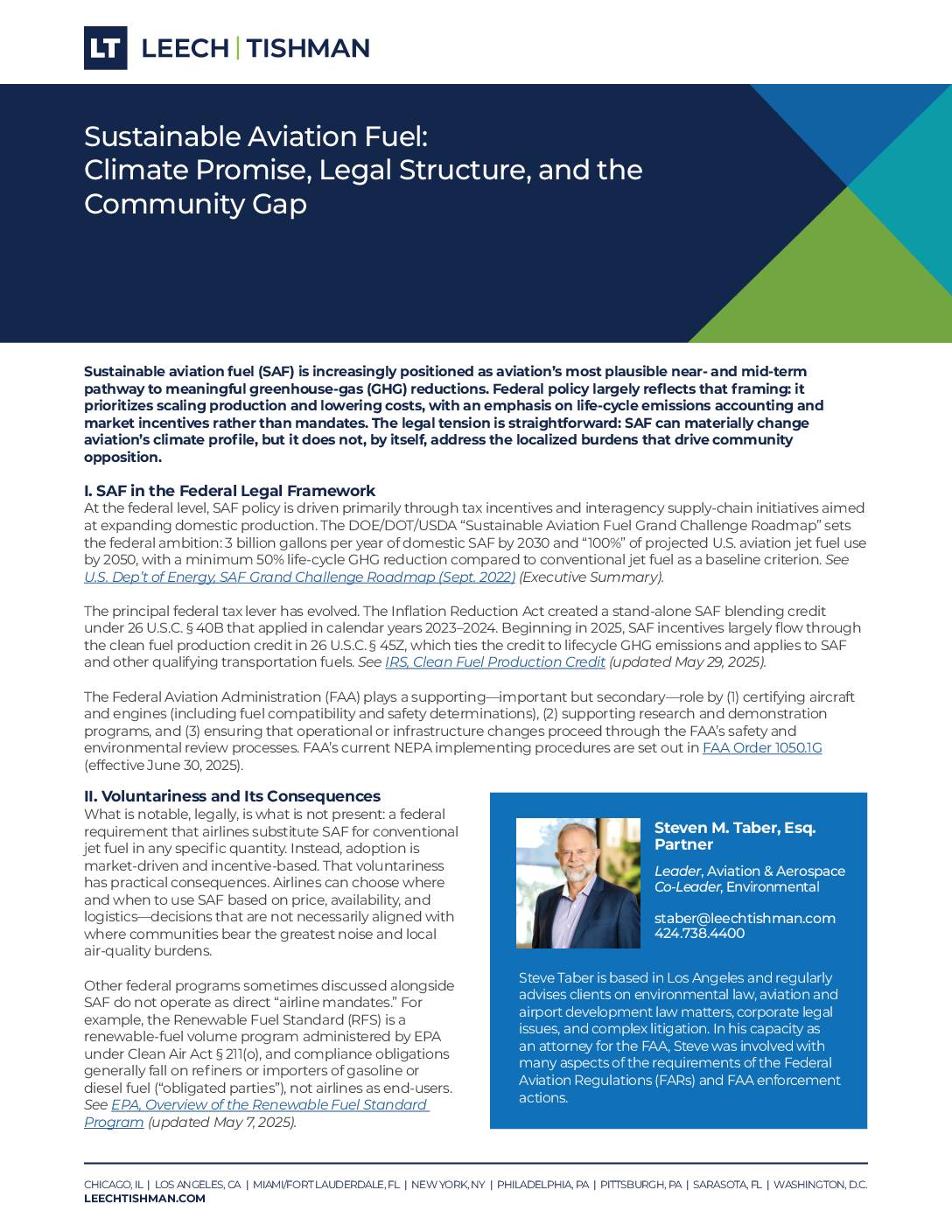
    Sustainable Aviation Fuel: Climate Promise, Legal Structure, and the Community Gap

    Legal analysis from Steve Taber @ Leech Tishman examining how Sustainable Aviation Fuel (SAF) addresses climate goals through federal tax incentives and production targets, while highlighting the gap between SAF’s global climate benefits and local community impacts like noise and air quality that remain unaddressed.
    TagsAirport Law, Aviation Fuel, greenwashing, Leech Tishman, NEPA, SAFFolderGreenwashing
  • 2026-01-06

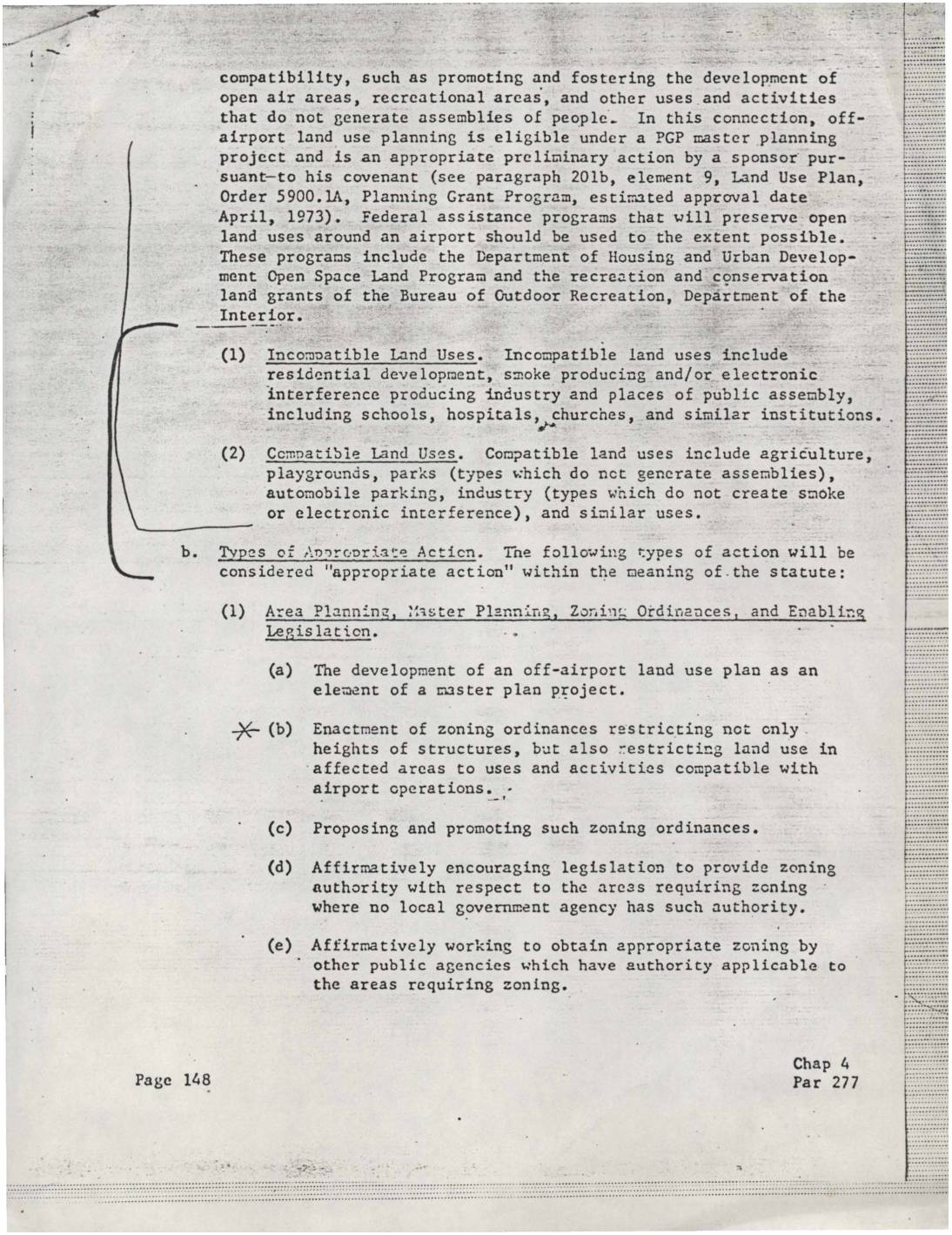
    Airport land use compatibility: Incompatible and compatible land uses and types of appropriate action

    This document outlines federal guidelines for managing land use around airports to minimize noise and safety conflicts. It distinguishes between incompatible land uses near airports—such as residential development, schools, hospitals, and churches—and compatible ones like agriculture, parks, and parking facilities. It also describes appropriate actions airport sponsors can take, including developing off-airport land use plans, enacting zoning ordinances, and working with local and regional authorities to restrict development in affected areas.
    TagsAirport Law, Airport Layout Plans, FAAFolderFAA
  • 2026-01-06

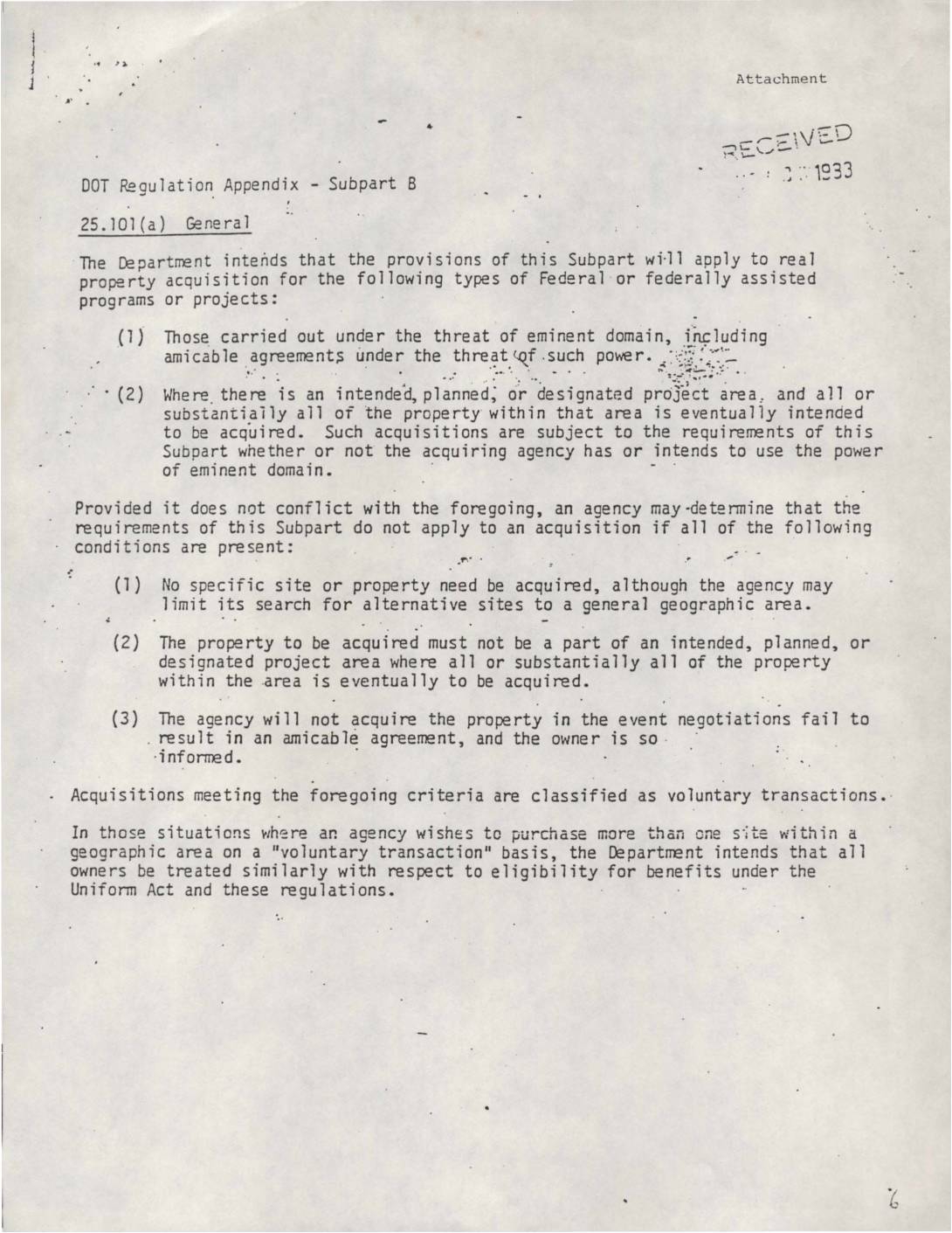
    DOT Regulation Appendix – Subpart B, Section 25.101(a): General Provisions on Real Property Acquisition

    This DOT regulation (Subpart B, Section 25.101a) outlines when federal property acquisition rules apply, covering situations involving eminent domain threats and large-scale planned project areas. It also defines the conditions under which an acquisition can be classified as a 'voluntary transaction,' exempt from those requirements — including that the agency must inform the owner it will not forcibly acquire the property if negotiations fail. When multiple properties are purchased voluntarily within the same area, all owners must be treated equally regarding eligibility for benefits under the Uniform Act.
    TagsAirport Law, Department Of Transportation, DOT, Property Rights, Regulations, Relocation Assistance ProgramFolderDOT
  • Cd9464C39116769B1F1C213A3A63Bc935C5B889E

    D.C. Circuit Court of Appeals Cracks Down on FAA Compliance with NEPA

    A legal article categorized under 'Aviation & Airport' reports that the D.C. Circuit Court of Appeals cracked down on FAA compliance with NEPA (National Environmental Policy Act). The publication appears to be from a legal news outlet with a red 'IL' or 'JL' logo.
    CategoriesLitigation, News Stories TagsAirport Expansion, Airport Law, Airport Noise Law, ANCA, Aviation Committees, Aviation EmissionsFolderFAA
  • 2025-10-21

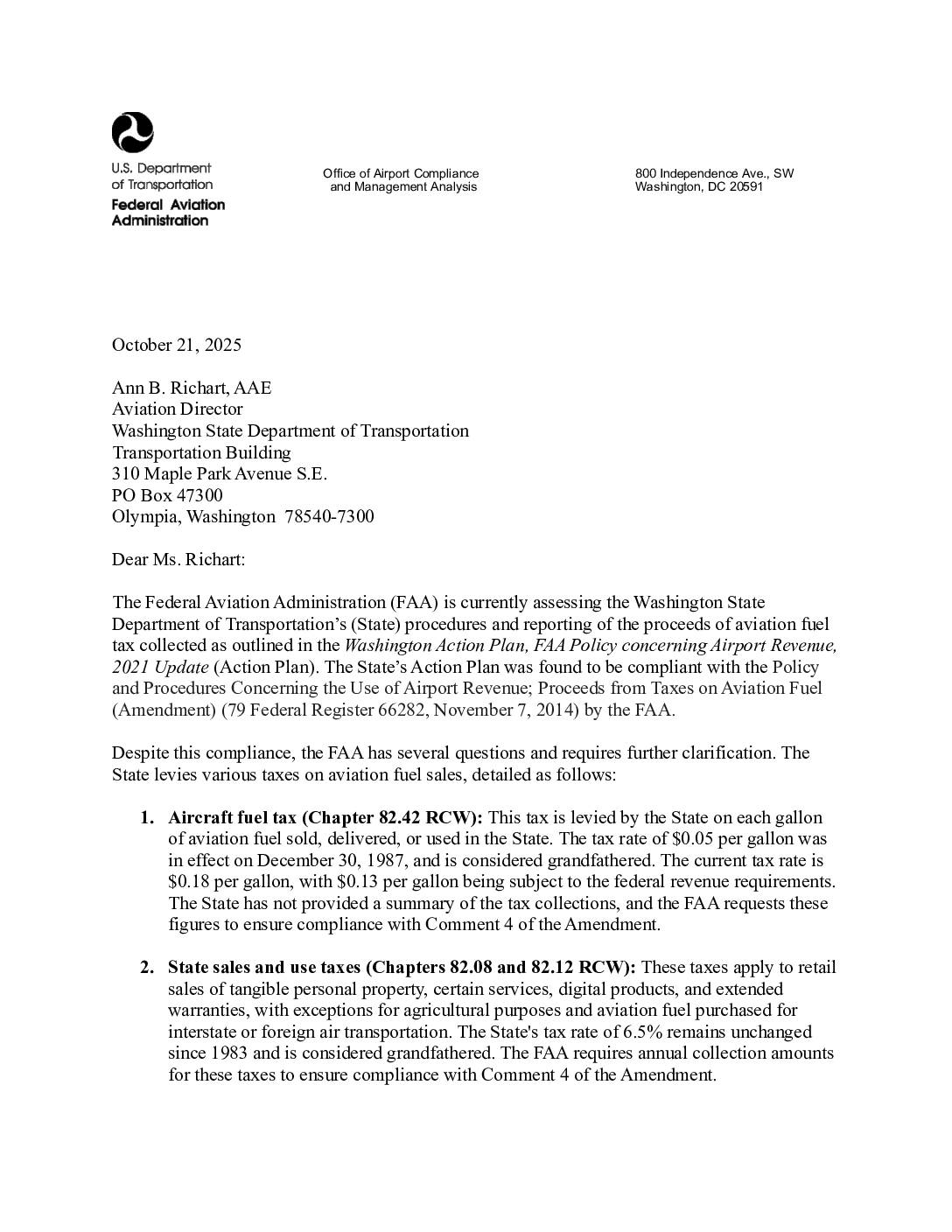
    FAA Letter to Washington State DOT on Aviation Fuel Tax Compliance

    The FAA sent a letter to Washington State's Aviation Director in October 2025 reviewing how the state collects and spends aviation fuel taxes, noting that despite having an approved compliance plan, the state has still not provided actual tax collection figures after 11 years. The FAA flagged concerns about three types of taxes — aircraft fuel tax, sales and use taxes, and environmental taxes (HST and PPT) — questioning whether the environmental tax revenues are being properly directed toward aviation purposes. The agency also reviewed over $97 million in state appropriations claimed as offsets, finding more than $82 million ineligible and nearly $15 million requiring further justification before a final compliance determination can be made.
    CategoriesCorrespondence TagsAirport Improvement Program, Airport Law, Aviation Fuel, FAA, SB240, WSDOTFolderFAA
  • 2025-10-01

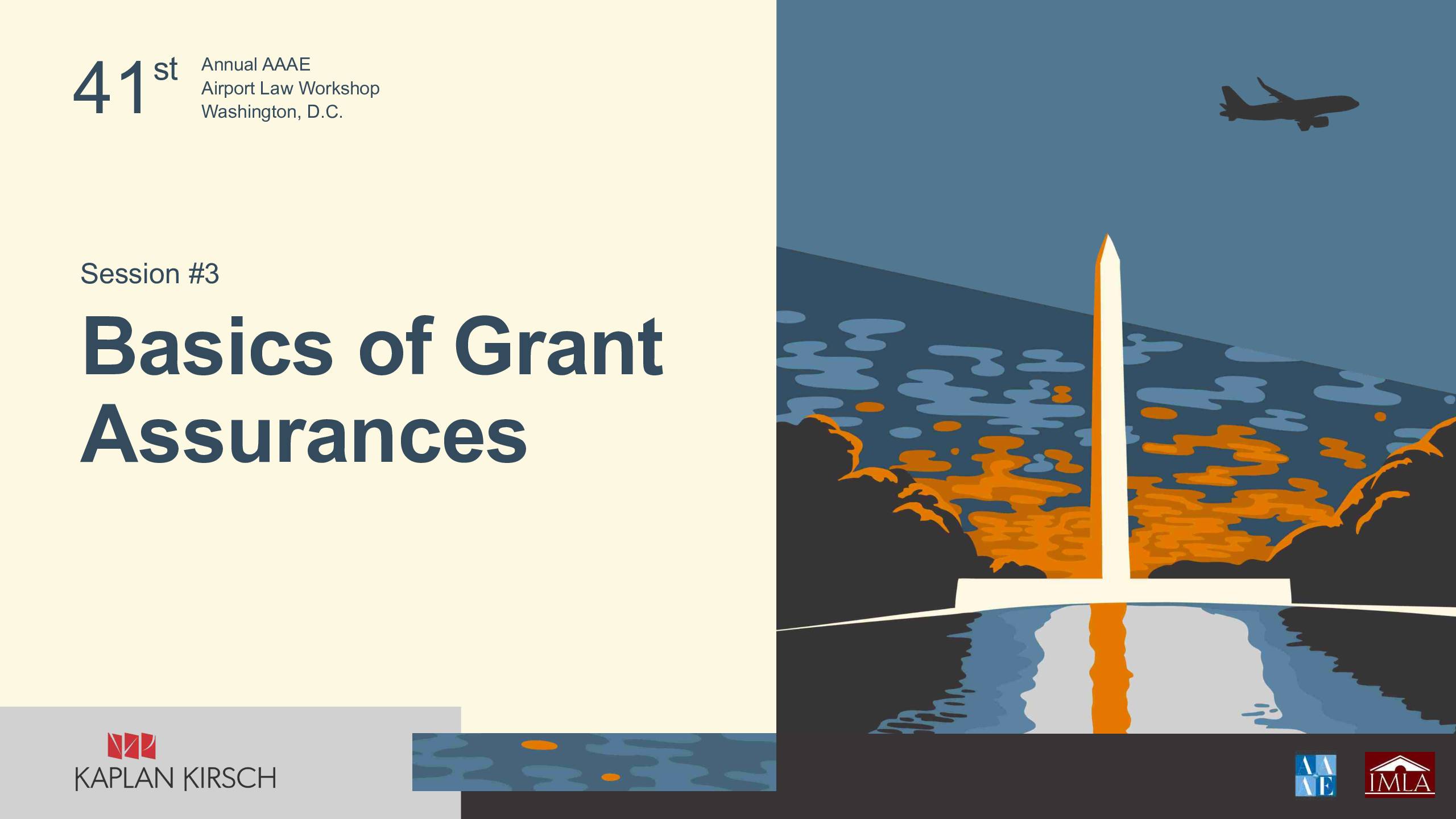
    AAA Basics of Grant Assurances

    This presentation from the 41st Annual AAAE Airport Law Workshop covers the basics of Grant Assurances — the federal obligations airports must fulfill in exchange for receiving federal funding under the Airport Improvement Program (AIP). Grant Assurances are prescribed by federal statute (49 U.S.C. 47106 & 47107) and are incorporated into grant agreements, which include both general and special conditions. While not laws themselves, these assurances are binding contractual commitments that airport sponsors accept when they receive AIP funding.
    TagsAAAE, AIP, Airport Improvement Program, Airport Law, Kaplan Kirsch RockwellFolderFAA
  • 2025-09-12

    Legal Services Agreement Regarding Issues Regarding Port of Seattle’s Sustainable Airport Master Plan (SAMP)

    ★
    In September 2025, the City of SeaTac, Washington engaged the law firm Leech Tishman Nelson Hardiman to provide legal counsel regarding the Port of Seattle's Sustainable Airport Master Plan (SAMP), specifically in response to an anticipated Federal Aviation Administration (FAA) Finding of No Significant Impact (FONSI) and Record of Decision (ROD). The firm's work includes preparing legal analysis, submitting comments, and filing a Petition for Review in either the Ninth Circuit or D.C. Circuit Court of Appeals challenging the FAA's environmental findings once published in late 2025. The engagement is capped at $300,000 with an initial $10,000 retainer, and billing rates range from $300–$400 per hour for associates to $540 per hour for lead attorney Steven M. Taber.
    CategoriesKey Documents, Litigation TagsAirport Law, SAMP, seatacFolderSeaTac
  • 2025-09-04

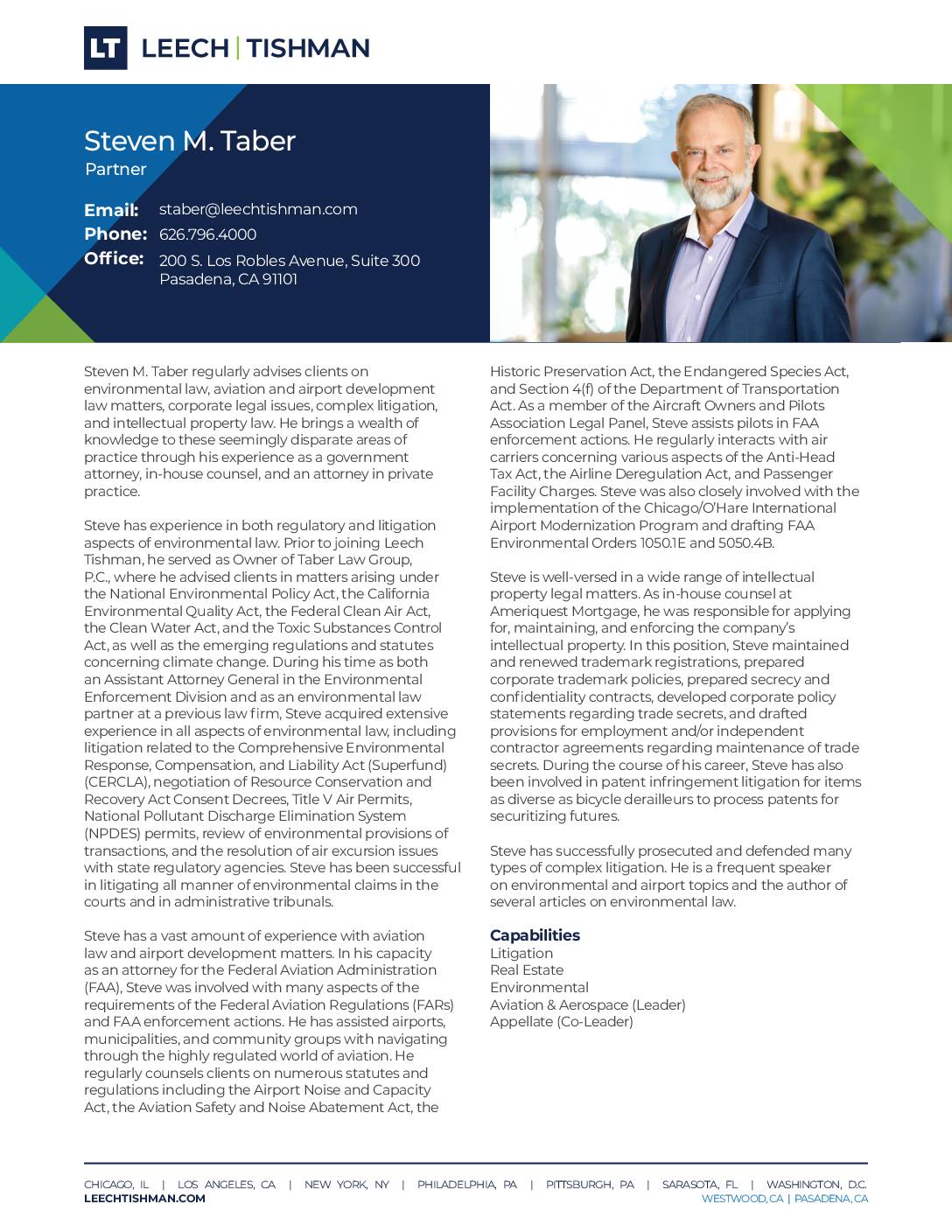
    Steven M. Taber: Attorney Profile, Leech Tishman

    Steven M. Taber is a Partner at Leech Tishman law firm specializing in environmental law, aviation and airport development, and related regulatory matters, with experience advising airports, municipalities, and community groups on noise and capacity issues under statutes such as the Airport Noise and Capacity Act and the Aviation Safety and Noise Abatement Act. He previously served as an attorney for the Federal Aviation Administration (FAA), where he was involved in drafting FAA Environmental Orders 1050.1E and 5050.4B, and has counseled clients navigating FAA enforcement actions and airport modernization programs. While his profile does not reference Sea-Tac Airport specifically, his broad expertise in aviation noise policy, environmental review processes, and federal aviation regulations makes him a relevant figure in airport noise policy research.
    TagsAirport Law, FAA, Leech Tishman, SAMP, Steven TaberFolderFour City ILA
  • 2024-07-12

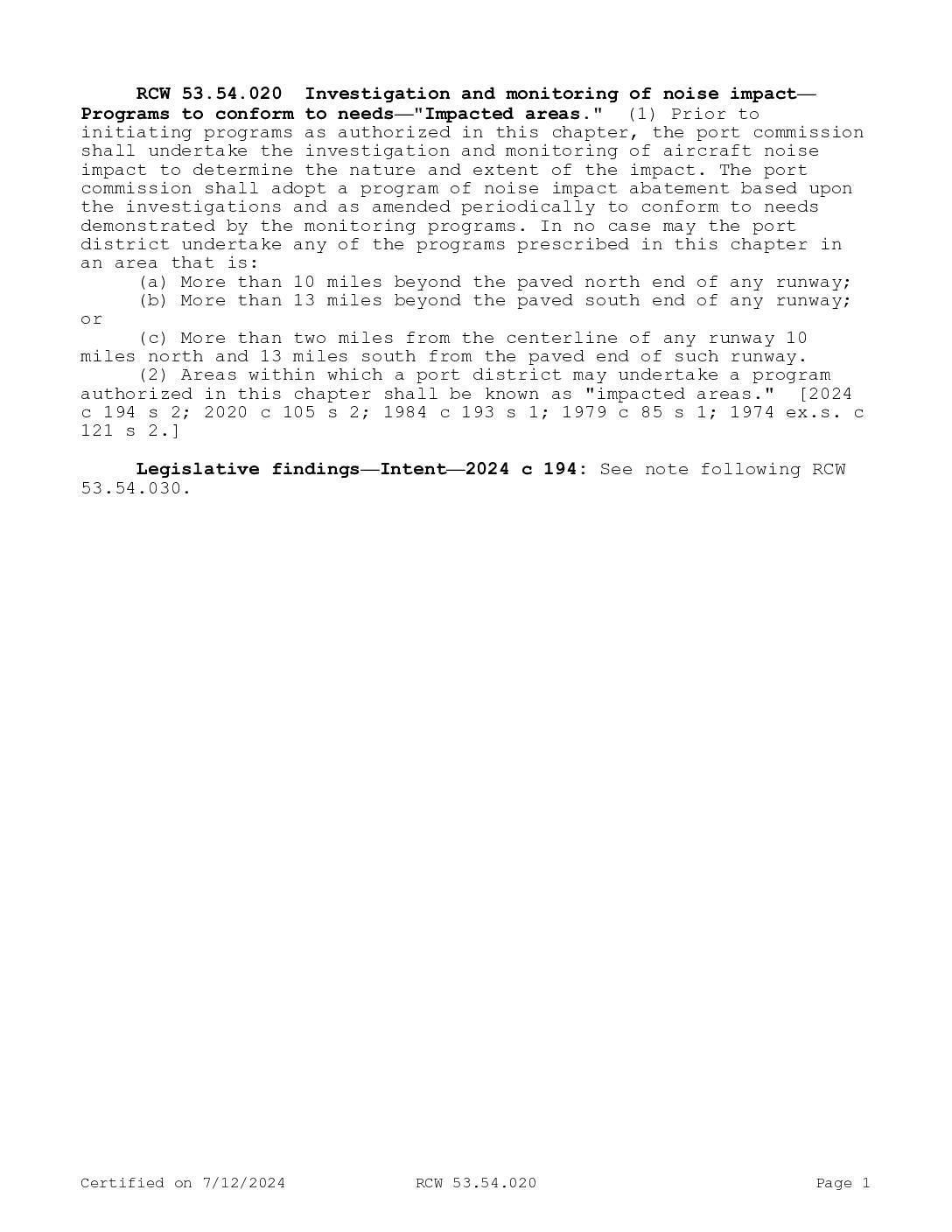
    RCW 53.54.020 Investigation and monitoring of noise impact—Programs to conform to needs—”Impacted areas.”

    Washington state law defining requirements for port commissions to investigate and monitor aircraft noise impact before initiating abatement programs. Establishes geographic boundaries for “impacted areas” where port districts may undertake noise programs, with specific distance limitations from runway ends and centerlines.
    TagsAirport Law, Airport Noise Law, Noise, Port Of Seattle, RCW53FolderLaw
  • 2022-09-16

    Airport Law Alert: FAA Issues Potentially Sweeping Changes to Airport Land Use Regulation

    The FAA proposed sweeping new rules in September 2022 governing how airports can use federally acquired or conveyed land for non-aeronautical purposes, such as hotels, warehouses, and car rental facilities. Under the draft policy, airports would need FAA approval for any non-aeronautical or mixed-use activities on such land, with approvals tied strictly to lease terms and requiring renewal each time a lease expires. The changes could significantly increase the regulatory burden on airport sponsors by eliminating the previous practice of permanently designating certain property as non-aeronautical and potentially triggering environmental review requirements under NEPA.
    TagsAirport Law, FAA, Kaplan Kirsch Rockwell, Land Use, NEPA, Reauthorization Act Of 2018, Section 163FolderLaw

Posts pagination

Page 1 Page 2
Sidebar On/Off

Upcoming Events

  • Part 150 NCP Workshop — Burien
    Add to CalendarMSaturday Oct 17: 10:00am

    Attend a Port of Seattle open house on the Part 150 Study Noise Compatibility Program (NCP). The Part 150 program determines the noise boundary around the airport and opportunities for noise mitigation such as sound insulation.

    [...]
  • Part 150 NCP Workshop — SeaTac
    Add to CalendarMMonday Oct 19: 6:00pm

    Attend a Port of Seattle open house on the Part 150 Study Noise Compatibility Program (NCP). The Part 150 program determines the noise boundary around the airport and opportunities for noise mitigation such as sound insulation.

    [...]
  • Part 150 NCP Workshop — Des Moines
    Add to CalendarMTuesday Oct 20: 6:00pm

    Attend a Port of Seattle open house on the Part 150 Study Noise Compatibility Program (NCP). The Part 150 program determines the noise boundary around the airport and opportunities for noise mitigation such as sound insulation.

    [...]

[See all...]


Issues

Sea-Tac Airport is currently undergoing the largest and longest expansion in its history, collectively known as the Sustainable Airport Master Plan (SAMP). Some of it you can already hear, but you’re probably not aware of what it all means. Here’s what you need to know.
read more...

Read This!

As the source for federal transportation grants, the Puget Sound Regional Council was charged with developing a system to meet the growing need for commercial aviation. When the search for a second airport failed, they authorized the Port of Seattle to build the Third Runway, with a mandate to develop a noise abatement and mitigation program. In their effort to stop the Third Runway, the ACC argued over every detail of the Port's efforts--including property buyouts and sound insulation. The dispute was meant to be settled by a three member Expert Arbitration Panel. This is their final report. It finds 2-1, that the Port's program was insufficient in several respects. Despite that, funding for the Third Runway was approved by the PSRC, and the 'Port Package' program, proceeded largely unchanged. Expert Arbitration Panel's final decision finding that the Port of Seattle had not shown sufficient reduction in real on-the-ground noise impacts to satisfy noise reduction conditions required for approval of a third runway at Sea-Tac International Airport. The majority decision concluded the Port's noise abatement programs were insufficient despite being impressive in scope.
continue...

  • Sea-Tac Noise.Info
  • Connect with STNI

    • Subscribe
    • Port Package Problem?
    • Donate
    • Podcast
    • Socials
      • Facebook
      • X (Twitter)
      • Bluesky
      • Instagram
  • Learn

    • Frequently Asked Questions
    • Explainers
    • Youtube
    • Research Requests
    • Complain about one flight
  • Goals

    Fulfill the promises of 1976:
    • Compensation
    • Reduced noise
    • Improved air quality
    • Environmental remediation
Login/Register
©2026•Data Privacy

Message

We use cookies to provide basic functionality. We also provide access to search engines in order to provide site analytics. We do not sell or share your data.
V V