TagIATA(10)
 The International Air Transport Association (IATA) represents and serves airlines with advocacy and global standards for safety, security, efficiency… According to Wikipedia: “The International Air Transport Association is an airline trade association founded in 1945. IATA has been described as a cartel since, in addition to setting technical standards for airlines, IATA also organized tariff conferences that served as a forum for price fixing.”
-
 2026-02-02
Shortages of new aircraft, fuel put emissions goal at risk, IATA’s Walsh says
By Tim Hepher and Huey Mun Leong Summary IATA chief says airline-supplier profit gap unsustainable Emissions targets becoming more challenging, Walsh says Engine makers are “not our partners,” IATA chief says SINGAPORE, Feb 2 (Reuters) – The head of a body representing global airlines said on Monday shortages of efficient new aircraft and alternative fuels -
 2024-08-08
Air cargo players want ‘cohesion and consistency’ in how aviation reports emissions
By Charlotte Goldstone 12/08/2024 Current CO2 air cargo emission calculating methodology has been compared to the VW emissions scandal, with a lack of standardisation allowing passenger ‘greenwashing’ at the expense of cargo. The disparity between IATA and ICAO’s baseline figures for calculating air cargo emissions could be resulting in false sustainability data, making passenger operations -
 2024-04-10
RBV vs. the State (Netherlands): Court Case Summary — Citizens Group Against Dutch State to Restore Protection Against Aviation Noise Nuisance at Schiphol Airport
A Dutch citizens' group won a landmark court ruling in March 2024, with The Hague's district court finding that the Netherlands violated residents' human rights under Article 8 of the European Convention on Human Rights by exposing a disproportionate number of people to serious noise and sleep disturbance from Schiphol Airport. The court ordered the Dutch government to enforce existing aviation noise regulations and reduce aircraft movements within 12 months, while also requiring the creation of more effective, individualized legal protections for affected residents — including those living outside established noise contours. The case may serve as a precedent for other major airports worldwide, as the ruling criticized decades of government prioritization of aviation industry economic interests over residents' health and well-being. -
 2023-09-04
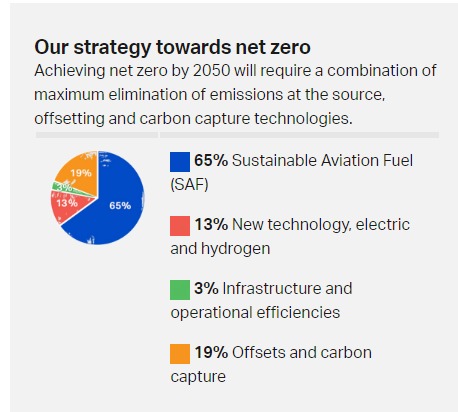
Net Zero Strategy Pie Chart — Aviation Emissions Reduction
A pie chart titled 'Our strategy towards net zero' outlines a combination of approaches to achieve net zero by 2050: 65% Sustainable Aviation Fuel (SAF), 19% Offsets and carbon capture, 13% New technology, electric and hydrogen, and 3% Infrastructure and operational efficiencies. No organizational logo or authorship is clearly visible in this cropped image. -
 2023-05-02
Sustainable aviation fuels / Addressing local air quality
Airlines for America presented at the 2023 Aviation Noise & Emissions Symposium at UC Davis, outlining U.S. airlines' environmental record and climate commitments, including a goal to reach net-zero carbon emissions by 2050. The presentation highlighted a 94% reduction in significant noise exposures since 1975, major improvements in fuel efficiency, and a target to make 3 billion gallons of sustainable aviation fuel available by 2030. Key pathways to further reduce emissions include new aircraft technology, operational improvements, modernized air traffic control, and the long-term potential of electric, hybrid, or hydrogen-powered flight. -
 2022-10-01
Corporate capture and the UN International Civil Aviation Organization
A 2022 report by InfluenceMap examines how aviation industry interests shape climate policy at the UN's International Civil Aviation Organization (ICAO), finding that 31% of delegates at recent climate negotiations represented industry. The report highlights that ICAO's limited transparency practices—including non-disclosure agreements, restricted media access, and undisclosed delegate affiliations—allow corporate influence to steer global aviation emissions policy. As a result, ICAO has prioritized carbon offsetting over direct emissions reductions, with global aviation CO2 emissions projected to grow by 190–277% between 2015 and 2050. -
 2022-07-01
Worldwide Airport Slot Guidelines (WASG), Edition 2
★The Worldwide Airport Slot Guidelines (WASG), Edition 2, effective July 1, 2022, is a joint publication by Airports Council International (ACI), the International Air Transport Association (IATA), and the Worldwide Airport Coordinators Group (WWACG) that provides global standards and guidance for managing airport slot allocation. The document is intended to help airports, airlines, and coordinators navigate capacity constraints and scheduling processes at busy airports worldwide. Note that while this document covers broad international slot management principles, readers should consult applicable local laws and regulations for specific airport noise or capacity policies. -
Our Commitment to Fly Net Zero by 2050
Fly Net Zero is the commitment of airlines to achieve net zero carbon by 2050. At the 77th IATA Annual General Meeting in Boston, USA, on 4 October 2021, a resolution was passed by IATA member airlines committing them to achieving net-zero carbon emissions from their operations by 2050. This pledge brings air transport -
2019 Worst Year for Air Freight Demand Since 2009
This was the first year of declining freight volumes since 2012, and the weakest performance since the global financial crisis three years earlier. International Air Transport Association (IATA) IATA Geneva – The International Air Transport Association (IATA) released full-year 2019 data for global air freight markets showing that demand, measured in freight tonne kilometers (FTKs), fell -
 2015-11-01
The Aviation Sector’s Climate Action Framework
This 2015 report from the Air Transport Action Group (ATAG) outlines the aviation industry's framework for addressing its climate impact, noting that while air transport carries over 3.3 billion passengers annually and supports 3.5% of global GDP, it also accounts for roughly 2% of human-induced CO2 emissions. The document presents the industry's strategies for balancing continued air traffic growth with the obligation to reduce greenhouse gas emissions. It represents a collaborative effort across airlines, airports, air navigation service providers, and aircraft manufacturers to pursue sustainable development goals.