TagDepartment Of Commerce(40)
-
 2026-08-28
Housing & Human Services Background Report Appendices: Appendix A — Sea-Tac 2024 Comprehensive Plan Land Capacity Analysis Methodology and Results Report
This document is a Land Capacity Analysis Methodology Report prepared as part of SeaTac's 2044 Comprehensive Plan update, focusing on housing and jobs growth targets rather than airport noise policy. It outlines SeaTac's requirement to accommodate 5,900 new housing units and 14,810 new jobs between 2019 and 2044, with housing targets broken down by income levels based on King County's Area Median Income (AMI). The report addresses affordable housing planning requirements under Washington State law, including provisions for permanent supportive housing and emergency housing for vulnerable populations. -
 2026-08-28
Housing & Human Services Background Report Appendices: Appendix A — Sea-Tac 2024 Comprehensive Plan Land Capacity Analysis Methodology and Results Report
This document is a Land Capacity Analysis Methodology Report prepared as part of SeaTac's 2044 Comprehensive Plan update, focusing on housing and jobs growth targets rather than airport noise policy. It outlines SeaTac's requirement to accommodate 5,900 new housing units and 14,810 new jobs between 2019 and 2044, with housing targets broken down by income levels based on King County's Area Median Income (AMI). The report addresses affordable housing planning requirements under Washington State law, including provisions for permanent supportive housing and emergency housing for vulnerable populations. -
 2026-02-09
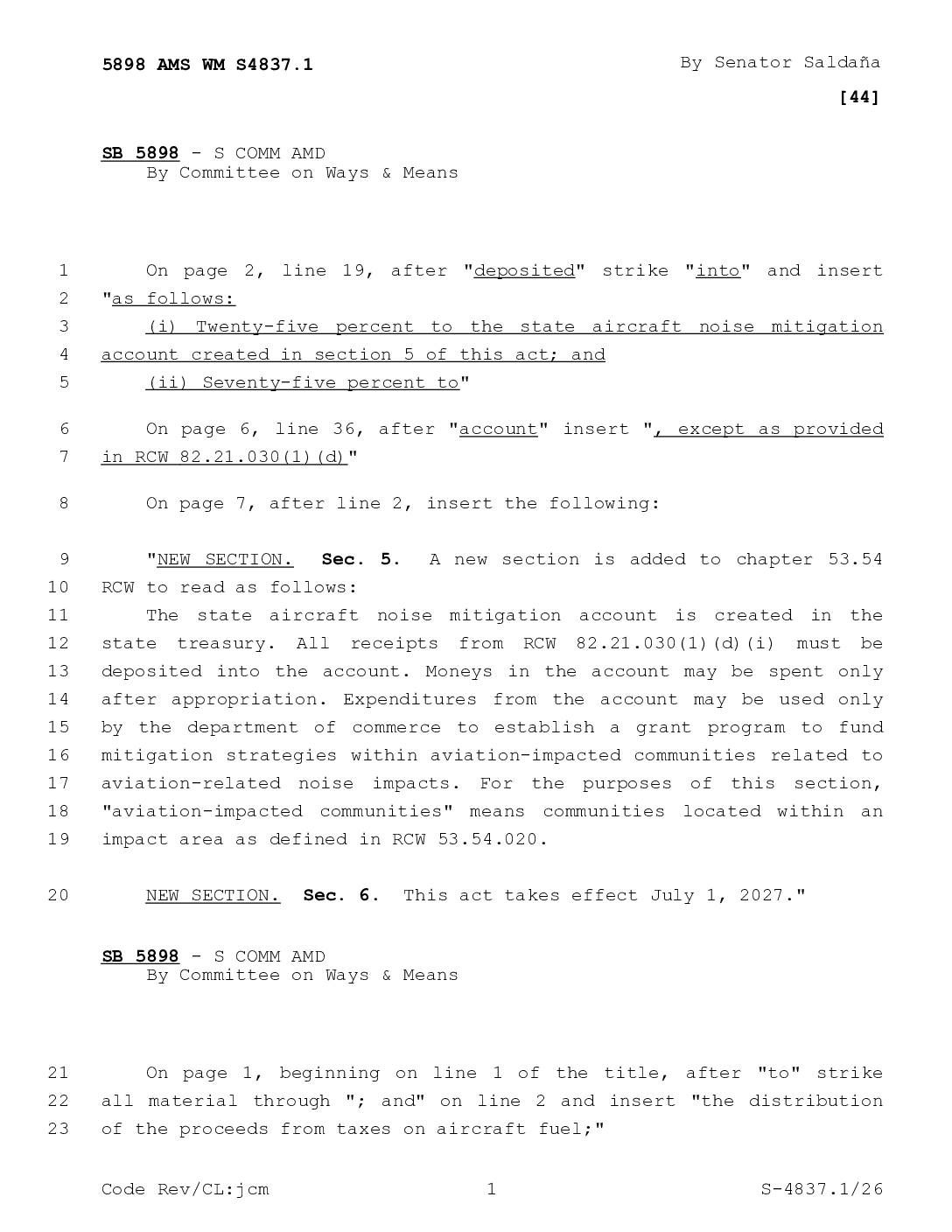
SB 5898 – S COMM AMD by Committee on Ways & Means
Washington Senate Bill 5898 proposes redirecting a portion of the state's hazardous substance tax on aircraft fuel to fund noise relief for communities near airports. Specifically, 25 percent of those tax proceeds would go into a new "state aircraft noise mitigation account," with the remaining 75 percent continuing to flow to the aeronautics account as before. The Department of Commerce would administer a grant program using these funds to support noise mitigation strategies in communities located within designated aviation impact areas, with the law taking effect July 1, 2027. -
 2026-01-26
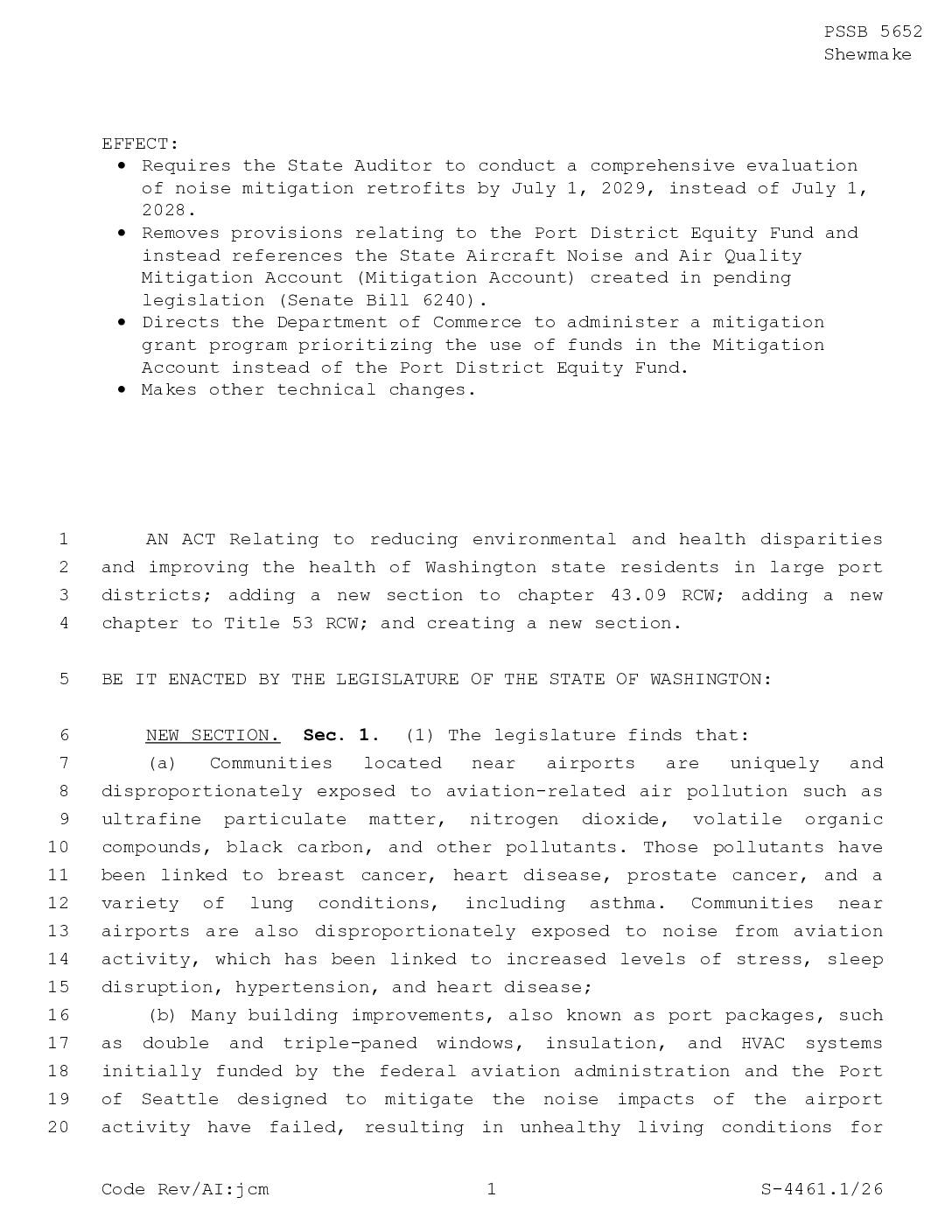
SB5652 – S-4461.1/26 AN ACT Relating to reducing environmental and health disparities and improving the health of Washington state residents in large port districts
Washington state legislation (PSSB 5652) establishing partnerships and grant programs to address aviation-related air quality and noise impacts on communities near airports. The bill requires the University of Washington to develop exposure maps and assess health impacts, directs the State Auditor to evaluate noise mitigation retrofits, and creates a mitigation grant program administered by the -
 2024-03-13
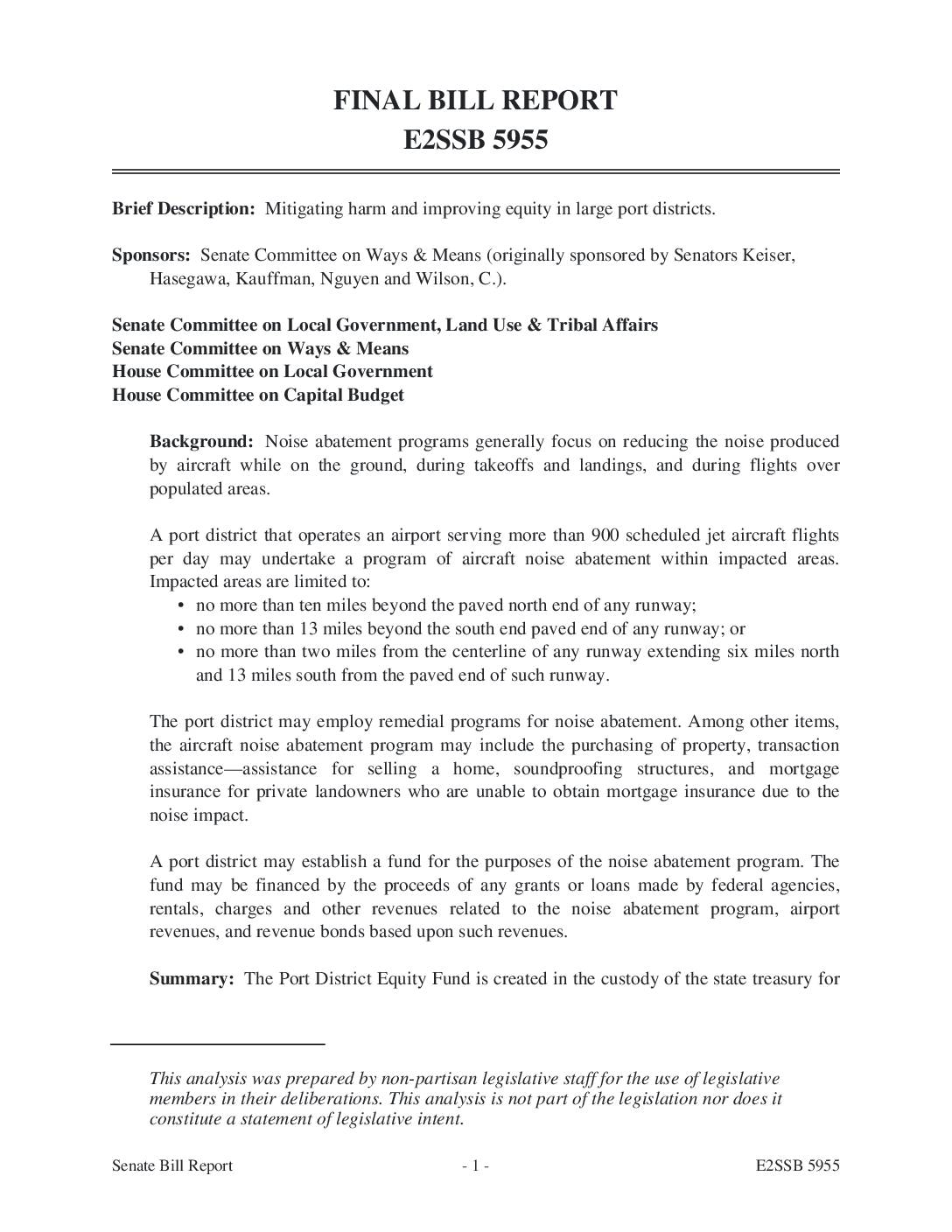
Final Bill Report: E2SSB 5955 — Mitigating Harm and Improving Equity in Large Port Districts
Washington State E2SSB 5955 creates the Port District Equity Fund to help large port districts, such as the Port of Seattle, repair or replace failing aircraft noise mitigation equipment in nearby homes and properties. The Department of Commerce administers the grant program, which requires port districts to match at least half of state funding, and mandates annual public reporting on inspections and repairs. The program is set to expire July 1, 2029, with a legislative audit review, and will be fully repealed by July 1, 2030. -
 2024-02-21
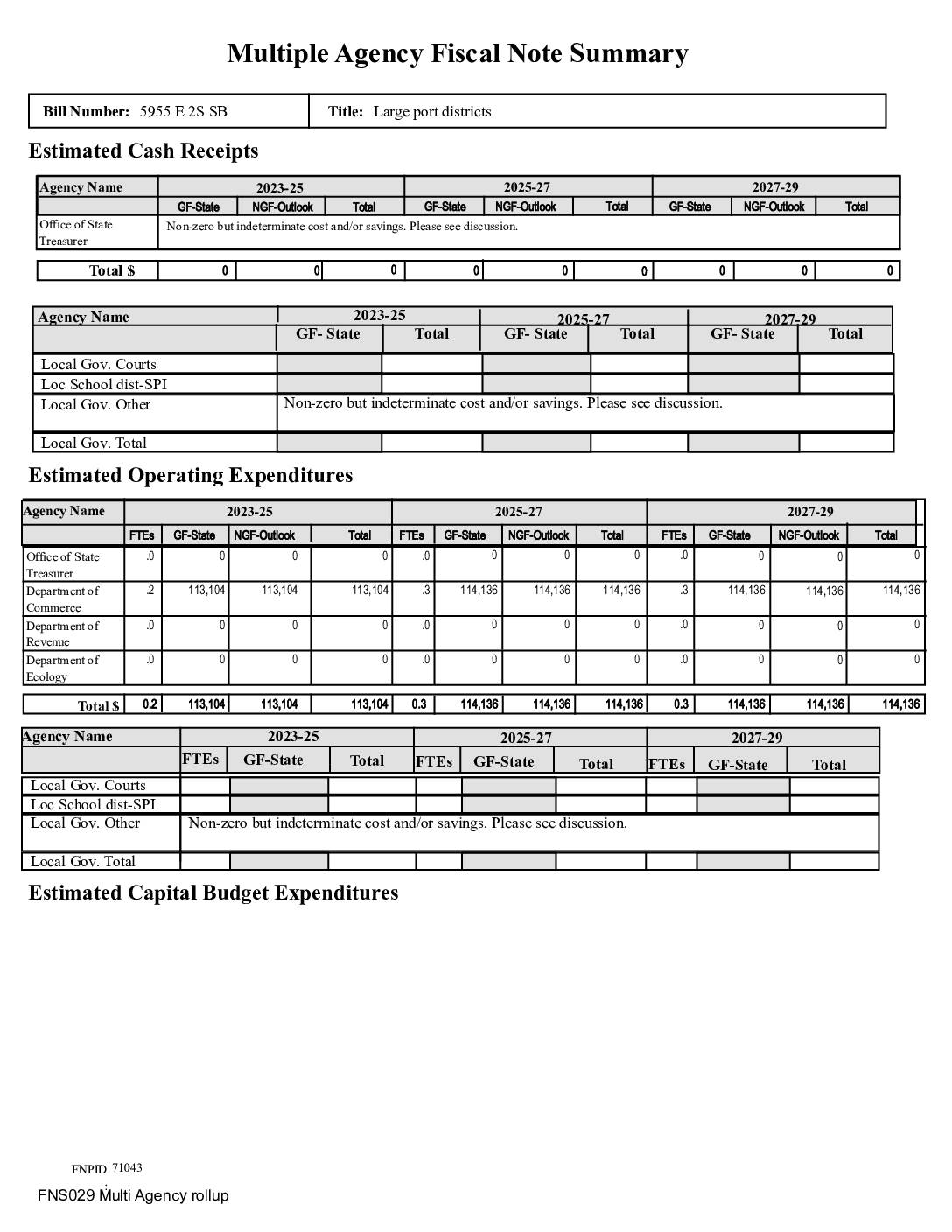
Multiple agency fiscal note summary: Bill 5955 E 2S SB, large port districts
This is a fiscal note summary for Washington State Senate Bill 5955, which concerns large port districts. The document estimates operating expenditures primarily from the Department of Commerce, ranging from approximately $113,104 in the 2023-25 biennium to $114,136 in subsequent biennia, along with capital budget costs starting at $86,586. The Office of State Treasurer notes non-zero but indeterminate cash receipt impacts, while other agencies such as the Department of Revenue and Department of Ecology report no fiscal impact. -
 2024-02-20
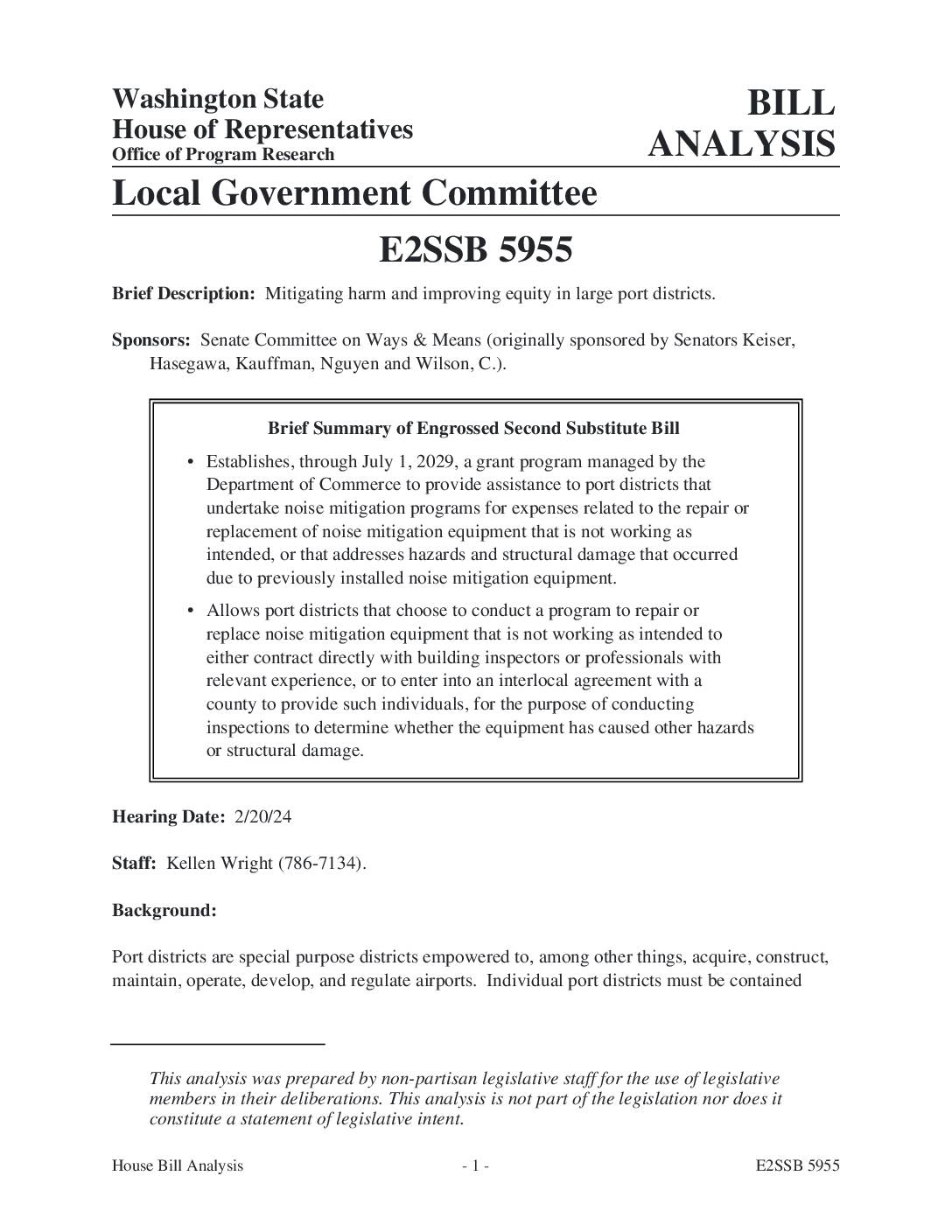
Bill Analysis: E2SSB 5955 – Mitigating Harm and Improving Equity in Large Port Districts
Washington State bill E2SSB 5955 creates a grant program, running through July 1, 2029, managed by the Department of Commerce to help large port districts — primarily the Port of Seattle, which operates Sea-Tac Airport — repair or replace faulty noise mitigation equipment installed in nearby homes, and address any structural damage caused by that equipment. Port districts can hire building inspectors or partner with their county to inspect affected properties, and must apply for grant funds when inspections reveal problems. The Joint Legislative Audit and Review Committee will review the program's effectiveness by July 1, 2028. -
 2024-02-20
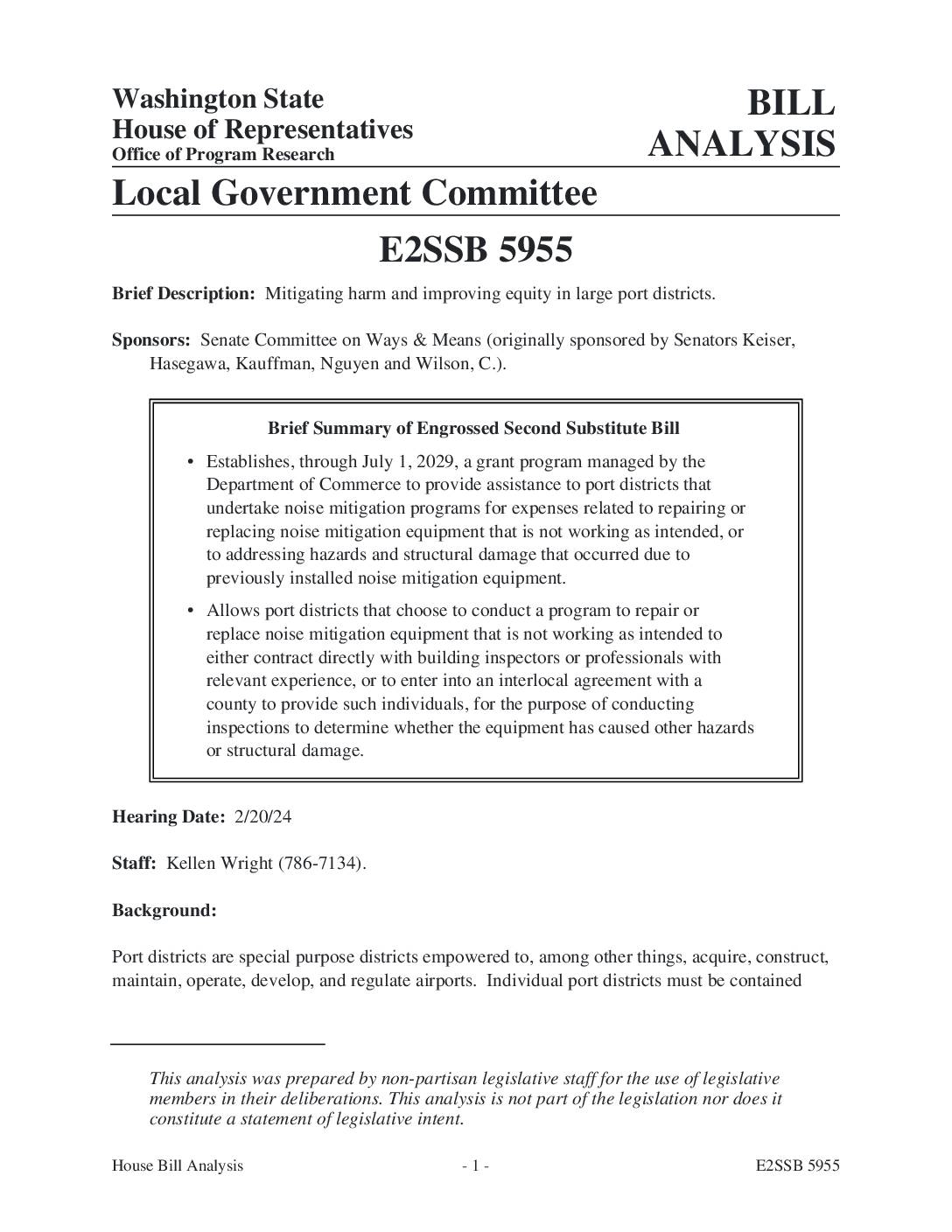
House Bill Analysis: E2SSB 5955 – Mitigating Harm and Improving Equity in Large Port Districts
Washington State Bill E2SSB 5955 creates a grant program, running through July 1, 2029, managed by the Department of Commerce to help port districts — primarily the Port of Seattle, which operates Sea-Tac Airport — repair or replace faulty noise mitigation equipment installed in nearby homes, and to fix any structural damage caused by that equipment. The program is funded through a new 'port district equity fund' drawing from legislative appropriations, local government contributions, and private donations. An independent review by the Joint Legislative Audit and Review Committee is required by July 1, 2028, to assess how many homes have been remediated and how many still need attention. -
 2024-02-03
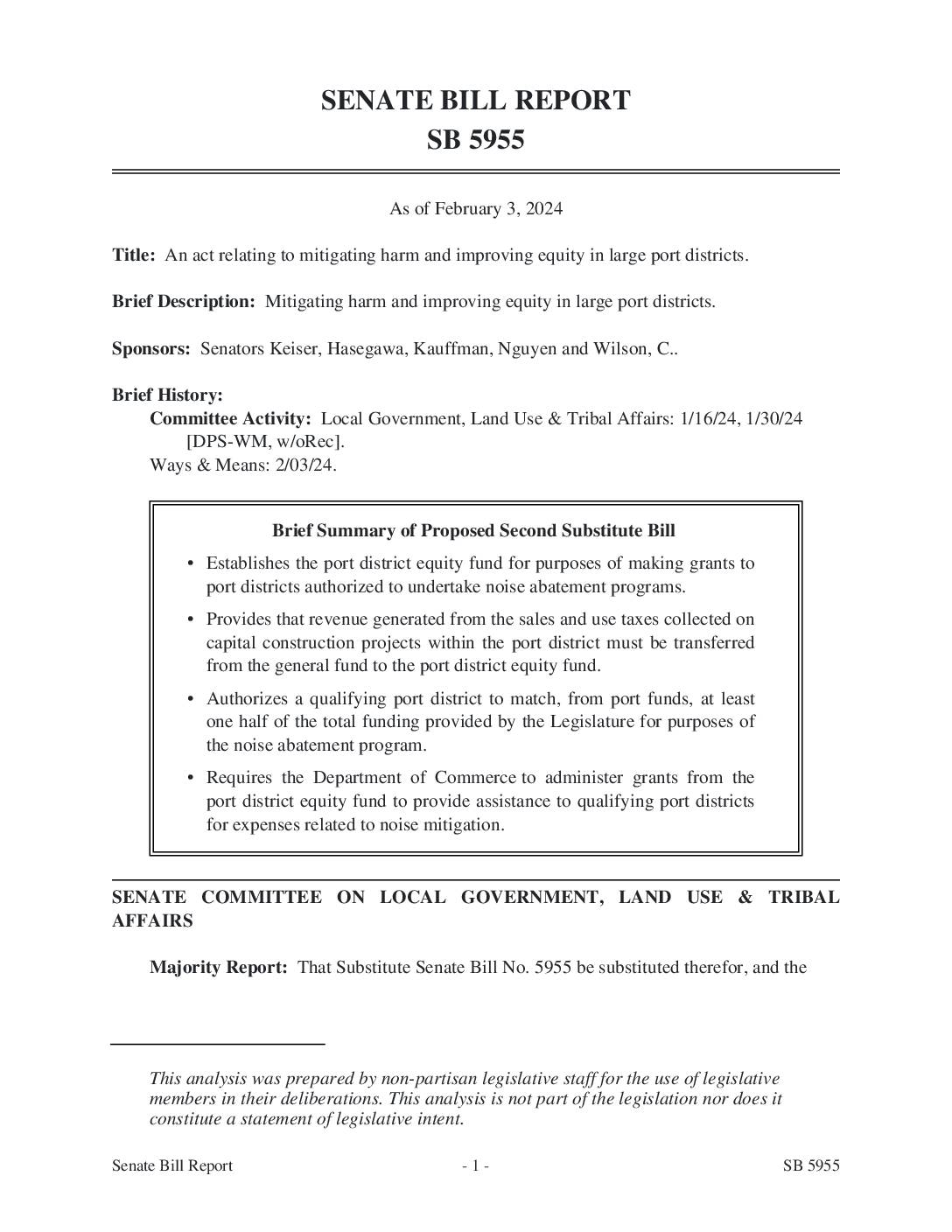
Senate bill report SB 5955: Mitigating harm and improving equity in large port districts
Washington Senate Bill 5955 proposes creating a 'port district equity fund' to help large port districts—such as the one operating Sea-Tac Airport—pay for aircraft noise mitigation programs. The fund would be seeded with a $10 million appropriation for fiscal year 2025 and subsequently replenished by sales and use tax revenue collected on capital construction projects at the airport, with the port district required to match at least half of state-provided funds. The Department of Commerce would administer grants from the fund to cover costs such as inspecting and repairing soundproofing equipment in nearby homes and addressing any structural damage caused by its installation. -
 2024-01-16
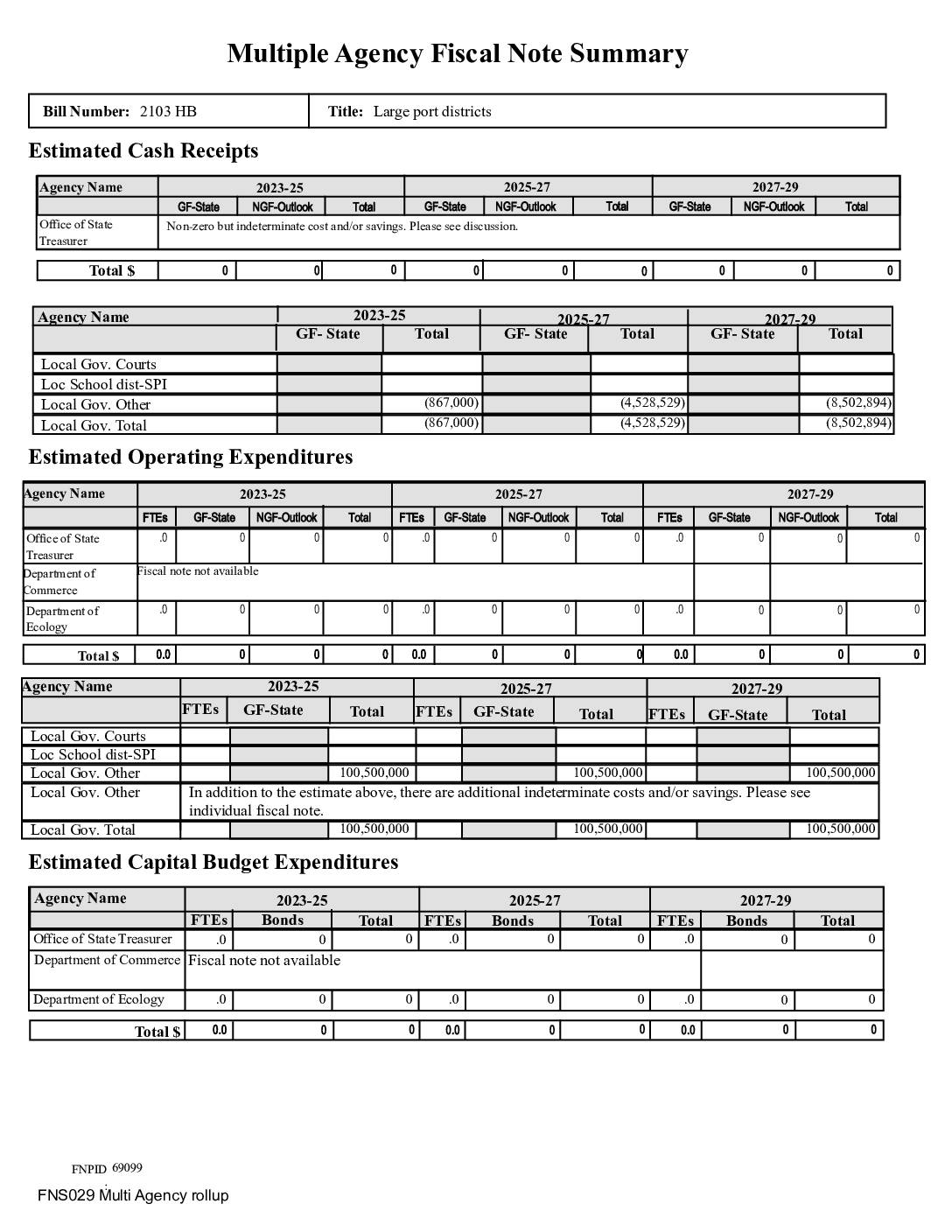
Multiple Agency Fiscal Note Summary: HB 2103 Large Port Districts
This is a fiscal note summary for Washington State House Bill 2103, concerning large port districts. It estimates that local governments would face operating expenditures of approximately $100.5 million per biennium across 2023-29, along with declining cash receipt reductions to local governments ranging from $867,000 in 2023-25 to over $8.5 million in 2027-29. The Office of State Treasurer notes non-zero but indeterminate financial impacts, while the Department of Commerce's fiscal note was not available at the time of the preliminary publication on January 16, 2024.