Let’s see how busy it is…
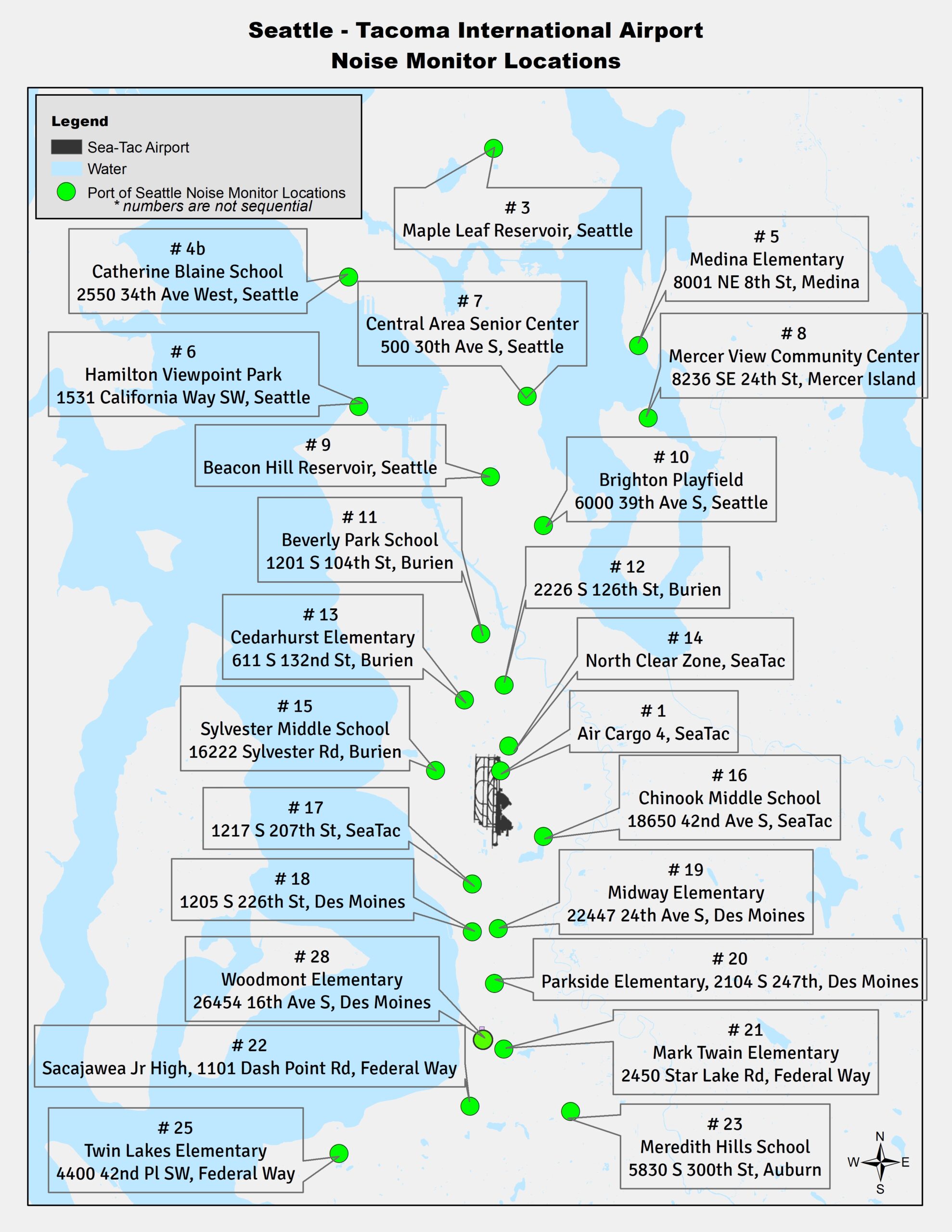
This is one of several tools we offer to help make sense of publicly available data collected from the Port Of Seattle’s own Noise Monitoring system. Despite the long list of disclaimers below (which you should read both to understand the noise monitoring system and its significant limitations), we think you’ll find these reports very useful.
The three reports on this page are:
- Busiest Hours of the Week: Displays 168 row of a virtual week (24 hours over seven days). If you ever wondered what time of day is most active over your neighborhood, this is for you.
- Busiest Days of the Year: Displays 365 rows – one for each day of a virtual year. If you select Jan 1, 2024 to Dec 31, 2024 you’ll understand the busiest days of 2024. If you select Jan 1, 2021 to Dec 31, 2024 the report looks at three years and give you the busiest days of the years for all that
- Busiest Hours of Each Day: Displays 105 rows – the 15 non-DNL hours of each day of the week ordered by most busy to least. If you ever wondered what is the busiest hour of every Wednesday, this is for you.
They can do a lot more than that by using the Filters explained below.
Busiest Times Of The Day (Outside of DNL)
| DAY | HOUR | AVG FLIGHTS PER HOUR | NOISE DBA | *ALTITUDE |
|---|---|---|---|---|
| Sunday | 10 | 65 | 83 | 1,904 |
| Sunday | 12 | 64 | 83 | 1,926 |
| Sunday | 8 | 62 | 83 | 2,002 |
| Sunday | 16 | 59 | 83 | 1,946 |
| Sunday | 18 | 58 | 83 | 1,889 |
| Sunday | 20 | 58 | 83 | 1,853 |
| Sunday | 14 | 57 | 83 | 1,831 |
| Sunday | 9 | 55 | 83 | 1,929 |
| Sunday | 21 | 51 | 82 | 1,784 |
| Sunday | 11 | 50 | 83 | 1,977 |
| Sunday | 13 | 50 | 83 | 1,936 |
| Sunday | 7 | 46 | 82 | 2,123 |
| Sunday | 17 | 46 | 83 | 1,920 |
| Sunday | 19 | 45 | 83 | 1,839 |
| Sunday | 15 | 42 | 83 | 2,074 |
| Monday | 12 | 65 | 83 | 1,917 |
| Monday | 10 | 63 | 83 | 1,864 |
| Monday | 20 | 62 | 82 | 1,831 |
| Monday | 16 | 61 | 83 | 1,916 |
| Monday | 18 | 60 | 83 | 1,860 |
| Monday | 8 | 60 | 83 | 1,965 |
| Monday | 9 | 57 | 83 | 1,909 |
| Monday | 14 | 54 | 83 | 1,886 |
| Monday | 21 | 51 | 83 | 1,786 |
| Monday | 11 | 51 | 83 | 1,927 |
| Monday | 19 | 48 | 83 | 1,856 |
| Monday | 17 | 45 | 83 | 1,836 |
| Monday | 7 | 45 | 83 | 2,095 |
| Monday | 13 | 44 | 83 | 1,954 |
| Monday | 15 | 44 | 83 | 2,038 |
| Tuesday | 10 | 65 | 83 | 1,863 |
| Tuesday | 12 | 62 | 83 | 1,882 |
| Tuesday | 18 | 58 | 83 | 1,832 |
| Tuesday | 8 | 58 | 83 | 2,037 |
| Tuesday | 16 | 56 | 83 | 1,861 |
| Tuesday | 14 | 55 | 83 | 1,807 |
| Tuesday | 9 | 54 | 82 | 1,950 |
| Tuesday | 20 | 52 | 82 | 1,810 |
| Tuesday | 11 | 48 | 83 | 1,922 |
| Tuesday | 7 | 46 | 82 | 2,138 |
| Tuesday | 21 | 46 | 83 | 1,741 |
| Tuesday | 17 | 45 | 83 | 1,851 |
| Tuesday | 15 | 42 | 83 | 1,998 |
| Tuesday | 19 | 41 | 82 | 1,826 |
| Tuesday | 13 | 40 | 83 | 1,883 |
| Wednesday | 12 | 70 | 83 | 1,971 |
| Wednesday | 10 | 70 | 82 | 1,920 |
| Wednesday | 18 | 66 | 82 | 1,939 |
| Wednesday | 8 | 64 | 82 | 2,016 |
| Wednesday | 9 | 61 | 83 | 1,979 |
| Wednesday | 20 | 57 | 82 | 1,835 |
| Wednesday | 16 | 56 | 83 | 1,888 |
| Wednesday | 11 | 56 | 82 | 1,915 |
| Wednesday | 14 | 56 | 82 | 1,901 |
| Wednesday | 21 | 51 | 82 | 1,711 |
| Wednesday | 7 | 48 | 82 | 2,124 |
| Wednesday | 13 | 45 | 82 | 2,001 |
| Wednesday | 15 | 45 | 82 | 1,997 |
| Wednesday | 17 | 45 | 82 | 1,889 |
| Wednesday | 19 | 45 | 82 | 1,812 |
| Thursday | 10 | 70 | 83 | 1,851 |
| Thursday | 12 | 70 | 83 | 1,893 |
| Thursday | 8 | 68 | 83 | 2,008 |
| Thursday | 18 | 67 | 83 | 1,933 |
| Thursday | 20 | 64 | 83 | 1,853 |
| Thursday | 9 | 62 | 83 | 1,899 |
| Thursday | 16 | 62 | 83 | 1,894 |
| Thursday | 14 | 58 | 83 | 1,841 |
| Thursday | 11 | 57 | 83 | 1,930 |
| Thursday | 21 | 56 | 83 | 1,798 |
| Thursday | 7 | 53 | 83 | 2,175 |
| Thursday | 19 | 48 | 83 | 1,932 |
| Thursday | 13 | 48 | 83 | 1,887 |
| Thursday | 17 | 47 | 83 | 1,771 |
| Thursday | 15 | 45 | 83 | 2,054 |
| Friday | 12 | 70 | 83 | 1,993 |
| Friday | 10 | 69 | 83 | 1,893 |
| Friday | 18 | 66 | 83 | 1,943 |
| Friday | 8 | 65 | 83 | 2,075 |
| Friday | 20 | 65 | 83 | 1,969 |
| Friday | 9 | 62 | 83 | 2,037 |
| Friday | 16 | 61 | 83 | 1,985 |
| Friday | 11 | 57 | 83 | 1,937 |
| Friday | 21 | 57 | 83 | 1,851 |
| Friday | 14 | 57 | 83 | 1,944 |
| Friday | 7 | 52 | 83 | 2,172 |
| Friday | 19 | 52 | 83 | 1,879 |
| Friday | 17 | 49 | 83 | 1,854 |
| Friday | 13 | 49 | 83 | 2,078 |
| Friday | 15 | 48 | 83 | 2,035 |
| Saturday | 10 | 67 | 83 | 1,903 |
| Saturday | 12 | 61 | 83 | 2,026 |
| Saturday | 8 | 61 | 83 | 1,995 |
| Saturday | 18 | 55 | 83 | 1,955 |
| Saturday | 14 | 54 | 83 | 1,895 |
| Saturday | 16 | 53 | 83 | 1,960 |
| Saturday | 11 | 50 | 83 | 1,972 |
| Saturday | 9 | 50 | 83 | 1,955 |
| Saturday | 7 | 49 | 83 | 2,049 |
| Saturday | 20 | 43 | 83 | 1,861 |
| Saturday | 15 | 42 | 83 | 1,897 |
| Saturday | 17 | 41 | 83 | 1,906 |
| Saturday | 13 | 41 | 83 | 1,985 |
| Saturday | 21 | 40 | 83 | 1,749 |
| Saturday | 19 | 36 | 83 | 1,840 |
All the disclaimers…
- The current data set represents 19,270,751 noise events from Jan 01, 2017 to Jul 31, 2026 gathered from 24 Permanent Noise Monitors.
- This information is extrapolated from noise events registered by the noise monitors. It is not the same thing as official FAA data – which does not include noise.
- It sometimes overcounts and undercounts events by 1-5%.
- Noise monitoring is neither mandated or regulated by the FAA. The accuracy of the Noise Monitor data is, in itself in no way guaranteed.
- Certain data (particularly altitudes) were spotty in earlier years.
- This information comes from the same data source as the *Port of Seattle, which will have exactly the same challenges.
Terminology
Noise is annoying. Measuring noise is annoying, complicated, and imperfect. But we have to agree on some form of measurements if we ever hope to regulate noise. Here are ones that deserve an explanation.
SEL: the reports on this page total up thousands of SEL – individual events (an aircraft flies over a noise monitor at one moment in time). SEL events are not flights. One flight may be detected by as many as five or even six noise monitors on arrival or departure. The grand total of SEL events for any time will be far greater than the number of operations
LEQ: This is an average of SEL events over a period of time. It could be 24 hours (a day) or it could be other time frames depending on what you are studying. You can get close to that by running these reports. LEQ is often used in aviation for short-term studies, such as comparing different noise events over a day, week, or even hour. Or analyzing temporary changes due to construction or unusual flight operations. We don’t talk about LEQ too much because the FAA (and we) think it under-represents community concerns. So they do not use it in their regulations. But we track it because in Europe they do use LEQ to regulate noise.
Penalty Events: When it comes to averages, you will hear much more about something called DNL65 because it determines who gets sound insulation. DNL65 is like LEQ – a way to assign a single number to an average of noise events per day. But DNL65 adds a 10 dB penalty to nighttime noise between 10PM and 7AM. (So, if an aircraft flying over your head at 2AM reads as ’80 decibels’, it gets calculated as 90 decibels). This is supposed to account for increased sensitivity during sleep hours. So, our reports track events within that penalty period.
Fly Quiet Events: Our reports also track Fly Quiet events – which are between midnight at 5AM. This is not an official term, we invented it. However, we think it is very important. For many decades, many airports have been attempting to obtain voluntary compliance from airlines either to not fly during that penalty period or to ‘fly quiet’, ie. shift to quieter aircraft. These programs have had their ups and downs because they are voluntary. There is nothing an airport can do to alter an airlines’ schedule, compel them to use particular aircraft, or even enact quieter departure or arrival procedures. Sea-Tac Airport’s Fly Quiet program is only from 12AM to 5AM. Note that this omits four hours from the DNL65 noise penalty – 10PM to 7AM. Why? Because 10PM at night and 6AM in the morning are prime time for many carriers – especially to Asia. And adding new routes to Asia is one of Sea-Tac airport’s primary goals. (Why do you think they built the International Arrivals Facility?) In addition to the fact that a five hour window is unhealthy, it’s important to note how busy the hours are immediately before and after.
*Their system is based on work we originally began in 2016, with the assistance of former Commission President Tom Albro and Acting Director Dave Soike. The Port now publishes the same data via their Tableau site. We’re both using the same data and both sites will have the same limitations.