TagEnvironmental Justice(100)
-
 2026-08-20
Comments on the Sea-Tac Airport Master Plan EIS Due August 20, 2026
A concerned resident living near Sea-Tac Airport submitted formal comments arguing that the airport's Master Plan Environmental Impact Statement (EIS) is deeply flawed, citing inconsistent data, outdated figures, lack of cumulative impact analysis, and poor document organization across its 6,000 pages. The commenter contends that the EIS fragments project reviews to minimize apparent harm, uses selectively chosen baselines to downplay environmental and health impacts on surrounding communities, and fails to address a full build-out scenario. The primary demand is that the EIS be completely redone with transparent assumptions, holistic cumulative impact analysis, up-to-date data, and accessible cross-referenced documentation. -
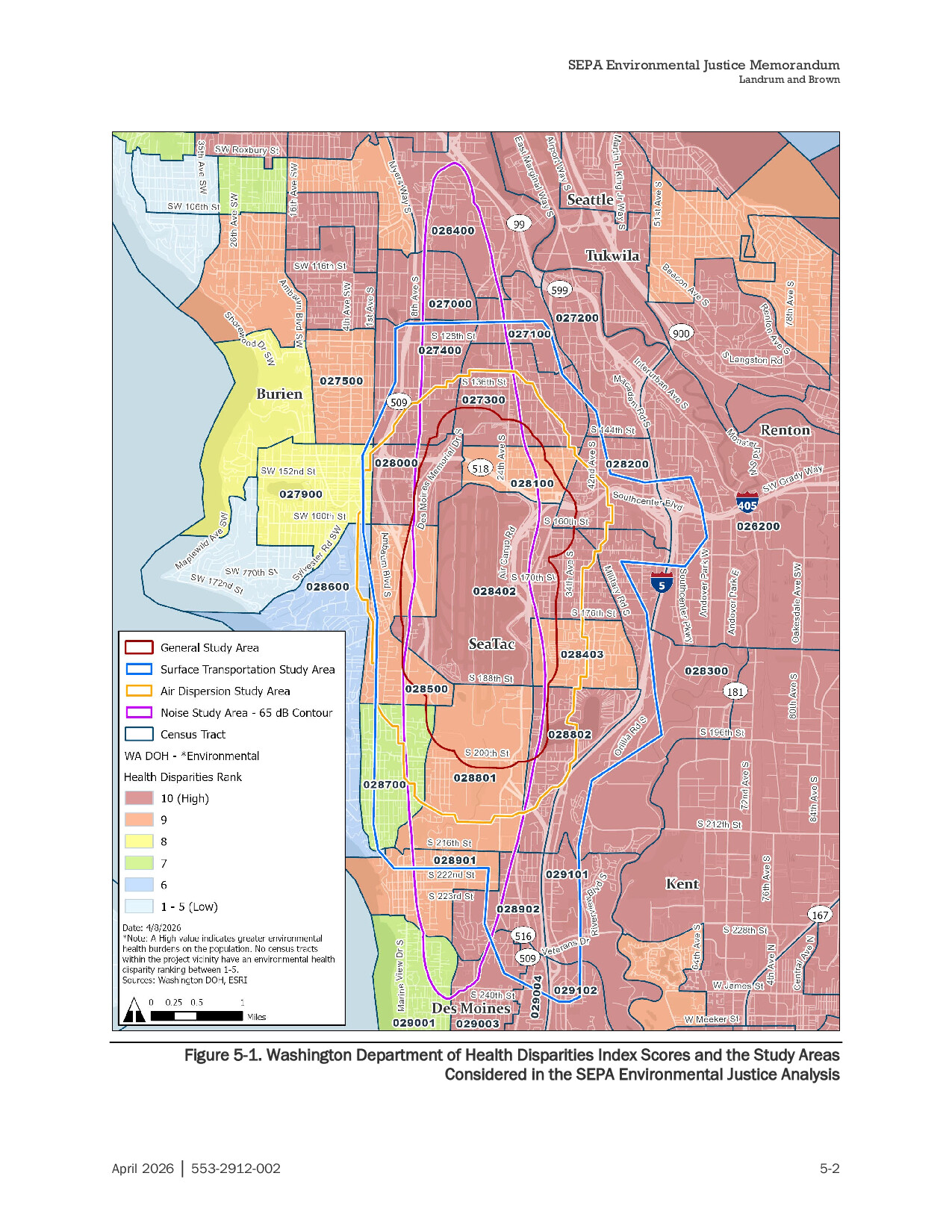
Appendix K SEPA Environmental Justice Disparities Map page 124
Figure 5-1 from a SEPA Environmental Justice Memorandum prepared by Landrum and Brown (document no. 553-2912-002, dated April 2026) maps Washington Department of Health Environmental Health Disparities Index scores across census tracts in the Sea-Tac Airport vicinity, including Seattle, Tukwila, Burien, SeaTac, Renton, Kent, and Des Moines. The map delineates four overlapping study areas—General Study Area, Surface Transportation Study Area, Air Dispersion Study Area, and Noise Study Area (65 dB contour)—over a background showing health disparity rankings ranging from 1–5 (Low) to 10 (High), with most tracts in the project vicinity ranked 9–10. -
 2026-08-07
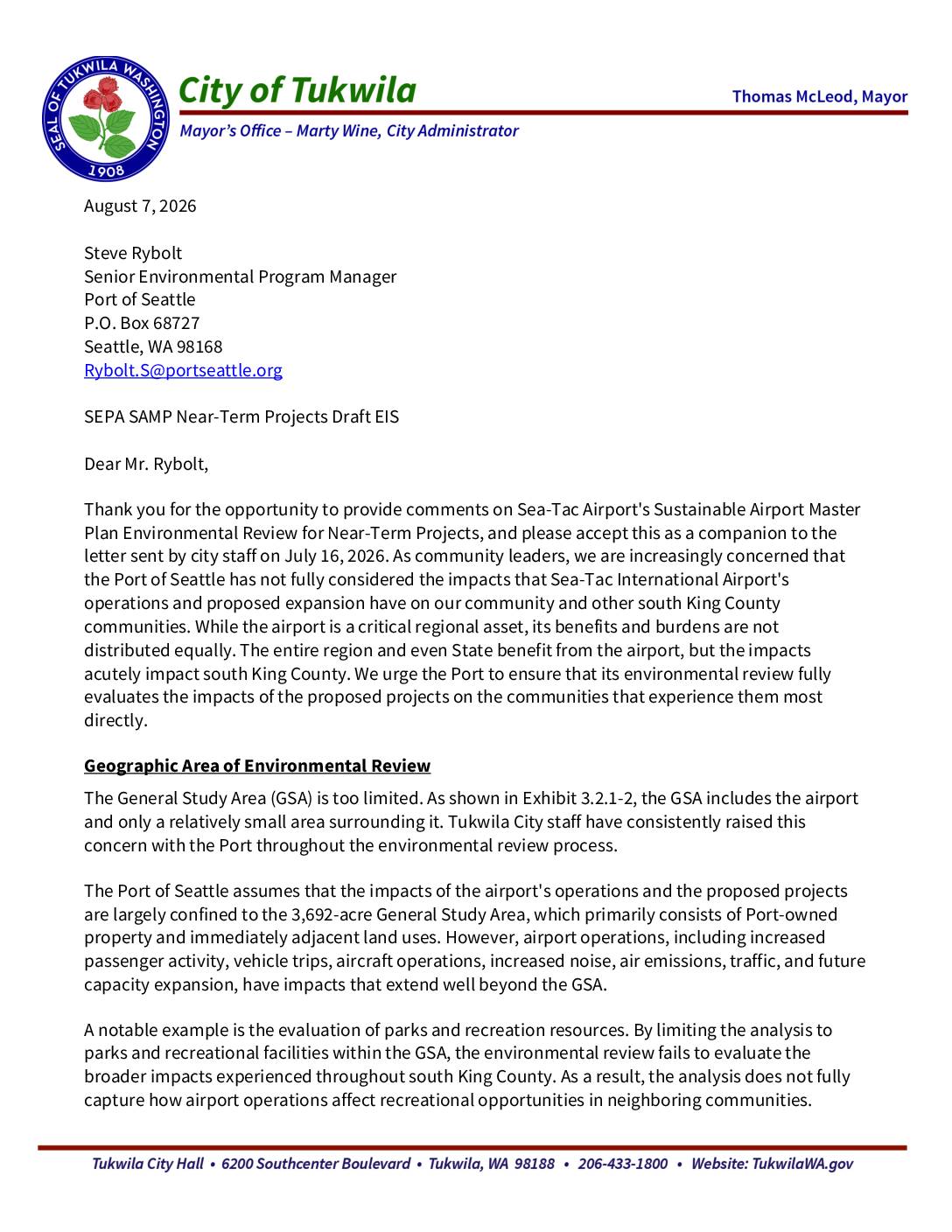
City of Tukwila Letter to Port Of Seattle on SEPA SAMP Near-Term Projects Draft EIS
Letter dated August 7, 2026 from Tukwila Mayor Thomas McLeod to Steve Rybolt, Senior Environmental Program Manager at Port Of Seattle, regarding the SEPA Sustainable Airport Master Plan (SAMP) Near-Term Projects Draft EIS. The City of Tukwila raises concerns that the 3,692-acre General Study Area (GSA) is too geographically limited to capture full impacts of -
 2026-04-01
2030 climate action plan
The City of Boston’s 2030 Climate Action Plan outlines strategies to achieve carbon neutrality by 2050, improve climate resilience, and advance environmental justice. The plan integrates greenhouse gas reduction and resilience measures while targeting health, justice, and quality-of-life outcomes for Boston residents. -
 2026-02-19
When Federal environmental maps go dark
The benefits and consequences for airport communities In January 2025, the Trump administration began removing content from federal websites following Executive Order 14151. The order directed all government agencies to terminate DEI and environmental justice–related programs. These include environmental justice and climate mapping using a nationally consistent dataset for evaluating the socioeconomic impacts of airports. -
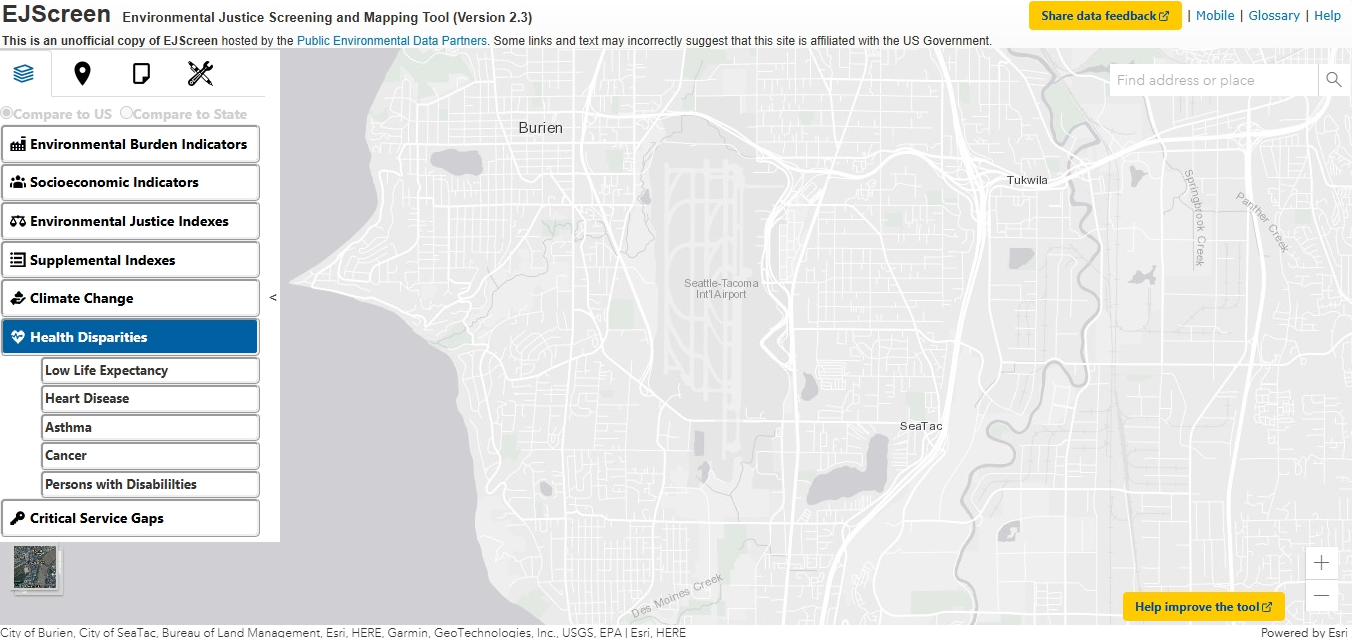
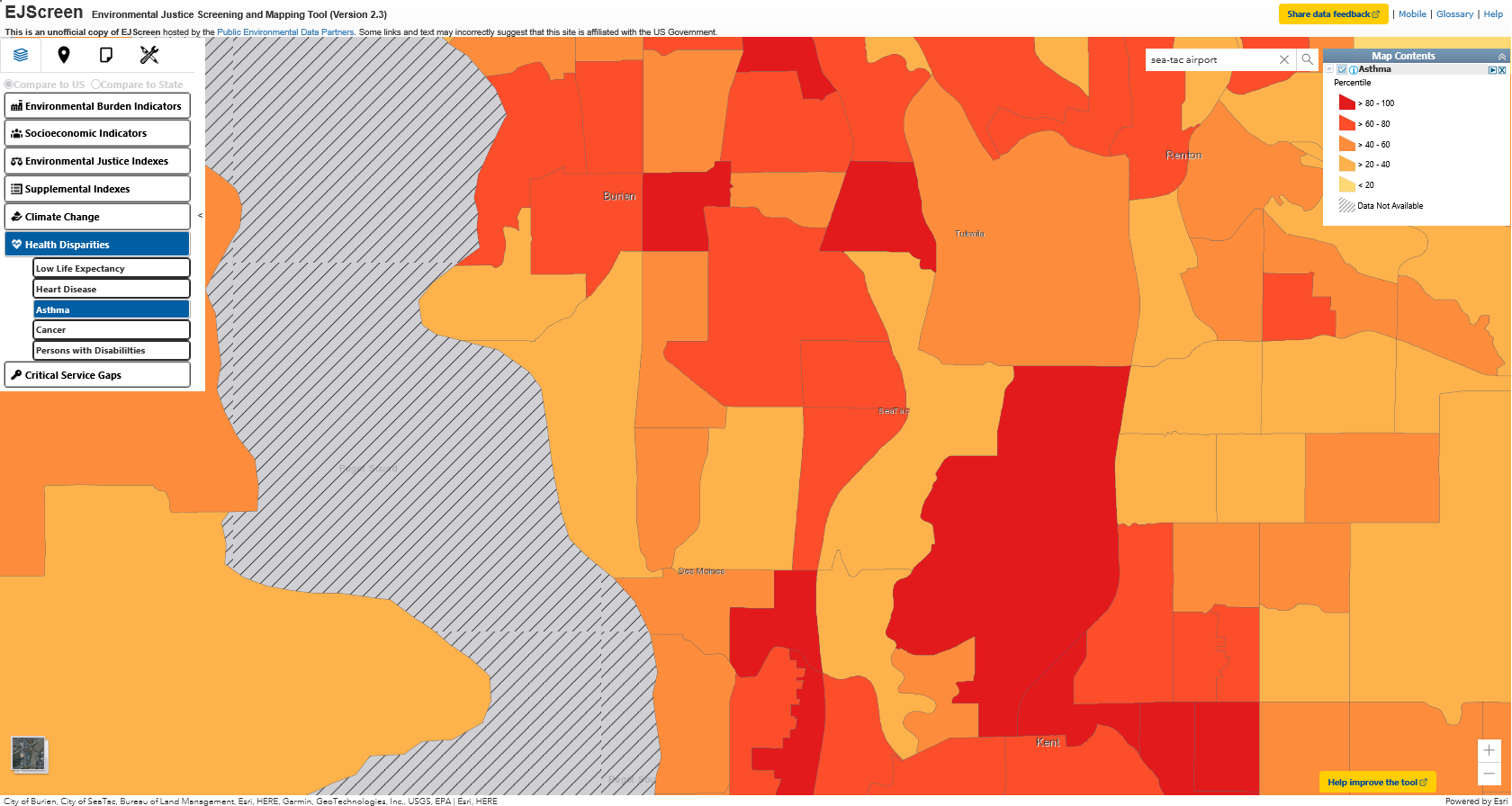
EJScreen Environmental Justice Screening and Mapping Tool (Version 2.3)
This is an 1unofficial copy of EJScreen hosted by the Public Environmental Data Partners. Some links and text may incorrectly suggest that this site is affiliated with the US Government. The EJScreen Tool was an EPA web application taken down in January of 2025 as part of Executive Order 14151. It was described as “an -
 2025-12-01
South Seattle Community 2025 Environmental Justice Report
A community report from the Washington State Department of Ecology providing information about air quality, demographic data, greenhouse gas emissions, and health impacts for the South Seattle community. The report identifies the community as overburdened and highly impacted by air pollution based on screening criteria. -
 2025-12-01
South King County Community 2025 Environmental Justice Report
An environmental justice report by the Washington State Department of Ecology’s Air Quality Program analyzing air pollution impacts in South King County communities. The report provides demographic data, air quality information, and health impact assessments for overburdened communities highly impacted by air pollution. -
 2025-10-14
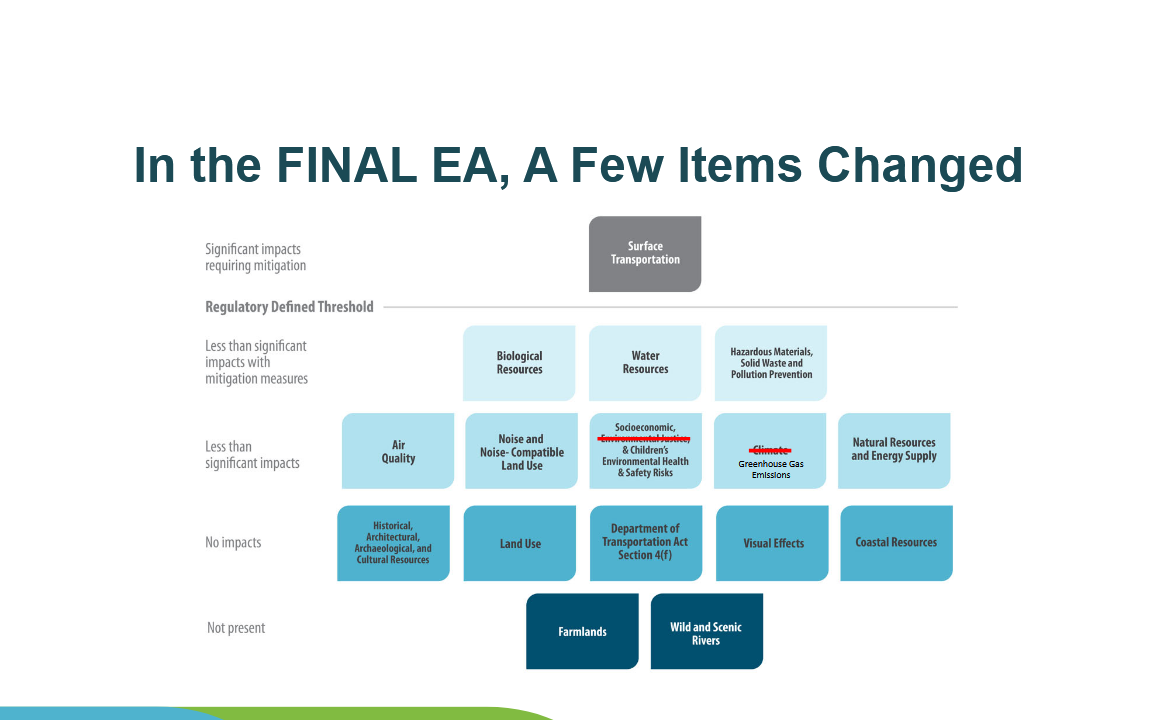
Final EA Impact Classification Chart
A slide titled 'In the FINAL EA, A Few Items Changed' presents a tiered matrix of environmental impact categories ranging from 'Significant impacts requiring mitigation' down to 'Not present.' Notable changes shown include 'Climate' being struck through and replaced with 'Greenhouse Gas Emissions,' and 'Environmental Justice' similarly struck through within the Socioeconomic category, indicating terminology revisions between draft and final Environmental Assessment versions. -
 2025-09-01
Appendix K: Children’s Environmental Health and Safety Risks, Socioeconomics, and Environmental Justice (NEPA Final EA and SEPA)
Appendix K of this environmental review examines socioeconomic conditions, environmental justice, and children's health and safety risks in the area surrounding the proposed project. It finds that 23.3% of the population in the study area is under 18—higher than both King County and statewide averages—and identifies two schools within the project boundary that could expose children to environmental health risks. The appendix also includes an economic impact analysis for the Northwest Seaport Alliance and a separate environmental justice memorandum prepared under Washington State's environmental review process.