Category : Correspondence(303)
-
 2022-07-06
Support Ordinance 2022-0011 regarding the health and climate impacts of King County International Airport (KCIA)
Letter from KCIACC and community organizations supporting Ordinance 2022-0011, which calls for environmental and health impact assessments at King County International Airport and establishment of a community-led advisory committee. The letter emphasizes the need for community benefits agreements and environmental justice for communities disproportionately impacted by airport operations. -
 2022-03-06
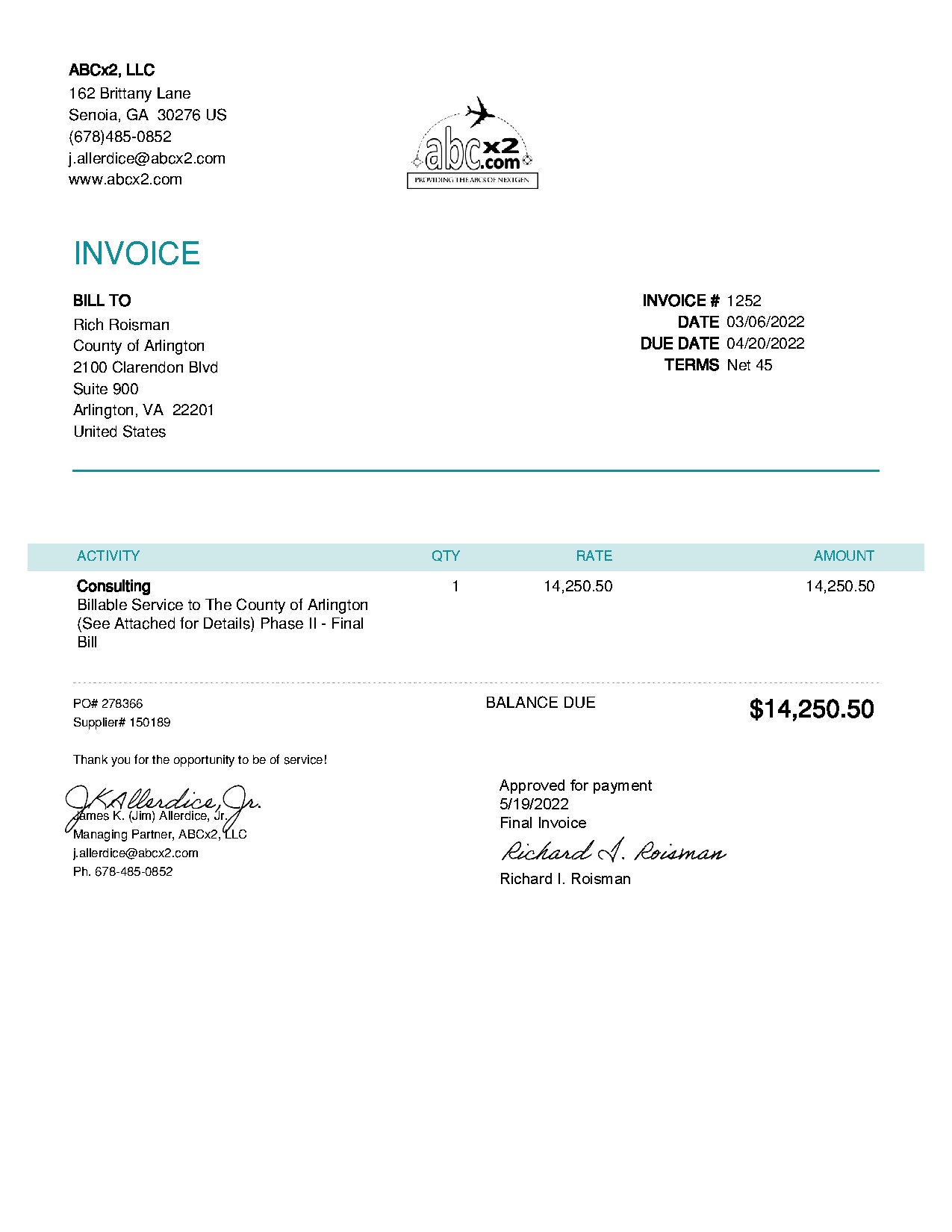
Invoice #1252 – ABCx2, LLC consulting services to County of Arlington, Phase II
ABCx2, LLC submitted Invoice #1252 to Arlington County for $14,250.50, representing the final bill for Phase II consulting services related to airport noise analysis, including tasks such as a Fly Quiet Report, Volume 3 Report, NADP 1 vs. 2 Analysis, and community engagement activities. The project spanned April 2021 through February 2022, totaling 532.6 hours and $150,000 in consulting fees billed at $250 per hour across a team of consultants. The invoice was approved for payment on May 19, 2022, by Arlington County's Richard I. Roisman. -
 2022-02-05
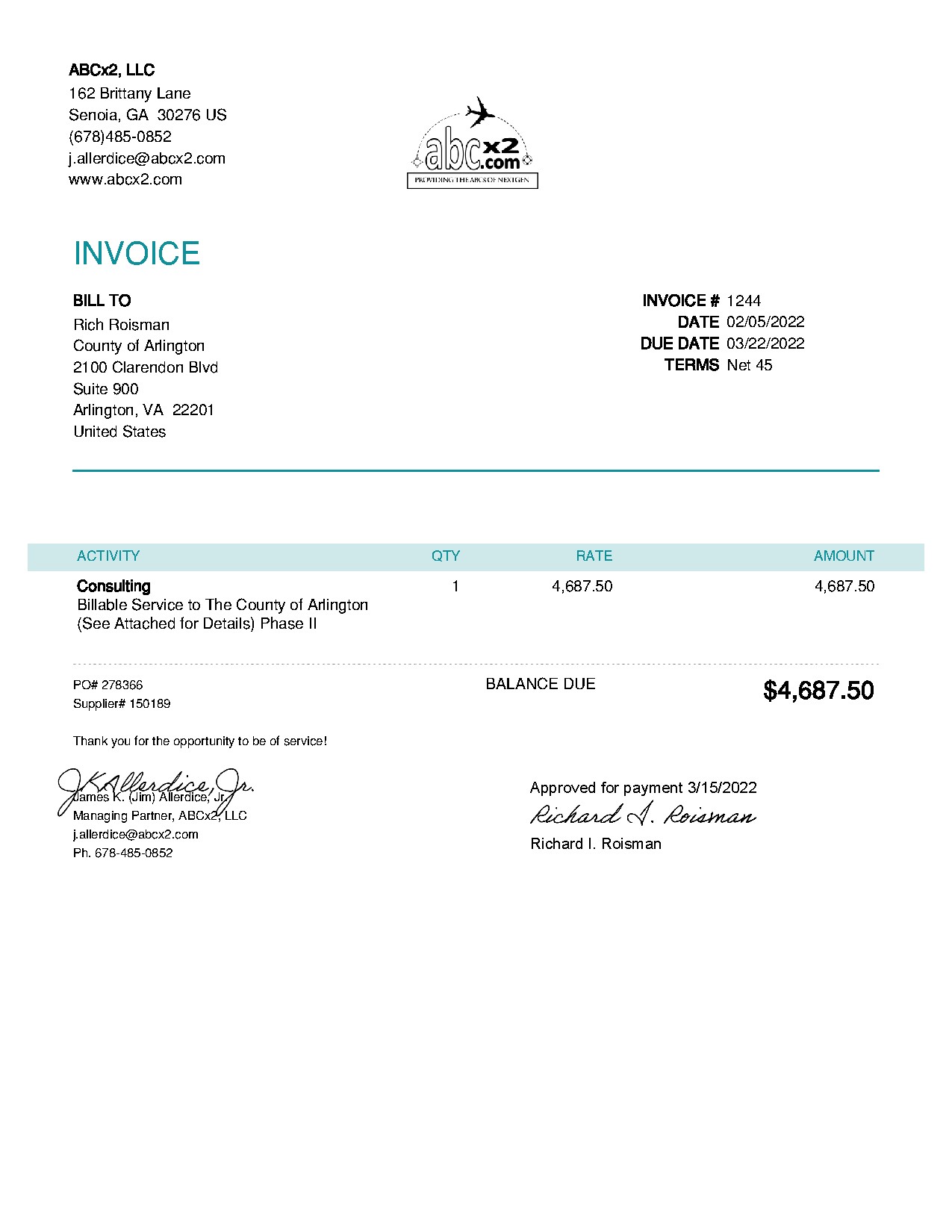
Invoice #1244 – ABCx2, LLC consulting services to County of Arlington, Phase II
ABCx2, LLC submitted Invoice #1244 to Arlington County on February 5, 2022, for $4,687.50 in Phase II consulting services related to airport noise mitigation and flight procedure analysis. The work, covering January 2022, included community meeting preparation, review of GPS approach procedures and Standard Instrument Departures (SIDs), and meetings with county officials and aviation stakeholders. The invoice represents part of a larger $150,000 Phase II project, of which approximately $133,249.50 had been billed through January 2022. -
 2022-01-04
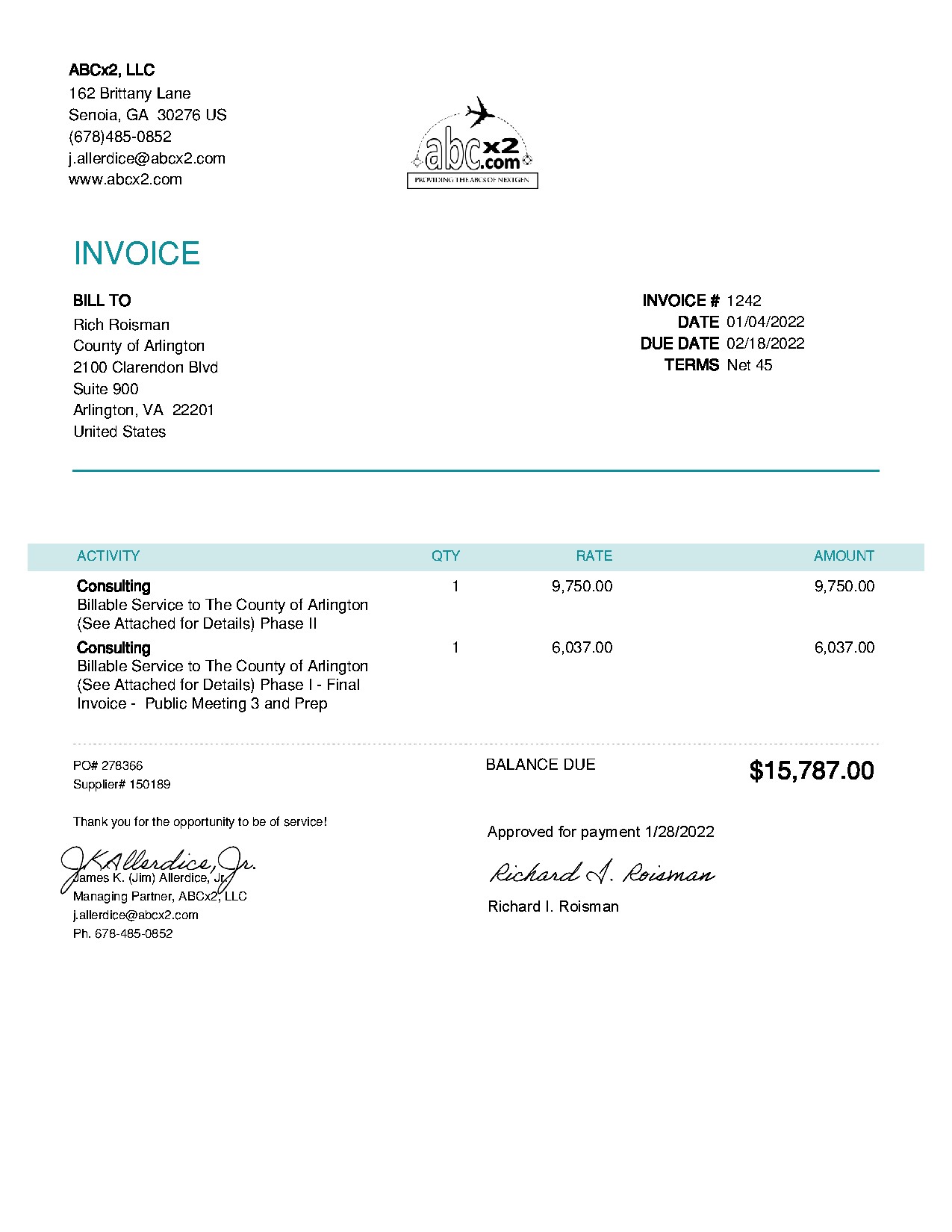
ABCx2, LLC invoice #1242 to County of Arlington
This document is an invoice dated January 4, 2022, from ABCx2, LLC to the County of Arlington for aviation consulting services totaling $15,787, covering Phase II work ($9,750) and the final Phase I public meeting activities ($6,037). An accompanying project budget summary shows the full consulting engagement spanned from April 2020 through December 2021, with a total project budget of $250,000 spread across multiple billing periods and consultant categories. The work appears related to NextGen air traffic modernization initiatives, focusing on safe, efficient, and environmentally responsible flight procedures. -
 2021-12-07
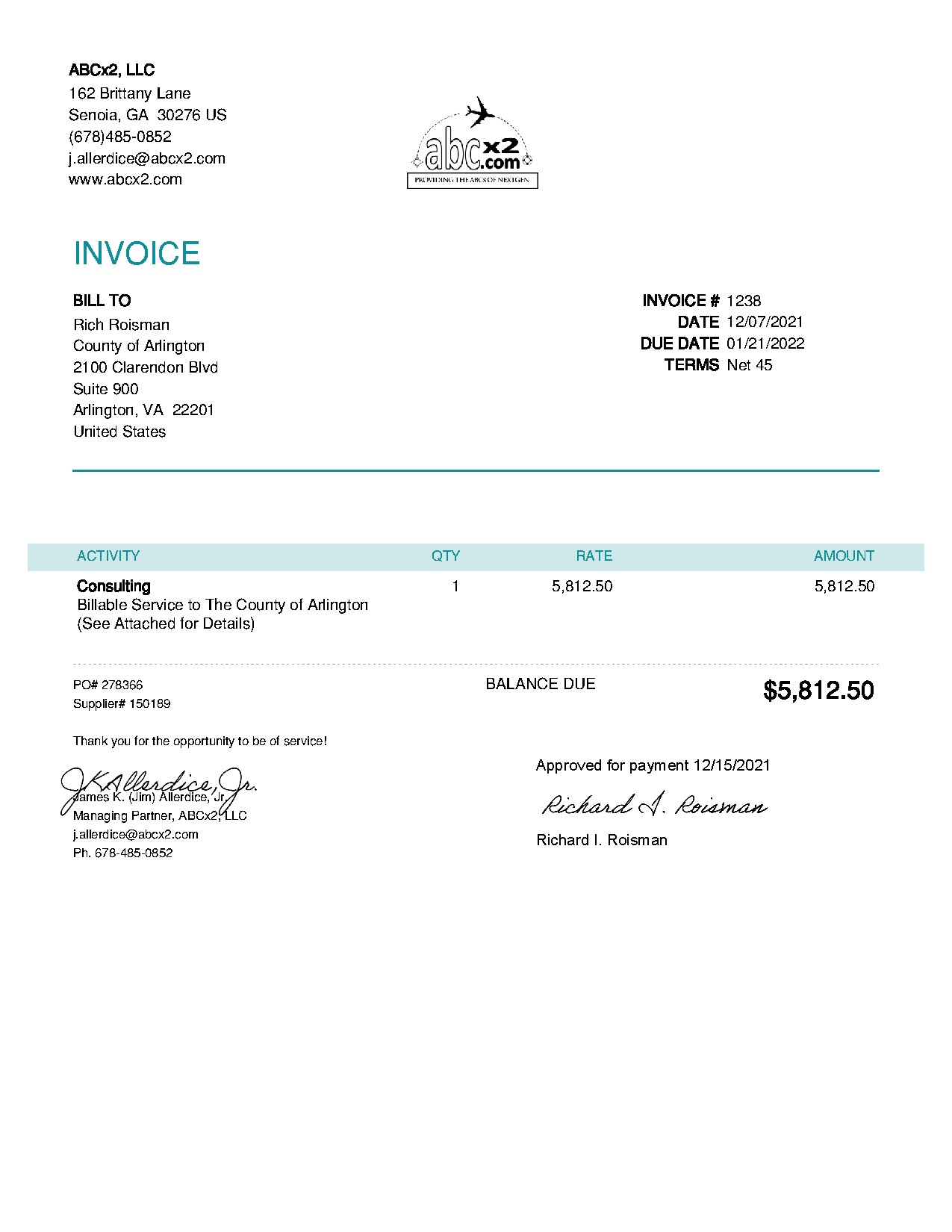
Invoice #1238 – ABCx2, LLC consulting services to County of Arlington
This document is an invoice and project billing summary from ABCx2, LLC to Arlington County, Virginia for consulting services related to Arlington - Phase II, a noise-optimization and airspace design project. Invoice #1238, dated December 7, 2021, covers 23.25 hours of work in November 2021 by consultants Jason, Jim, and Tim, totaling $5,812.50, with tasks including NOA design sessions, DCA SID design, and meetings and briefing development. Across the full project lifecycle, the team logged over 400 hours and $118,812 of a $150,000 budget through November 2021. -
 2021-11-05
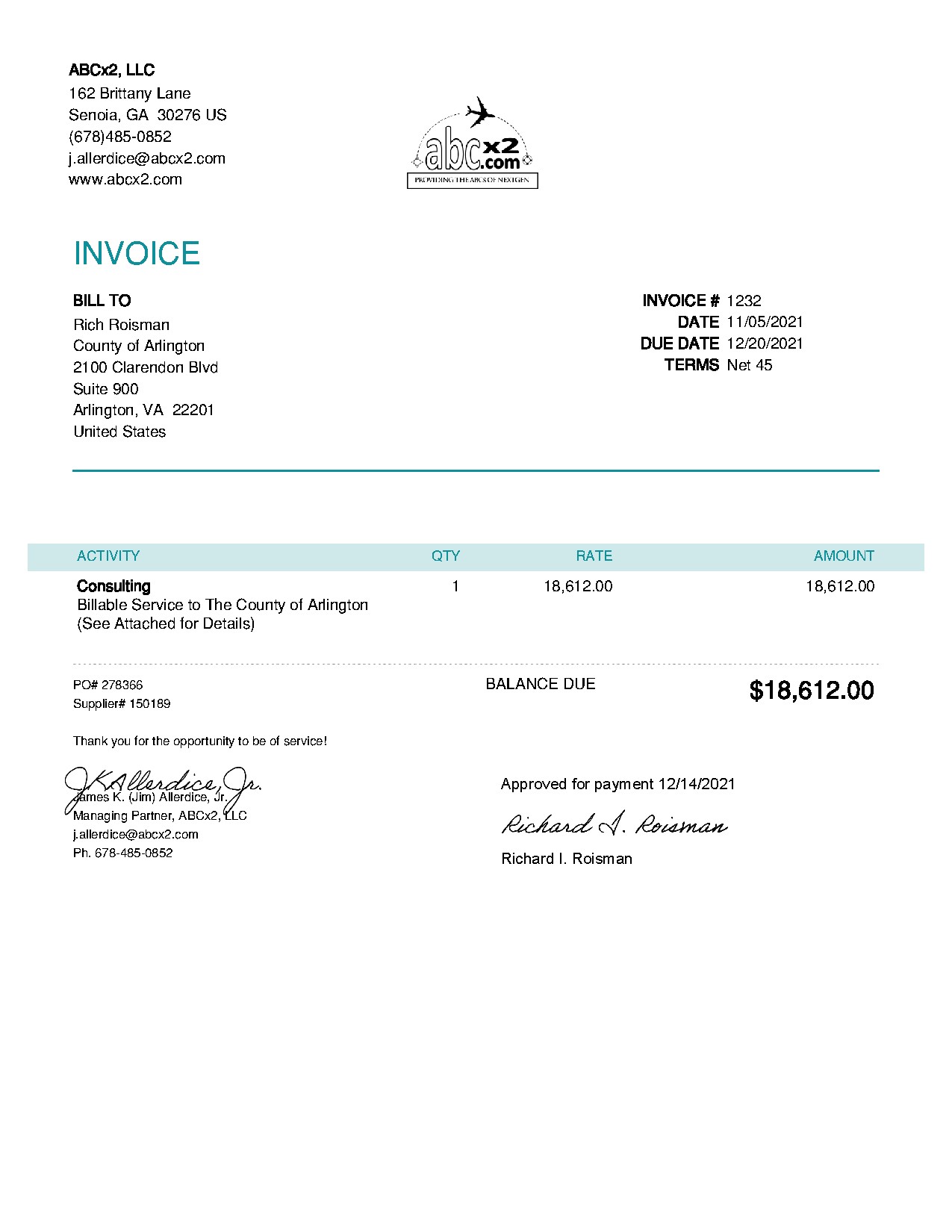
Invoice #1232 – ABCx2, LLC consulting services to County of Arlington
This invoice and supporting detail document a consulting billing of $18,612 submitted by ABCx2, LLC to Arlington County in November 2021 for aviation-related services during period 2021_10, including SID (Standard Instrument Departure) procedure design, noise analysis, whitepaper development, and FAA policy strategy meetings related to Ronald Reagan Washington National Airport (DCA). The work was performed by a team of consultants and subcontractors—including Vianair, who conducted flight design, noise analysis, and results visualization—as part of the larger Arlington Phase II project, which carried a total budget of $150,000 and had accumulated $112,999.50 in billings across seven periods. The invoice was approved for payment on December 14, 2021, by Arlington County's Richard I. Roisman. -
 2021-10-08
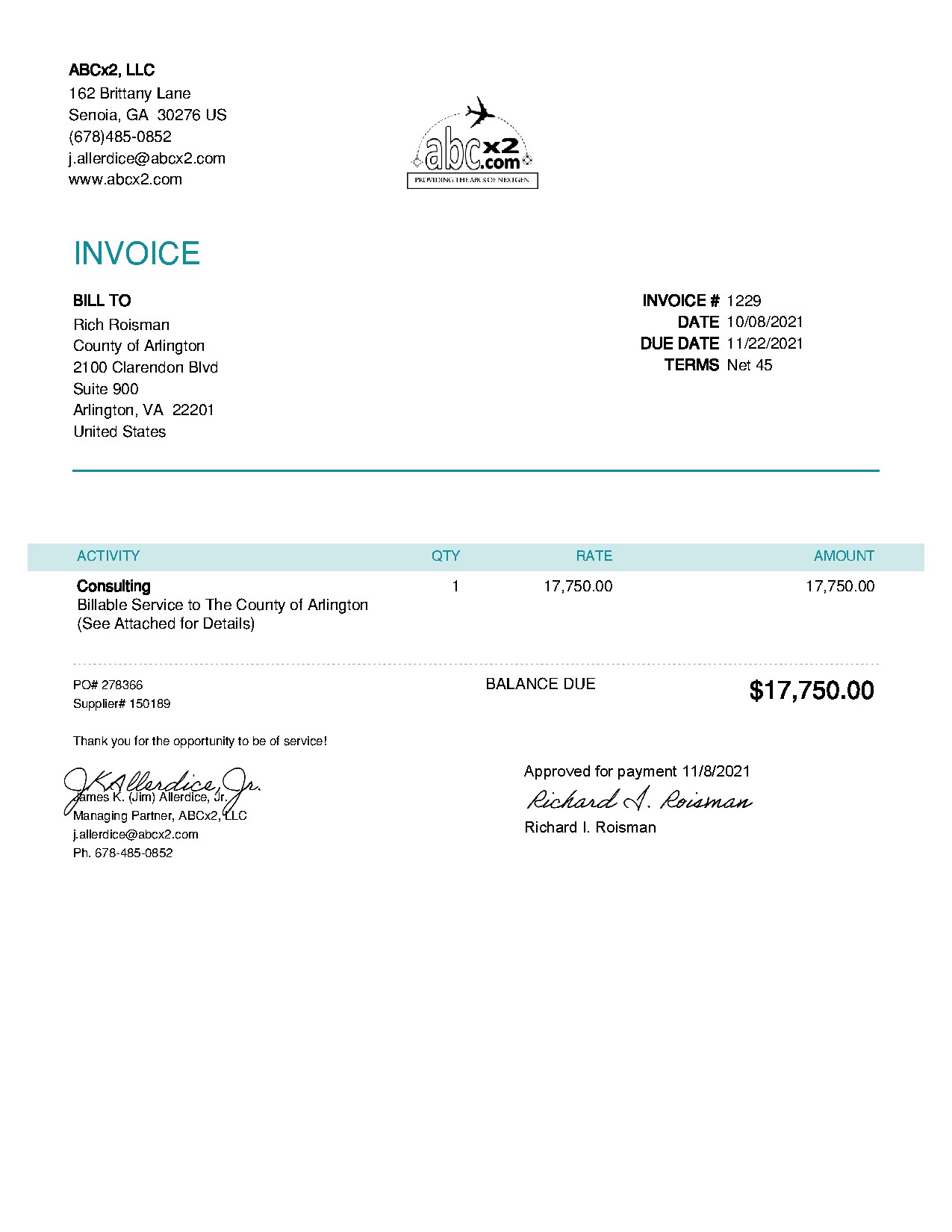
Invoice #1229 – ABCx2, LLC consulting services to County of Arlington
This document is an invoice dated October 8, 2021, from ABCx2, LLC to the County of Arlington, Virginia, for $17,750 in consulting services related to aviation noise policy work, including SID (Standard Instrument Departure) design meetings, white paper drafting, and flight tracking analysis. The attached billing detail shows the work was performed in September 2021 by a team including aviation consultants and a flight analysis firm called Vianair, with tasks involving FAA coordination and NextGen Advisory Committee engagement. The invoice represents one installment of a broader Phase II project with a total budget of $150,000, of which approximately $94,387 had been billed through September 2021. -
 2021-06-22
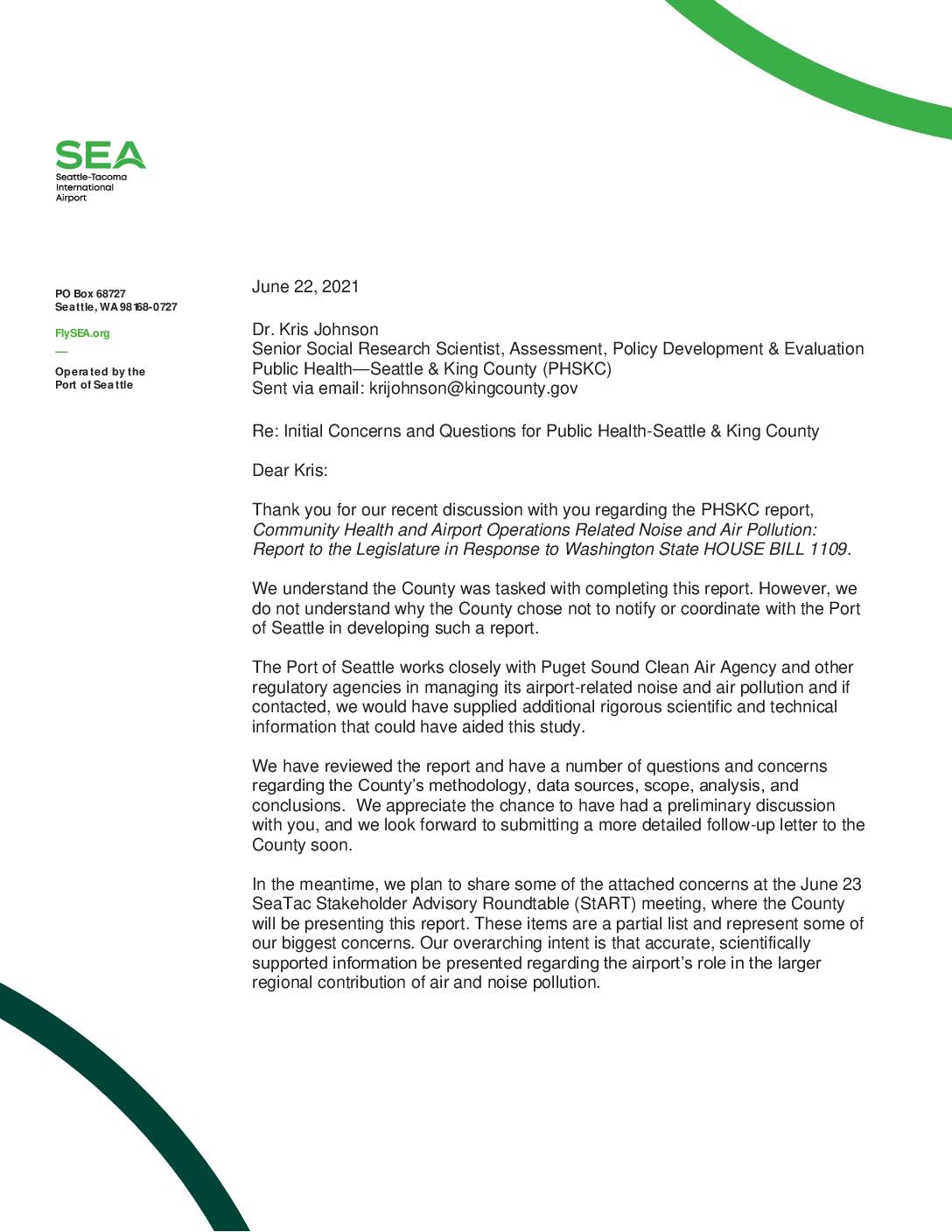
Initial concerns and questions for Public Health-Seattle & King County
In a June 22, 2021 letter, Seattle-Tacoma International Airport (operated by the Port of Seattle) raised formal concerns about a Public Health–Seattle & King County report examining community health impacts from airport-related noise and air pollution. The Port objected that it was not consulted during the report's development and questioned the methodology, noting that SEA aircraft account for only about 0.25% of total PM2.5 emissions in the region. The letter calls for a more rigorous toxicity assessment and asks how other contributing health factors—such as smoking rates and access to medical care—were accounted for before drawing conclusions about the airport's health impacts. -
A letter to Representative Adam Smith: Conservation
Representative Smith, I had a conversation yesterday with your wonderful aide . I mentioned the idea of bringing ‘conservation’ into the discussion of air travel and she must have thought I was nuts. It is hard to explain to younger people how much Americans used to glamourise cars. The idea that we might ever feel -
A letter to the Commissioners of the Port of Seattle re. the SAMP and COVID-19
Commissioners, After many years of preparation, the Sustainable Airport Master Plan (SAMP) will finally swing into gear this summer. For me, there is an eerie resemblance between today and the last expansion at Sea-Tac Airport–the Third Runway. As you know, the Port was granted permission to begin construction of the Third Runway in 1996 based