TagGreener Skies(28)
-
 2024-05-11
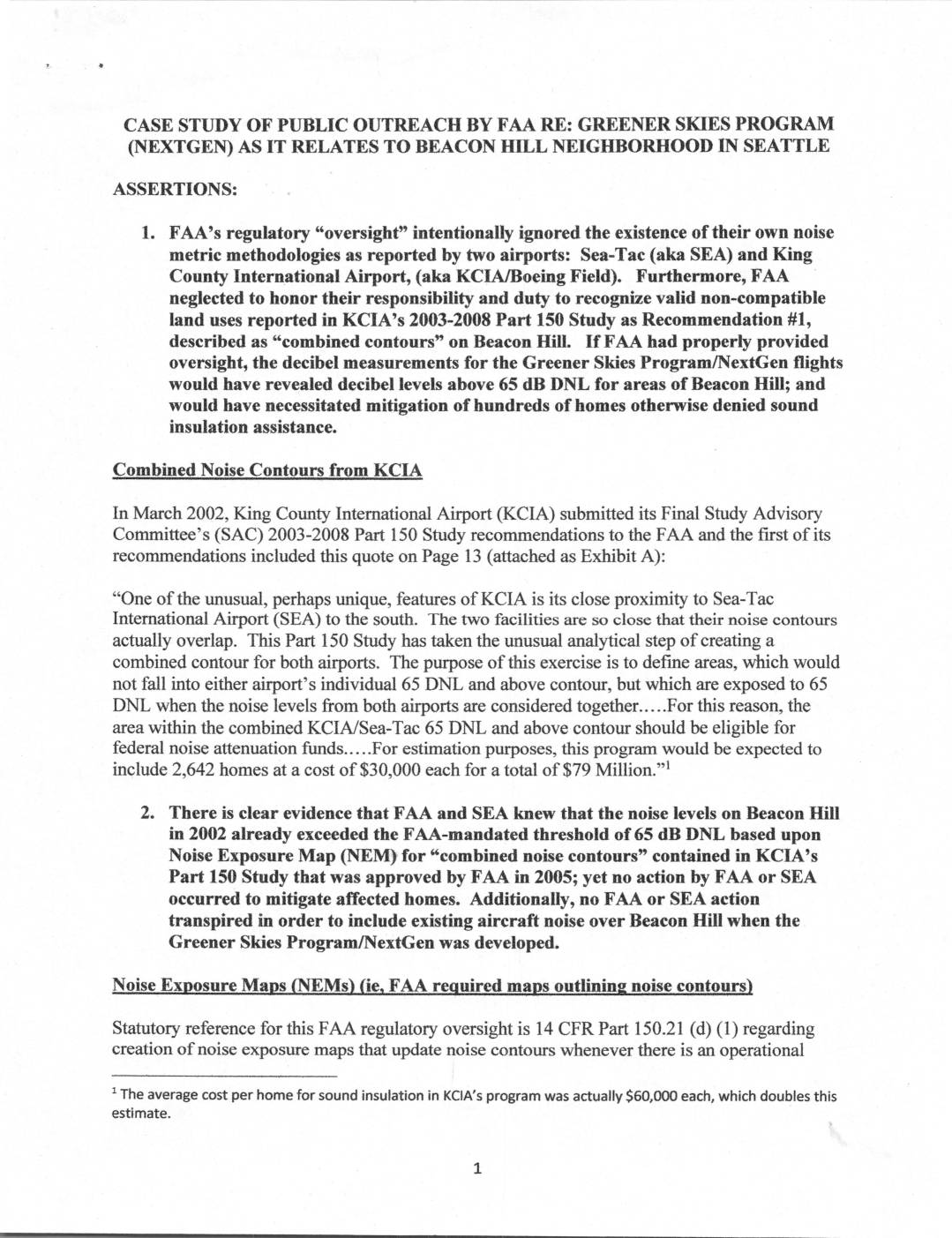
Case study of public outreach by FAA re: Greener Skies Program (NextGen) as it relates to Beacon Hill neighborhood in Seattle
This document argues that the FAA and Sea-Tac Airport failed to properly account for combined aircraft noise from both Sea-Tac and Boeing Field when approving the Greener Skies/NextGen flight program, leaving hundreds of Beacon Hill homes without sound insulation assistance they may have been entitled to. A 2002 King County International Airport study had already identified that noise levels in parts of Beacon Hill exceeded the 65 dB DNL federal threshold when both airports' noise was measured together, yet no mitigation was provided. The document also highlights that no public outreach was conducted in the Beacon Hill neighborhood—a majority-Asian, multilingual community—before the new flight paths were implemented. -
 2024-05-11
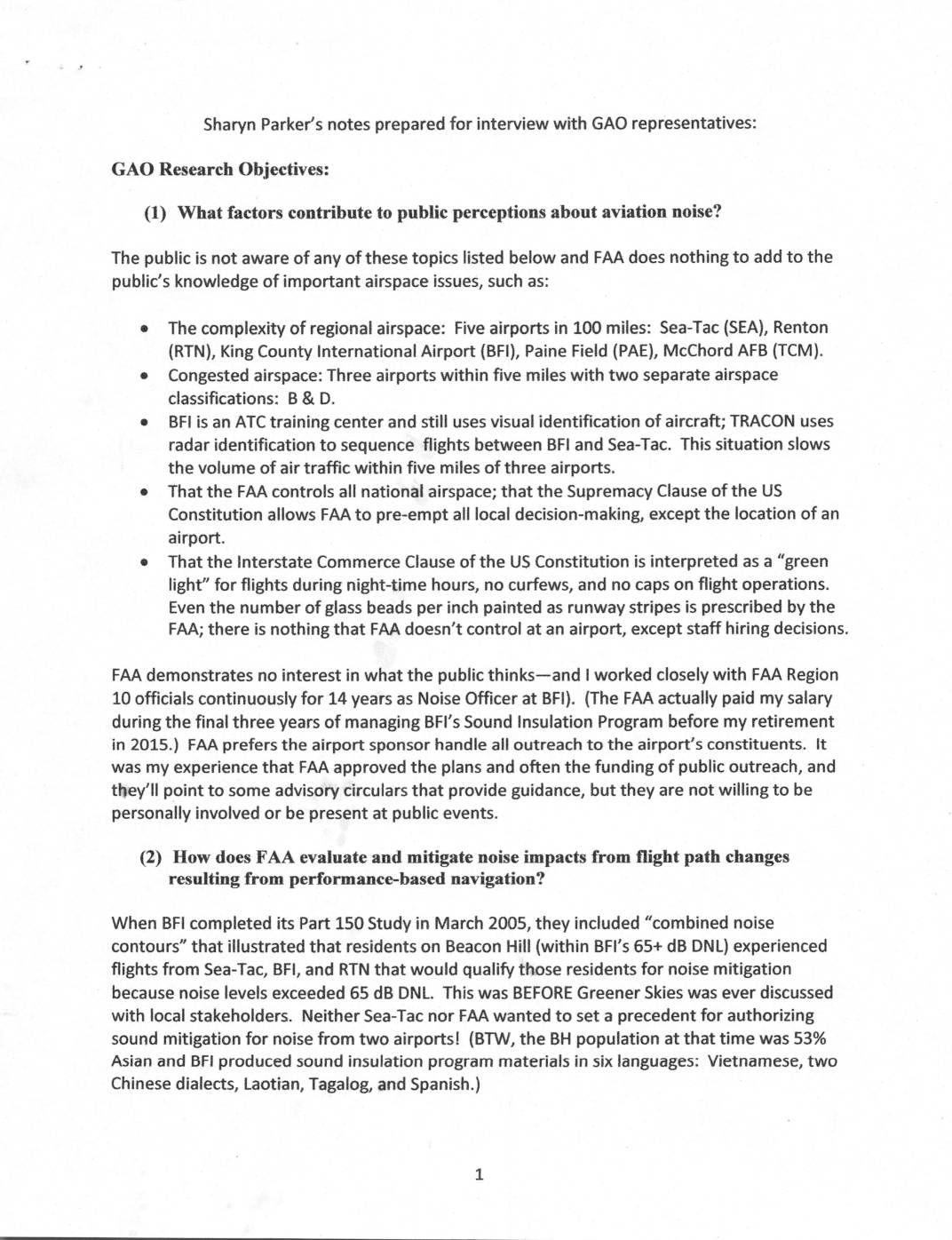
Sharyn Parker’s notes prepared for interview with GAO representatives
Former King County International Airport (BFI) Noise Officer Sharyn Parker's prepared notes for a GAO interview outline significant concerns about FAA regulatory failures and Sea-Tac Airport's inadequate noise mitigation practices in the Seattle region. Parker argues that the FAA has consistently failed to require Sea-Tac to update noise exposure maps, enforce timely sound mitigation programs, or conduct meaningful public outreach — particularly for minority communities disproportionately affected by flight path changes like the Greener Skies/RNP initiative. The notes also highlight contradictions between Sea-Tac's deliberately low flight-operation projections in its Part 150 noise studies and the far higher growth figures used in its capital development plans. -
 2024-05-11
Read this, to start understanding the ‘Greener Skies’ fraud
The 'Greener Skies' program, approved by the FAA in late 2012 and promoted by the FAA and Port of Seattle, promised to dramatically reduce aircraft noise near Sea-Tac Airport by routing more than half of all arrivals over Elliott Bay, far from residential areas. Critics argue the program was fundamentally flawed and never delivered on its promises, as air traffic controllers rarely use the Elliott Bay routes due to the need to merge east- and west-side arrival streams. FAA and industry's own data are cited as evidence that the program amounted to an environmental fraud, with concentrated flight paths continuing to impact west-side communities while east-side routes were never given equivalent precision procedures. -
 2023-04-24
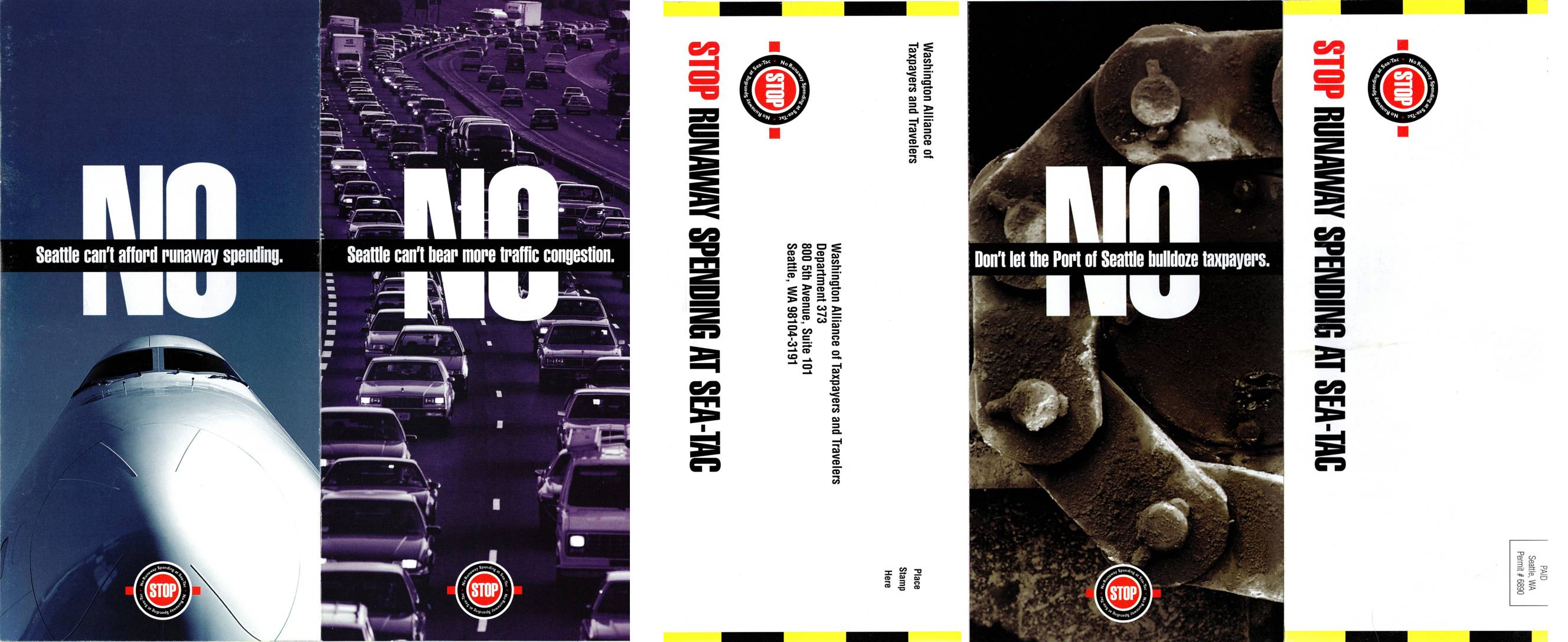
Stop Runaway Spending at Sea-Tac: WATT Campaign Mailer
This campaign mailer from the Washington Alliance of Taxpayers and Travelers (WATT) opposes the Port of Seattle's plan to build a third runway at Sea-Tac Airport, calling it a billion-dollar 'boondoggle' that would take four years to construct and burden the region with overwhelming truck traffic. The group warns that the project would require moving 26 million cubic yards of dirt via 2,000 trucks per day through neighborhoods across the Puget Sound region, and that taxpayers could face property tax increases of over 60% if airline fees fall short of covering costs. Residents are urged to contact the Port of Seattle and mail in an attached postcard to oppose the runway expansion. -
Screen Shot 2012 09 14 at 5.21.15 PM
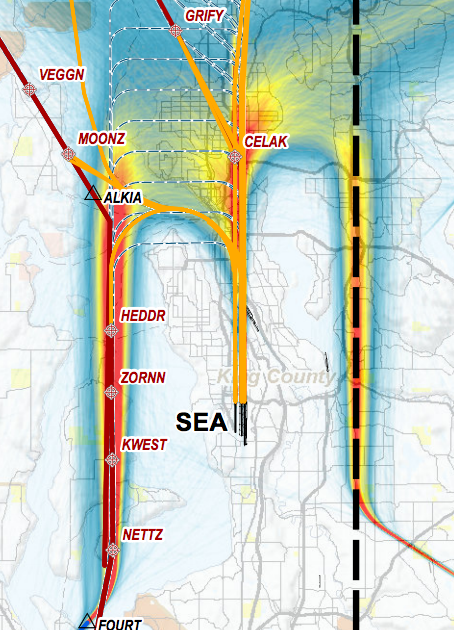
A noise exposure or flight track density map centered on Seattle-Tacoma International Airport (labeled 'SEA'), showing instrument fixes/waypoints including GRIFY, VEGGN, MOONZ, CELAK, ALKIA, HEDDR, ZORNN, KWEST, NETTZ, and FOURT over King County, Washington. Heat-map coloring (red/orange/yellow/blue) indicates noise or traffic concentration levels along approach and departure corridors. -
vTFCQVDfpjAtQMX 800×450 noPad
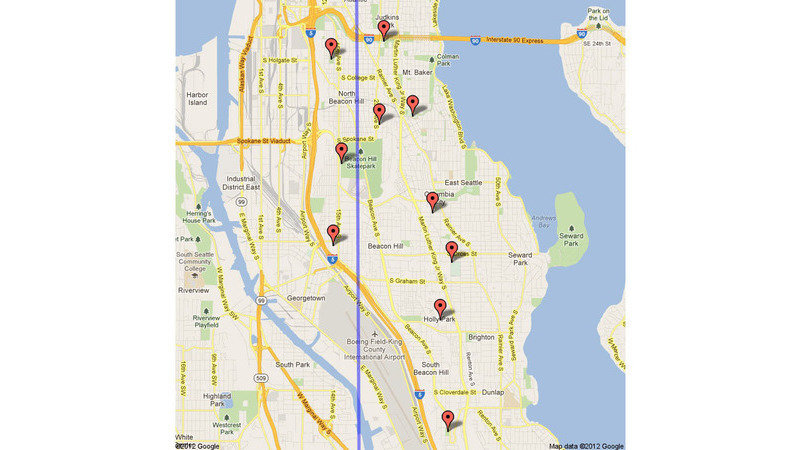
A Google Maps screenshot (watermarked '©2012 Google') showing the Beacon Hill, Georgetown, and South Seattle neighborhoods near Boeing Field/King County International Airport. Multiple red map pins mark specific locations along a north-south corridor, with a vertical blue line overlaid, likely indicating noise-impact sites or complaint locations relative to flight paths. -
FAA-Greener-Skies-Initial-Benefits-of-RNPe-at-Seattle-International-Airport (1)
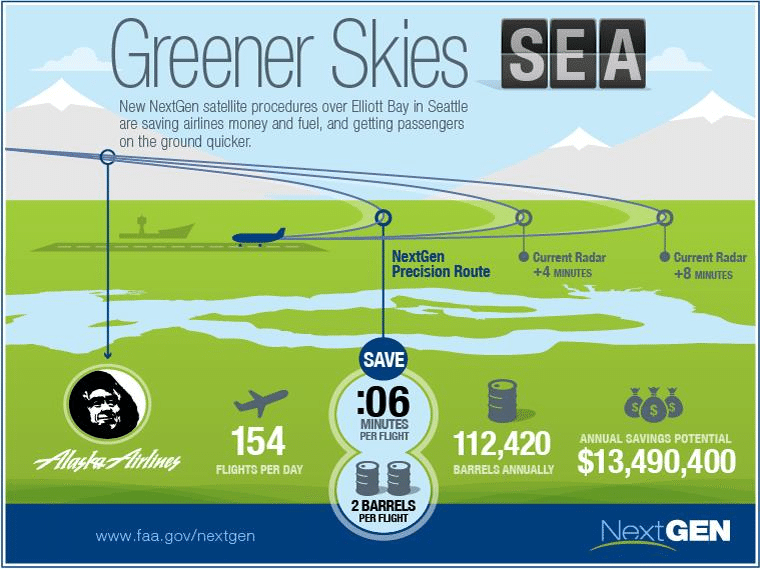
An FAA NextGen infographic promoting the 'Greener Skies' satellite precision navigation procedures over Elliott Bay at Seattle-Tacoma International Airport (SEA). It highlights Alaska Airlines' 154 daily flights saving 6 minutes per flight, 2 barrels of fuel per flight (112,420 barrels annually), and an annual savings potential of $13,490,400, sourced from www.faa.gov/nextgen. -
 2018-10-25
As Sea-Tac Airport traffic booms, distant neighborhoods are noisy despite FAA plan
Sea-Tac Airport traffic is growing rapidly and set to expand further as the region’s economy booms. But in cities from Shoreline to Des Moines, airplane noise is raising increased concern among residents. Promised relief from a project called “Greener Skies over Seattle” never materialized. By Dominic Gates Seattle Times aerospace reporter After more than two -
 2018-09-24
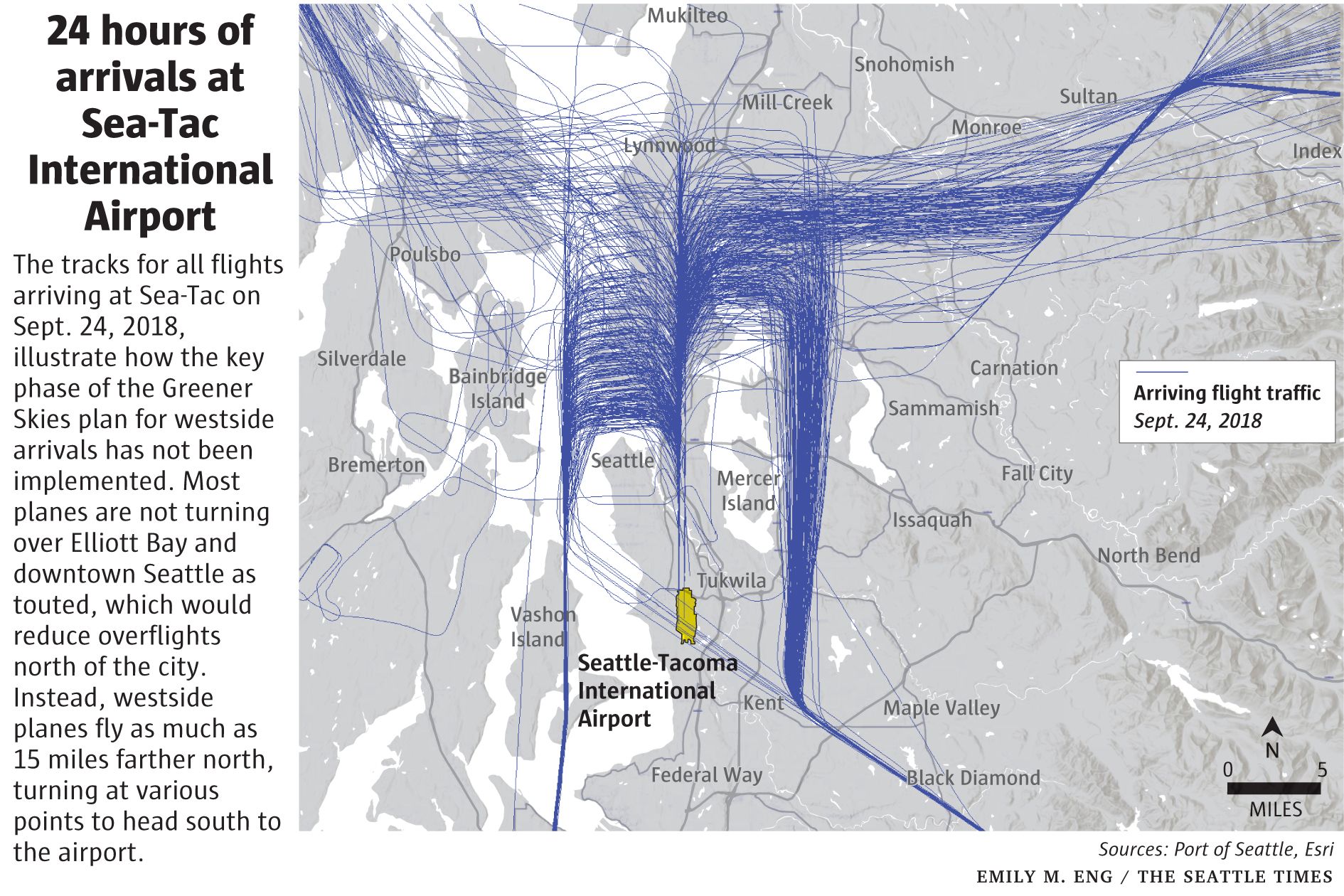
Seattle Times 24 hours of arrivals at Sea-Tac Greener Skies not implemented on west side of zipper merge
A flight-track map published by The Seattle Times (graphic by Emily M. Eng, sources: Port of Seattle and Esri) showing all arriving flights at Seattle-Tacoma International Airport on September 24, 2018. The graphic illustrates that the Greener Skies plan's westside-arrival procedure had not been implemented as designed, with planes flying up to 15 miles farther north than intended rather than turning over Elliott Bay and downtown Seattle. -
 2017-12-11
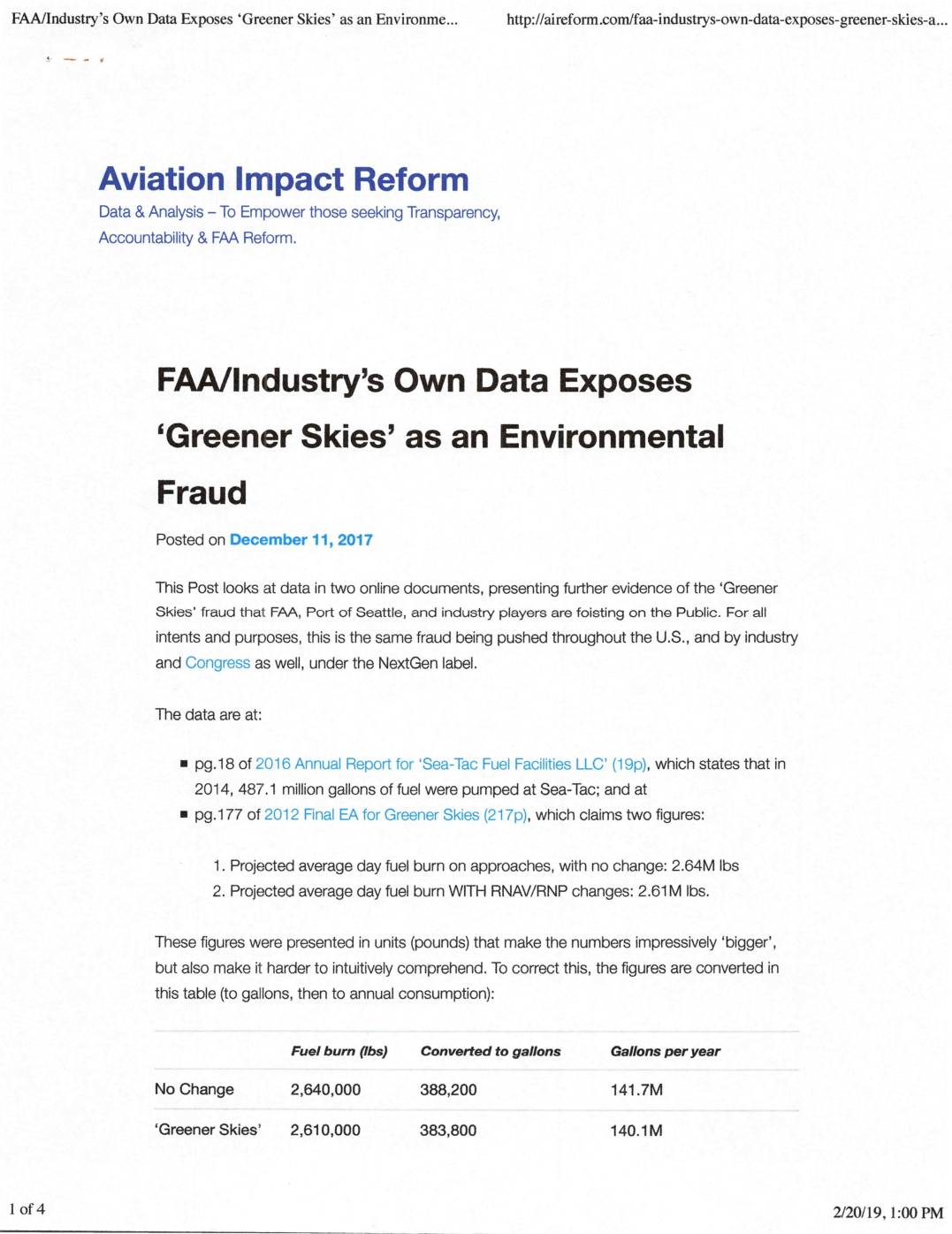
FAA/Industry’s own data exposes ‘Greener Skies’ as an environmental fraud
An analysis of FAA and industry data argues that the 'Greener Skies' flight procedure changes at Seattle-Tacoma International Airport provided negligible environmental benefits, saving only about 1.6 million gallons of fuel annually — less than one-third of one percent of the airport's total fuel consumption. Meanwhile, actual fuel use at Sea-Tac grew by hundreds of millions of gallons per year due to increased flight operations, completely overshadowing the claimed savings. The article contends that the program was essentially a public relations campaign that shifted noise burdens onto surrounding neighborhoods without delivering meaningful environmental improvements.