TagPBN(10)
-
 2026-05-29
ANES 2026 MAA BWI Vianair 0004
Presentation slides from the Maryland Aviation Administration (MAA) and BWI Marshall Airport Roundtable Technical Subcommittee covering aviation noise outcomes and next steps. Topics include expanded DNL contours below 65DNL, separation of East and West Flow contours, NextGen implementation impacts, FAA Instrument Flight Procedure (IFP) Gateway filing, and an upcoming 14 CFR Part 150 Study beginning -
 2026-04-02
Planes Overhead: How Airplane Noise Impacts Home Values
MIT CEEPR Working Paper 2026-06 by Florian Allroggen, R. John Hansman, Christopher R. Knittel, Jing Li, Xibo Wan, and Juju Wang estimating the causal effect of aviation noise on housing prices using quasi-experimental variation from FAA rollout of performance-based navigation (PBN) procedures and runway reconfigurations at three major U.S. airports. Using a difference-in-differences hedonic price -
 2026-04-02
Planes Overhead: How Airplane Noise Impacts Home Values
MIT CEEPR Working Paper 2026-06 by Florian Allroggen, R. John Hansman, Christopher R. Knittel, Jing Li, Xibo Wan, and Juju Wang estimating the causal effect of aviation noise on housing prices using quasi-experimental variation from FAA rollout of performance-based navigation (PBN) procedures and runway reconfigurations at three major U.S. airports. Using a difference-in-differences hedonic price -
 2025-12-09
Vashon Island Fair Skies – What changed?
A document explaining changes to aircraft arrival patterns at SeaTac airport around 2015, including the introduction of Performance Based Navigation (PBN) technology and lowered flight altitudes. The changes concentrated flight paths over Vashon Island in a narrow corridor, causing increased noise pollution for residents who chose to live there for its peaceful environment. -
 2025-10-01
NBER: How airplane noise impacts home values, October 2025
NBER Working Paper No. 34431 by Florian Allroggen, R. John Hansman, Christopher R. Knittel, Jing Li, Xibo Wan, and Juju Wang (MIT, Tufts, University of Connecticut), October 2025. Estimates causal effect of aviation noise on U.S. housing prices using quasi-experimental variation from FAA performance-based navigation (PBN) procedures and runway reconfigurations at three major U.S. airports. -
 2024-05-11
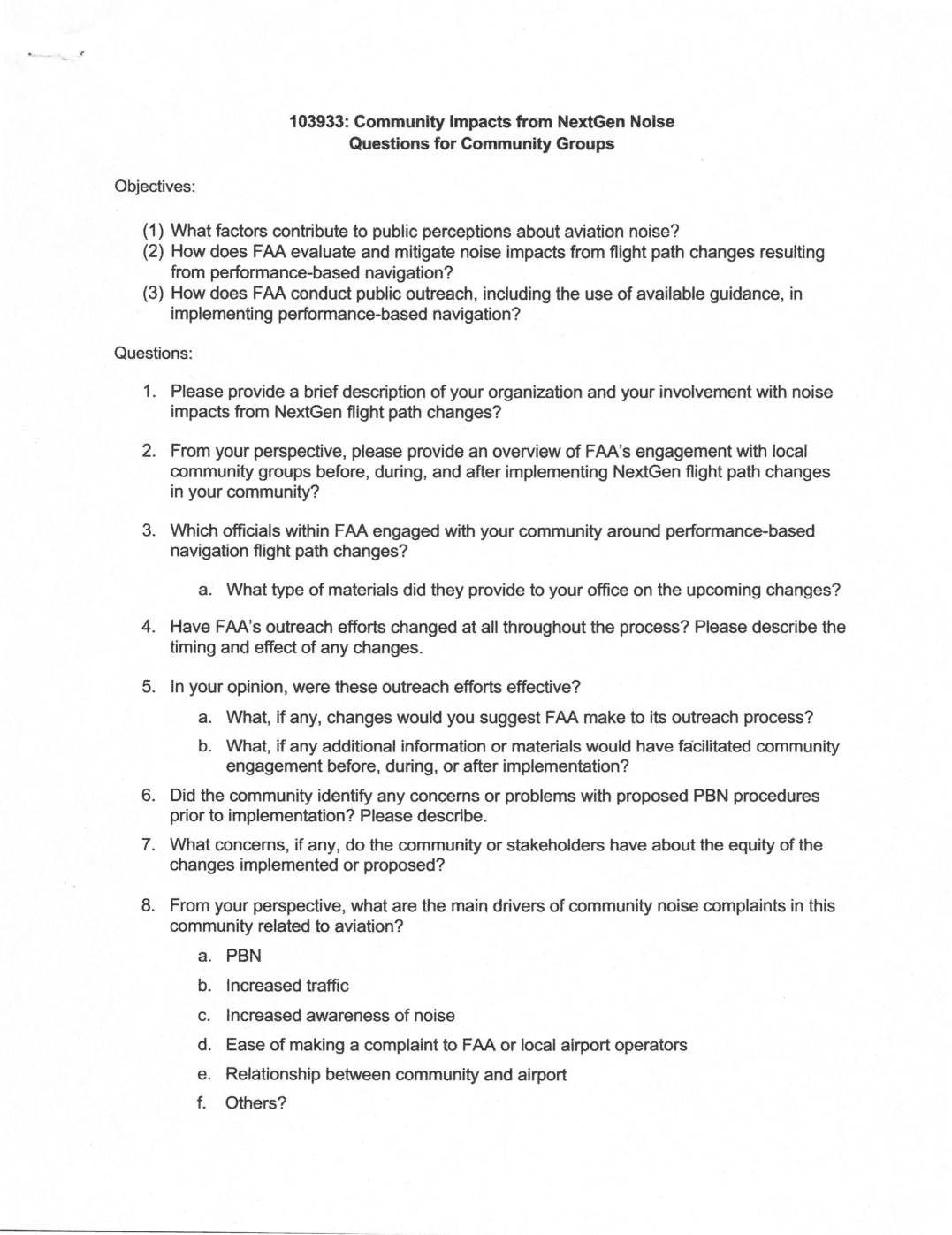
Community impacts from NextGen noise: Questions for community groups
This document contains a structured set of interview questions developed for a GAO study (project 103933) examining how NextGen flight path changes have affected local communities through increased aviation noise. The questions are directed at community groups and cover topics including FAA outreach efforts before and after implementation, equity concerns, the drivers of noise complaints, and whether any flight path modifications were sought or made following implementation. It aims to assess how effectively the FAA communicated with and involved communities in performance-based navigation (PBN) decisions. -
 2021-02-01
Dispersion in the Age of RNAV Jim Allerdice, Jr. ABCx2 ANES
This 2021 presentation by aviation consultant Jim Allerdice examines 'dispersion' — the practice of intentionally varying flight paths so that aircraft noise is spread across a wider area rather than repeatedly concentrated over the same neighborhoods. It explores the tension between the FAA's preference for Performance-Based Navigation (PBN/RNAV), which promotes precise, repeatable flight paths for safety and efficiency, and the concerns of communities living under those concentrated flight corridors. The material is relevant to ongoing debates about how airports like Sea-Tac can balance operational efficiency with equitable distribution of aircraft noise impacts. -
 2019-08-27
FAA has made progress in implementing its Metroplex program, but benefits for airspace users have fallen short of expectations
A 2019 U.S. Department of Transportation Inspector General report found that the FAA's Metroplex program—designed to modernize flight routes using satellite-based navigation in busy metropolitan areas—fell significantly short of its promised benefits, delivering only $31.1 million in annual savings compared to the $61.6 million minimum originally projected. The program also faced delays of up to four years, driven largely by community concerns about aircraft noise, which is directly relevant to ongoing noise issues around airports like Sea-Tac. Key obstacles such as unclear pilot-controller terminology and a slow procedure amendment process remained unresolved at the time of the report. -
Why is it getting so much worse? (NextGen For Dummies)
Spoiler alert: The answer is not ‘The Third Runway’. However, you might call the current situation for residents in certain neighborhoods around Sea-Tac Airport a ‘Perfect Storm’. What’s The Frequency, Kenneth? Yes, there has been a great deal of growth in the number of daily operations. First, there is the fact that in 2012 Delta -
 2013-04-01
NextGen air transportation system: FAA has made some progress in midterm implementation, but ongoing challenges limit expected benefits
A 2013 U.S. Government Accountability Office report found that the FAA made limited progress in modernizing the air transportation system through its NextGen initiative, with ongoing challenges reducing expected benefits. The report highlights the FAA's Greener Skies project at Seattle-Tacoma International Airport, initiated by Alaska Airlines, which aimed to shorten flight paths and route aircraft over water to save fuel, but excluded certain eastern flight procedures due to community concerns about aviation noise. The report notes that the full benefits of new flight procedures depend heavily on how often airlines and pilots actually use them.