Skip to content
  • STNI
  • Statistics
    • Ops and Passengers
      • King County International Airport (Boeing Field) Annual Operations
    • Financials
    • Aviation fuel uplift in the State of Washington 2018 – 2025
      • Aviation Fuel Uplift at Sea-Tac Airport
    • Air Quality Monitoring
    • Flight Tracking
      • Flow and Flight Tracks
      • Five Year Comparison
      • Busiest Hours and Days
    • SEL Noise Reports & Graphs
      • About The Permanent Noise Monitors
      • Minutes of Quiet by Noise Monitor
      • Noise Events mapped
      • Noise Events (SEL)
    • Runways
    • Employees
    • Real Estate
      • Port Properties and Trees mapped
    • Parking
  • Events
  • Protest
    • Regular Events
    • Legislation 2026
    • Complain about a particular flight
    • Advocacy Organizations
    • Media Outlets
    • People
    • The Port of Seattle
      • Commission Meetings
      • Public Records Requests
      • StART
      • Highline Forum
    • Contact Your Electeds
  • Resources
    • FAQs
      • FAA Occurrences/Accidents/Indents
    • The unSustainable Airport Master Plan
      • SAMP Public Comment Template
        • Two versions of Appendix K: NEPA/SEPA 2018 vs 2023
      • SAMP NTP: 31 projects by the numbers
      • SEPA Draft EIS (2026)
      • SAMP Record of Decision/FONSI (2025)
      • SAMP Draft EA (October 2024)
      • 2018 Scoping
    • Port Packages
      • Port Package Property Costs
      • Port Packages mapped
      • The Port Package Explainer
      • So you want a (first-time) Port Package? Start here
      • Port Package Looker Upper
      • How do I determine if I have a Port Package or Avigation Easement?
      • Progress on Port Package Update legislation
      • Having a Port Package Problem?
      • Port Package Site Visit Follow-Up
    • Document Library
    • Explainers
      • The Airport Law Cheat Sheet
      • The Grant Explainer
    • External Articles
    • History
      • Timeline
      • The Sea-Tac Communities Plan
        • Sea-Tac Communities Plan – Planning Maps
      • PSRC Third Runway Decision Process
    • Studies
    • Videos
  • Stories
  • Mission
  • Subscribe
  • Contact
Scroll down to content

Get InformedStay Informedx

I understand that you will never share my information with anyone, you will only use it to keep me updated on relevant events and that I may unsubscribe at any time.

STNI

STNISea-Tac Noise.Info

  • Solve for Sea-Tac. Solve for every airport.
  • Since 2016, working to obtain justice for everyone living under the flight path.
  • Less Noise. Cleaner Air. Better Public Health. Compensation.
  • Everything you think you know about the airport is wrong.

TagEnvironmental Development Commission(7)

Advanced Search Options

  • Dates
  • Media
    • External Articles
    • Images
    • PDFs
    • Video
    • Audio
  • Order By
  • 2022-07-23

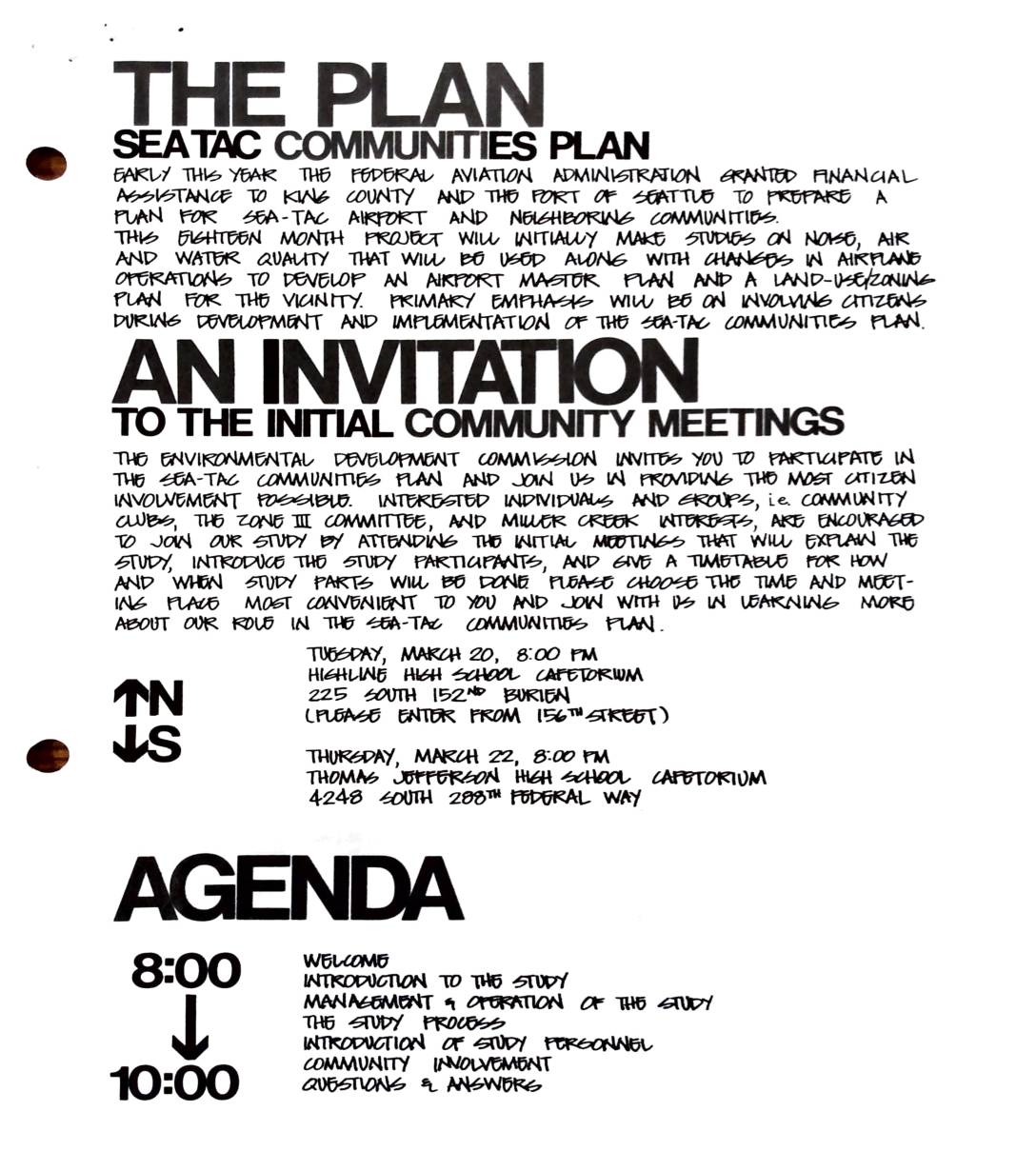
    Sea-Tac Communities Plan: An invitation to the initial community meetings

    The Sea-Tac Communities Plan was a federally funded, eighteen-month study sponsored by King County and the Port of Seattle to assess noise, air, and water quality impacts from Sea-Tac Airport and develop an airport master plan and land-use/zoning plan for surrounding neighborhoods. The Environmental Development Commission invited residents, community clubs, and local interest groups to participate in initial public meetings held at Highline and Thomas Jefferson High Schools in March. A central goal of the plan was to maximize citizen involvement in both the development and implementation of policies shaping the future of Sea-Tac Airport and its neighboring communities.
    Tagscommunity engagement, Environmental Development Commission, King County, Port Of Seattle, Sea-Tac Communities Plan
  • 1974-02-13

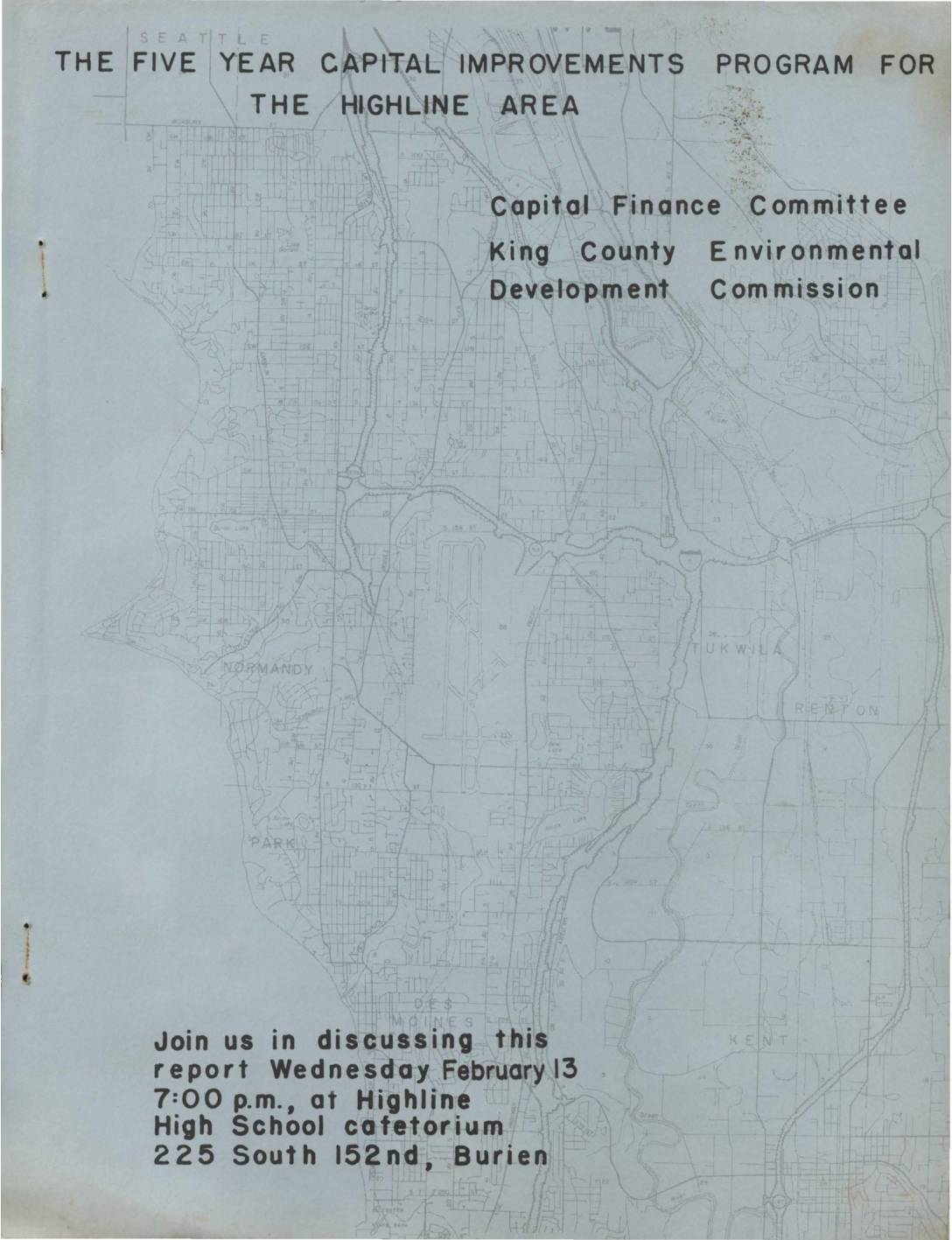
    Five Year Capital Improvements Program for the Highline Area

    This 1974 report by the King County Environmental Development Commission outlines capital improvement projects tentatively scheduled for the Highline Area — a community near present-day Sea-Tac Airport — covering the years 1974 through 1979. Prepared to encourage public input before financial and legislative commitments were finalized, it invited residents to review and discuss planned development projects at a public meeting held at Highline High School in Burien on February 13, 1974.
    Tagscapital improvements, community engagement, Environmental Development Commission, Highline Community, King County, Land Use
  • King county edc 1974 02 13 five year capital improvements program highline area pdf
    1974-02-13

    Five Year Capital Improvements Program for the Highline Area

    Report prepared by the Capital Finance Committee of the King County Environmental Development Commission (E.D.C.) covering the Five Year Capital Improvements Program for the Highline Area, covering projects tentatively scheduled for acquisition and/or construction from 1974 through 1979. The E.D.C. was a 134-member citizens advisory group with an 18-member commission and 9 functional committees. Public
    Tagscapital improvements, community engagement, Environmental Development Commission, Highline Community, King County, Land Use
  • 1973-09-20

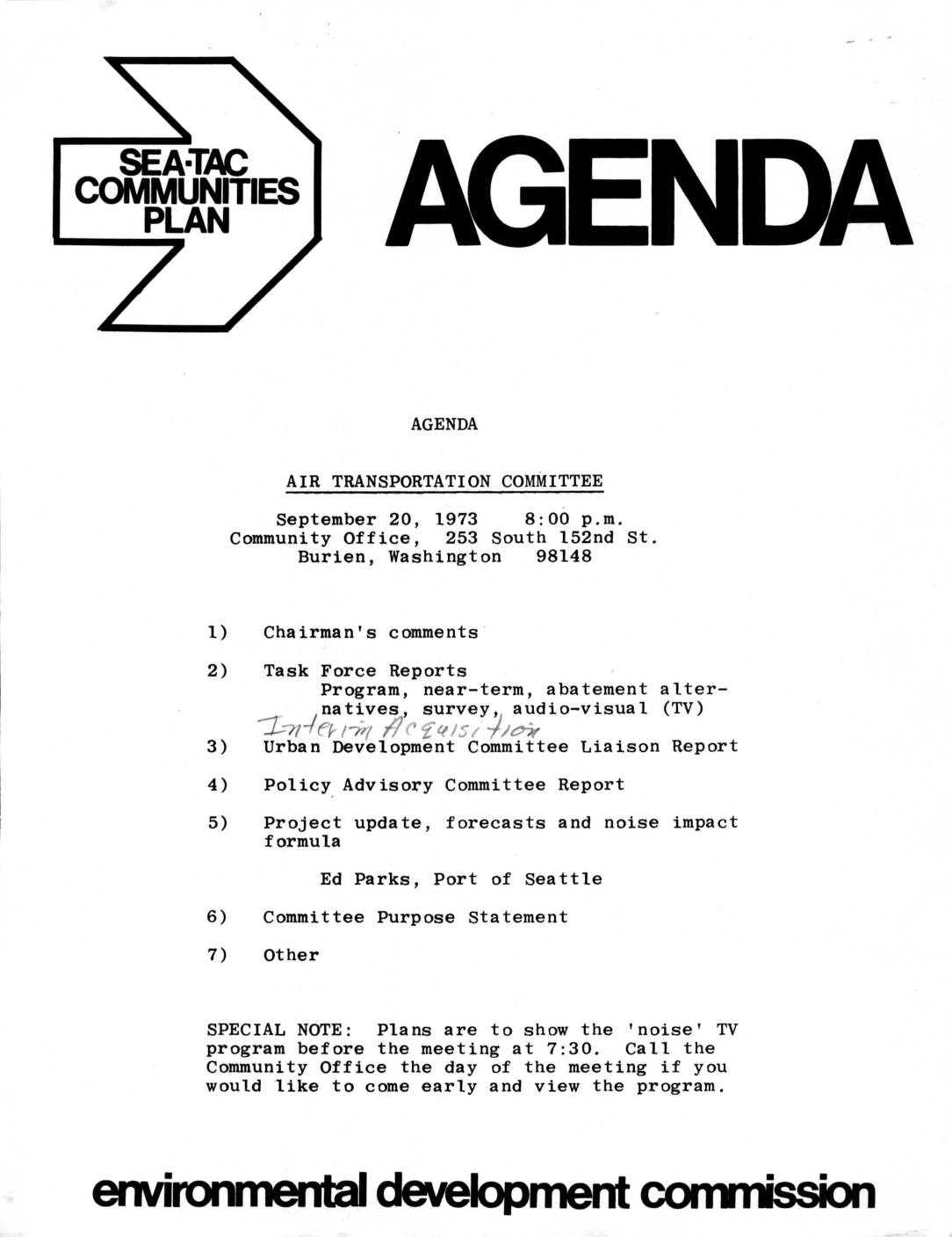
    Air Transportation Committee agenda, September 20, 1973

    This document is the agenda for an Air Transportation Committee meeting held on September 20, 1973, at the Community Office in Burien, Washington, organized under the Sea-Tac Communities Plan. The meeting covered task force reports on noise abatement alternatives, surveys, and audio-visual programs, along with updates on urban development, policy advisory matters, and a project briefing by Ed Parks of the Port of Seattle on forecasts and noise impact formulas. Attendees were also invited to view a noise-related TV program before the meeting at 7:30 p.m.
    TagsAir Transportation Commission, Ed Parks, Environmental Development Commission, Sea-Tac Communities Plan
  • 1973-05-02

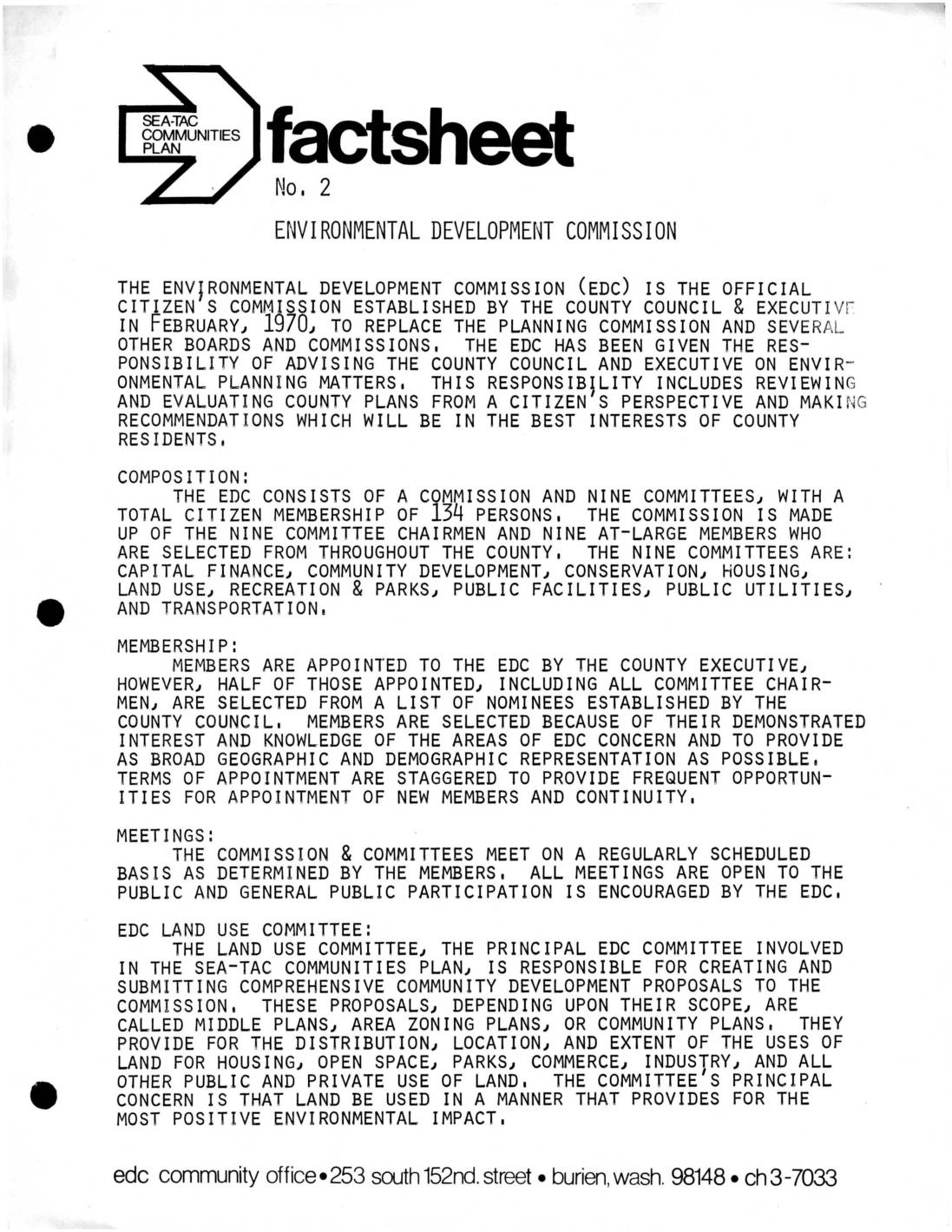
    Fact Sheet No. 2: Environmental Development Commission

    The Environmental Development Commission (EDC) is an official citizens' advisory body established by King County in February 1970 to replace the Planning Commission and advise the County Council and Executive on environmental planning matters. It consists of 134 citizen members organized into nine committees, including a Land Use Committee that plays a central role in the Sea-Tac Communities Plan by developing proposals governing how land is used for housing, commerce, industry, and open space. All EDC meetings are open to the public, and the commission's overarching goal is to ensure land use decisions provide the most positive environmental impact for county residents.
    TagsEDC, Environmental Development Commission, FactSheet, Sea-Tac Communities Plan, STCP
  • 1973-04-20

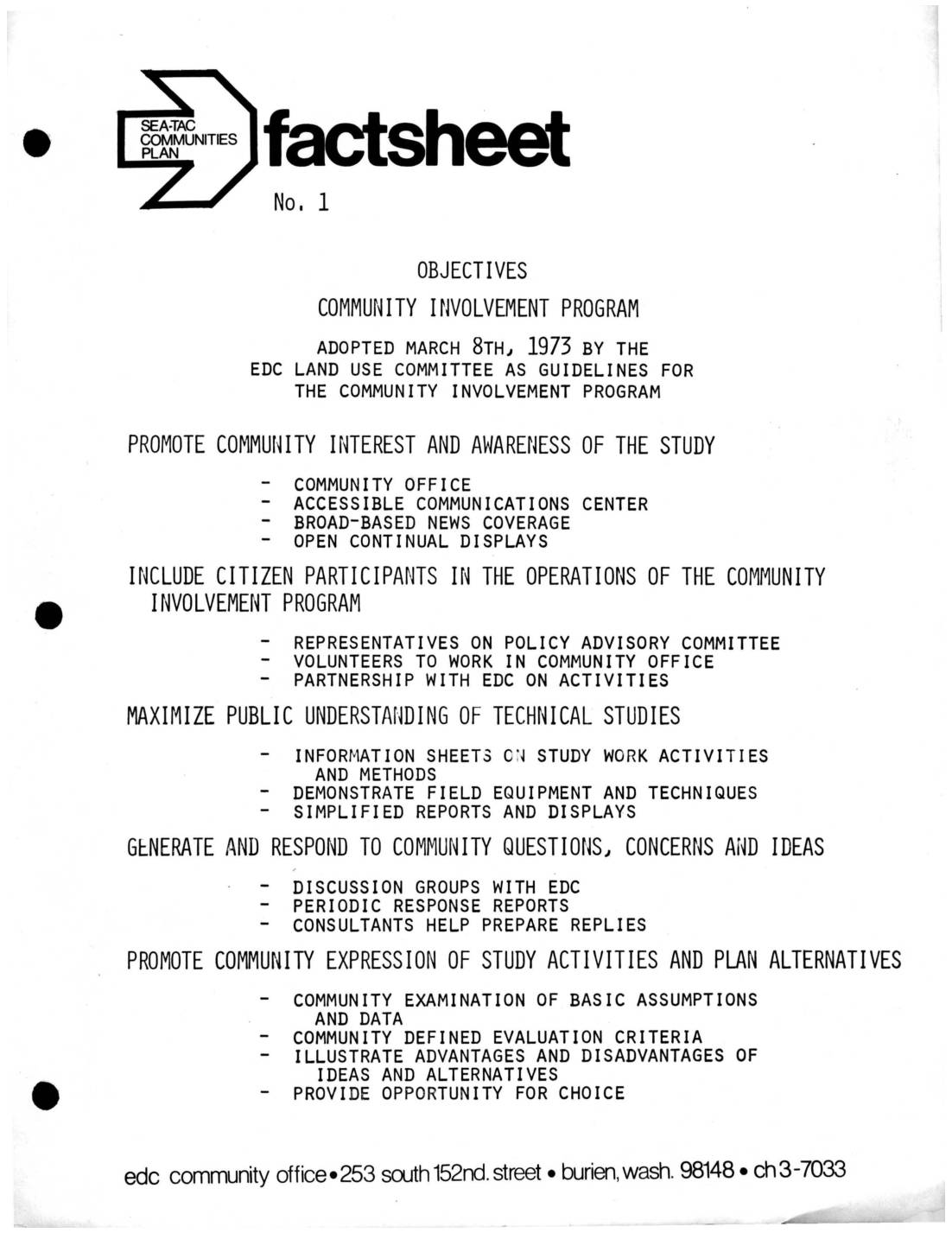
    Sea-Tac Communities Plan Fact Sheets: Community Involvement Program Objectives, Environmental Development Commission, and Technical Advisory Committee

    These fact sheets from 1973 outline the structure and goals of the Sea-Tac Communities Plan, a planning study focused on Sea-Tac International Airport and surrounding areas. The Community Involvement Program aimed to engage local residents through a community office, public displays, and citizen representation on advisory committees. Technical oversight was provided by the Technical Advisory Committee (TAC), which brought together representatives from local, state, and federal agencies—including the FAA, EPA, Boeing, and area school districts—to coordinate planning efforts and review recommendations.
    CategoriesHistory Tagscommunity engagement, EDC, Environmental Development Commission, FactSheet, Land Use, Sea-Tac Communities Plan, Technical Advisory Committee
  • Stcp fact sheets 73 splsp sst20220827145145 pdf
    1973-04-20

    Sea-Tac Communities Plan Fact Sheets: Community Involvement Program Objectives, Environmental Development Commission, and Technical Advisory Committee

    Three fact sheets (Nos. 1–3) from the Sea-Tac Communities Plan (STCP), published by the EDC Community Office at 253 South 152nd Street, Burien, WA 98148. Fact Sheet No. 1 outlines the objectives of the Community Involvement Program, adopted March 8, 1973 by the EDC Land Use Committee, covering community office operations, citizen participation, public understanding
    CategoriesHistory Tagscommunity engagement, EDC, Environmental Development Commission, FactSheet, Land Use, Sea-Tac Communities Plan, Technical Advisory Committee
Sidebar On/Off

Upcoming Events

  • StART SEA Stakeholder Advisory Round Table
    Add to CalendarMWednesday Aug 26, 5:00pm - 7:00pm
    Zoom (Virtual Meeting)
    START meetingagenda 2026826 final 0 pdf

    Meeting Objectives Introduce the primary feedback themes identified by StART members regarding StART’s Operating Procedures and determine areas that may warrant future discussion. 5:00 PM – Welcome Meeting Management Welcome Lead: Andrés Mantilla, Facilitator, Uncommon Bridges; Wendy Reiter, Airport Managing Director, POS 5:15 PM – Dinner: All participants eat. 5:30 PM – StART Operating Procedures

    [...]
  • Commercial Aviation Work Group
    Add to CalendarMThursday Sep 3, 10:00am - 1:30pm
    Virtual Meeting (Zoom)
    Cawg agenda sep 3 26 virtual pdf

    Meeting Agenda 10:00 a.m. – 10:15 a.m. | Welcome – Evan Nordby, Chair a. Introductions and Agenda Reviewb. Status of appointments and non-voting member invitationsc. Other updates as necessary 10:15 a.m. – 11:00 a.m. | Is it practical and legal to operate the western Washington [Puget Sound] airports as a single airport system? – Consultant

    [...]

[See all...]


Help study childhood asthma. Get free HEPA filter!

read more...

Issues

Sea-Tac Airport is currently undergoing the largest and longest expansion in its history, collectively known as the Sustainable Airport Master Plan (SAMP). Some of it you can already hear, but you’re probably not aware of what it all means. Here’s what you need to know.
read more...

Read This!

As the source for federal transportation grants, the Puget Sound Regional Council was charged with developing a system to meet the growing need for commercial aviation. When the search for a second airport failed, they authorized the Port of Seattle to build the Third Runway, with a mandate to develop a noise abatement and mitigation program. In their effort to stop the Third Runway, the ACC argued over every detail of the Port's efforts--including property buyouts and sound insulation. The dispute was meant to be settled by a three member Expert Arbitration Panel. This is their final report. It finds 2-1, that the Port's program was insufficient in several respects. Despite that, funding for the Third Runway was approved by the PSRC, and the 'Port Package' program, proceeded largely unchanged. Expert Arbitration Panel's final decision finding that the Port of Seattle had not shown sufficient reduction in real on-the-ground noise impacts to satisfy noise reduction conditions required for approval of a third runway at Sea-Tac International Airport. The majority decision concluded the Port's noise abatement programs were insufficient despite being impressive in scope.
continue...

The Podcast!

Subscribe to the only podcast devoted to policies, politics, history, impacts for people living under the flight path everywhere. It’s definitely not just about noise!
  • Sea-Tac Noise.Info
  • Connect with STNI

    • Subscribe
    • Port Package Problem?
    • Donate
    • Podcast
    • Socials
      • Facebook
      • X (Twitter)
      • Bluesky
      • Instagram

    "Sea-Tac Noise Hotline Calls Per Month, 1986–1990 (First Quarter 1990 Report)" — , 2023

  • Learn

    • Frequently Asked Questions
    • Explainers
    • Youtube
    • Research Requests
    • Make a complaint
  • Goals

    Fulfill the promises of 1976:
    • Compensation
    • Reduced noise
    • Improved air quality
    • Environmental remediation
Login/Register
©2026•Data Privacy

Message

We use cookies to provide basic functionality. We also provide access to search engines in order to provide site analytics. We do not sell or share your data.
V V