TagRegional Airport System Plan(10)
-
 2001-08-01
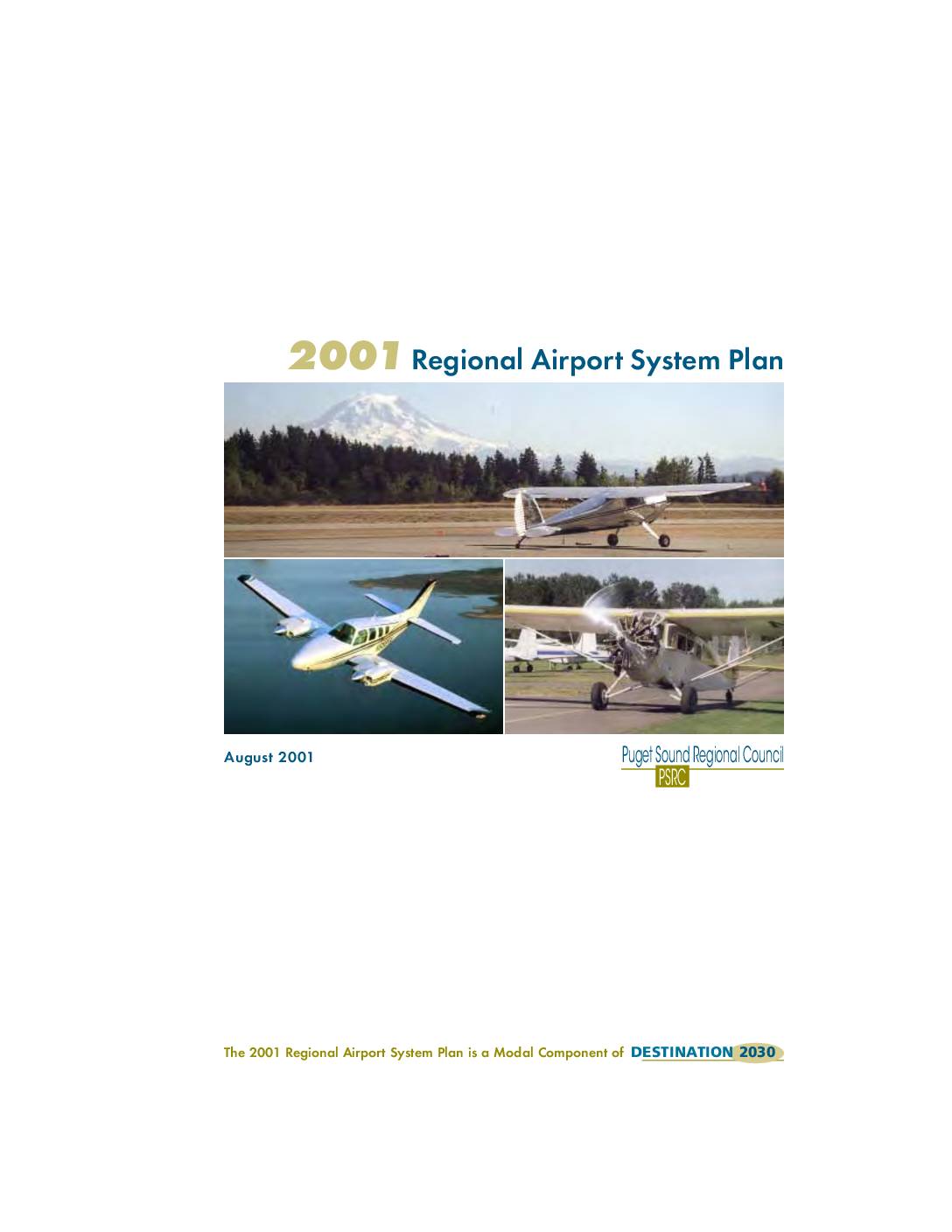
2001 Regional Airport System Plan
The 2001 Regional Airport System Plan, published by the Puget Sound Regional Council in August 2001, is a comprehensive planning document for airports across the Central Puget Sound Region and serves as a modal component of the long-range transportation plan known as Destination 2030. Prepared with input from a Regional Airport System Plan Advisory Committee and partially funded through a Federal Aviation Administration planning grant, the plan addresses aviation infrastructure, capacity, and noise considerations for the region. It covers policy and development guidance for airports in the greater Seattle–Tacoma area, though its contents do not necessarily reflect official FAA policy or commitments. -
 2001-04-04
Regional Airport System Plan Technical Advisory Committee
This document is the table of contents for the Puget Sound Regional Council's Regional Airport System Plan (RASP) Technical Advisory Committee records from 1998 to 2001. It covers seven committee meetings that addressed topics such as aviation forecasts, system capacity, land use compatibility, airport access, and implementation planning for the regional airport system. The plan refinement process culminated in a final draft in March 2001. -
 1996-01-01
Box 1321: Airport Litigation Documents — Expert Arbitration Panel Audio Tapes, Transcripts, and Cassettes, 1993–1996
This archival box (Historical Box No. 1321) contains airport litigation documents from 1993–1996, including Expert Arbitration Panel audio tapes, meeting transcripts, and diskettes related to proceedings involving Treece, Shirley & Brodie. It also holds records on the FAA Grant MSA Phase II, the MSA Consultant Selection Process, Regional Airport System Plan applications for federal assistance, and materials related to the Four Post Task Force and North/Adjacent planning. The box is held on long-term loan at the WA State Archives. -
1996-01-01
Box 1321: Airport Litigation Documents — Expert Arbitration Panel Audio Tapes, Transcripts, and Cassettes, 1993–1996
This is an Archives and Storage record (CID 10996, Box No. 01289, Historical Box No. 1321) from the Administration Office, prepared by Angie Daniels, covering 1993–1996. Contents include Expert Arbitration Panel audio tapes, meeting transcripts, cassette tapes of proceedings, FAA Grant MSA Phase II materials, Regional Airport System Plan federal assistance applications, Puget Sound Regional Council Four Post Plan documents, and related correspondence pertaining to Sea-Tac Airport litigation and system management. -
 1993-04-29
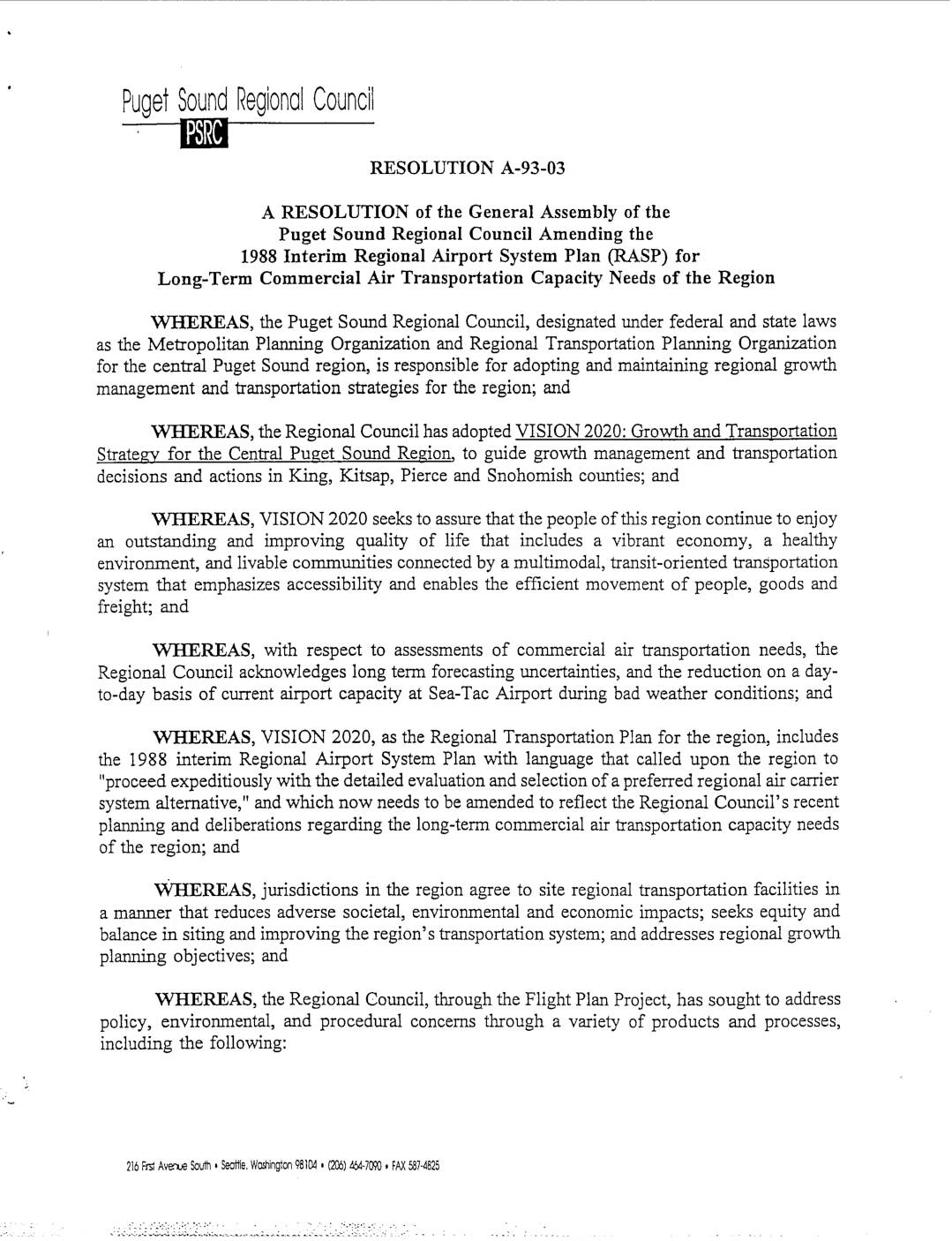
Resolution A-93-03: A resolution of the General Assembly of the Puget Sound Regional Council amending the 1988 Interim Regional Airport System Plan (RASP) for long-term commercial air transportation capacity needs of the region
In April 1993, the Puget Sound Regional Council adopted Resolution A-93-03, amending its Regional Airport System Plan to address long-term commercial air transportation needs for the central Puget Sound region. The resolution established a dual-track strategy of pursuing both a major supplemental airport within the four-county area and a third runway at Sea-Tac Airport, with the third runway to be authorized by April 1, 1996 unless a viable supplemental site could eliminate that need. Key conditions attached to the third runway approval included independent evaluation of demand management programs and measurable noise reduction performance objectives, while small supplemental airports such as Paine Field were eliminated as preferred alternatives. -
 1989-04-20
Resolution No. 3042, as amended: Interagency agreement with Puget Sound Council of Governments for long term air carrier system planning
In April 1989, the Port of Seattle Commission passed Resolution No. 3042 authorizing the Executive Director to enter into an agreement with the Puget Sound Council of Governments (PSCOG) to develop a long-term regional air carrier system plan for the Puget Sound area. The resolution was prompted by a recognized need for additional air carrier capacity beyond the year 2000, following a 1988 Airspace Study Update of Seattle-Tacoma International Airport. The agreement allowed the Port to seek federal FAA funding and hire consultants to study long-term aviation capacity options for the region. -
 1988-09-01
Regional Airport System Plan 1988-2020: Air Transportation Element of the Regional Transportation Plan
The Regional Airport System Plan (1988–2020) serves as the air transportation element of the Regional Transportation Plan for the Puget Sound area, published in September 1988. Developed under the guidance of an Air Transportation Advisory Committee representing airports, government agencies, community groups, and industry stakeholders, the plan outlines a long-range framework for managing and developing the region's airport system. It addresses air transportation needs and policy across multiple airports in the greater Seattle–Tacoma region, including considerations relevant to noise, land use, and capacity planning through the year 2020. -
 1987-12-01
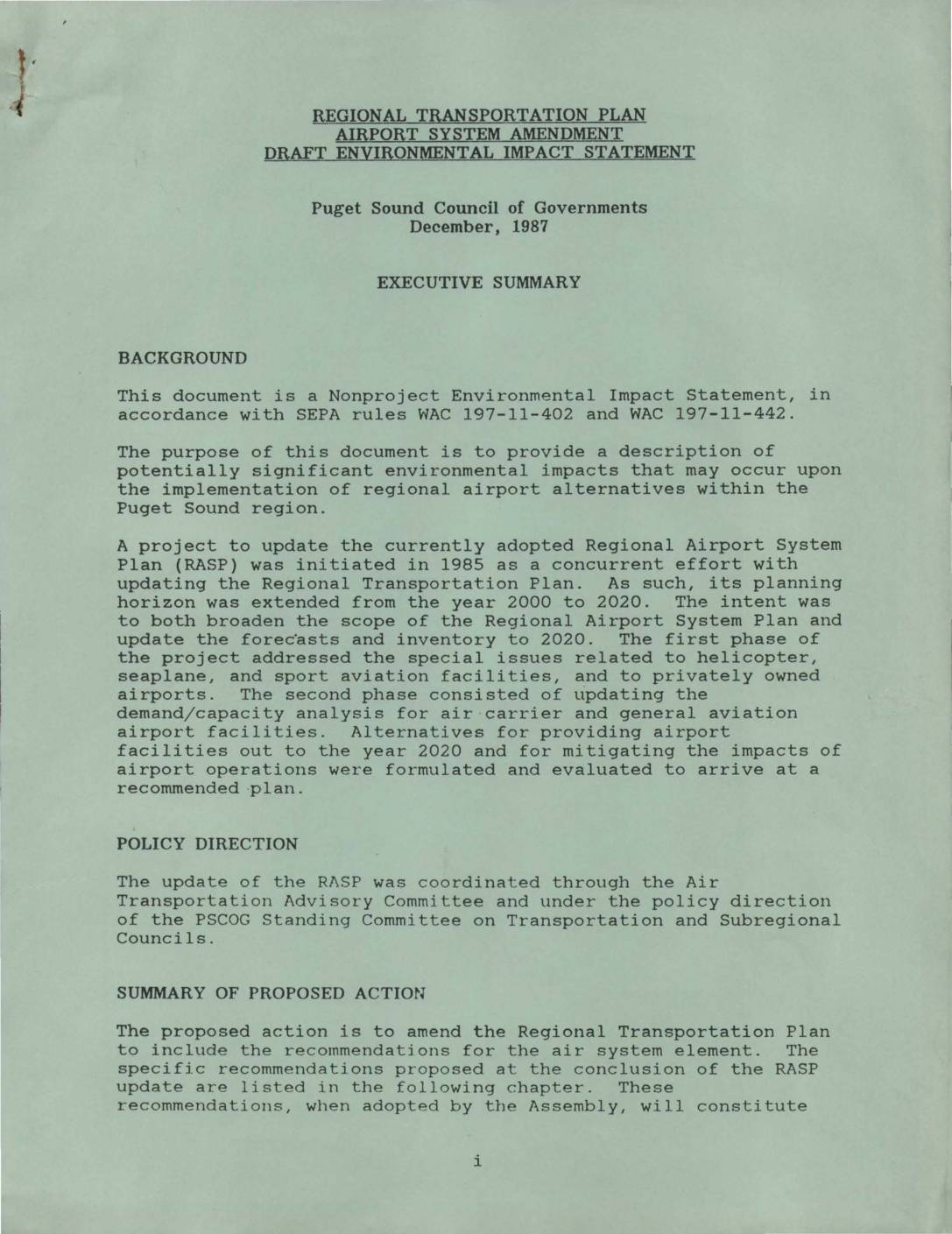
RASP 1988 DEIS Executive Summary
This 1987 Draft Environmental Impact Statement from the Puget Sound Council of Governments evaluates alternatives for expanding and managing the regional airport system through the year 2020, assessing their potential environmental and economic impacts. The study found that all alternatives would generate significant impacts to both natural and human environments, with the key difference being whether those impacts would be concentrated at existing airports or spread across new locations. Extensive mitigation measures were identified as necessary for any chosen alternative, and no single option was found to be clearly superior to the others. -
 1987-10-01
Regional Airport System Plan 1988-2020: Air transportation element of the Regional Transportation Plan
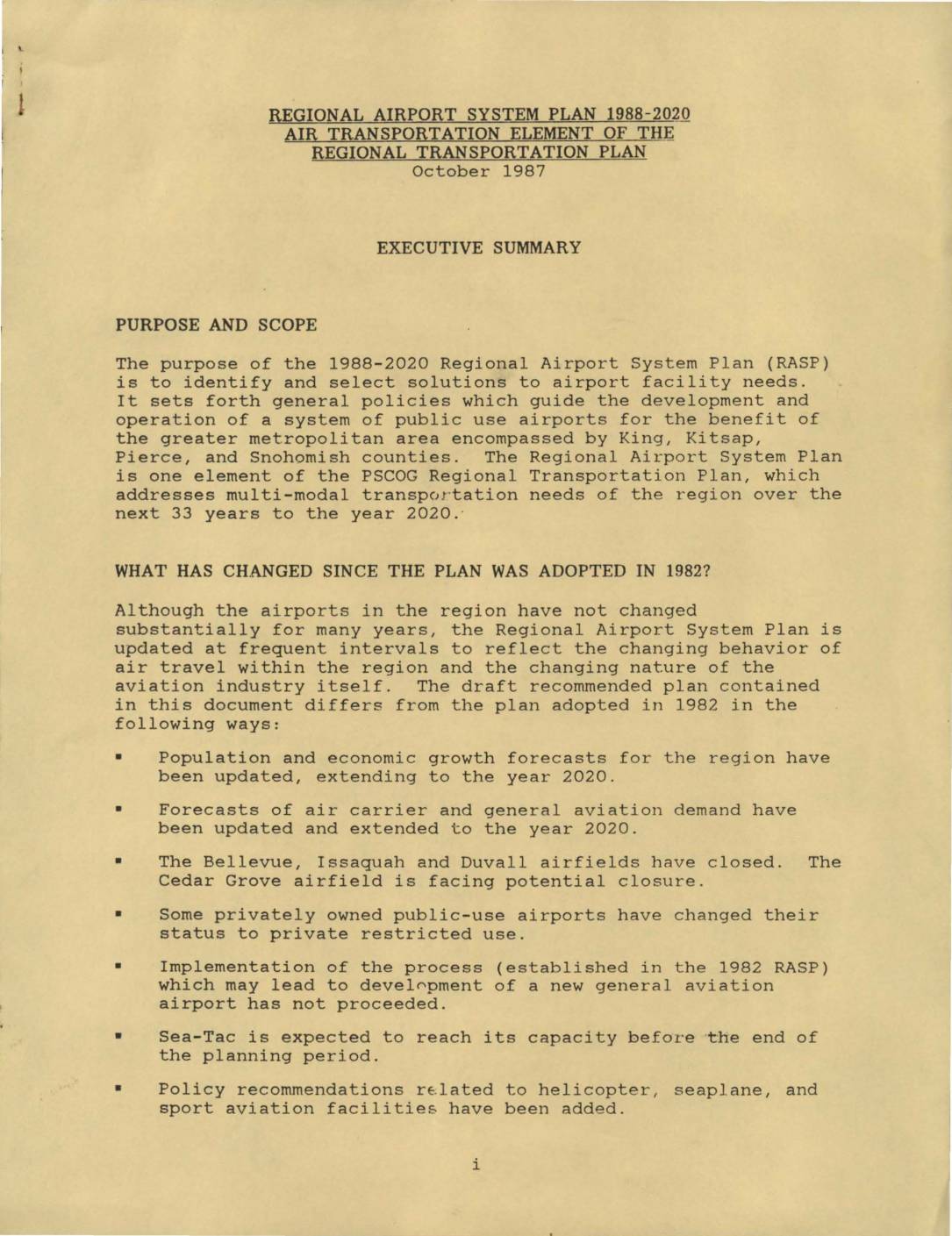
★The 1988-2020 Regional Airport System Plan, published in October 1987, outlines policies for managing and developing public-use airports across King, Kitsap, Pierce, and Snohomish counties through the year 2020. A central finding is that Sea-Tac Airport was projected to reach full capacity within 10 to 15 years, with intolerable aircraft delays expected unless alternative measures were taken. The plan also addresses noise and flight track mitigation programs, land use compatibility near airports, and the potential role of satellite airports such as Paine Field, Bremerton National, and Tacoma Narrows in relieving pressure on Sea-Tac. -
 1982-06-01
Regional Airport System Plan
The Regional Airport System Plan, published in June 1982 by the Puget Sound Council of Governments (PSCOG), provides policy guidance for aviation planning across the greater Puget Sound region, including the Seattle-Tacoma area. Prepared with funding from member jurisdictions, the Washington State Department of Transportation, the Federal Aviation Administration, and the Port of Seattle, the plan addresses regional airport system needs and aviation forecasts. It was developed under the oversight of PSCOG's Standing Committee on Transportation, which included representatives from King, Pierce, Snohomish, and Kitsap counties.