TagINM(7)
-
 2024-05-13
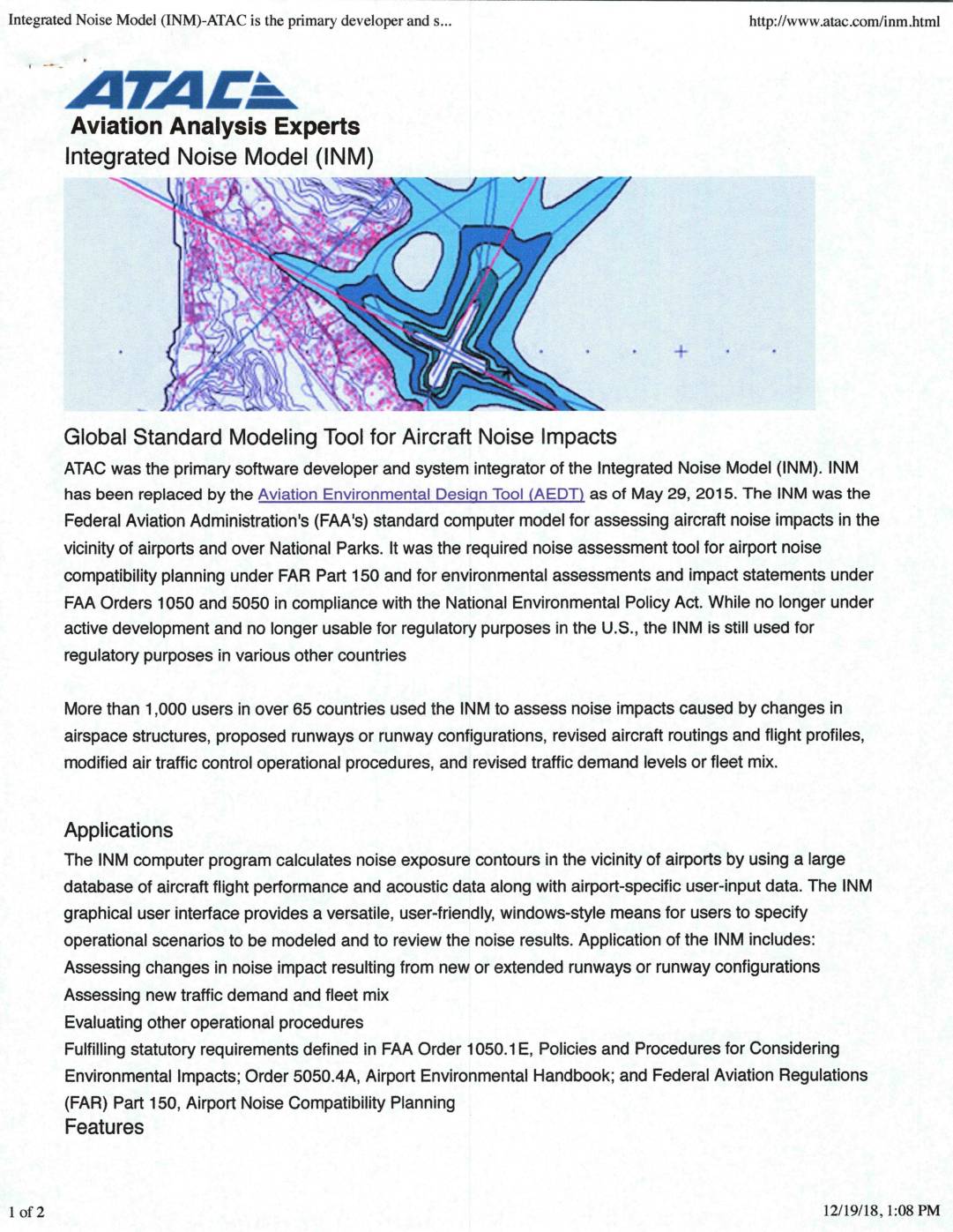
Integrated Noise Model (INM)
The Integrated Noise Model (INM), developed by ATAC Corporation for the FAA, was the standard computer tool used to assess aircraft noise impacts near airports like Sea-Tac, calculating noise exposure contours and predicted sound levels at sensitive locations such as schools and hospitals. It was required for airport noise compatibility planning under FAR Part 150 and environmental reviews under the National Environmental Policy Act until it was replaced by the Aviation Environmental Design Tool (AEDT) in May 2015. Though no longer valid for regulatory use in the U.S., the INM was used by over 1,000 users in 65 countries to evaluate the noise effects of runway changes, flight routing, air traffic procedures, and shifts in aircraft fleet mix. -
 2013-10-01
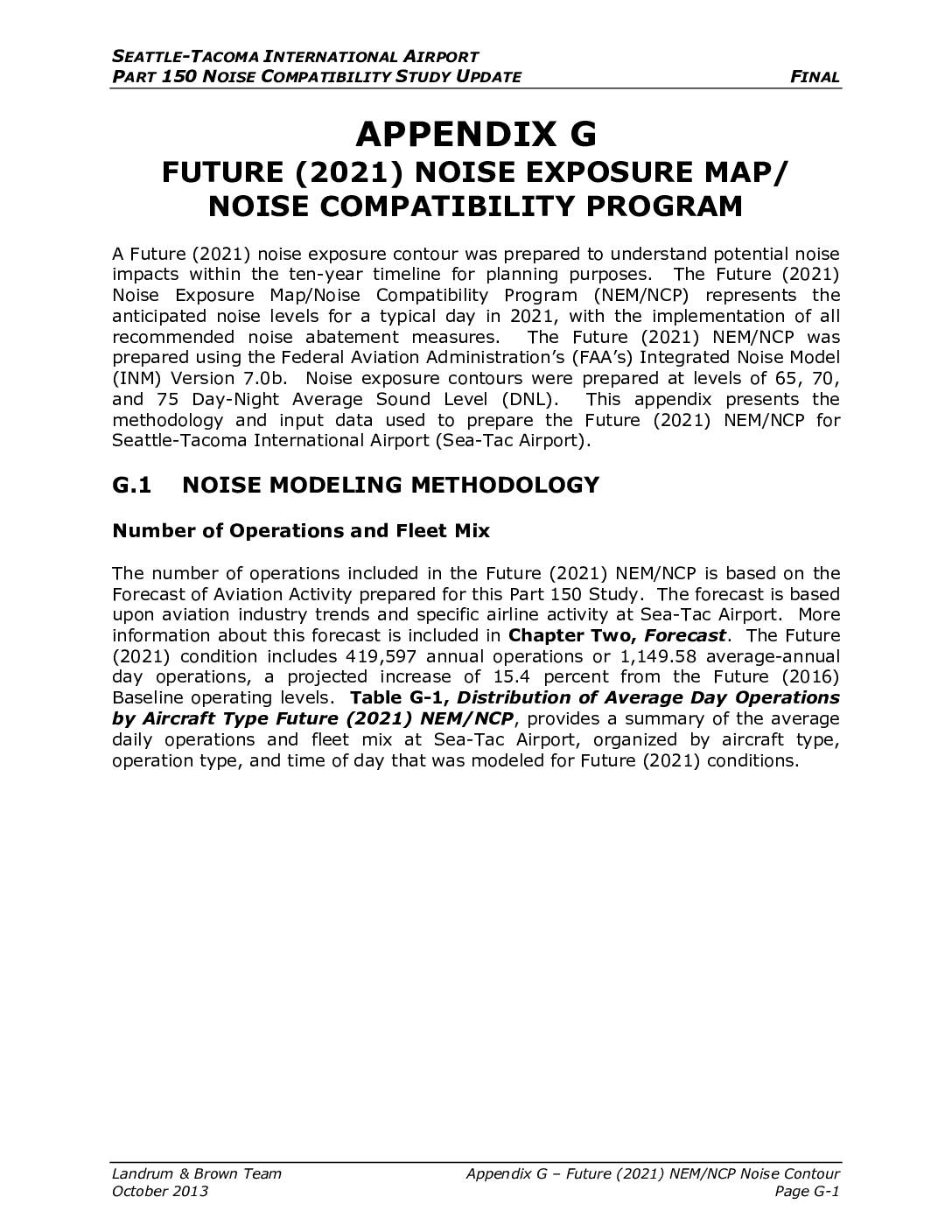
Future (2021) noise exposure map/noise compatibility program – Seattle-Tacoma International Airport Part 150 noise compatibility study update
This document outlines the Future (2021) Noise Exposure Map and Noise Compatibility Program for Seattle-Tacoma International Airport, projecting noise levels for a typical day in 2021 assuming all recommended noise abatement measures are in place. Using the FAA's Integrated Noise Model, it forecasts 419,597 annual aircraft operations — a 15.4% increase over 2016 baseline levels — and maps noise contours at 65, 70, and 75 decibel DNL thresholds. The report details the fleet mix and runway usage data used in the modeling, with Boeing 737-800s representing the largest share of daily operations. -
 1992-03-06
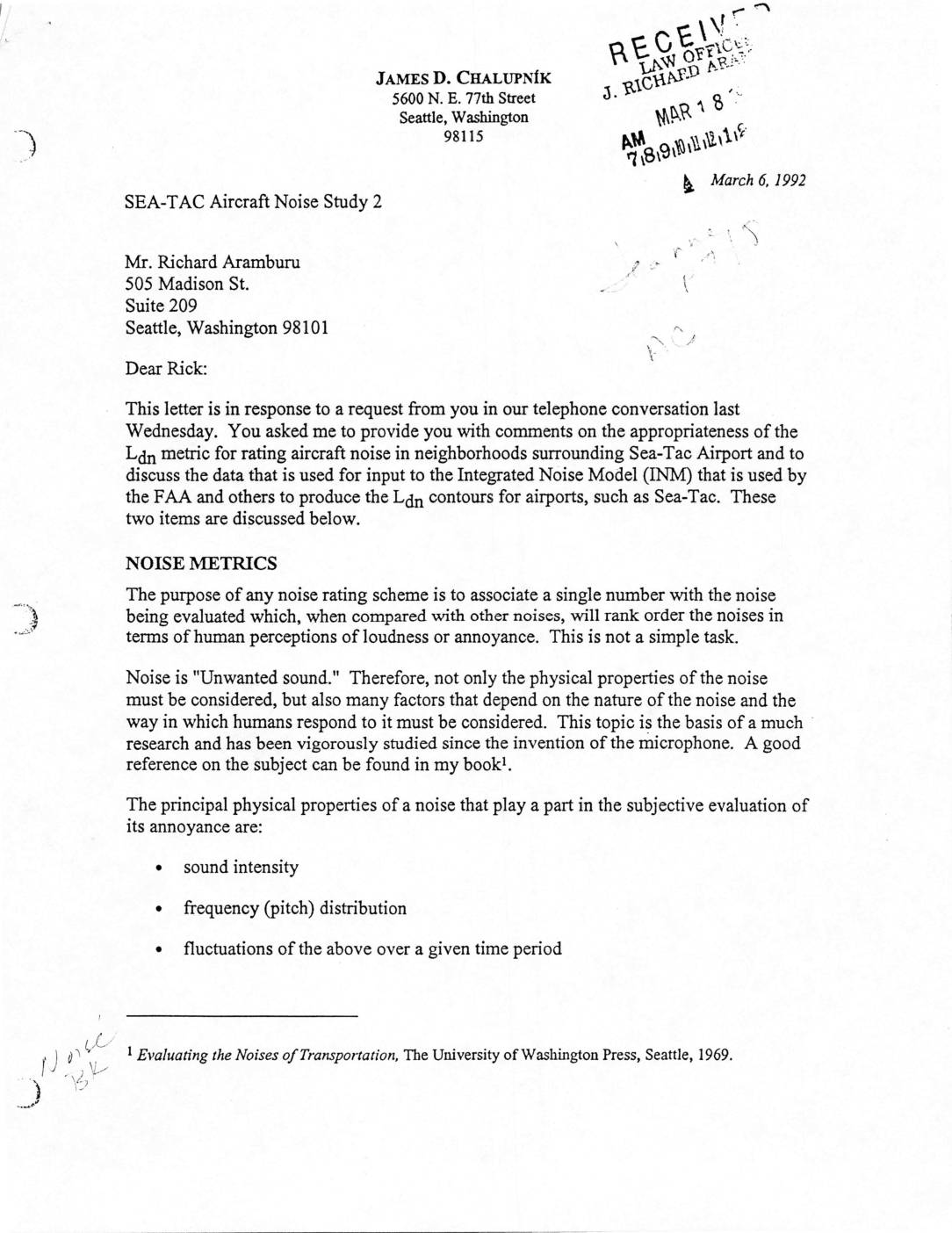
Letter from James D. Chalupník to Richard Aramburu Regarding Sea-Tac Aircraft Noise Study 2: Ldн Metric and Integrated Noise Model
In this 1992 letter, acoustics expert James D. Chalupník explains to attorney Richard Aramburu how aircraft noise near Seattle's Sea-Tac Airport is measured and rated, focusing on the appropriateness of the Ldn metric and the data used in the FAA's Integrated Noise Model (INM). He outlines the key physical properties of noise—intensity, frequency distribution, and fluctuation over time—and describes how various weighting schemes, particularly the A-weighting (dBA) scale, are used to approximate human perception of loudness and annoyance. The letter also notes the limitations of simpler metrics and introduces more sophisticated rating methods such as Stevens' Loudness Level and Perceived Noise Level for evaluating aircraft noise. -
 1981-12-17
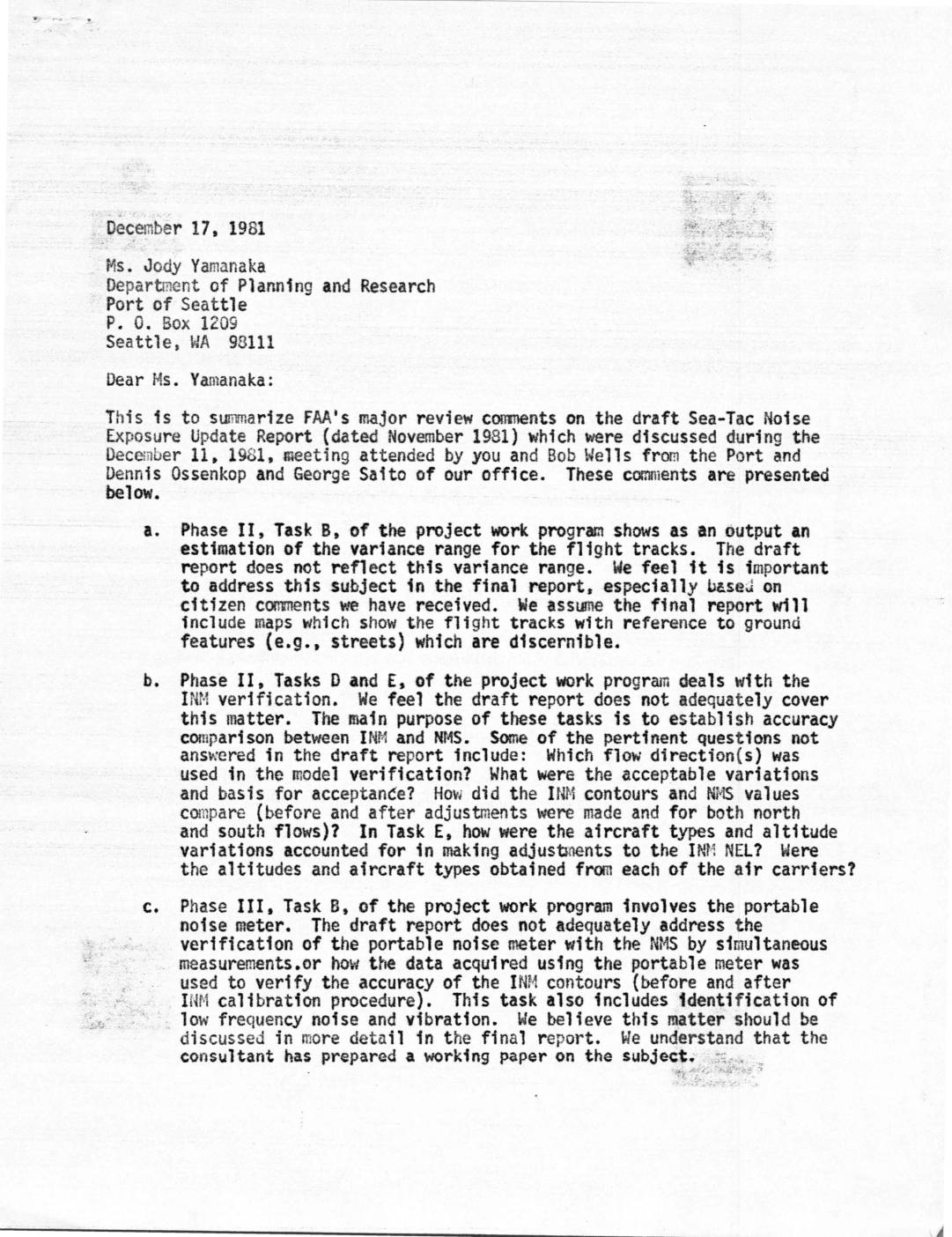
FAA Review Comments on Draft Sea-Tac Noise Exposure Update Report: Letter to Jody Yamanaka
A December 17, 1981 letter from FAA Acting Chief Mark A. Beisse to the Port of Seattle summarizes the FAA's major review comments on the draft Sea-Tac Noise Exposure Update Report. The letter identifies multiple deficiencies in the draft, including inadequate coverage of flight track variance ranges, INM model verification, portable noise meter data, and noise impact projections under different operational scenarios. The FAA requested that these issues be addressed in the final report and asked the Port to clarify whether certain project tasks, such as a population and land use survey, would be dropped from the study. -
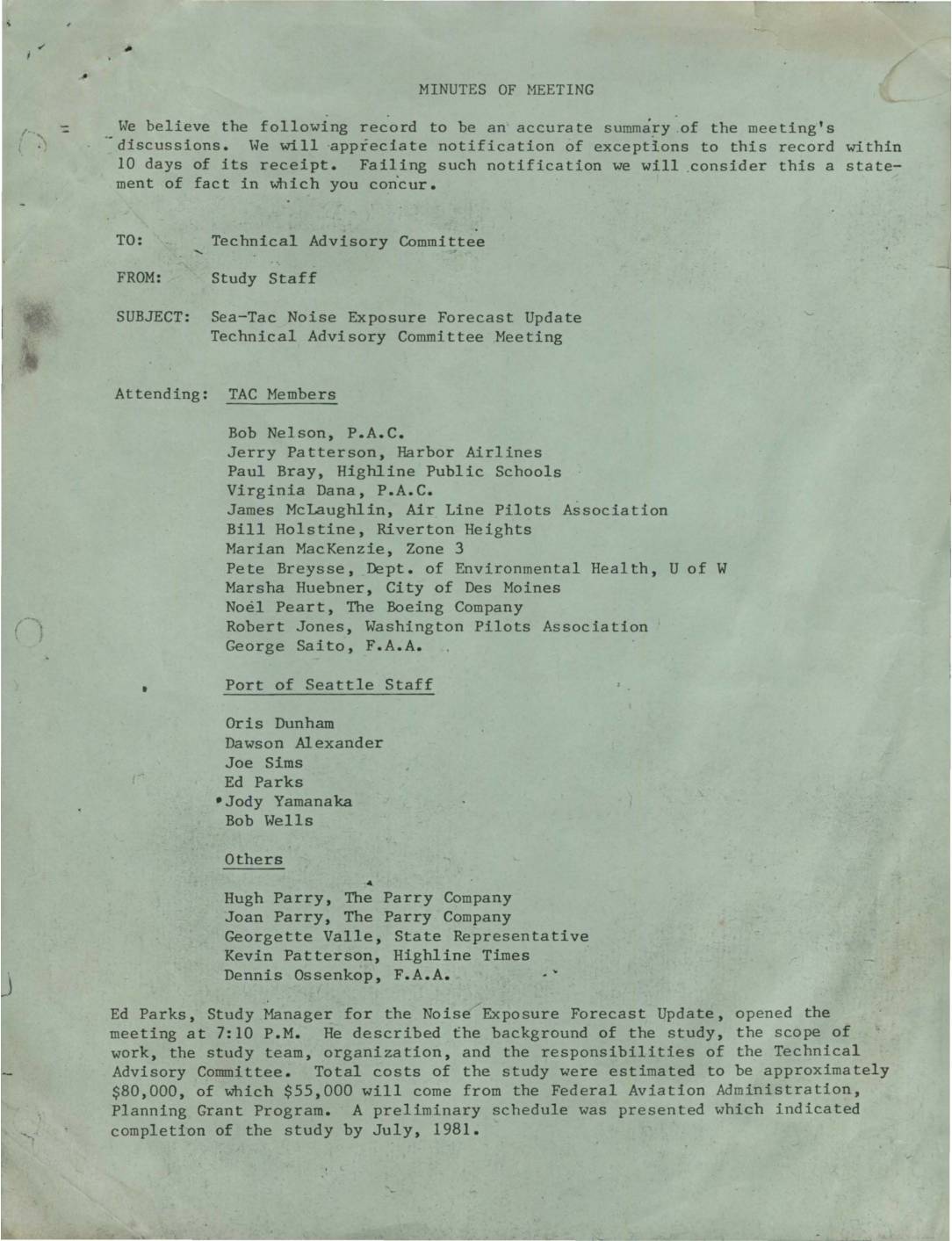 1980-12-01
Sea-Tac Noise Exposure Forecast Update: Technical Advisory Committee Meeting Minutes
Minutes from a Technical Advisory Committee meeting on the Sea-Tac Airport Noise Exposure Forecast Update, an approximately $80,000 study partially funded by the FAA and expected to be completed by July 1981. The meeting covered two key study tools — the Integrated Noise Model (INM), a computer program that estimates aircraft noise using Ldn (day-night average sound level) measurements, and the Sea-Tac Noise Monitoring System (NMS). Committee members raised concerns about using averaged noise metrics, debating whether single-event noise levels or a 'misery index' tracking flights above a threshold decibel level would better reflect community impact. -
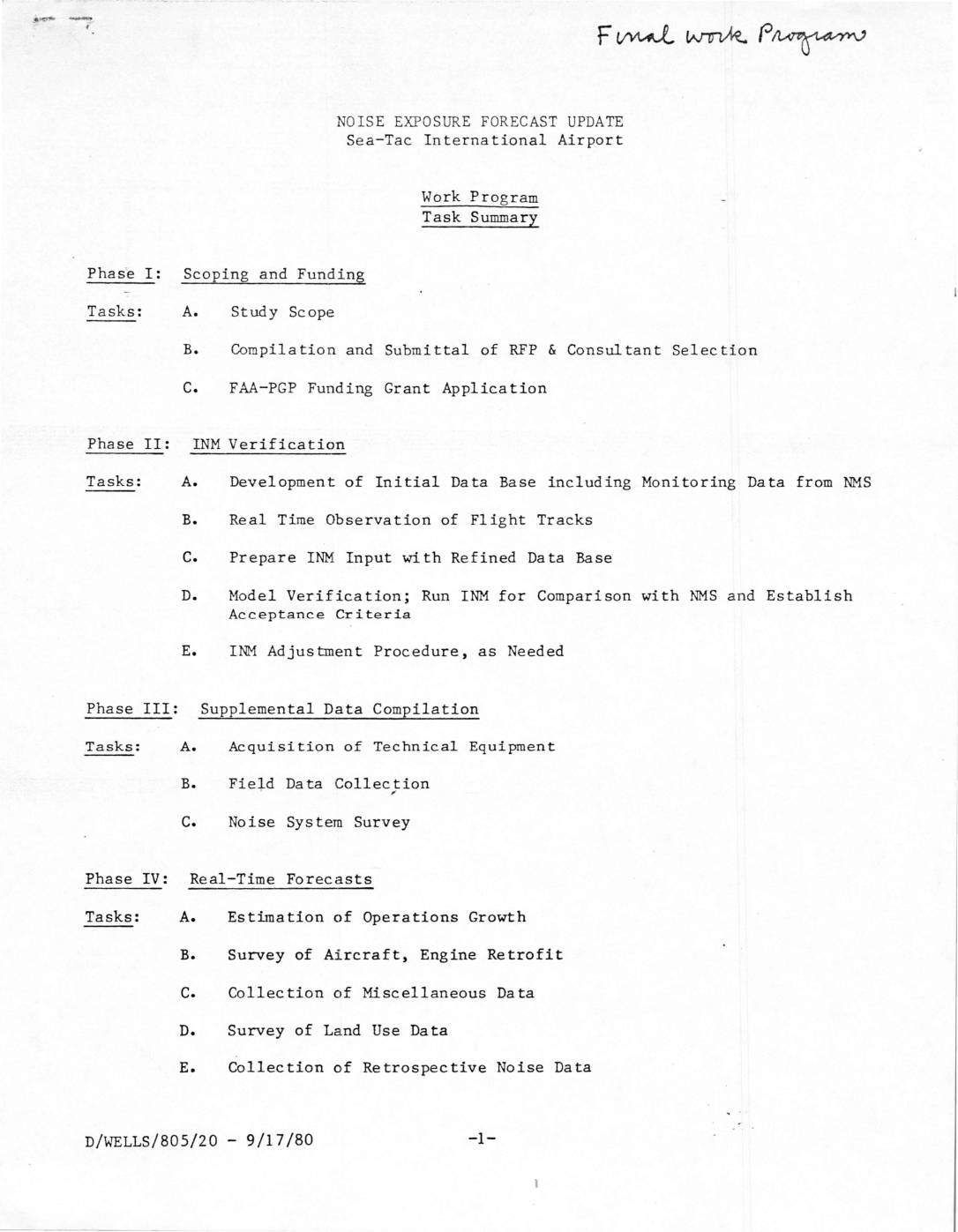 1980-09-17
Noise Exposure Forecast Update Work Program Task Summary: Sea-Tac International Airport
This document outlines the work program for a Noise Exposure Forecast Update at Sea-Tac International Airport, dated September 17, 1980. The program is divided into six phases covering study scoping and funding, INM (Integrated Noise Model) verification, supplemental data collection, real-time forecasting, report generation, and public/administrative involvement. It details specific tasks, staff assignments, and procedures aimed at validating or revising noise impact programs developed under the Sea-Tac/Communities Plan, in compliance with the Aviation Safety and Noise Abatement Act of 1979. -
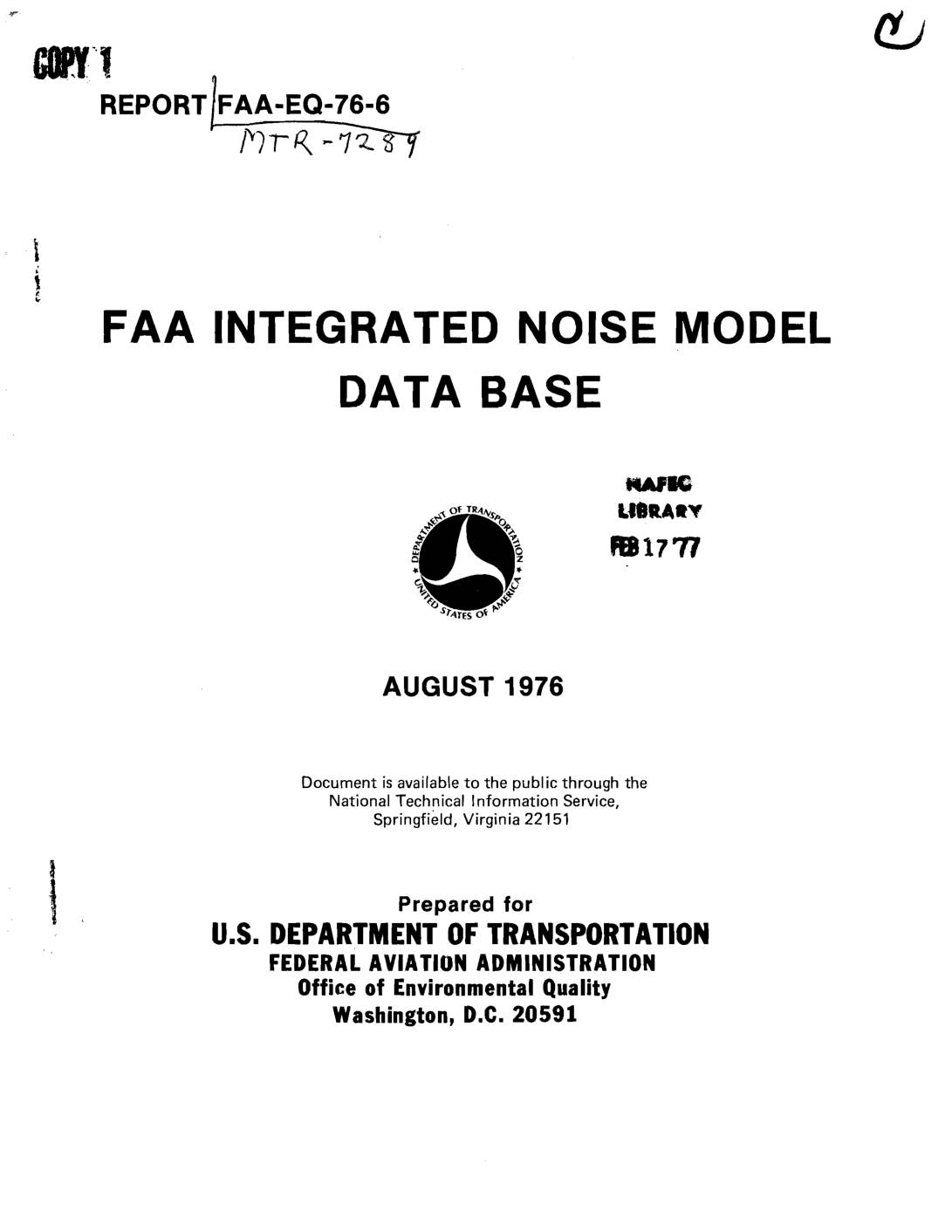 1976-08-01
FAA integrated noise model data base
This 1976 Federal Aviation Administration report documents the data library underlying the FAA Integrated Noise Model (INMPROG), a computer program used to calculate various noise exposure indices around airports. The library contains both acoustic measurements and operational flight procedure data for standard aircraft types. The report serves as a reference for analysts seeking to reproduce noise studies or customize the model with their own flight procedures.