Taglocal government funding(21)
-
 2026-08-11
City of Sea-Tac Bridge Budget: 2027–2028 Biennial Budget Overview Presentation
City of SeaTac City Manager’s Office presentation to Council Study Session on August 11, 2026, introducing the 2027–2028 Biennial Budget titled ‘The Bridge Budget: Guiding Us Across the Gap.’ Documents a projected structural gap of $1.6 million in 2027 and $4.4 million in 2028, defined as the difference between expected revenues and the cost of -
 2025-05-28
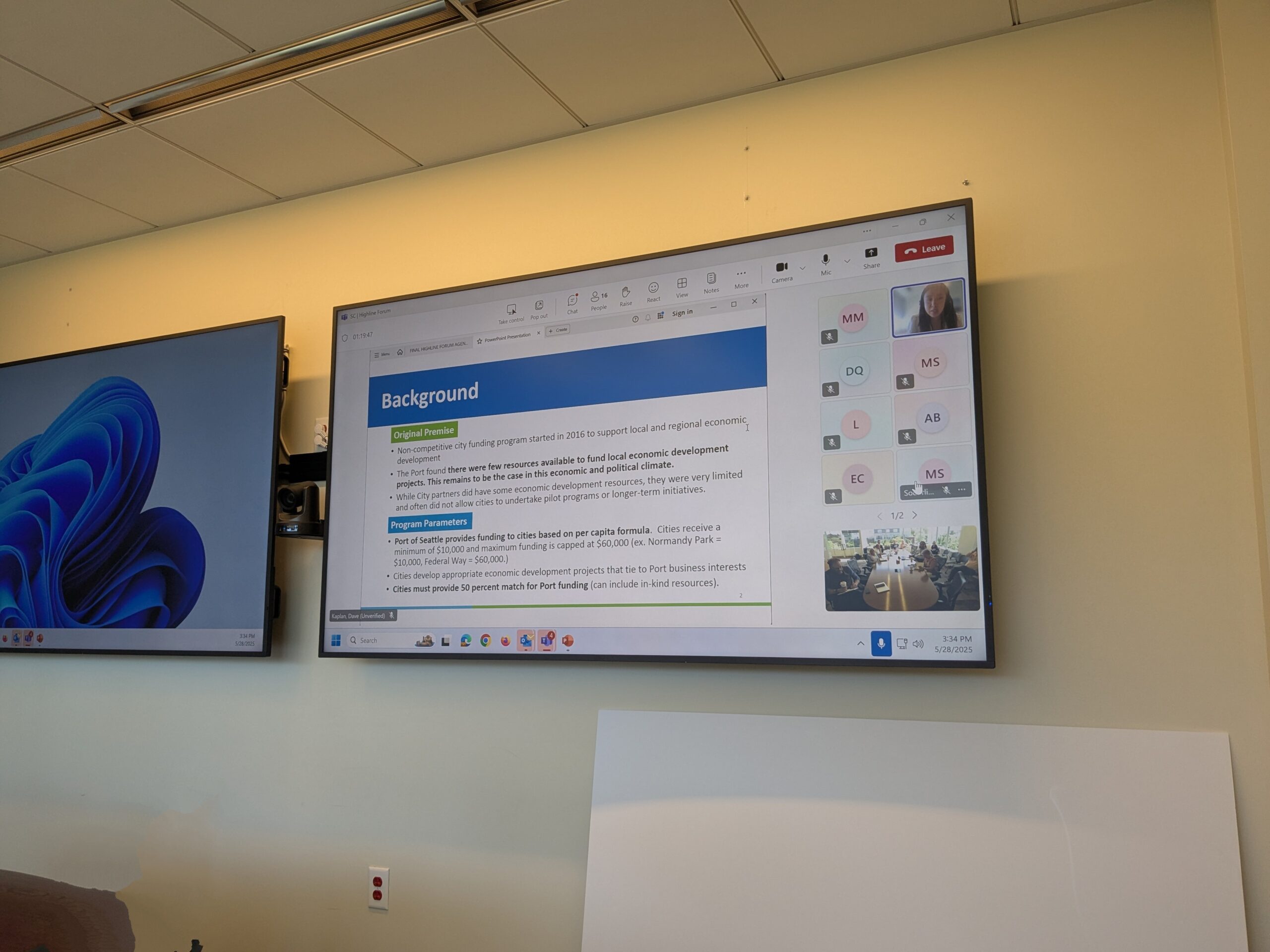
Port Of Seattle City Partnerships Program Background Presentation – May 28, 2025
A Microsoft Teams hybrid meeting displays a PowerPoint slide titled 'Background' describing the Port of Seattle's non-competitive city funding program, which began in 2016 to support local and regional economic development. Key program parameters include per capita funding formula with a minimum of $10,000 and maximum of $60,000, a requirement for cities to develop economic development projects tied to Port business interests, and a 50 percent match requirement for Port funding. -
 2025-05-28
Recap 2024 and 2025-2026 Funding Cycle: Port Of Seattle Economic Development City Partnership Program
The Port of Seattle's Economic Development City Partnership Program distributed $804,052 in funding to 27 cities during its 2024 funding cycle, leveraging an additional $637,211 in city matching funds for a total investment of $1,441,263. The non-competitive program, which began in 2016, allocates funding to cities on a per-capita basis (ranging from $10,000 to $60,000) to support local economic development projects tied to Port business interests. The largest share of funding—36.5%—went toward small business technical assistance, followed by buy-local and placemaking initiatives at 26%. -
 2025-04-13
Substitute Senate Bill 5195: Concerning the capital budget
Substitute Senate Bill 5195 is a Washington State capital budget bill that appropriates funding for various state capital projects for the period ending June 30, 2027. Originally sponsored by Senators Trudeau, Schoesler, Chapman, Dozier, and Nobles at the request of the Office of Financial Management, the bill amends numerous existing state laws and allocates funds across state agencies and programs. It establishes definitions, conditions, and limitations governing how appropriated funds may be spent, lapsed, or reappropriated. -
2025-04-13
Substitute Senate Bill 5195: Concerning the capital budget
Substitute Senate Bill 5195 is a Washington State capital budget bill that appropriates funding for various state capital projects for the period ending June 30, 2027. Originally sponsored by Senators Trudeau, Schoesler, Chapman, Dozier, and Nobles at the request of the Office of Financial Management, the bill amends numerous existing state laws and allocates funds across state agencies and programs. It establishes definitions, conditions, and limitations governing how appropriated funds may be spent, lapsed, or reappropriated. -
 2025-04-08
Port Of Seattle Economic Development City Partnership Program briefing & authorization request
The Port of Seattle is requesting Commission authorization for up to $1,900,000 to fund its 2025-2026 Economic Development City Partnership Program, which provides grants to King County cities based on a per capita formula ranging from $10,000 to $60,000 per city. Started in 2016, the non-competitive program requires cities to contribute a 50% match and develop economic development projects aligned with Port business interests. In recent years, the program has focused on small business relief, tourism support, and buy-local campaigns. -
 2025-04-01
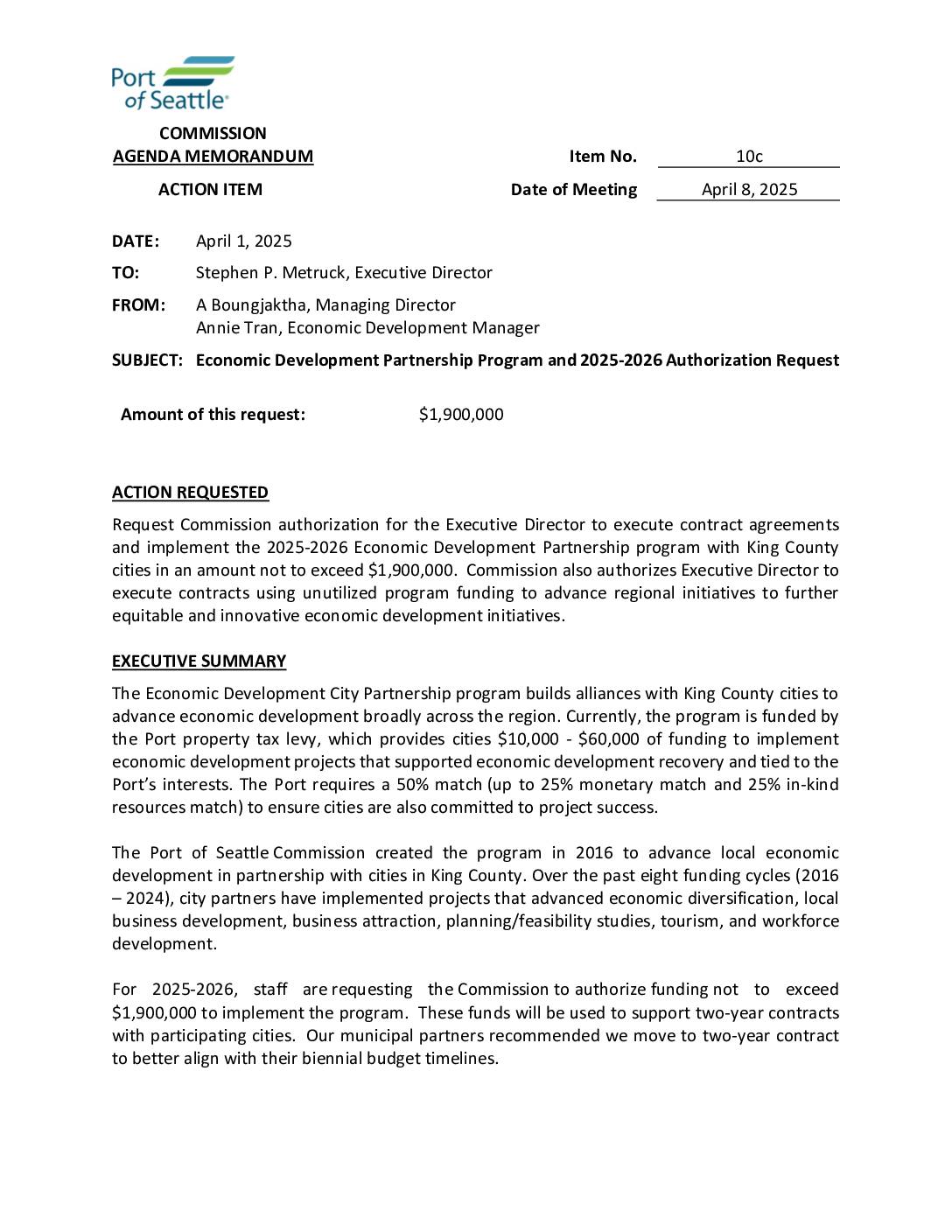
Economic Development Partnership Program and 2025-2026 authorization request
The Port of Seattle is requesting $1.9 million to continue its Economic Development Partnership Program for 2025-2026, which provides grants of $10,000–$60,000 to King County cities for local economic development projects such as small business support, tourism, and workforce development. In 2024, 27 cities participated, leveraging over $637,000 in city matching funds to generate a combined $1.4 million investment across the region. The program, active since 2016, is funded by the Port's property tax levy and requires cities to provide a 50% match to ensure shared commitment to project success. -
 2025-01-01
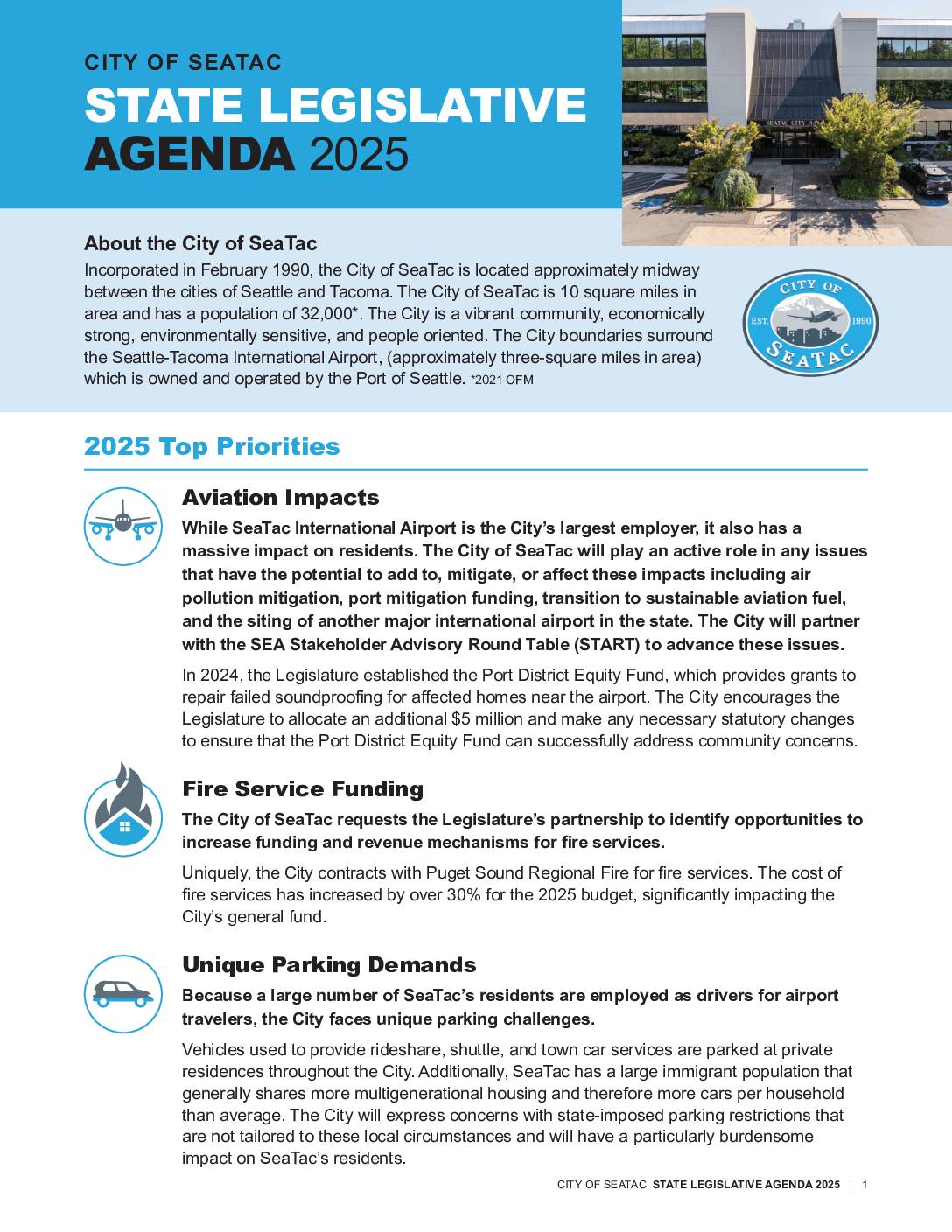
City of SeaTac state legislative agenda 2025
The City of SeaTac's 2025 State Legislative Agenda outlines the city's top priorities and policy goals for the Washington State Legislature, with aviation impacts—including airport noise and soundproofing—listed as a leading concern. The City specifically urges the Legislature to allocate an additional $5 million to the Port District Equity Fund, established in 2024, to repair failed soundproofing in homes affected by Seattle-Tacoma International Airport noise. Additional priorities include fire service funding, public safety, affordable housing, and infrastructure investments tied to the city's unique role as host to the region's major international airport. -
 2024-12-17
2023-24 State Tourism Program Operational Funding Request: Quick information
The State of Washington Tourism program is requesting operational funding through companion bills HB 1258 and SB 5465, which would raise the general funds cap to $13 million per fiscal year and adjust industry matching requirements. Without this funding, the program faces budget cuts of 36% in 2023 and an additional 30% in 2024, threatening statewide tourism initiatives. The request represents just 1% of state sales tax collections from rental cars, lodging, and restaurants, and aims to support rural communities, responsible travel campaigns, and economic resilience across Washington State. -
 2024-10-31
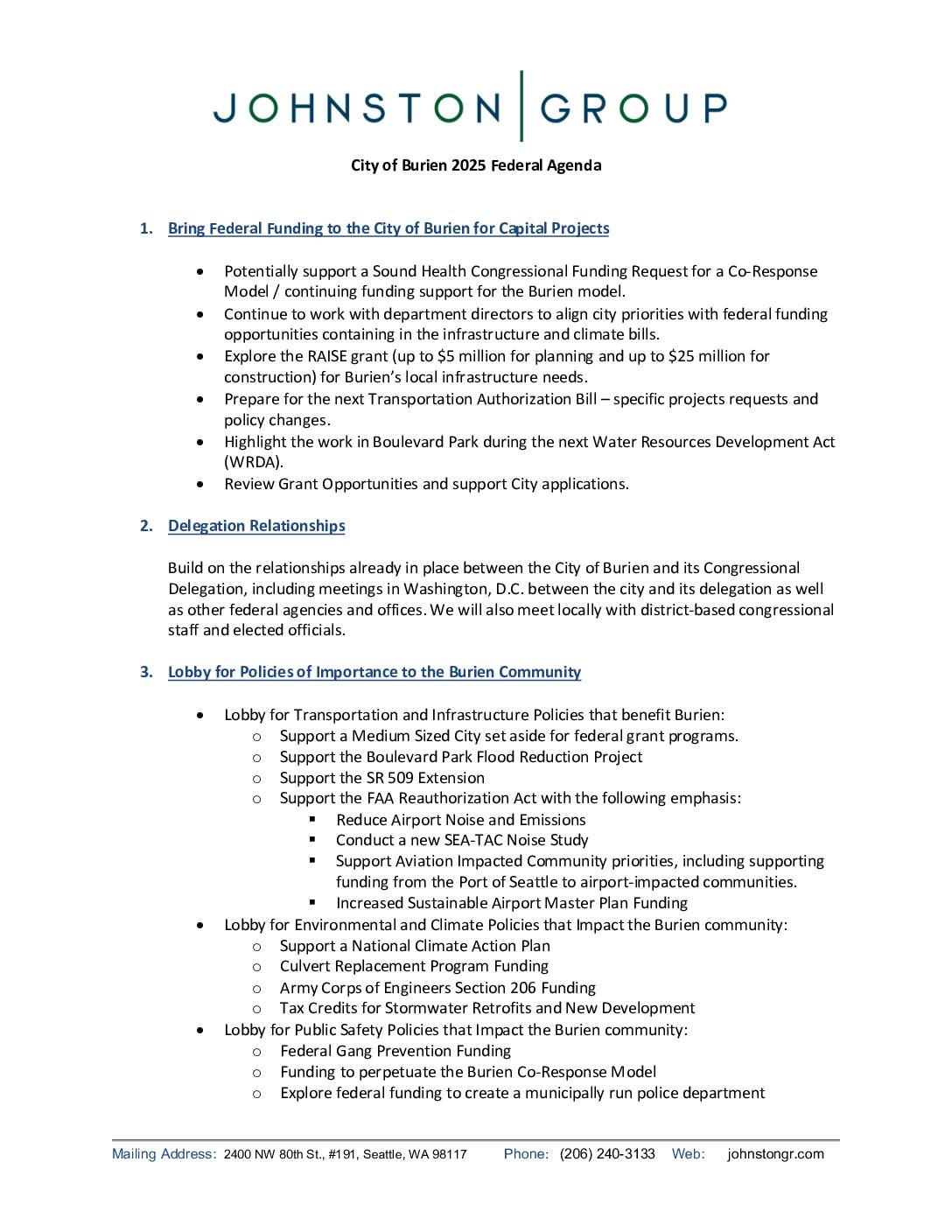
City of Burien 2025 federal agenda
The City of Burien's 2025 Federal Agenda, prepared by the Johnston Group, outlines lobbying priorities that include pushing for reduced airport noise and emissions near Sea-Tac Airport, conducting a new SEA-TAC noise study, and securing dedicated funding for aviation-impacted communities. The agenda also seeks increased Sustainable Airport Master Plan funding and supports the FAA Reauthorization Act as key vehicles for advancing these goals. Burien's federal lobbying effort aims to build congressional relationships and align city priorities with available federal funding to address the ongoing impacts of airport operations on surrounding neighborhoods.