TagDispersion(6)
-
What is a TRACON?
The area from 6-50 miles will affect you with or without a second airport. It’s an FAA acronym. Terminal Radar Approach Control. And if you live in any of the areas considered for a Second Airport, including Enumclaw or Pierce and Thurston Counties, keep reading. TRACONs are FAA facilities that house air traffic controllers who -
 2021-03-24
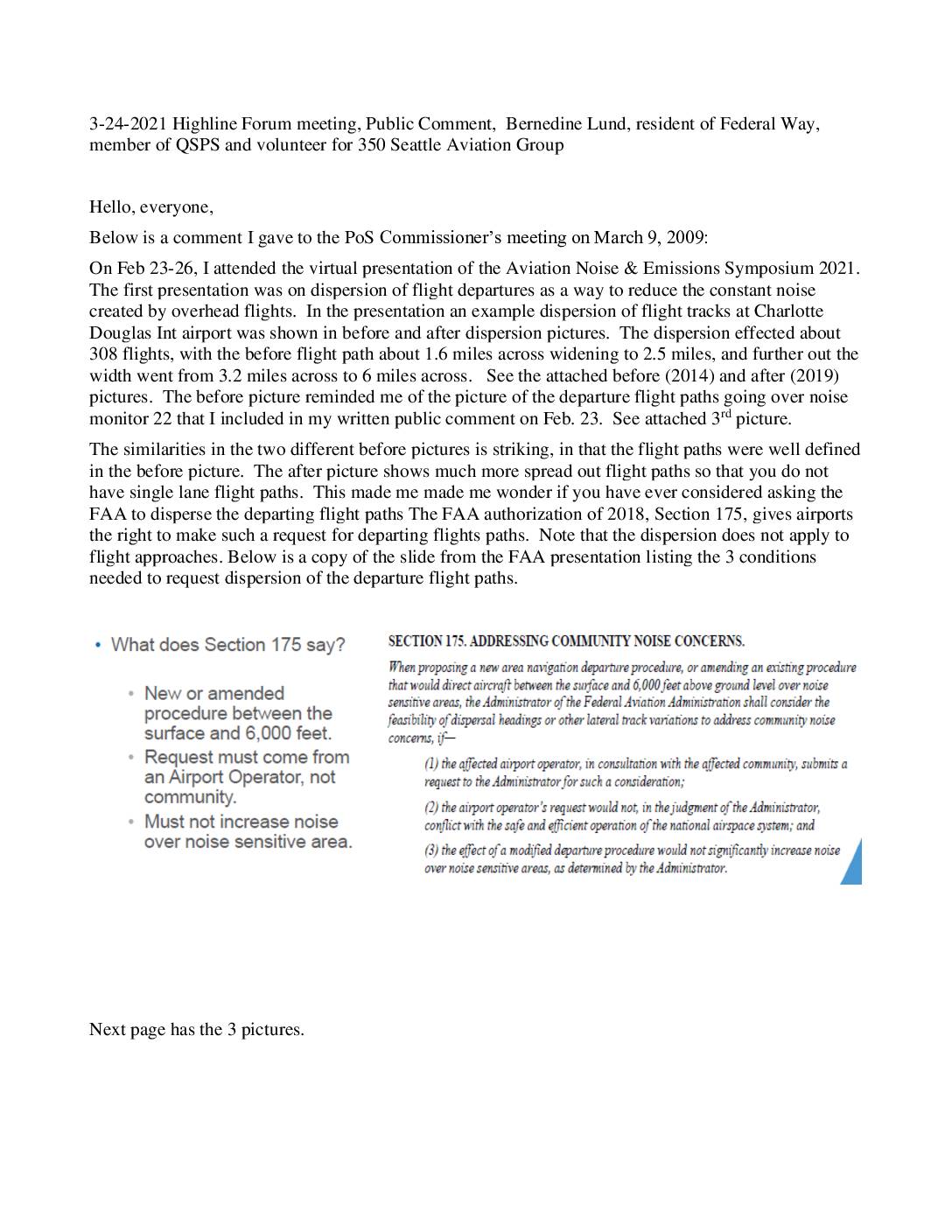
Public comment on flight path dispersion for Sea-Tac Airport departures, Highline Forum meeting
In a March 2021 public comment to the Highline Forum, Federal Way resident Bernedine Lund urged Sea-Tac Airport officials to request that the FAA disperse departure flight paths to reduce concentrated aircraft noise over residential areas. Drawing on examples from the 2021 Aviation Noise & Emissions Symposium, she highlighted how Charlotte Douglas International Airport successfully spread departure tracks from a 1.6-mile-wide corridor to 2.5 miles, and noted that similar tightly clustered flight paths exist over Federal Way. She pointed to FAA Reauthorization Act of 2018, Section 175, which allows airport operators—in consultation with affected communities—to formally request dispersal of departure procedures between the surface and 6,000 feet, provided the change does not increase noise over sensitive areas. -
 2021-02-18
Section 175: Understanding dispersion
This FAA presentation from February 18, 2021 explains Section 175 of the 2018 FAA Reauthorization Act, which addresses community noise concerns related to aircraft departure procedures. The law requires the FAA to consider dispersal headings or varied flight paths for new or amended departure procedures that direct aircraft between the surface and 6,000 feet over noise-sensitive areas, but only when the airport operator — not the community directly — formally requests it. Any approved changes must not significantly increase noise over noise-sensitive areas or interfere with the safe and efficient operation of the national airspace system. -
 2021-02-01
Dispersion in the age of RNAV
This presentation by aviation consultant Jim Allerdice explores 'dispersion,' a strategy for reducing repetitive aircraft noise over residential neighborhoods by intentionally varying the lateral flight paths of aircraft. It distinguishes between natural dispersion, which occurs randomly with manually flown routes and air traffic control vectors, and systematic dispersion, which uses satellite-based navigation (RNAV) to spread flights across multiple precise, predictable tracks in a controlled way. Examples of systematic dispersion techniques discussed include radar vectors to RNAV, open Standard Instrument Departures (SIDs), and Equivalent Lateral Spacing Operations (ELSO). -
 2021-02-01
Dispersion in the Age of RNAV Jim Allerdice, Jr. ABCx2 ANES
This 2021 presentation by aviation consultant Jim Allerdice examines 'dispersion' — the practice of intentionally varying flight paths so that aircraft noise is spread across a wider area rather than repeatedly concentrated over the same neighborhoods. It explores the tension between the FAA's preference for Performance-Based Navigation (PBN/RNAV), which promotes precise, repeatable flight paths for safety and efficiency, and the concerns of communities living under those concentrated flight corridors. The material is relevant to ongoing debates about how airports like Sea-Tac can balance operational efficiency with equitable distribution of aircraft noise impacts. -
 2021-01-01
Aircraft noise and overflight dispersion: Opportunities and challenges
A 2021 Aviation Noise and Emissions Symposium presentation by Charlotte Douglas International Airport Noise Abatement Specialist Dan Gardon explores the shifting landscape of aircraft noise complaints, noting that community annoyance is increasingly driven by the frequency of overhead flights rather than individual loud noise events. The presentation examines the opportunities and challenges airports face in dispersing flight paths to manage overflight noise. While focused on Charlotte Douglas, the insights are broadly relevant to airport noise management policy across the industry.