TagPart 150(269)
-
 2032-01-01
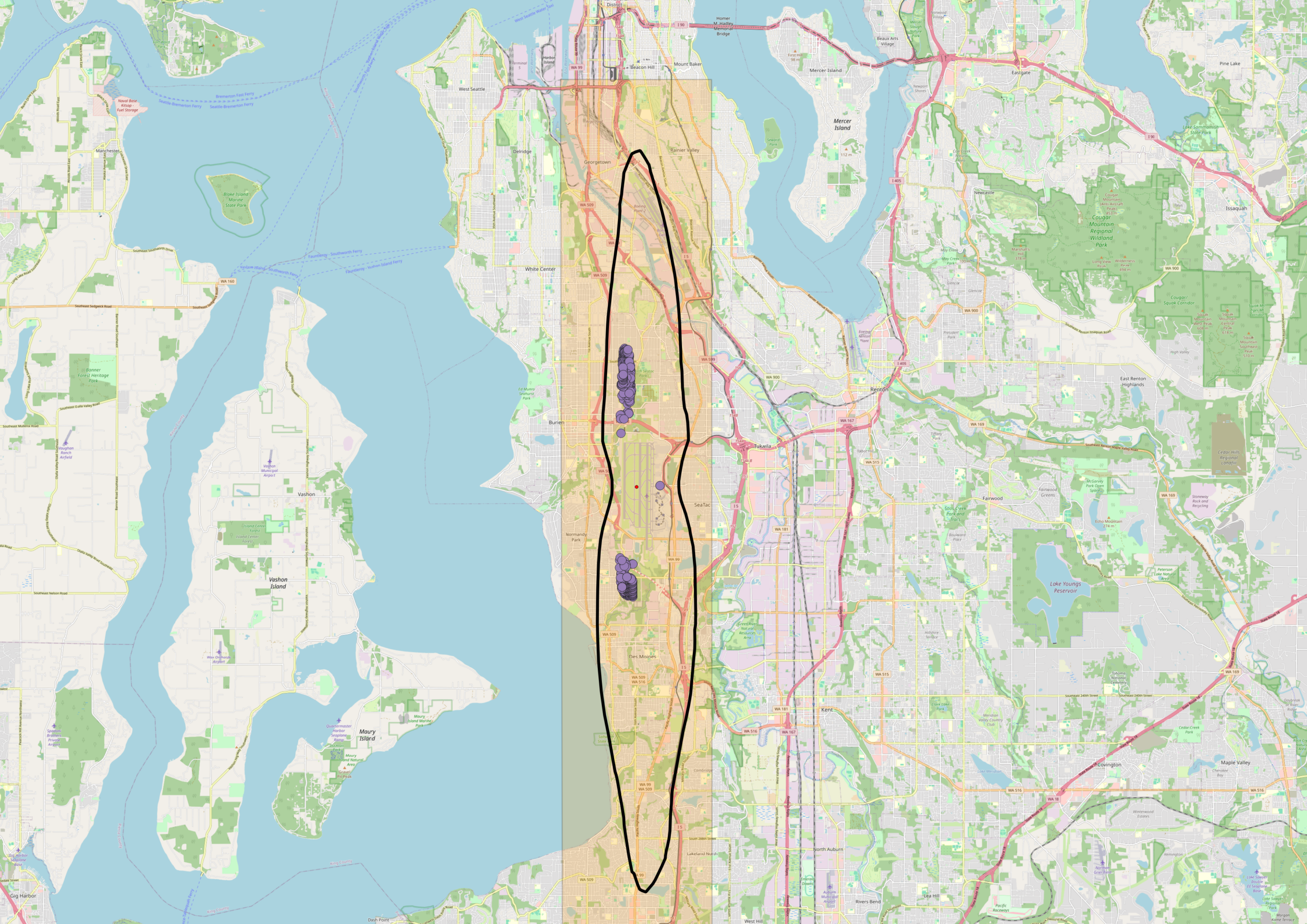
DNL 65 Noise Contour Map — Sea-Tac Airport Area with Noise Complaint Markers
An OpenStreetMap-based map centered on the Seattle–Tacoma (Sea-Tac) Airport area showing a highlighted corridor (shaded in orange/yellow) and a black oval outline delineating what appears to be a flight path or noise impact study zone. Clustered purple markers, likely representing noise complaint locations or monitoring stations, are visible near Burien and a southern cluster near Des Moines/Federal Way, with Sea-Tac Airport identifiable near the center of the map. -
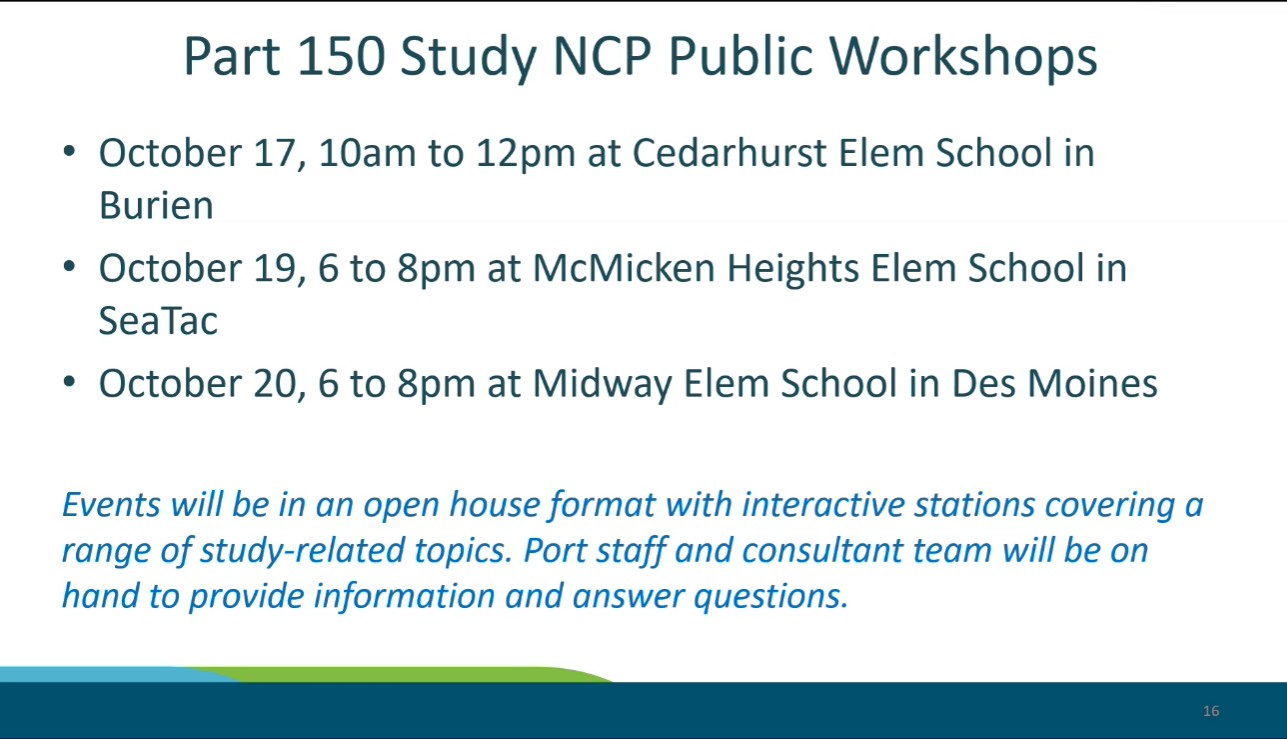
Part 150 NCP Workshop — Des Moines
Attend a Port of Seattle open house on the Part 150 Study Noise Compatibility Program (NCP). The Part 150 program determines the noise boundary around the airport and opportunities for noise mitigation such as sound insulation. -
Part 150 NCP Workshop — SeaTac
Attend a Port of Seattle open house on the Part 150 Study Noise Compatibility Program (NCP). The Part 150 program determines the noise boundary around the airport and opportunities for noise mitigation such as sound insulation. -
Part 150 NCP Workshop — Burien
Attend a Port of Seattle open house on the Part 150 Study Noise Compatibility Program (NCP). The Part 150 program determines the noise boundary around the airport and opportunities for noise mitigation such as sound insulation. -
 2026-09-25
Highline Forum Postgame
The sparsely attended meeting of electeds and administrators from the Highline Cities and Schools was held at the Des Moines Police Station and featured two updates of interest to readers: SAMP SEPA DEIS Summary Port Environmental Manager Steve Rybolt is charged with reviewing public the 490 comments provided. He stated that though this number is -
 2026-09-23
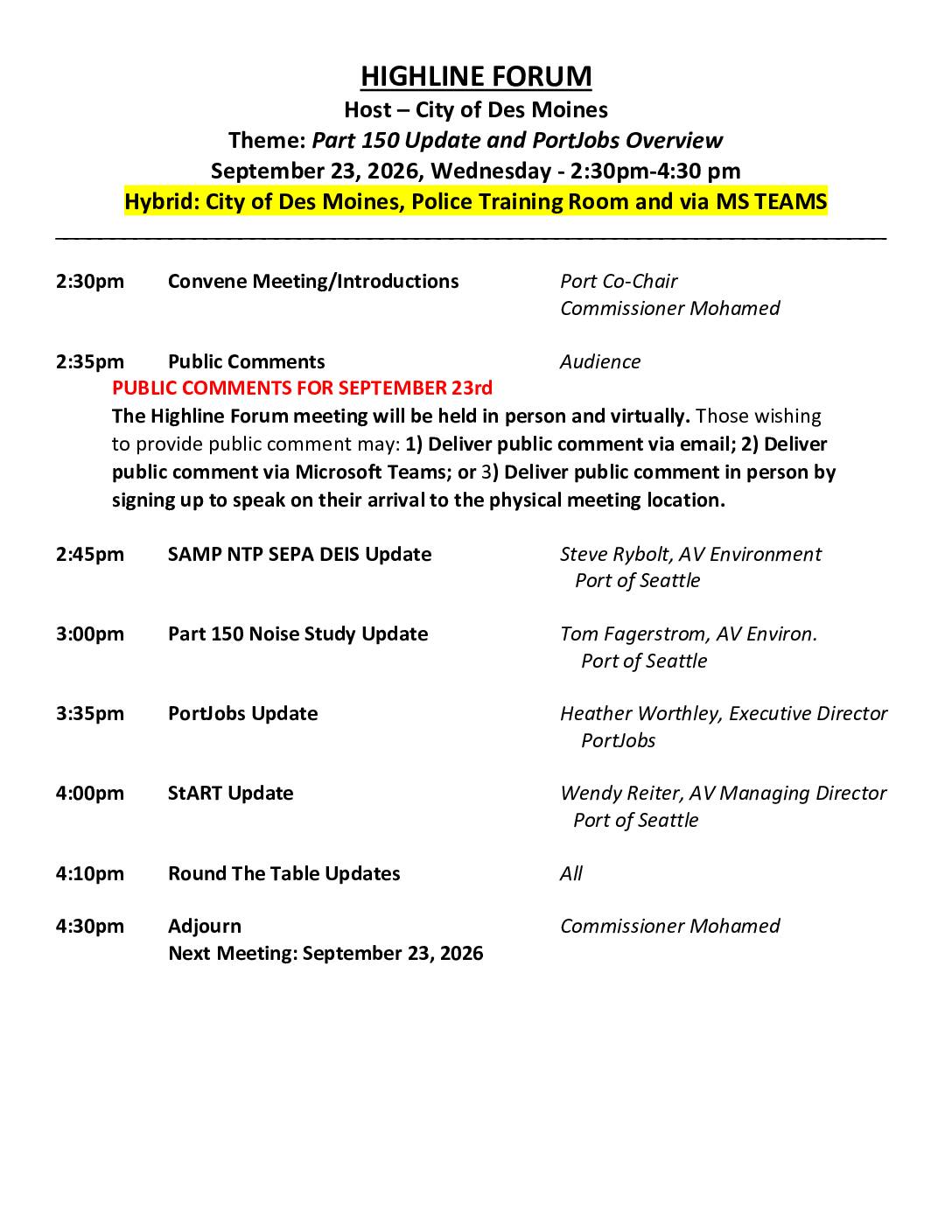
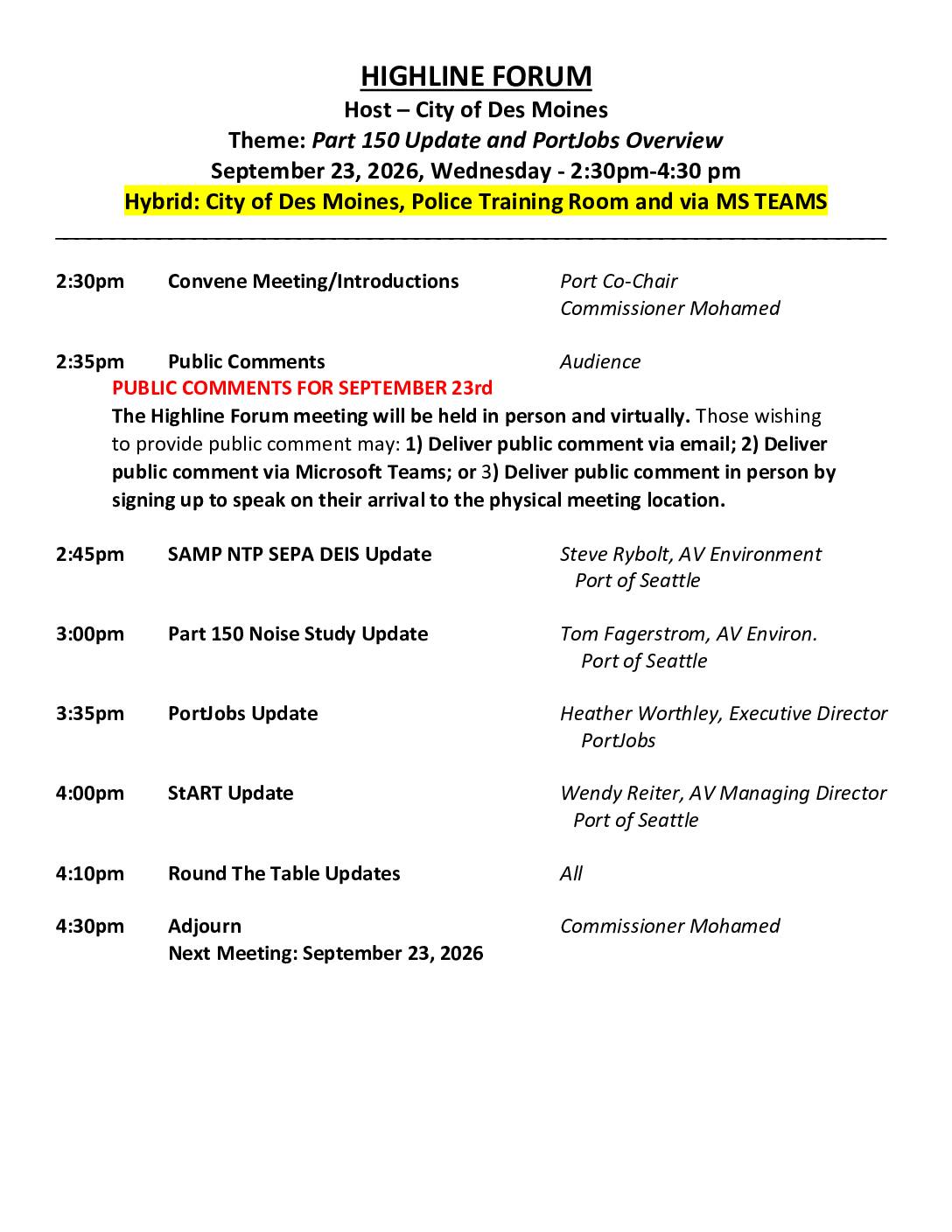
Highline Forum Agenda – September 23, 2026
Highline Forum Agenda Theme: Part 150 Update and PortJobs Overview 2:30pm – Convene Meeting/Introductions Port Co-Chair, Commissioner Mohamed 2:35pm – Public Comments Audience The meeting will be held in person and virtually. Those wishing to provide public comment may: 1) Deliver public comment via email; 2) Deliver public comment via Microsoft Teams; or 3) Deliver -
 2026-09-23
Highline Forum Agenda – September 23, 2026
Highline Forum meeting agenda for September 23, 2026, hosted by the City of Des Moines at the Police Training Room (hybrid via MS Teams), co-chaired by Port of Seattle Commissioner Hamdi Mohamed. Agenda includes: SAMP NTP SEPA DEIS Update by Steve Rybolt (AV Environment/Port of Seattle); Part 150 Noise Study Update by Tom Fagerstrom (AV -
2026-09-23
Highline Forum Agenda – September 23, 2026
Highline Forum meeting agenda for September 23, 2026, hosted by the City of Des Moines at the Police Training Room (hybrid via MS Teams), co-chaired by Port of Seattle Commissioner Hamdi Mohamed. Agenda includes: SAMP NTP SEPA DEIS Update by Steve Rybolt (AV Environment/Port of Seattle); Part 150 Noise Study Update by Tom Fagerstrom (AV -
 2026-09-23
Part 150 Noise and Land Use Compatibility Study Update
Port of Seattle presentation to the Highline Forum on September 23, 2026, providing an update on the Part 150 Noise and Land Use Compatibility Study for Sea-Tac Airport. Covers Part 150 study basics under CFR 14 Part 150, FAA Airport Improvement Program (AIP) grant funding requirements for sound insulation and noise abatement projects, the 65 -
 2026-09-15
Burien Airport Committee Meeting September 15, 2026
a) Part 150 Noise Study (Emily Inlow-Hood) — 15 minutes b) SAMP Update and Next Steps (Brian Davis and Sarah Moore) — 15 minutes c) Legislative Updates — 10 minutes • SCA (Sarah Moore) • Work with Sen. Orwall (Brian Davis) d) StART Reorganization (Jeff Harbaugh and Karen Veloria) — 10 minutes