TagNextGen(65)
-
 2026-05-29
ANES 2026 MAA BWI Vianair 0004
Presentation slides from the Maryland Aviation Administration (MAA) and BWI Marshall Airport Roundtable Technical Subcommittee covering aviation noise outcomes and next steps. Topics include expanded DNL contours below 65DNL, separation of East and West Flow contours, NextGen implementation impacts, FAA Instrument Flight Procedure (IFP) Gateway filing, and an upcoming 14 CFR Part 150 Study beginning -
 2026-05-29
ANES 2026 AWG: Orange County Community Proactive Involvement in Addressing Change (Post NexGen) — Commercial Airline Requested Departure Procedure Adjustments at SNA
Aviation Noise and Emissions Symposium (ANES) Aviation Working Group (AWG) presentation on seven specific community requests to airlines to mitigate departure noise at John Wayne Airport (SNA/Orange County). Covers NADP-1 steep departure procedures (1.2 dB reduction), STAYY4 two-turn procedure approved by FAA, 1200-foot throttle cutback, further power reduction at 1200 feet altitude initiated April 2024 -
 2025-12-17
FAA head details air traffic control modernization progress, next steps
By Lindsey Wilkinson December 17, 2025 FAA Administrator Bryan Bedford speaks during a hearing in the U.S. Capitol on Dec. 17, 2025 in Washington, DC. (Photo by Heather Diehl/Getty Images) With modernization efforts ramping up at the Transportation Department’s Federal Aviation Administration, leaders have a sharpened focus on efficiency, safety and accountability, Administrator Bryan Bedford -
 2025-11-21
Petition for Review of Agency Order: Vashon Island Fair Skies v. Federal Aviation Administration
Vashon Island Fair Skies (VIFS), a Washington nonprofit representing residents affected by aircraft noise, has filed a petition in the Ninth Circuit Court of Appeals challenging a September 2025 FAA decision approving near-term expansion projects at Seattle-Tacoma International Airport. The group argues that the FAA's environmental review failed to adequately address the significant noise impacts on Vashon and Maury Islands resulting from concentrated, low-altitude flight paths introduced under the FAA's NextGen navigation program. VIFS has been actively opposing these flight path changes since 2018, when new Performance-Based Navigation procedures began routing more aircraft directly over the islands at lower altitudes. -
 2024-05-13
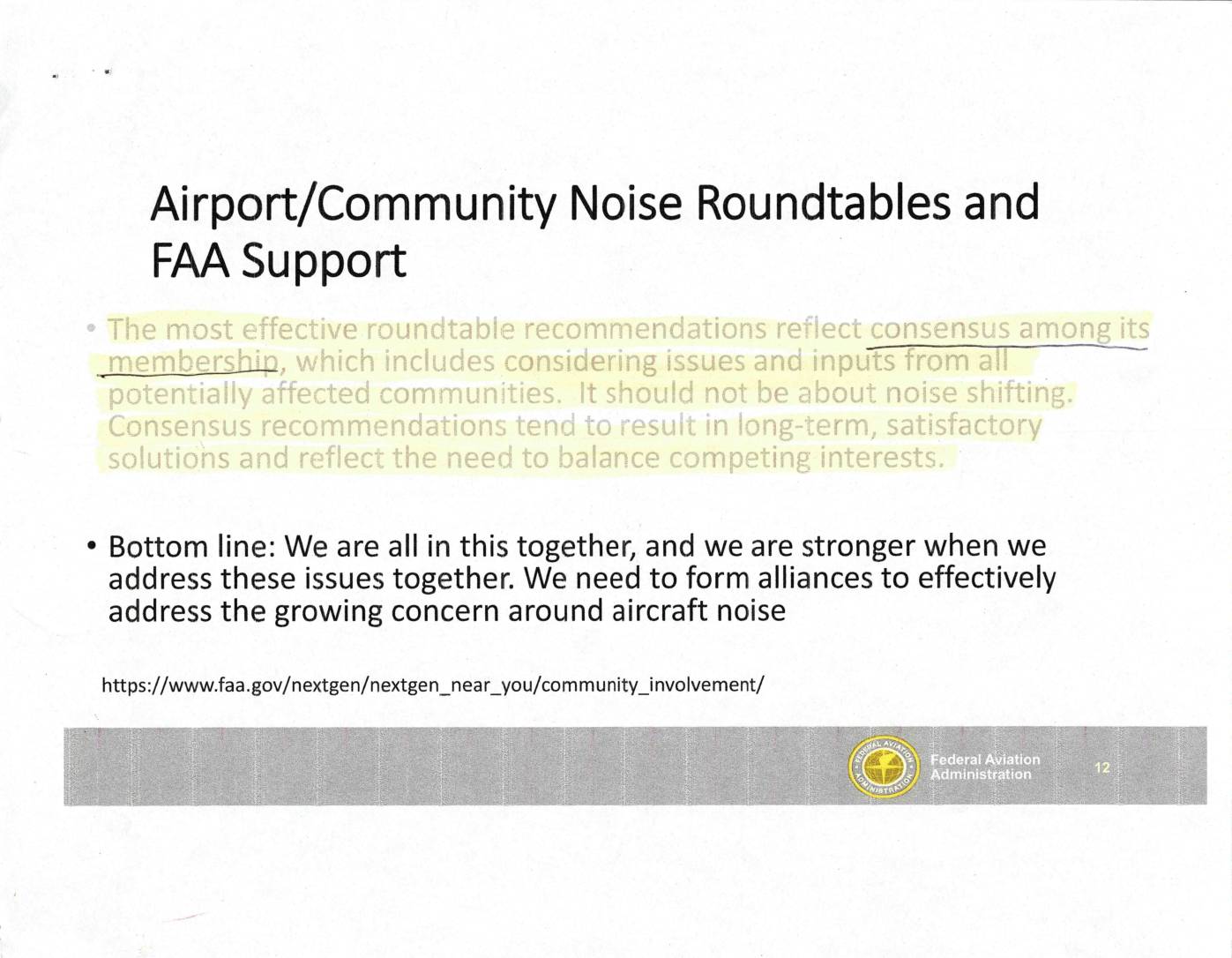
Airport/community noise roundtables and FAA support
This FAA presentation covers Airport/Community Noise Roundtables and FAA support for addressing aircraft noise concerns near airports like Sea-Tac. It explains that effective roundtables build consensus among all affected communities, while the FAA's Air Traffic Organization (ATO) works through a large backlog of noise-reduction recommendations, each requiring months of technical feasibility review and environmental assessment. The FAA encourages communities to focus on the most actionable recommendations and to form alliances, emphasizing that collaborative, balanced solutions produce the best long-term outcomes. -
 2024-05-11
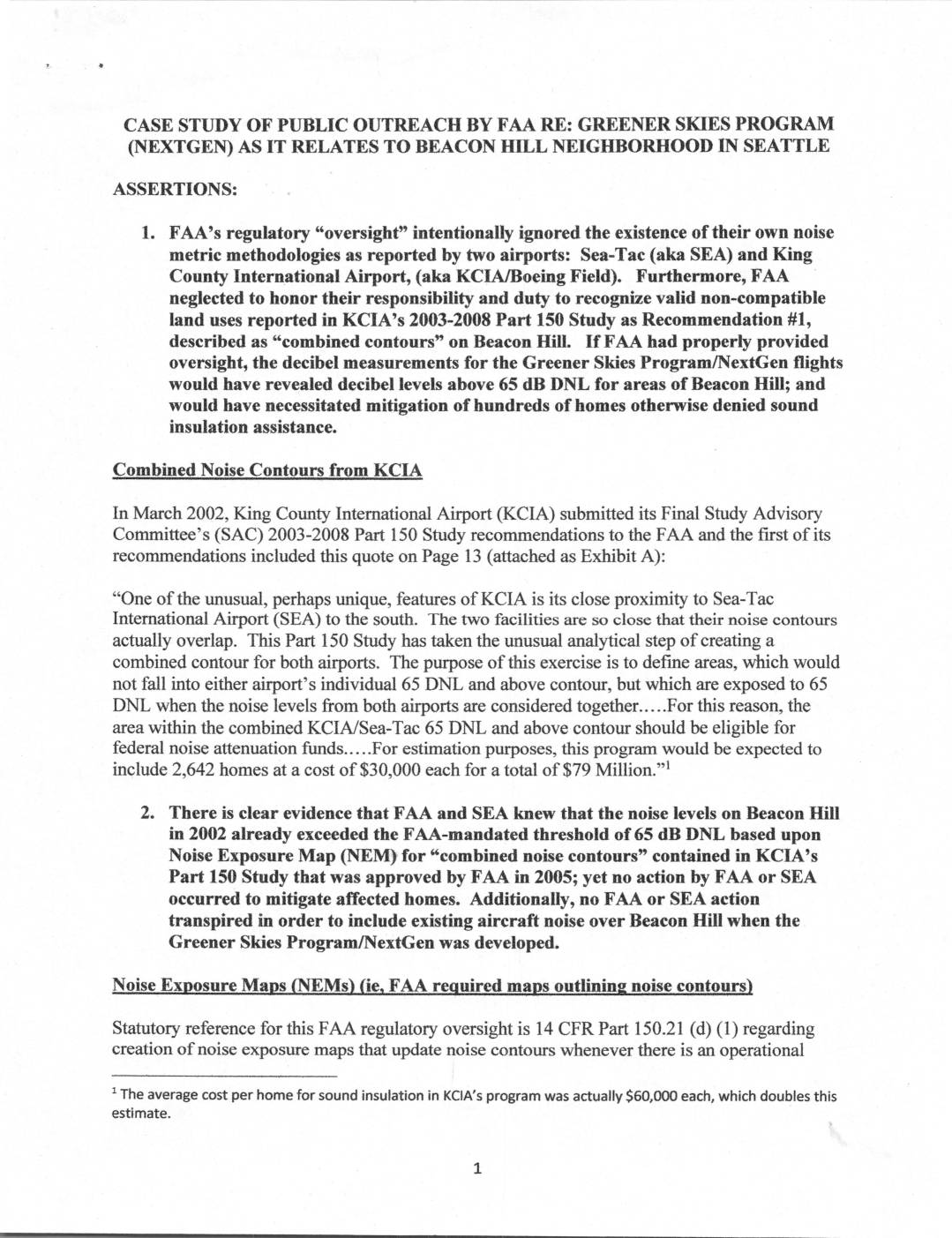
Case study of public outreach by FAA re: Greener Skies Program (NextGen) as it relates to Beacon Hill neighborhood in Seattle
This document argues that the FAA and Sea-Tac Airport failed to properly account for combined aircraft noise from both Sea-Tac and Boeing Field when approving the Greener Skies/NextGen flight program, leaving hundreds of Beacon Hill homes without sound insulation assistance they may have been entitled to. A 2002 King County International Airport study had already identified that noise levels in parts of Beacon Hill exceeded the 65 dB DNL federal threshold when both airports' noise was measured together, yet no mitigation was provided. The document also highlights that no public outreach was conducted in the Beacon Hill neighborhood—a majority-Asian, multilingual community—before the new flight paths were implemented. -
 2024-05-11
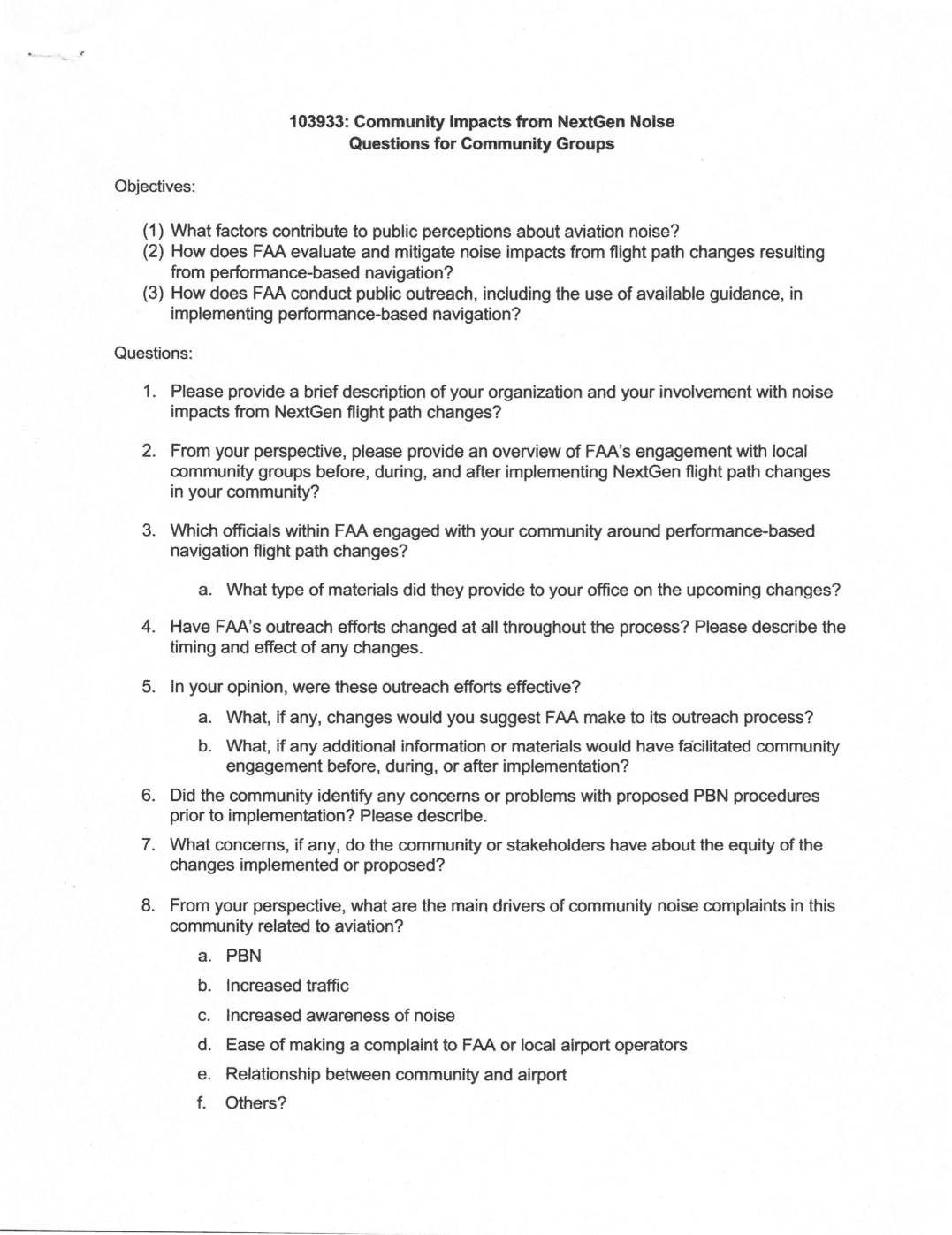
Community impacts from NextGen noise: Questions for community groups
This document contains a structured set of interview questions developed for a GAO study (project 103933) examining how NextGen flight path changes have affected local communities through increased aviation noise. The questions are directed at community groups and cover topics including FAA outreach efforts before and after implementation, equity concerns, the drivers of noise complaints, and whether any flight path modifications were sought or made following implementation. It aims to assess how effectively the FAA communicated with and involved communities in performance-based navigation (PBN) decisions. -
 2024-05-11
NextGen effects on communities surrounding Sea-Tac Airport
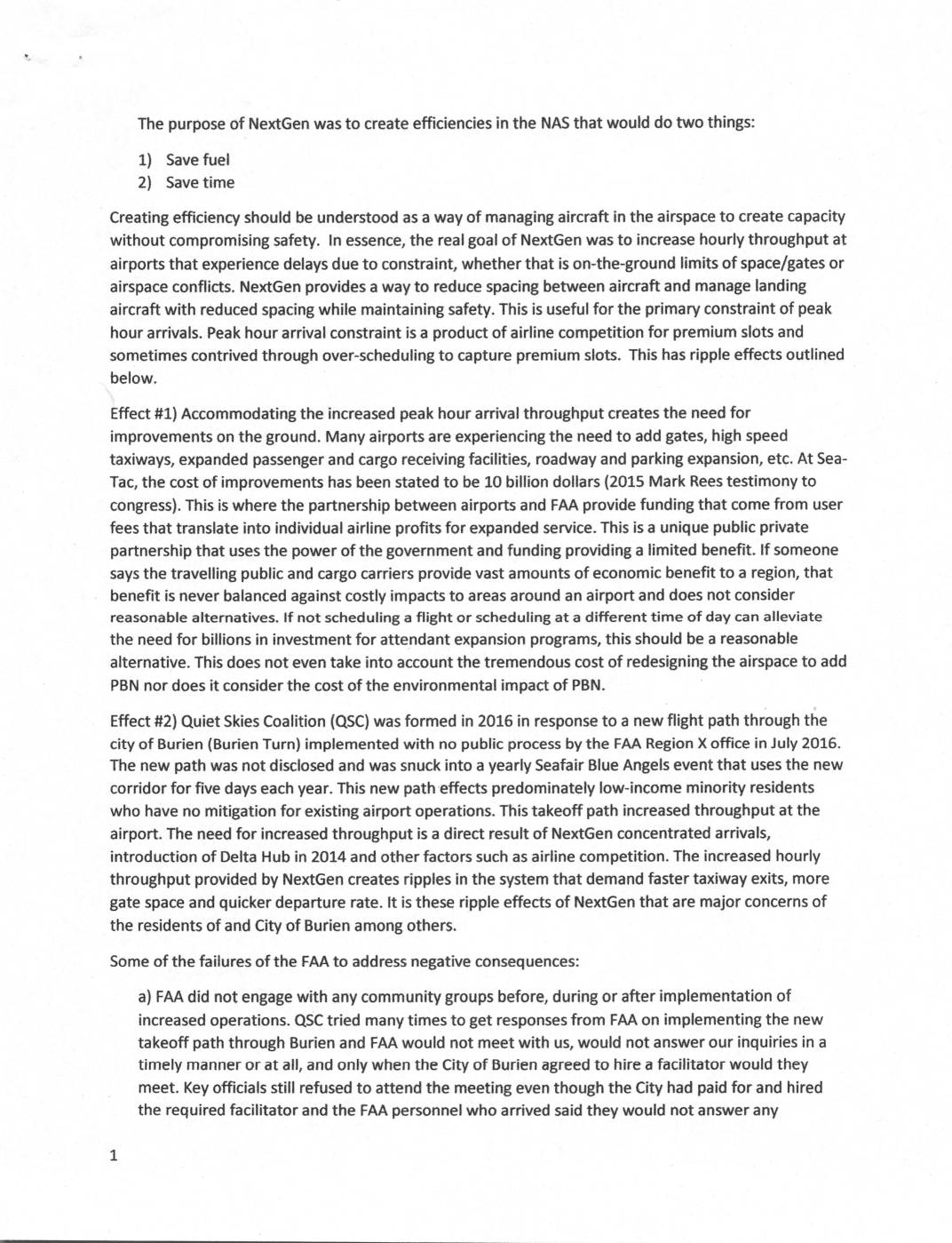
This document outlines concerns raised by the Quiet Skies Coalition about how the FAA's NextGen air traffic modernization program has increased flight operations at Seattle-Tacoma International Airport, creating concentrated flight paths over low-income and minority neighborhoods like Burien. It argues that the FAA failed to engage communities before implementing new flight routes, dismissed significant noise and air quality concerns, and has not analyzed the cumulative health impacts of aircraft noise and ultrafine particle emissions on nearby residents. The document also details a successful legal challenge by the City of Burien against the FAA in the 9th Circuit Court of Appeals, which the FAA has continued to ignore. -
 2023-06-12
FAA Reauthorization Act of 2023
The FAA Reauthorization Act of 2023 is a proposed Senate bill that would authorize funding for the Federal Aviation Administration from fiscal years 2024 through 2028. The legislation covers a wide range of aviation topics including airport planning, noise compatibility programs, safety improvements, airspace modernization, and aviation workforce development. Of particular relevance to airport noise policy, the bill includes provisions on flight profile optimization, performance-based navigation, and NextGen airspace modernization efforts that can affect flight paths and noise impacts on communities near airports like Sea-Tac. -
 2023-06-07
Noise programs & NextGen briefing
This Port of Seattle briefing, presented by Noise Programs Manager Stan Shepherd, covers key topics related to aircraft noise management at Seattle-Tacoma International Airport, including flight procedures, noise contours, and mitigation programs. It highlights a steady rise in noise complaints received through the Noise Information Hotline and online forms, growing from 2,172 inquiries in 2014 to 2,959 in 2016, with a small number of repeat callers accounting for the majority of contacts each year.