TagAirspace Study(26)
-
 2025-10-23
DCA South of Airport Aircraft Noise and Mitigation Study: Recommendations and Noise Analysis
This October 2025 report from the DCA South of Airport Aircraft Noise and Mitigation Study examines how post-Metroplex airspace changes increased aircraft overflights and noise exposure for residents south of Ronald Reagan Washington National Airport, including communities in Alexandria, Fairfax, and Prince George's Counties. The study, conducted by aviation consultancy Vianair, presents recommendations and noise analysis aimed at reducing the impact of arrival and departure flight paths on affected residential populations. Note: This document pertains to DCA (Washington, D.C.), not Sea-Tac Airport. -
 2025-02-20
FAA JO7400.2R Handling Airspace Matters
FAA Order JO 7400.2R, effective February 20, 2025, sets out procedures for managing U.S. airspace, covering topics such as objects affecting navigable airspace, airport airspace analysis, terminal and en route airspace, special use airspace, and laser and rocket operations. The order updates policies related to surveillance facilities and airport proposals to reflect modern, contractor-supported National Airspace System technologies. Note that this document addresses broad national airspace management procedures and does not specifically cover Sea-Tac Airport noise policy. -
 2023-08-14
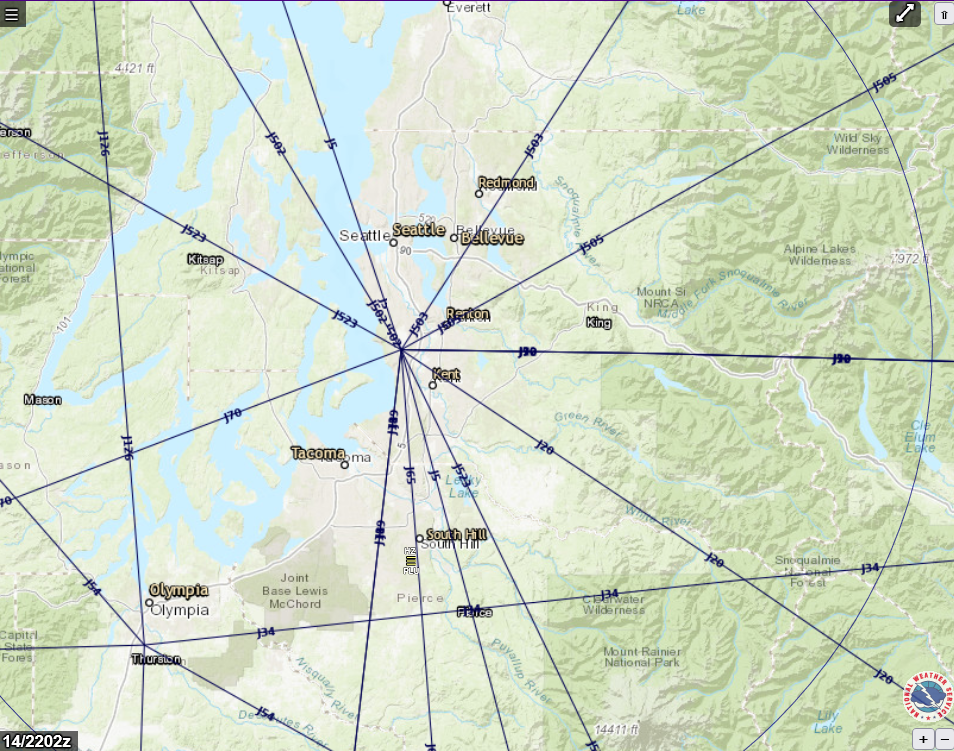
FAA Jet Route Chart Centered on Seattle-Tacoma Area – 14/2202z
A National Weather Service (NWS)-branded interactive aviation map showing FAA high-altitude jet routes (J-routes) radiating from a central fix near Seattle-Tacoma International Airport (Sea-Tac), with surrounding cities including Seattle, Bellevue, Renton, Kent, Tacoma, and Olympia visible. The map is timestamped 14/2202z and displays multiple labeled jet airways (J20, J34, J90, J523, etc.) overlaid on a terrain basemap of the greater Puget Sound region. -
 2023-03-07
Aircraft noise mitigation study and plan: The City of Alexandria, VA
This 2023 study, prepared by aviation consulting firm Vianair for the City of Alexandria, Virginia, assesses aircraft noise impacts on communities south of Ronald Reagan Washington National Airport (DCA) and proposes solutions acceptable to the FAA. The work involves analyzing historical flight operations and noise exposure data from 2014–2019, examining changes in flight paths and procedures, and developing recommendations to reduce noise for residents in Alexandria, Fairfax County, and Prince George's County. The findings are intended to be accessible to the general public and local policymakers, not just aviation experts. -
tracon-uRw2a
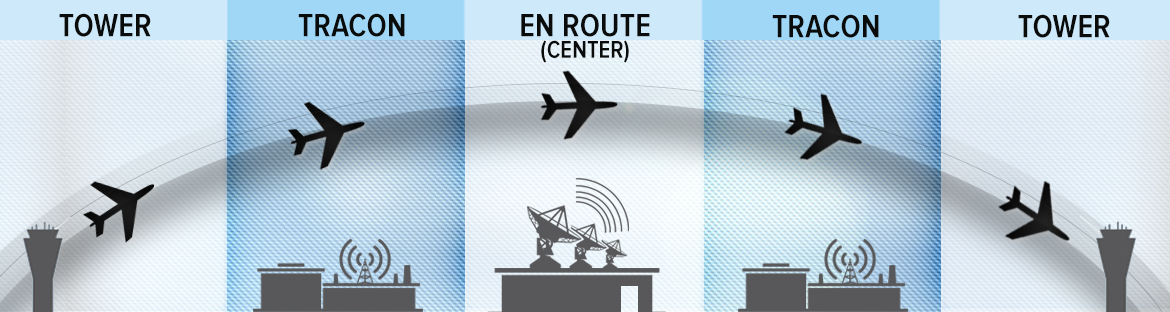
Diagram illustrating the FAA's layered air traffic control system, showing the handoff of aircraft between Tower (airport), TRACON (Terminal Radar Approach Control), and En Route Center facilities. The graphic depicts a flight path arc from departure to arrival, with corresponding ground facility silhouettes for each control segment. -
 2019-10-10
Regional Aviation Baseline Study: Technical Workshop #2 Presentation
This document presents the agenda and materials for the second technical workshop of the Regional Aviation Baseline Study, held on October 10, 2019. The workshop covered key aviation metrics across commercial service, air cargo, general aviation, and multimodal access, as well as an analysis of regional aviation needs including capacity versus demand, challenges, and opportunities by sector. A regional airspace analysis and discussion of next steps were also included. -
 2019-02-01
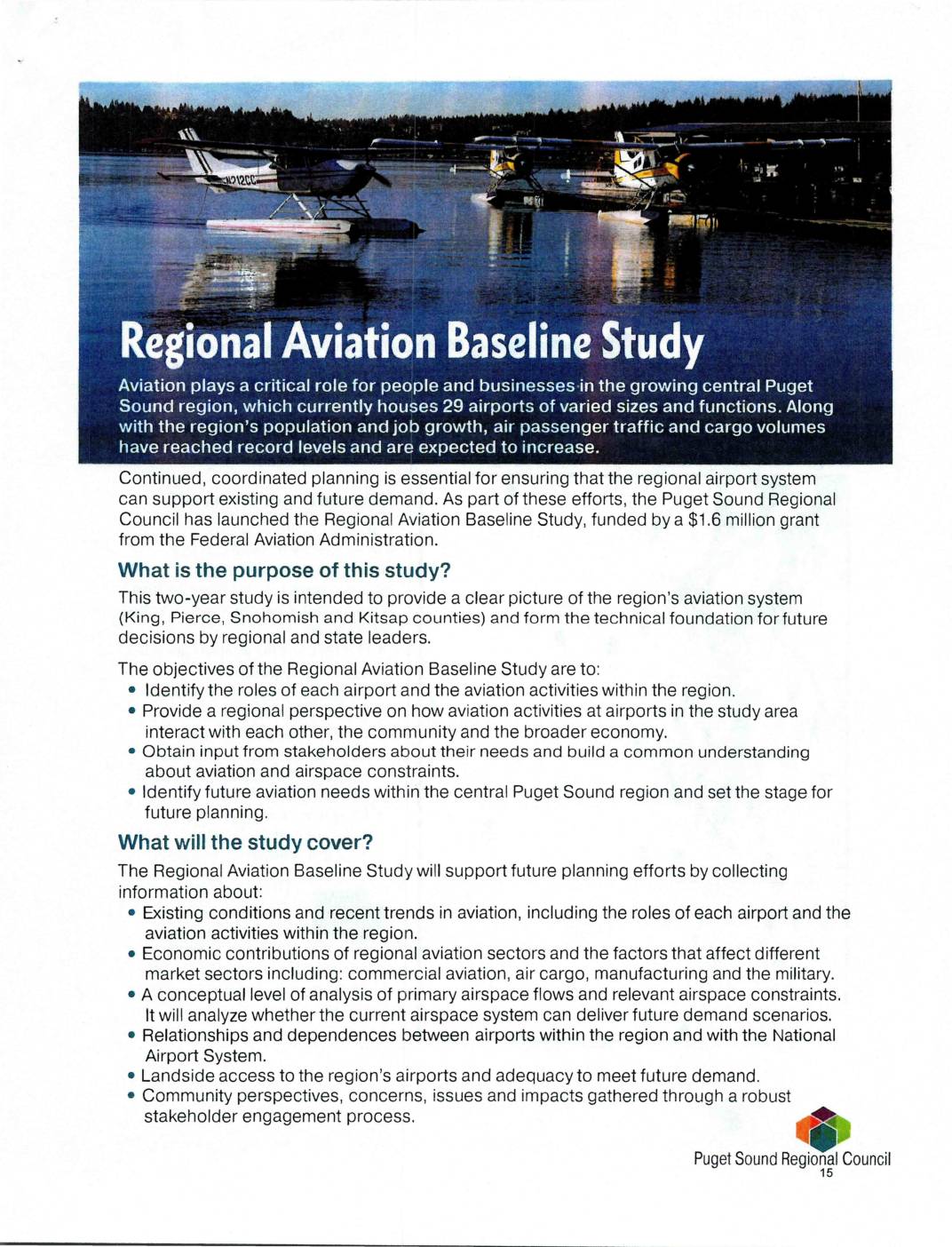
Regional Aviation Baseline Study
The Puget Sound Regional Council launched a two-year Regional Aviation Baseline Study, funded by a $1.6 million FAA grant, to assess the aviation system across King, Pierce, Snohomish, and Kitsap counties. The study examined existing airport roles, economic contributions, airspace capacity, and community impacts to build a technical foundation for future regional aviation planning decisions. Conducted in phases from 2019 to 2020, the study included stakeholder engagement, public meetings, and a final report outlining strategies for accommodating future aviation demand in the central Puget Sound region. -
 2005-06-24
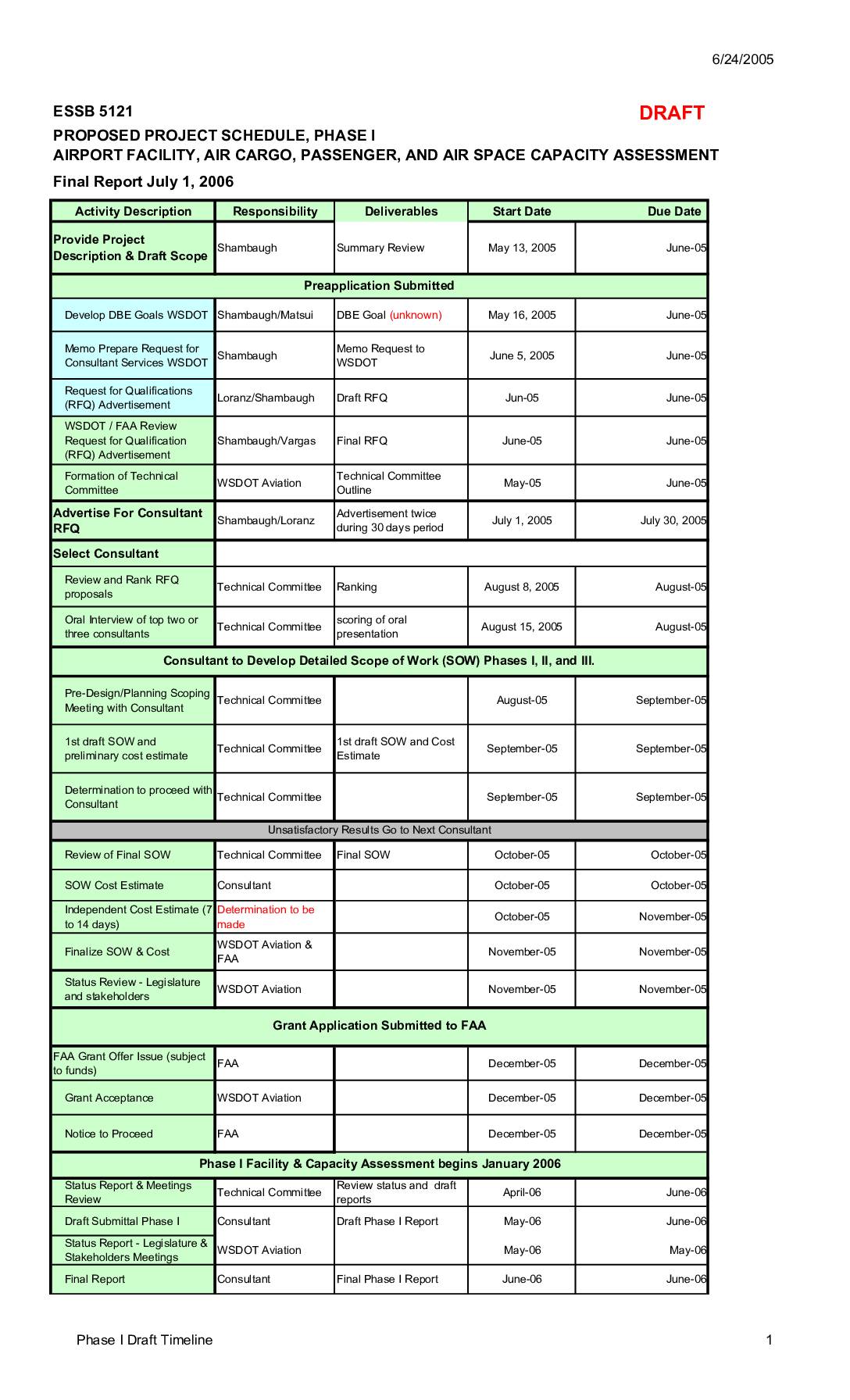
ESSB 5121 proposed project schedule, Phase I: Airport facility, air cargo, passenger, and air space capacity assessment
This draft project schedule outlines the planned timeline for Phase I of Washington State's airport facility, air cargo, passenger, and airspace capacity assessment under ESSB 5121, running from May 2005 through August 2006. Key milestones include advertising for a consultant, developing a detailed scope of work, securing an FAA grant, and completing a final Phase I report by July 1, 2006. WSDOT Aviation was responsible for submitting the findings to legislative committees, the governor, transportation commission, and regional planning organizations. -
 1992-07-01
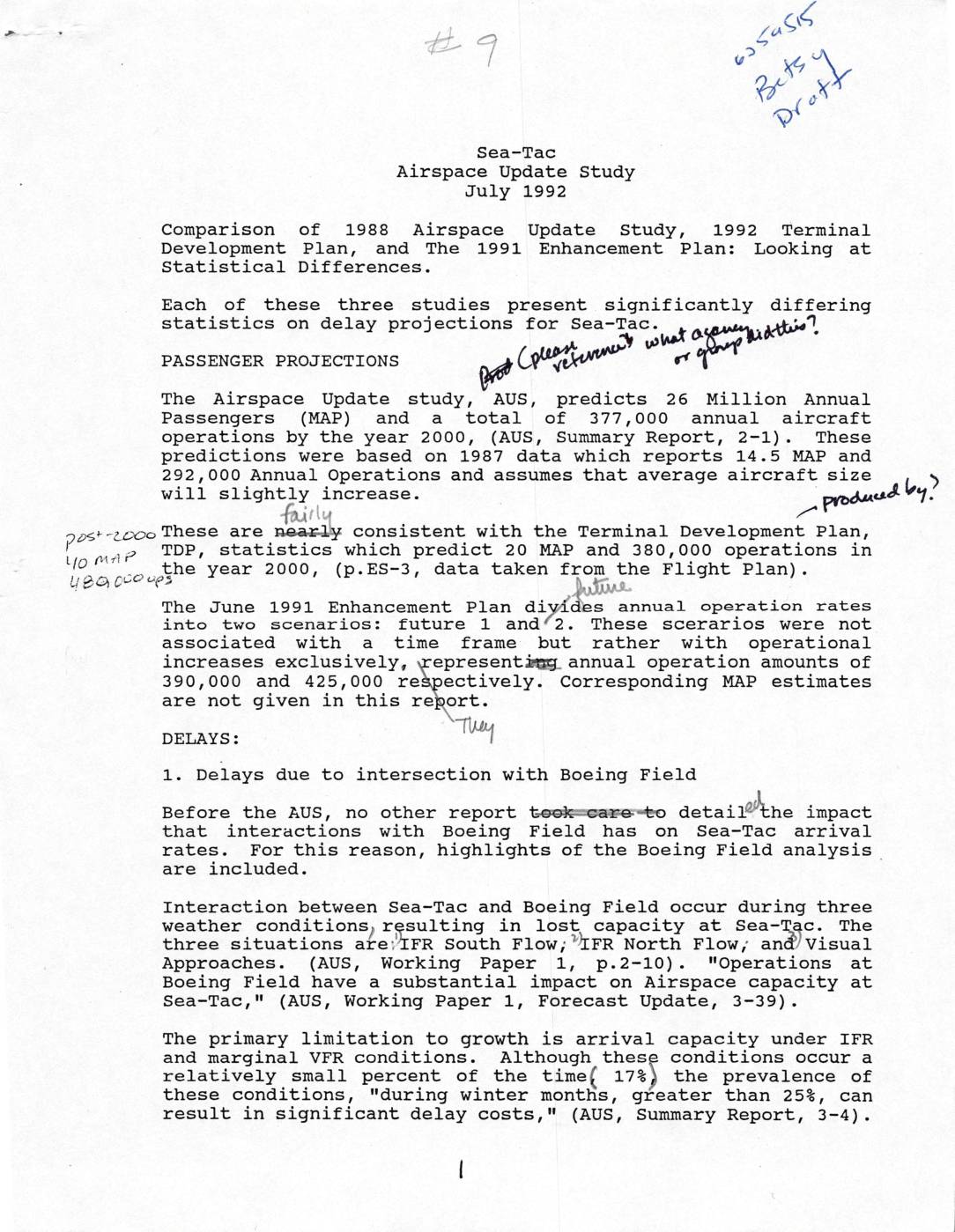
Sea-Tac Airspace Update Study: Comparison of 1988 Airspace Update Study, 1992 Terminal Development Plan, and the 1991 Enhancement Plan
This 1992 study compares three planning reports on Sea-Tac Airport's future capacity and delays: the 1988 Airspace Update Study, the 1992 Terminal Development Plan, and the 1991 Enhancement Plan. The reports differ significantly in their passenger and flight operation projections for the year 2000, and show striking discrepancies in delay estimates — with the Enhancement Plan projecting delay hours more than five times higher than the Airspace Update Study. The document also outlines proposed solutions to reduce delays, including new runway construction, airspace conflict resolution with nearby Boeing Field, and improved approach procedures. -
 1982-10-27
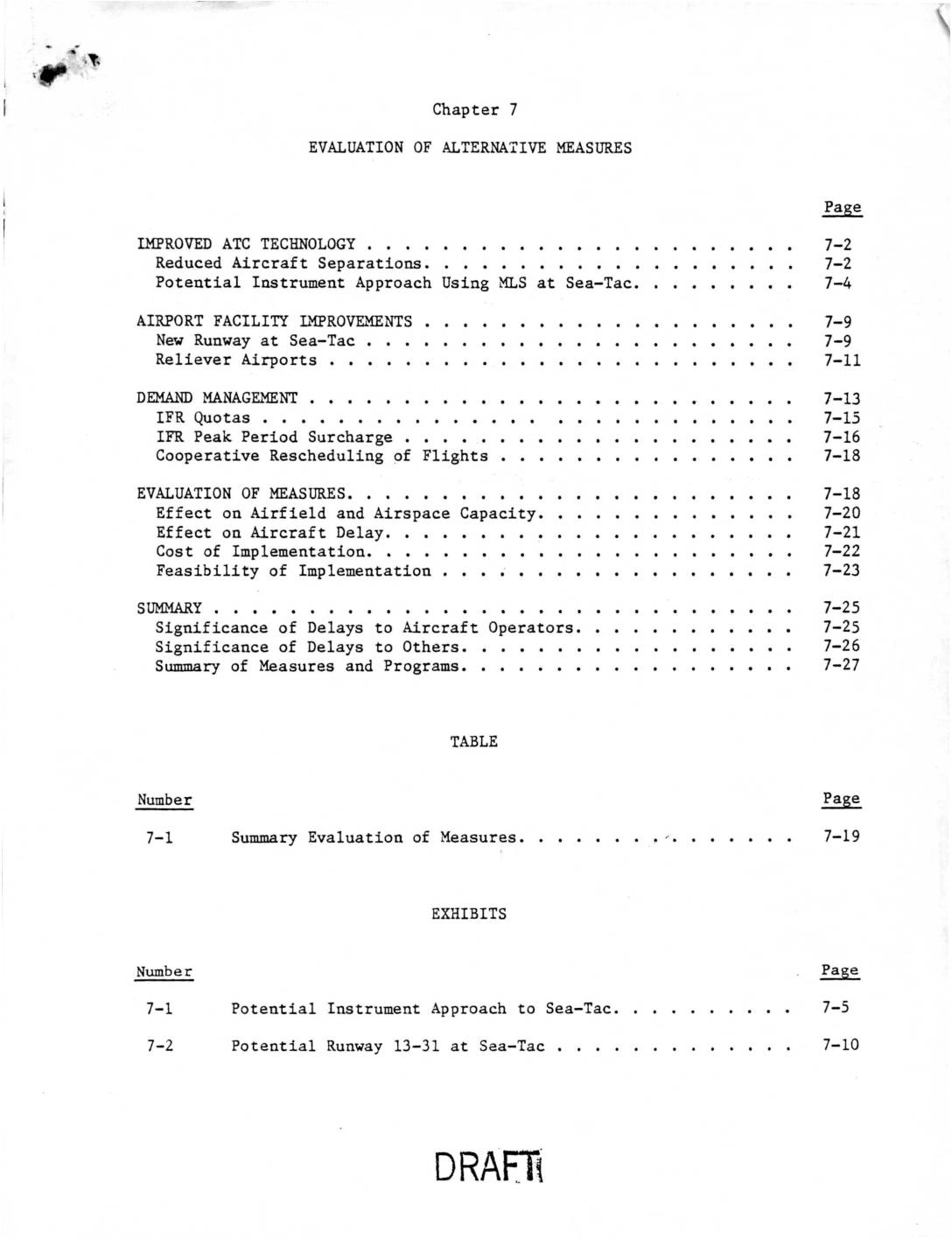
Evaluation of Alternative Measures: Chapter 7, Shared Airspace Study
This draft chapter evaluates alternative measures to reduce growing aircraft delays caused by airspace interactions between Seattle-Tacoma International Airport (Sea-Tac) and Boeing Field, which are projected to worsen significantly between 1990 and 2000. Three main approaches are examined: improving air traffic control (ATC) technology to allow reduced aircraft separations, expanding airport facilities through new runways or reliever airports, and managing demand through flight quotas or peak-period pricing. The chapter concludes that a combination of these measures will likely be necessary, and that action should begin immediately since implementation could take until 1990 when the delays are expected to become critical.