TagBuyouts(12)
-
1994-12-11
Sea-Tac’s Turbulent History
Dec 11, 1994 Stephen Clutter, Paul J. Lim The latest controversy at Sea-Tac, over a possible third runway, is one more chapter in a long, turbulent history of airport expansion. Planes started using the site in 1944 and in five decades, it has become the 16th-busiest airport in the nation. ———————————- If you’re upset about -
 1985-09-24
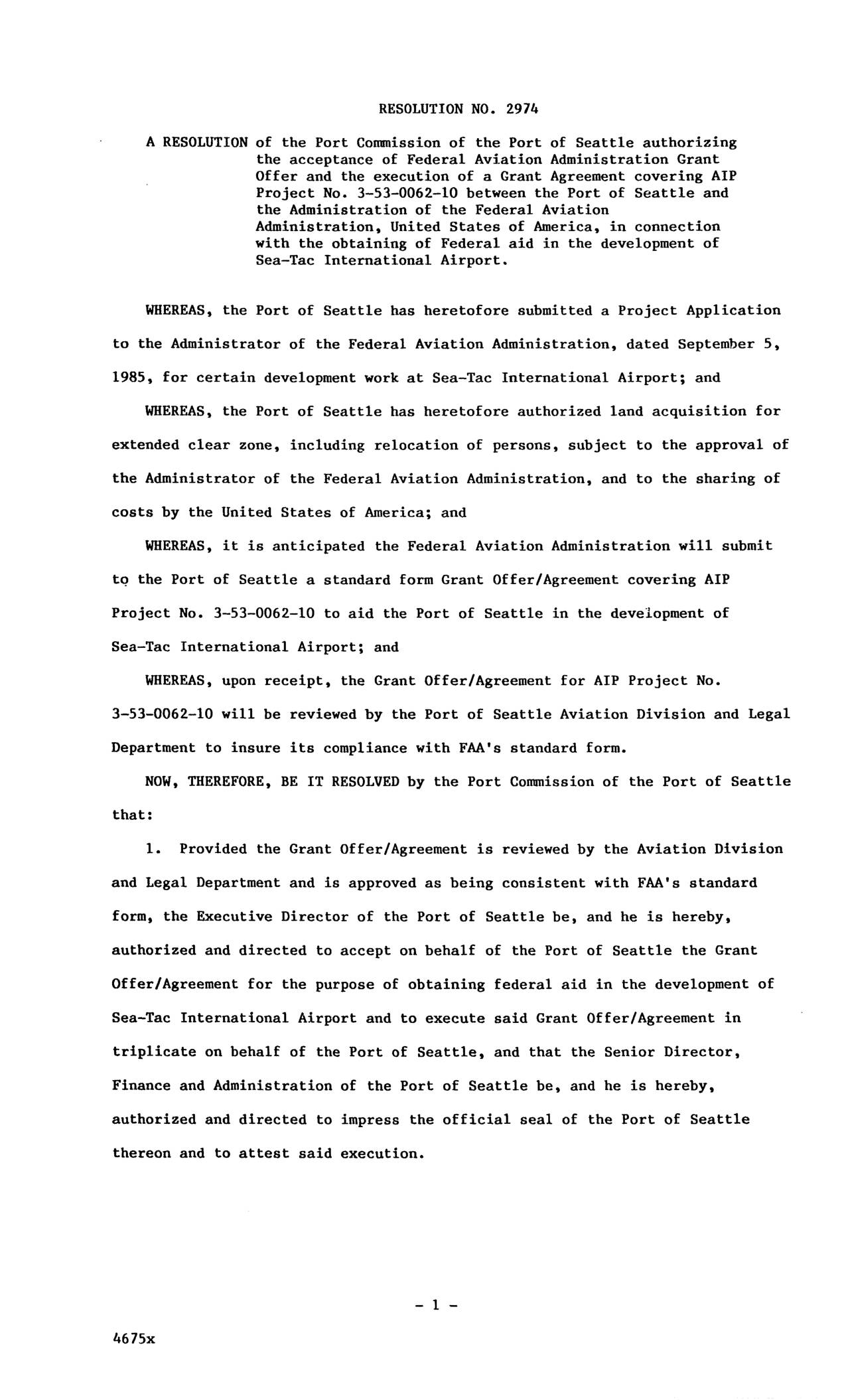
Resolution No. 2974: Authorization to accept FAA grant offer for AIP Project No. 3-53-0062-10
In September 1985, the Port of Seattle's Port Commission passed Resolution No. 2974, authorizing acceptance of a Federal Aviation Administration grant (AIP Project No. 3-53-0062-10) to fund land acquisition and relocation of residents in the extended clear zone around Seattle-Tacoma International Airport. The grant agreement, issued under Contract No. DOT-FA85NM-0062, covered nine specific land parcels (J-54, J-56, J-114, J-141, J-144, J-146, J-149, J-150, and J-151) adjacent to the airport. The resolution directed the Port's Executive Director to execute the agreement on the Port's behalf, provided it met FAA standard form requirements. -
 1984-08-28
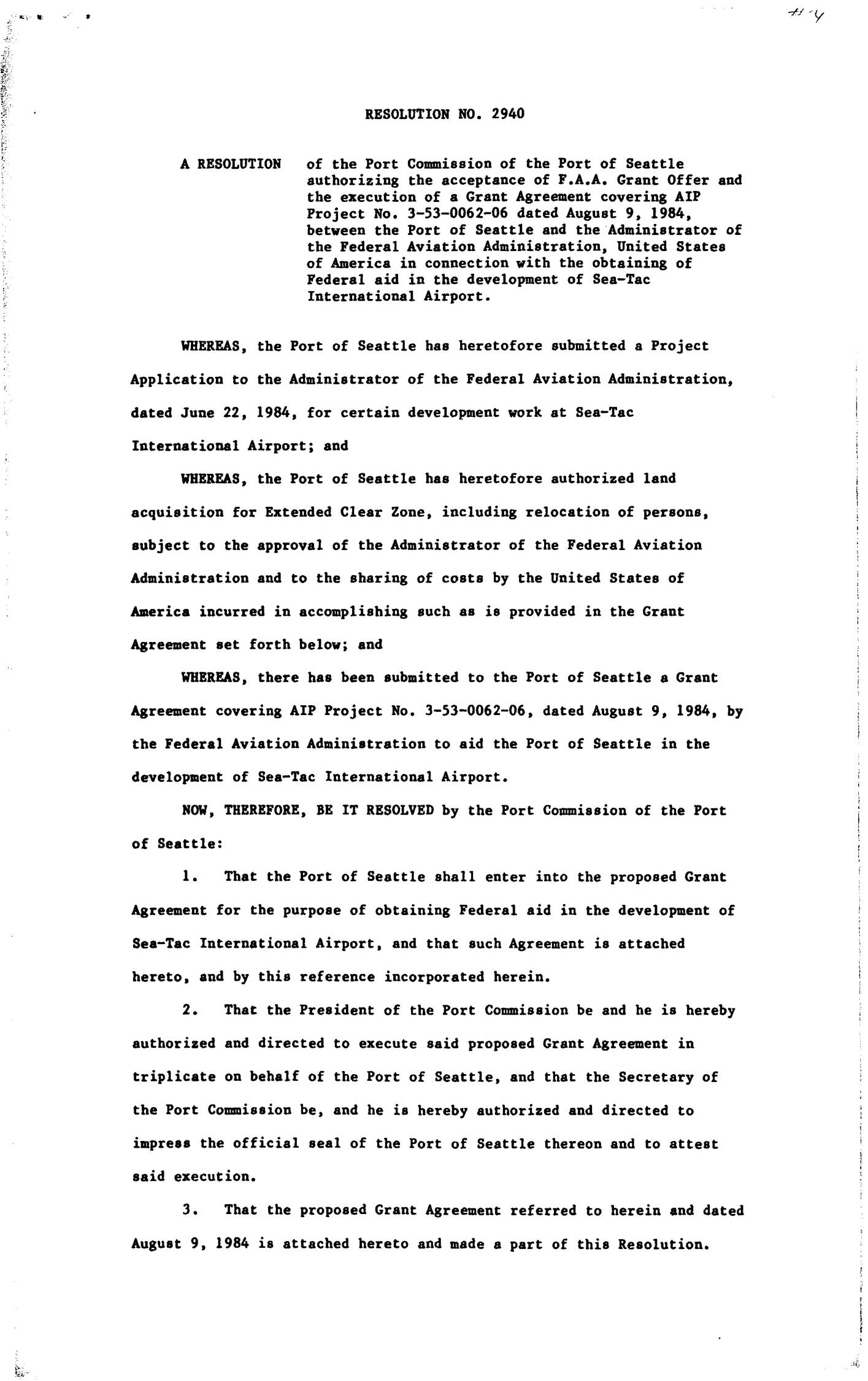
Commission Resolution no. 2940 FAA Grant AIP Clear Zone land acquisition
A resolution authorizing the Port of Seattle to accept an FAA grant offer and execute Grant Agreement for AIP Project No. 3-53-0062-06 to obtain federal aid for Sea-Tac International Airport development, specifically for land acquisition in Extended Clear Zone areas and relocation of persons. The resolution was adopted by the Port Commission on August 28, -
 1984-01-16
Final Evaluation of Noise Abatement and Noise Remedy Measures – Acoustical Treatment of Existing Structures
★ 32This draft report from Peat Marwick, consultants to the Port of Seattle, evaluates noise remedy measures for neighborhoods surrounding Seattle-Tacoma International Airport. It outlines eligibility criteria for a sound insulation program, targeting approximately 5,529 existing residential structures exposed to noise levels of Ldn 70 or higher in 1980, or Ldn 65 or higher projected for the year 2000. The recommendations build on the 1976 Sea-Tac/Communities Plan, reflecting updated noise exposure data, airline deregulation impacts, and residential growth in the area. -
 1979-04-10
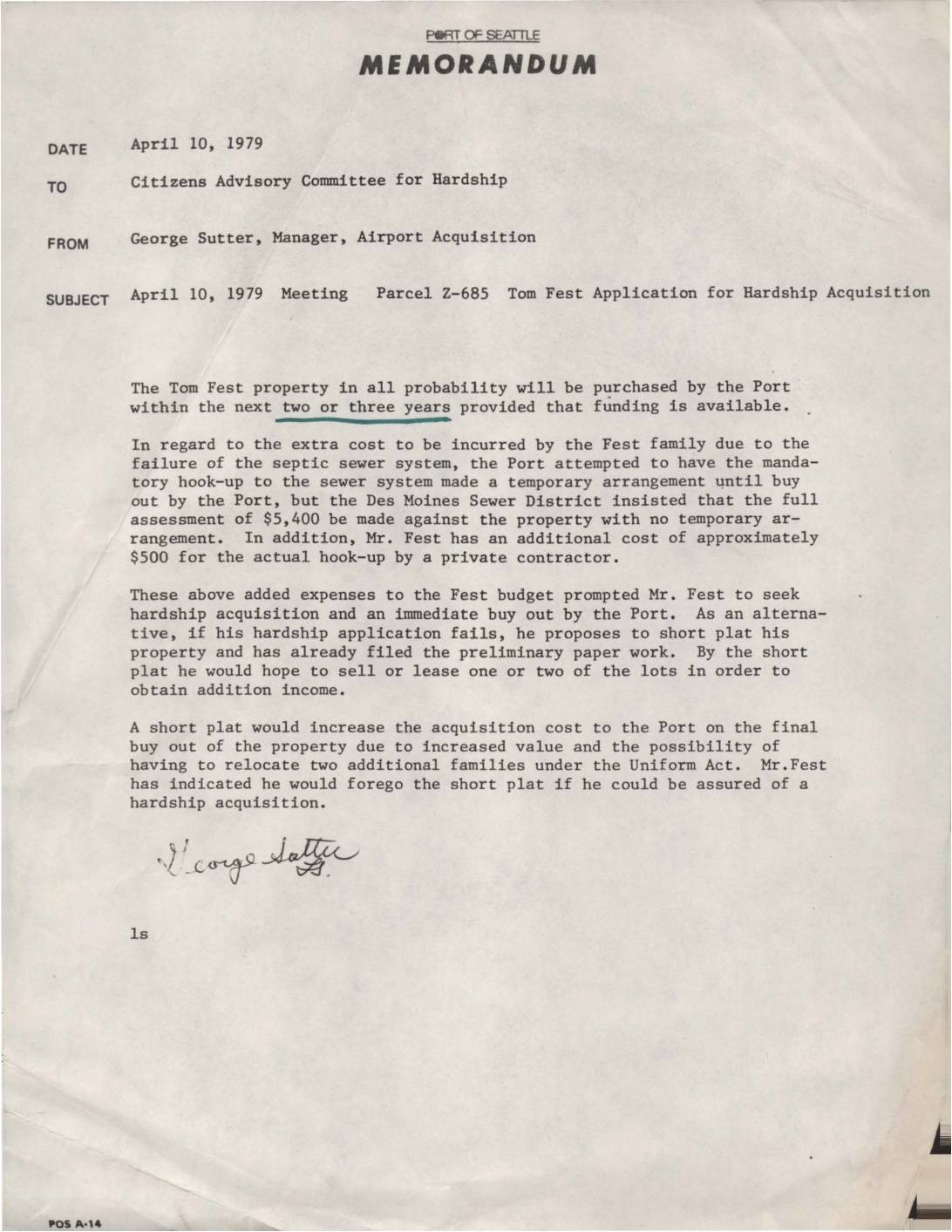
Tom Fest Application for Hardship Acquisition – Parcel Z-685
A 1979 Port of Seattle memo from Airport Acquisition Manager George Sutter to the Citizens Advisory Committee for Hardship outlines Tom Fest's application for hardship acquisition of his property (Parcel Z-685), prompted by unexpected sewer hook-up costs totaling approximately $5,900. The Port expected to purchase the property within two to three years, but the Fest family sought an immediate buyout due to financial strain. As an alternative, Mr. Fest threatened to subdivide the property via short plat — a move that would increase the Port's eventual acquisition costs — but indicated he would abandon that plan if hardship acquisition was approved. -
 1979-04-10
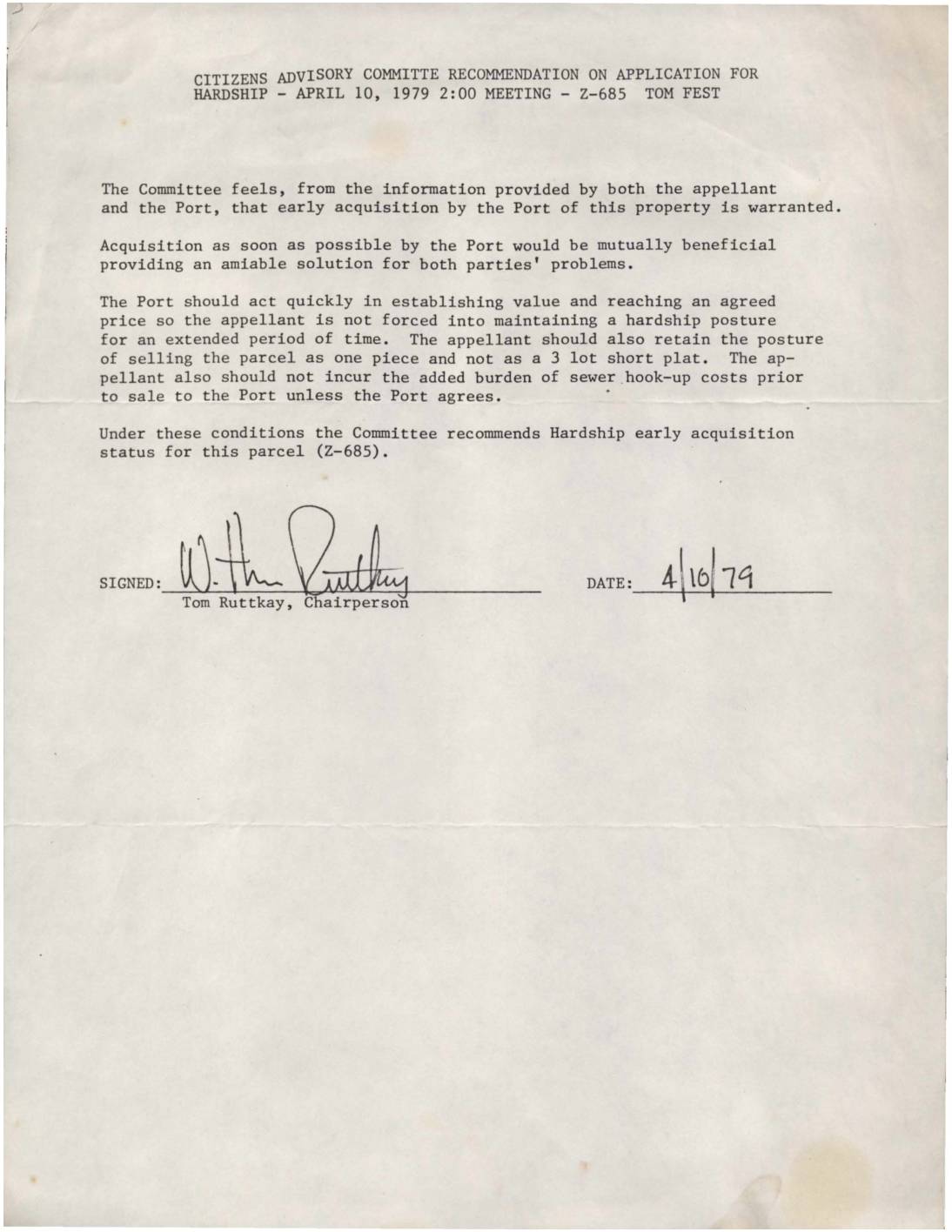
Citizens Advisory Committee Recommendation on Application for Hardship – Z-685 Tom Fest
In April 1979, the Citizens Advisory Committee recommended that the Port of Seattle pursue early acquisition of a property owned by Tom Fest (parcel Z-685) under hardship status. The Committee determined that a quick purchase would benefit both parties, urging the Port to promptly establish a fair price and the owner to sell the property as a single parcel rather than subdividing it into three lots. The recommendation also specified that the owner should not be required to pay sewer hook-up costs before the sale unless the Port agreed to them. -
 1979-03-15
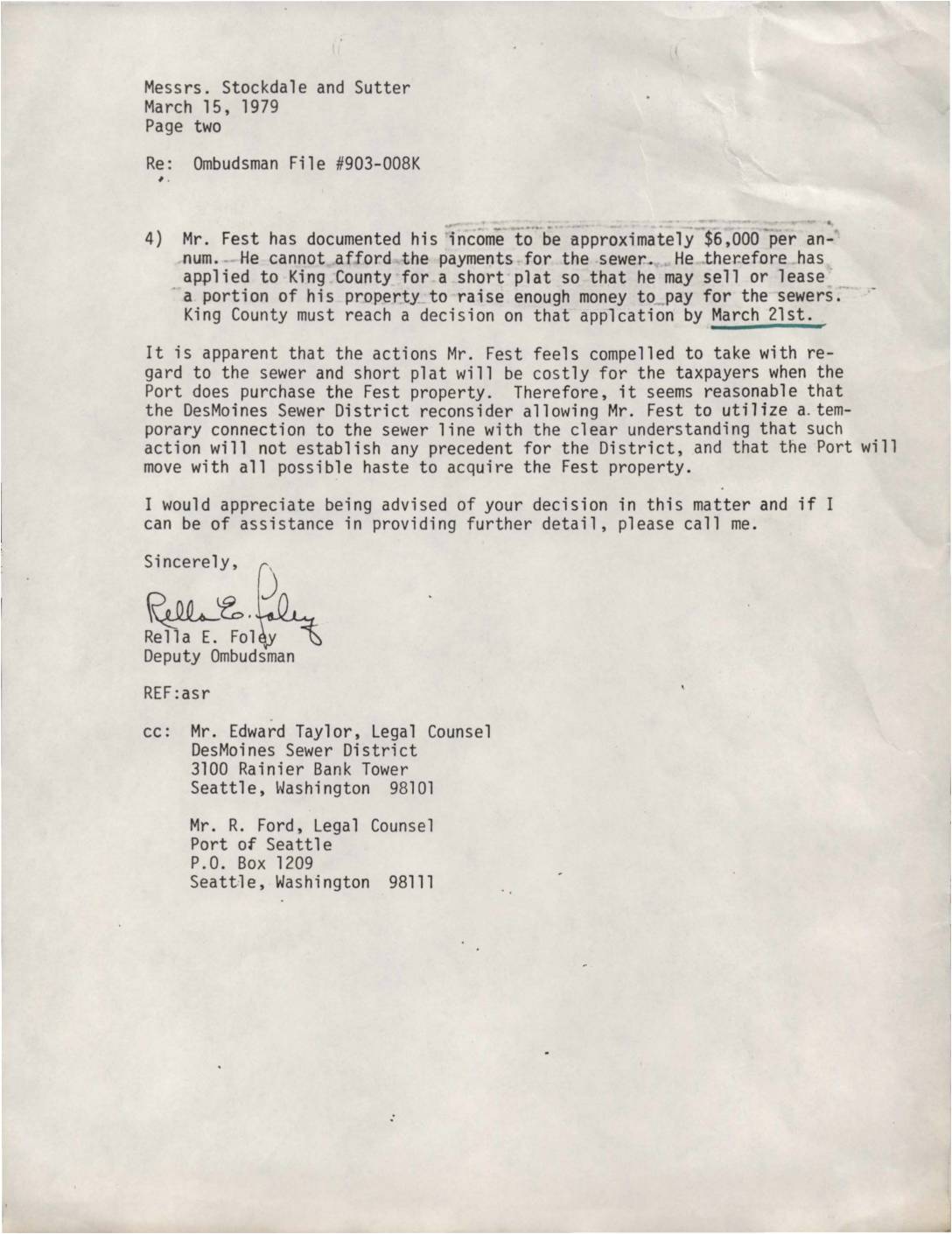
Ombudsman Letter to Messrs. Stockdale and Sutter Regarding DesMoines Sewer District Connection
A March 1979 letter from Deputy Ombudsman Rella E. Foley to Messrs. Stockdale and Sutter details the financial hardship of a Mr. Fest, whose annual income of approximately $6,000 makes it impossible for him to afford sewer connection payments. Foley recommends that the DesMoines Sewer District allow Mr. Fest a temporary sewer connection while the Port of Seattle moves quickly to acquire his property, noting that delays forcing him to pursue a short plat subdivision would ultimately cost taxpayers more. The letter was copied to legal counsel for both the DesMoines Sewer District and the Port of Seattle. -
 1976-03-31
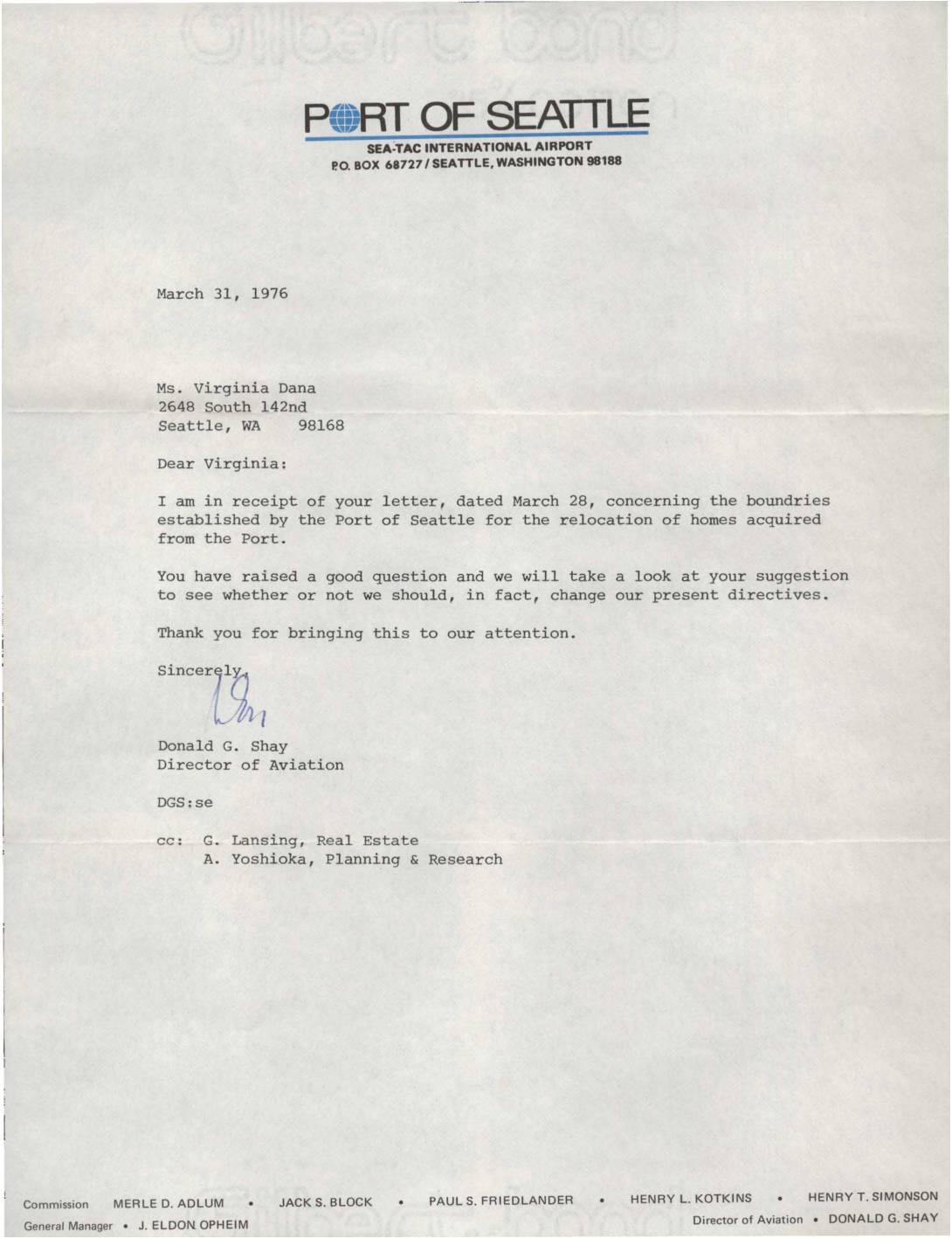
Port of Seattle response to Virginia Dana regarding home relocation boundaries
In March 1976, Virginia Dana wrote to Donald G. Shay, Director of Aviation at Sea-Tac International Airport, questioning why the Port of Seattle had not updated its relocation boundaries for airport-acquired homes to reflect new high-noise zones identified in the Sea-Tac Communities Plan. She argued that using Highway 99 as an eastern boundary was inadequate and that vacant lots east of the airport, between the airport and South 126th, could accommodate relocated homes while boosting the local tax base. Shay responded that the Port would review her suggestion and consider whether to revise its existing relocation directives. -
 1975-08-26
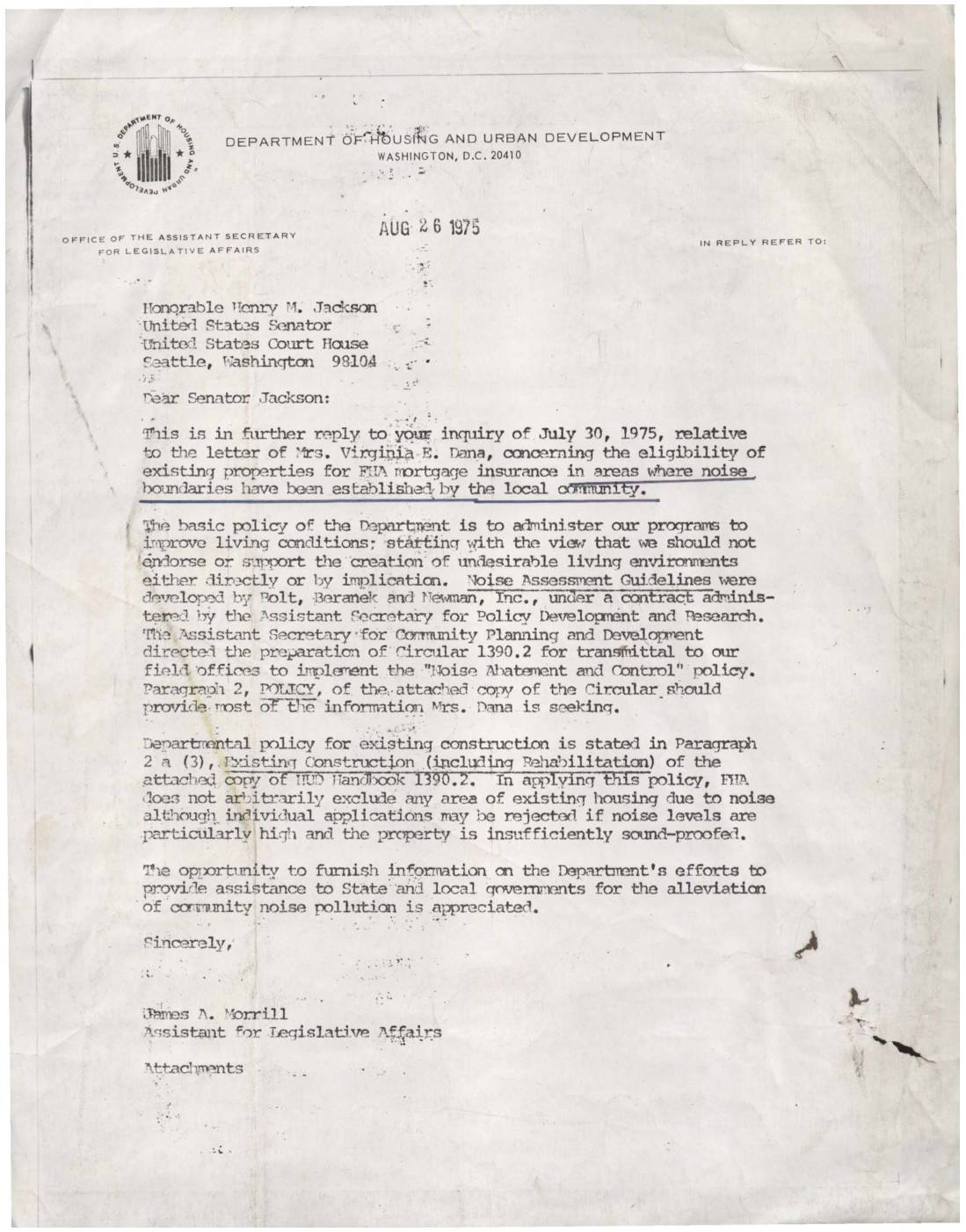
HUD Response to Senator Jackson on FHA Mortgage Insurance in Noise Areas
A August 26, 1975 letter from HUD's Assistant Secretary for Legislative Affairs, James A. Morrill, to U.S. Senator Henry M. Jackson of Washington responds to an inquiry about FHA mortgage insurance eligibility for homes in areas where local communities have established noise boundaries. The letter explains that HUD's basic policy, outlined in Circular 1390.2, is to avoid endorsing undesirable living environments, but that FHA does not automatically exclude existing housing in noise-affected areas from mortgage insurance. Individual applications may still be rejected if noise levels are particularly high and the property lacks sufficient soundproofing. -
 1975-01-06
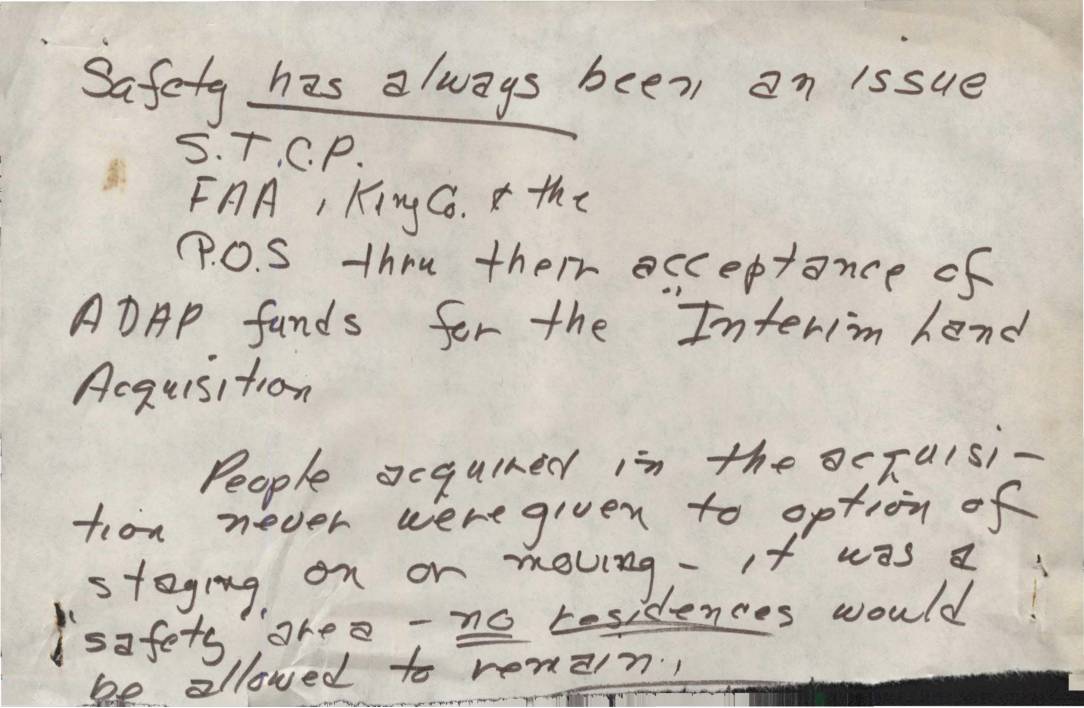
Safety Has Always Been An Issue – Notes on Organizations and Land Acquisition
Safety has always been an issue at Sea-Tac Airport, with the S.T.C.P., FAA, King County, and P.O.S. acknowledging concerns through their acceptance of ADAP funds for the Interim Land Acquisition. Residents acquired in the acquisition were never given the option of staying or moving, as the area was designated a safety zone where no residences would be allowed to remain. A separate note on the reverse raises questions about the Kellogs and others connected to the matter.