TagCATEX(26)
-
 2026-09-18
Nashville suburbs sue FAA over new departure headings
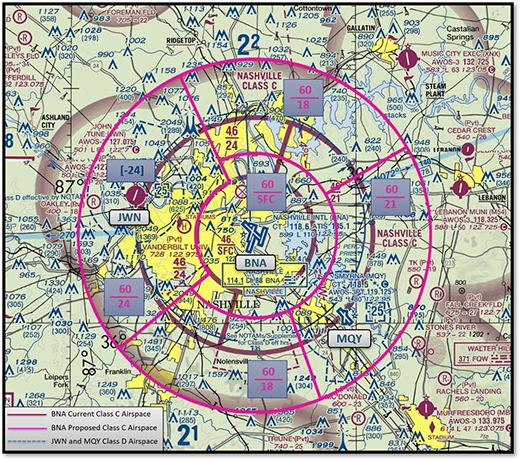
Nashville's suburbs are taking the FAA to court arguing against the same shortcut to changing flight paths used in so many previous community lawsuits: CATEX, challenging new departure headings and Performance-Based Navigation procedures at Nashville International Airport — an airport growing from 200,000 to an expected 300,000-plus annual operations by 2037. At the heart of the case are troubling contradictions in the FAA's own paperwork: noise modeling that claims zero impact anywhere in the study area, while a separate FAA letter quietly acknowledges noise increases of more than 5 dB in two locations. Add in a categorical exclusion that deliberately splits one airspace redesign into smaller pieces to avoid public environmental review, and a nature preserve being modeled without accounting for terrain — and a familiar pattern emerges. -
 2026-09-08
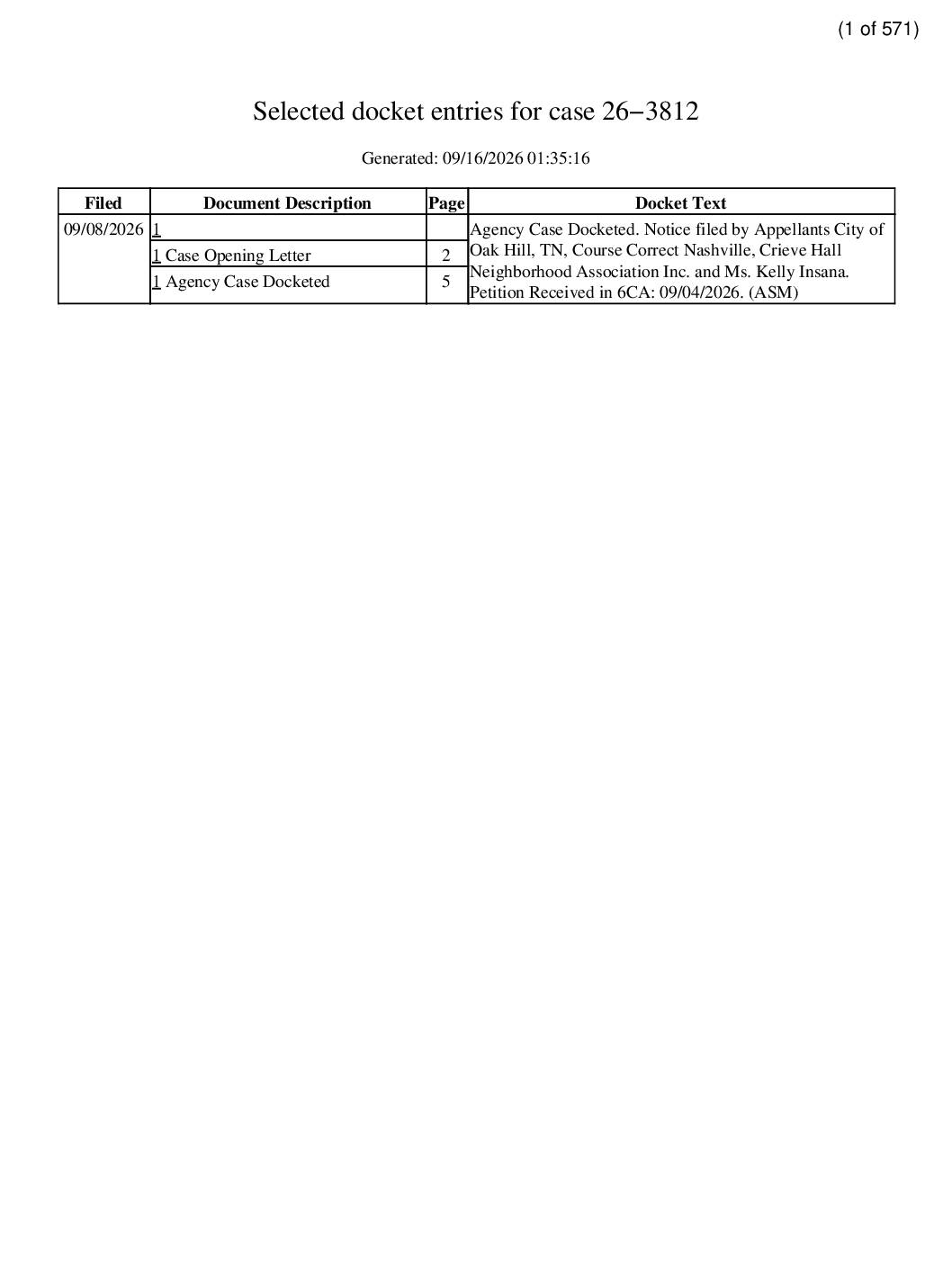
City of Oak Hill, TN, et al v. FAA, et al — Case No. 26-3812 Docket and Case Opening Letter
Sixth Circuit Court of Appeals case 26-3812, City of Oak Hill, TN, Course Correct Nashville, Crieve Hall Neighborhood Association Inc., and Ms. Kelly Insana v. FAA. Petition received 09/04/2026, docketed 09/08/2026. Originating case JO 7400.2R. Case opening letter from Clerk Kelly L. Stephens addressed to FAA Office of the Chief Counsel (Russell Christensen, William McKenna) -
 2025-11-14
NEPA Determination, Simple Categorical Exclusion for the Industrial Wastewater Treatment Plan Expansion Project at Seattle-Tacoma International Airport
The FAA has determined that Seattle-Tacoma International Airport's proposed expansion of its Industrial Wastewater Treatment Plant (IWTP) qualifies for a Simple Categorical Exclusion under the National Environmental Policy Act, meaning the project is not expected to have a significant impact on the environment. The project includes upgrades to the existing treatment plant infrastructure, construction of an aerated gravel bed, and updates to the adjacent Lagoon 3 site. This determination, issued November 14, 2025, clears the way for the required Airport Layout Plan update without the need for further environmental review. -
2025-11-14
NEPA Determination, Simple Categorical Exclusion for the Industrial Wastewater Treatment Plan Expansion Project at Seattle-Tacoma International Airport
The FAA has determined that Seattle-Tacoma International Airport's proposed expansion of its Industrial Wastewater Treatment Plant (IWTP) qualifies for a Simple Categorical Exclusion under the National Environmental Policy Act, meaning the project is not expected to have a significant impact on the environment. The project includes upgrades to the existing treatment plant infrastructure, construction of an aerated gravel bed, and updates to the adjacent Lagoon 3 site. This determination, issued November 14, 2025, clears the way for the required Airport Layout Plan update without the need for further environmental review. -
 2024-05-06
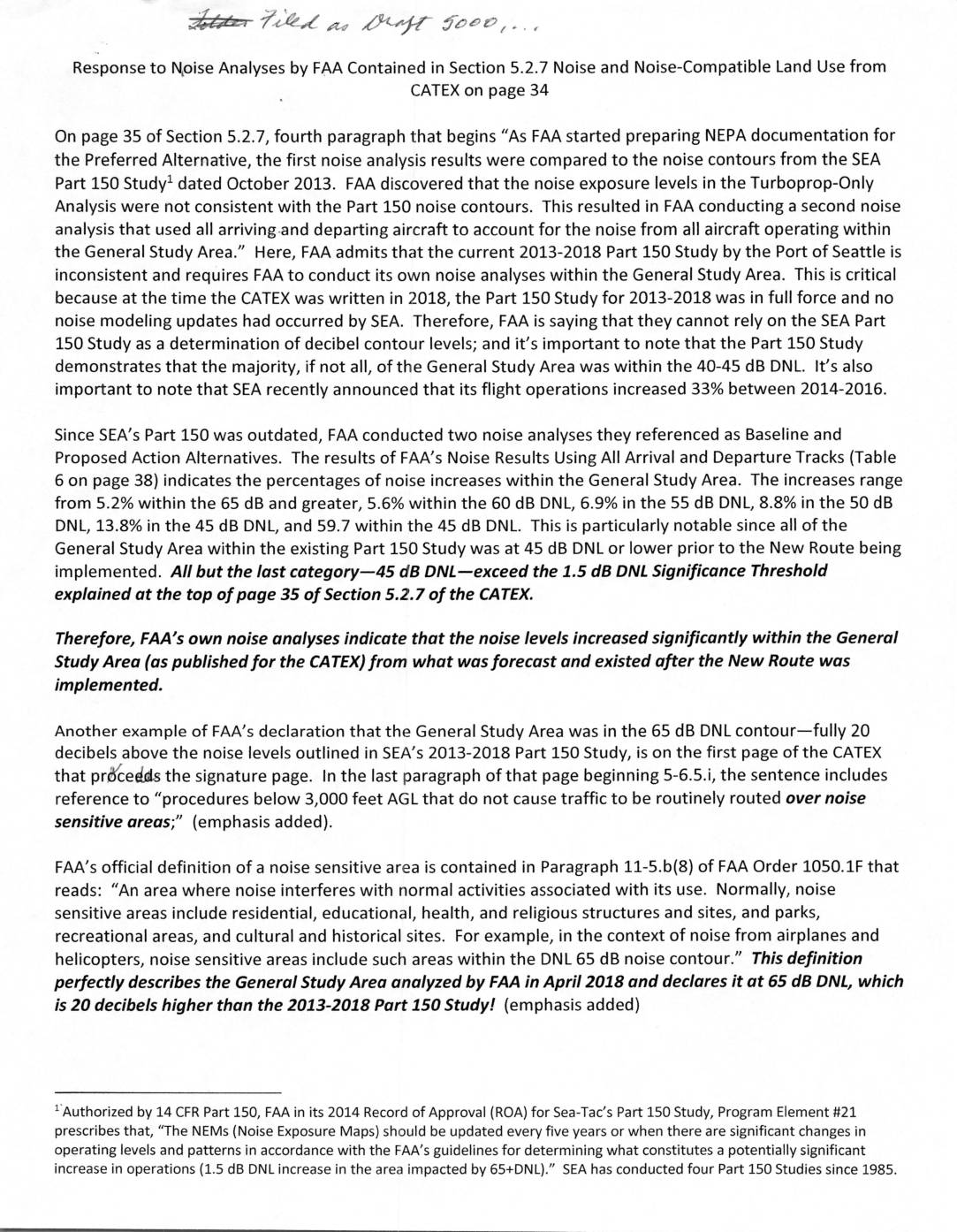
Response to noise analyses by FAA contained in Section 5.2.7 noise and noise-compatible land use from CATEX on page 34
The Quiet Skies Coalition challenges the FAA's Categorical Exclusion (CATEX) for new turboprop flight routes over Burien, Washington, arguing that the FAA's own noise analyses show significant increases in noise levels that exceed the agency's 1.5 dB DNL significance threshold — contradicting the FAA's claim of no environmental impact. The coalition contends that the FAA's reliance on an outdated 2013-2018 Sea-Tac Part 150 noise study, which failed to account for a 51% increase in airport operations, led to inaccurate noise assessments and improper use of a categorical exclusion. Community members and the City of Burien are urged to join legal and political efforts to challenge the FAA and Port of Seattle's authority over flight path decisions affecting residents from Shoreline to Federal Way. -
 2024-05-06
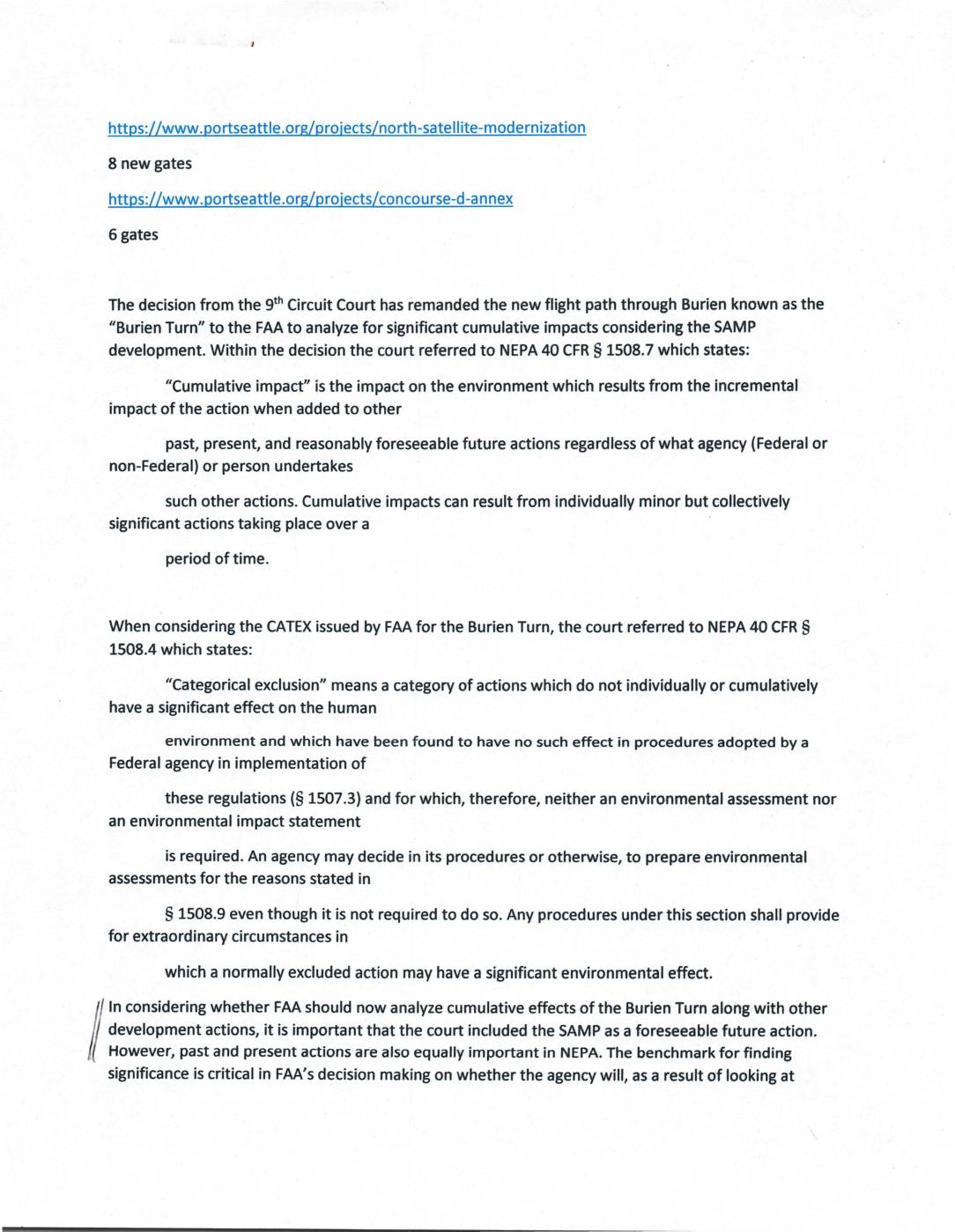
Cumulative impact analysis of the Burien Turn and Sea-Tac Airport development actions under NEPA
A legal and regulatory analysis arguing that the FAA must conduct a broader cumulative environmental impact review of Seattle-Tacoma International Airport expansion, following a 9th Circuit Court ruling that remanded the 'Burien Turn' flight path back to the FAA. The document contends that multiple airport expansion projects—including the addition of 14 new gates and the extension of Highway 509—were each approved individually under categorical exclusions (CATEXs) without properly accounting for their combined effects on noise, air quality, and environmental justice communities. The author argues that under NEPA regulations, the FAA is required to analyze these past, present, and future actions together to determine whether their collective impact is significant. -
 2024-05-06
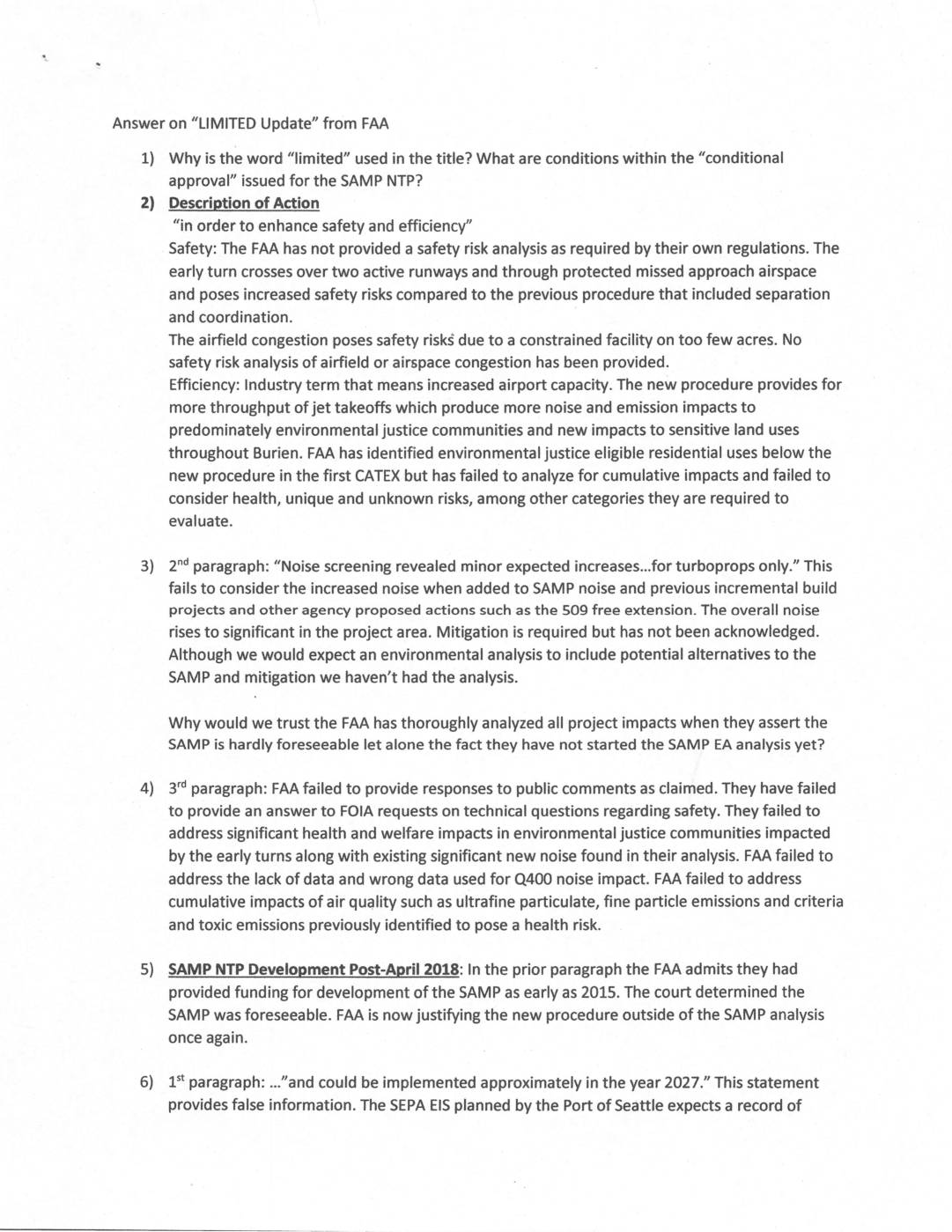
Answer on ‘LIMITED Update’ from FAA
This document presents a point-by-point rebuttal to an FAA 'Limited Update' regarding a new flight departure procedure at Seattle-Tacoma International Airport, arguing that the FAA has failed to conduct required safety risk analyses, properly assess cumulative noise and air quality impacts on environmental justice communities, and comply with court-ordered environmental review under NEPA. The authors contend that the FAA is understating the scope and timeline of the Sea-Tac Airport Master Plan (SAMP) expansion while dismissing significant health, noise, and emissions impacts on nearby residents. The critique calls out procedural shortcuts, incomplete public comment responses, and what it characterizes as predetermined conclusions designed to avoid full environmental scrutiny. -
 2020-07-17
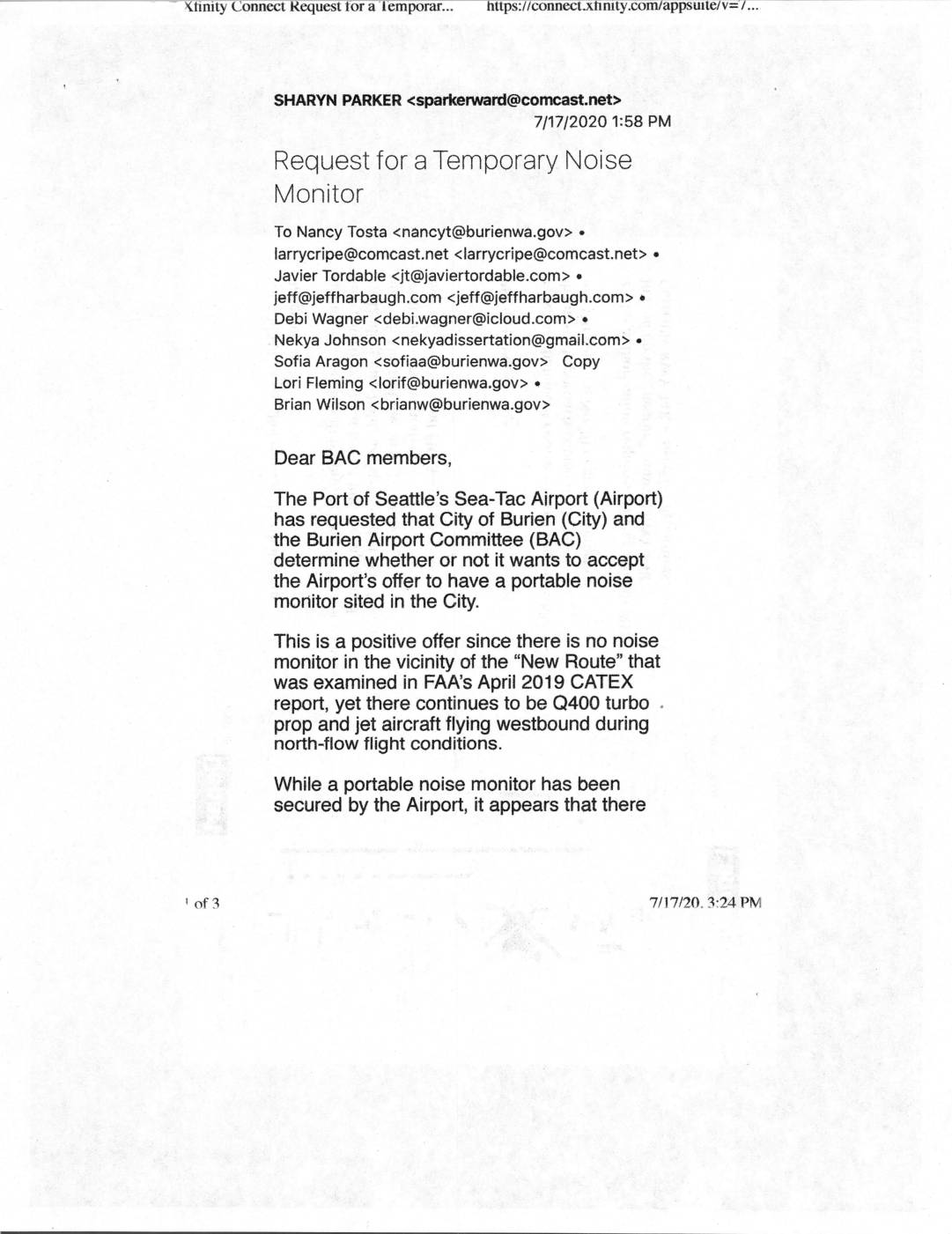
Request for a temporary noise monitor
In a July 17, 2020 email to Burien Airport Committee members, Sharyn Parker urges the City of Burien to accept Sea-Tac Airport's offer to place a temporary portable noise monitor in the city, noting there is currently no monitor near the 'New Route' where Q400 turboprop and jet aircraft continue to fly westbound during north-flow conditions. Parker cautions that site selection is a complex process requiring careful attention to obstacles, noise buffers, and power availability, drawing on her experience with King County International Airport where similar projects took two to four years. She recommends the city respond with a simple 'yes' by the July 24, 2020 deadline and request an extension if needed to properly identify one or two suitable monitoring locations. -
 2020-03-03
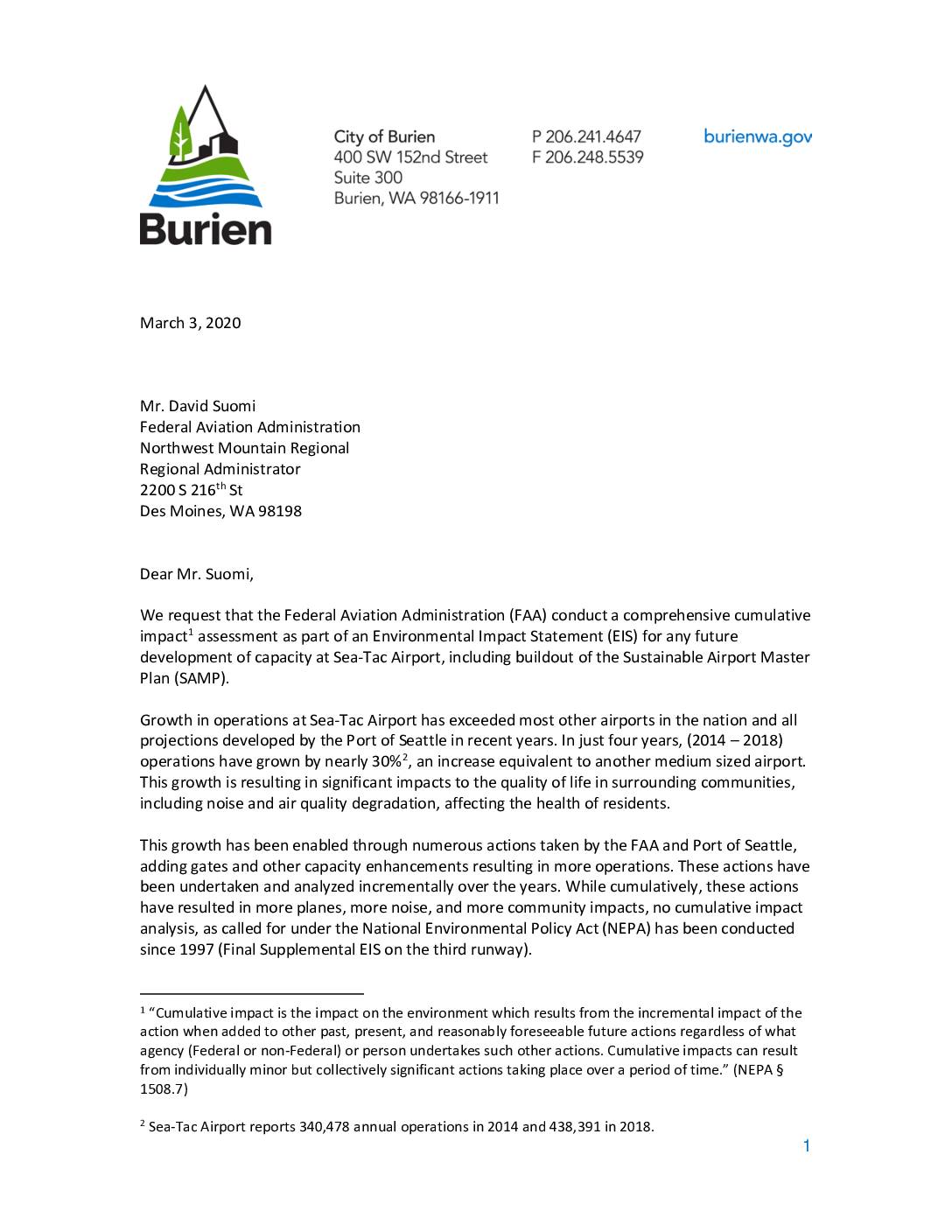
Letter to FAA requesting cumulative impact assessment for Sea-Tac Airport development
In March 2020, the Burien City Council wrote to the FAA requesting a comprehensive Environmental Impact Statement (EIS) that fully accounts for the cumulative noise and air quality impacts of Sea-Tac Airport's rapid growth, which saw operations increase by nearly 30% between 2014 and 2018. The letter argues that multiple airport expansion projects — including new terminal gates and altered flight paths — were each approved without significant environmental review, but together have caused substantial harm to surrounding communities. The council also cites a 2019 Ninth Circuit Court ruling that found the FAA failed to properly assess cumulative impacts, and demands the agency conduct a thorough analysis using a pre-expansion baseline of 2013. -
 2020-01-22
Limited Update to the Burien Categorical Exclusion on Remand: Letter of Agreement Update to Automate a 250 Degree Westerly Turn for Southbound Turboprops, Sea-Tac Airport North-Flow Operations, 6am–10pm
This January 2020 FAA document updates a noise and air traffic policy for Seattle-Tacoma International Airport (Sea-Tac), allowing the airport's control tower to automatically direct southbound turboprop aircraft to make a westerly turn shortly after takeoff during north-flow operations, between 6am and 10pm. The change, originally implemented in 2016 but suspended after a legal challenge by the City of Burien, underwent a thorough environmental and noise review before being reinstated. The FAA determined that while the procedure may slightly concentrate turboprop flight paths, the resulting noise increases remain well below federally established thresholds requiring further environmental review.