TagAirport Impacted Communities Act(13)
-
 2026-01-23
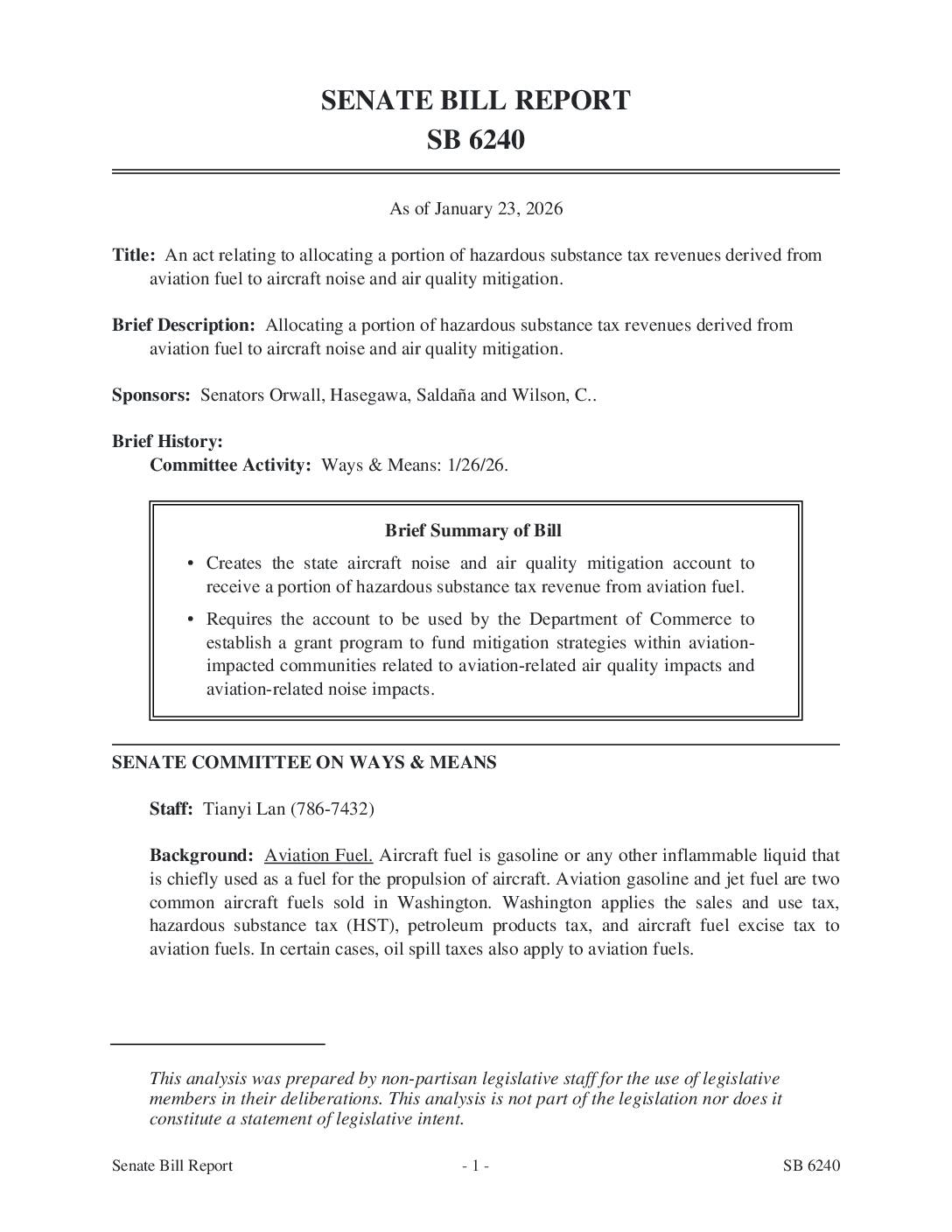
Senate Bill Report SB 6240 – Aircraft Noise and Air Quality Mitigation
Washington Senate Bill 6240 proposes creating a new state account funded by a portion of hazardous substance tax revenue collected on aviation fuel, with money directed toward communities affected by airport noise and air pollution. Starting October 1, 2026, the Department of Commerce would use these funds to run a grant program supporting noise and air quality mitigation projects in aviation-impacted neighborhoods. The bill does not include a direct appropriation and would take effect 90 days after the legislative session in which it is passed. -
 2025-10-03
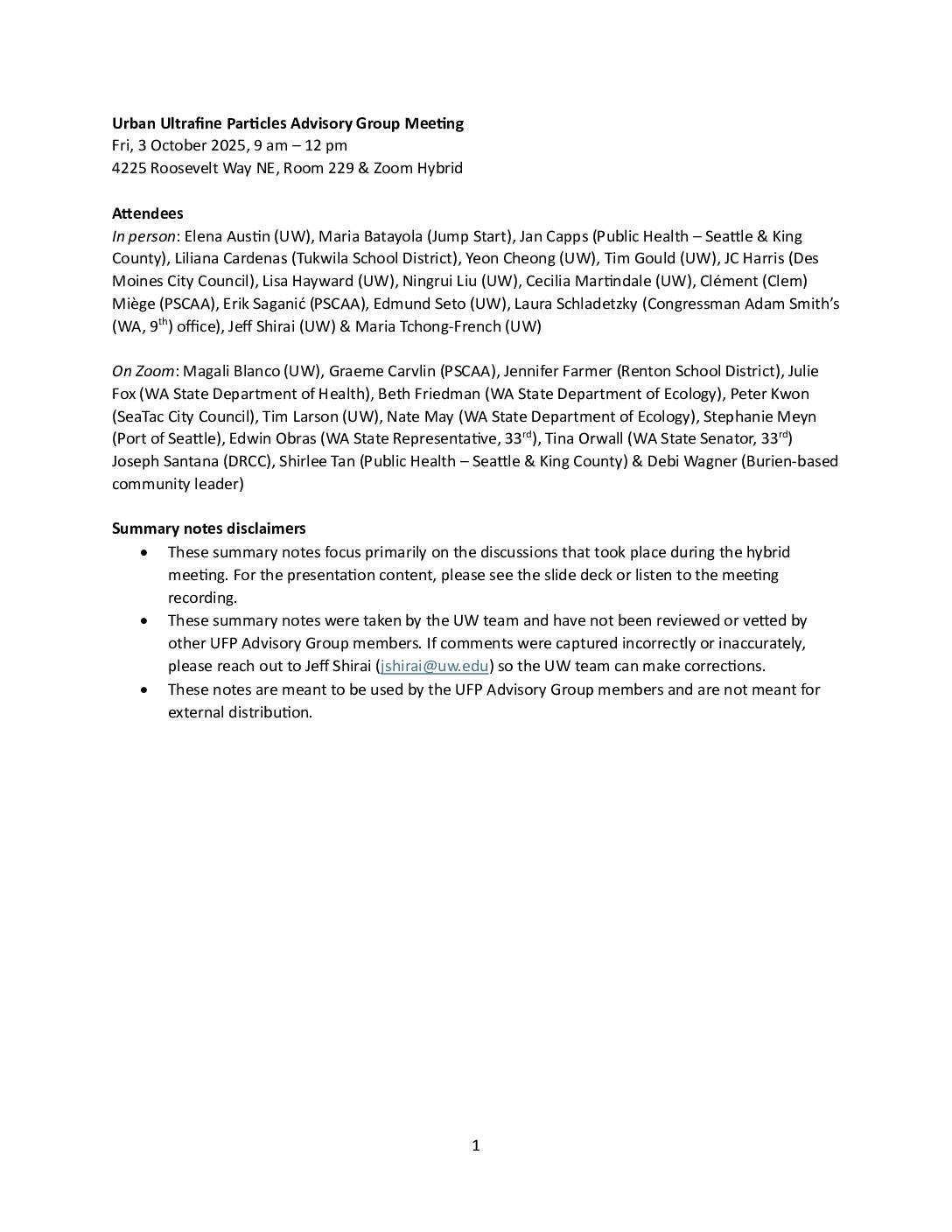
UFP-Advisory-Group-Meeting-2025.10
Meeting minutes from the UFP Advisory Group discussing research priorities for ultrafine particle health effects, mitigation strategies, and exposure reduction in aviation-impacted communities. Participants included University of Washington researchers, public health officials, school district representatives, and community leaders focusing on air quality and health impacts near Sea-Tac Airport. -
 2025-02-14
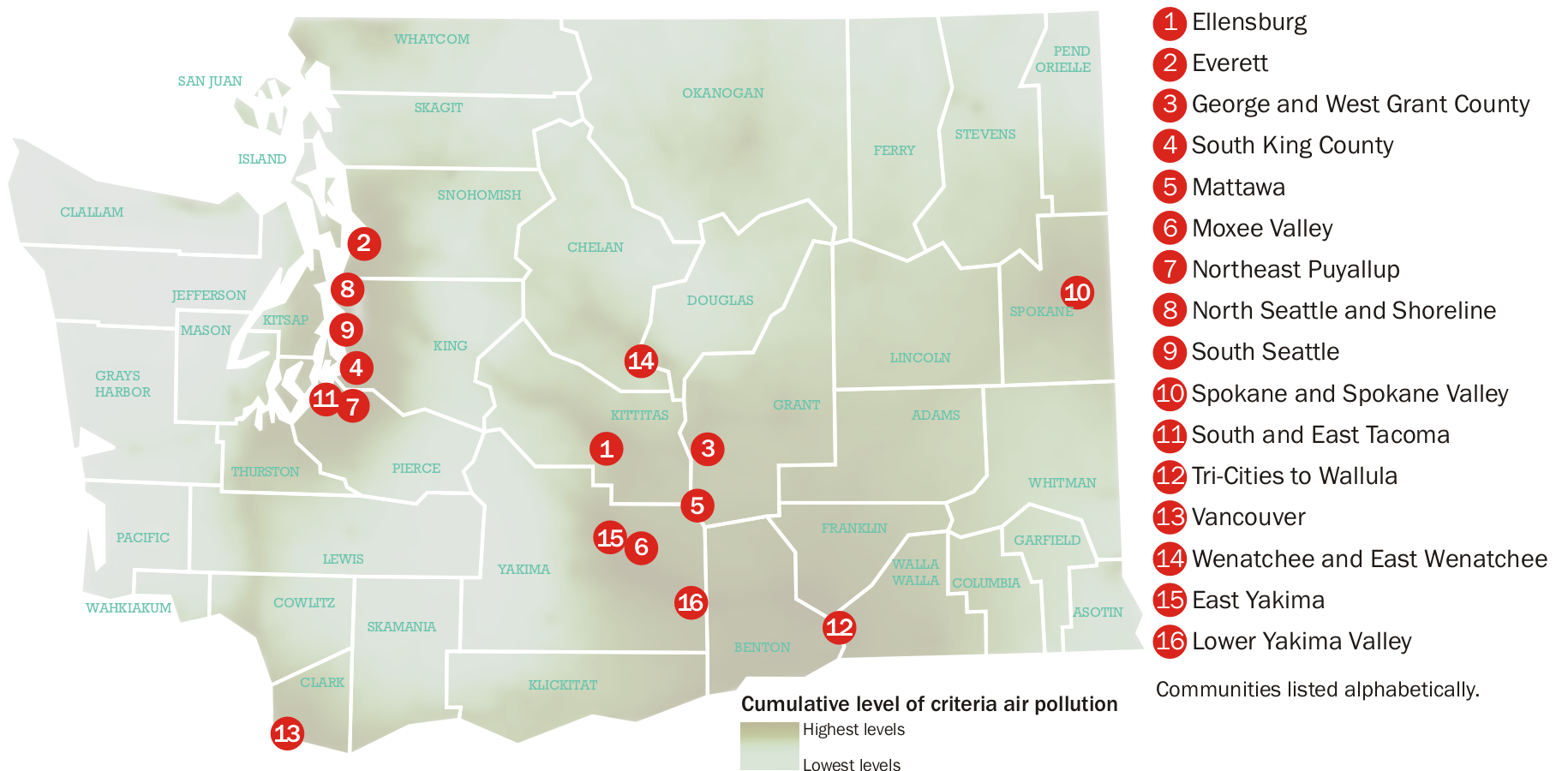
Washington State Air Pollution Map – Airport Communities
A map of Washington State identifying 16 communities with elevated cumulative criteria air pollution levels, including locations such as Spokane, Tacoma, Seattle, Yakima Valley, and Vancouver. The map uses a shading gradient to indicate highest to lowest pollution levels, with numbered red markers pinpointing each named community. -
 2025-01-14
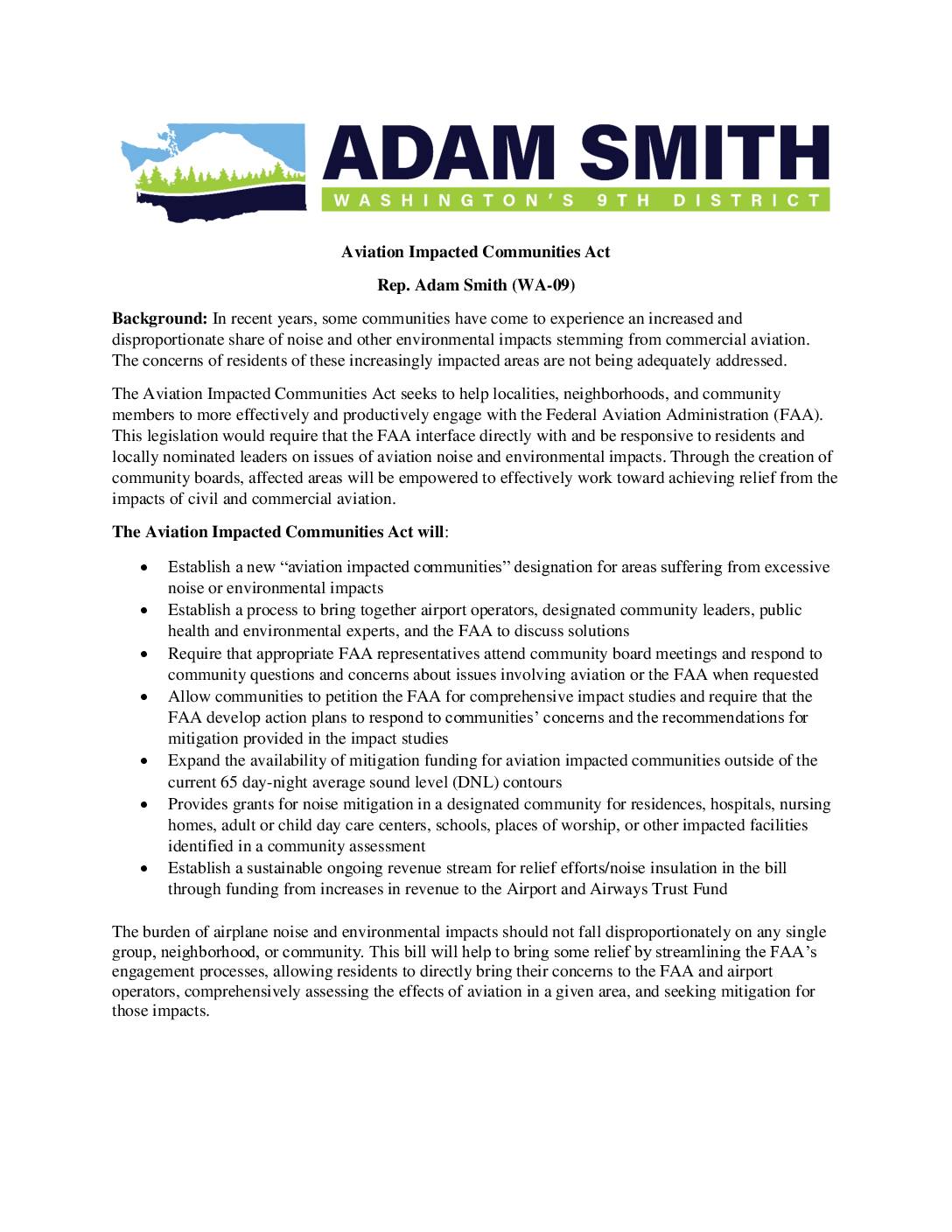
Aviation Impacted Communities Act: Fact Sheet
The Aviation Impacted Communities Act, introduced by Rep. Adam Smith (WA-09), aims to give residents and local leaders a stronger voice in addressing excessive airplane noise and environmental impacts by requiring the FAA to engage directly with affected communities through newly established community boards. The bill would create an 'aviation impacted communities' designation, allow communities to petition for comprehensive impact studies, and expand funding for noise mitigation beyond current sound-level boundaries. It also establishes a sustainable revenue stream for ongoing relief efforts through the Airport and Airways Trust Fund. -
 2024-10-08
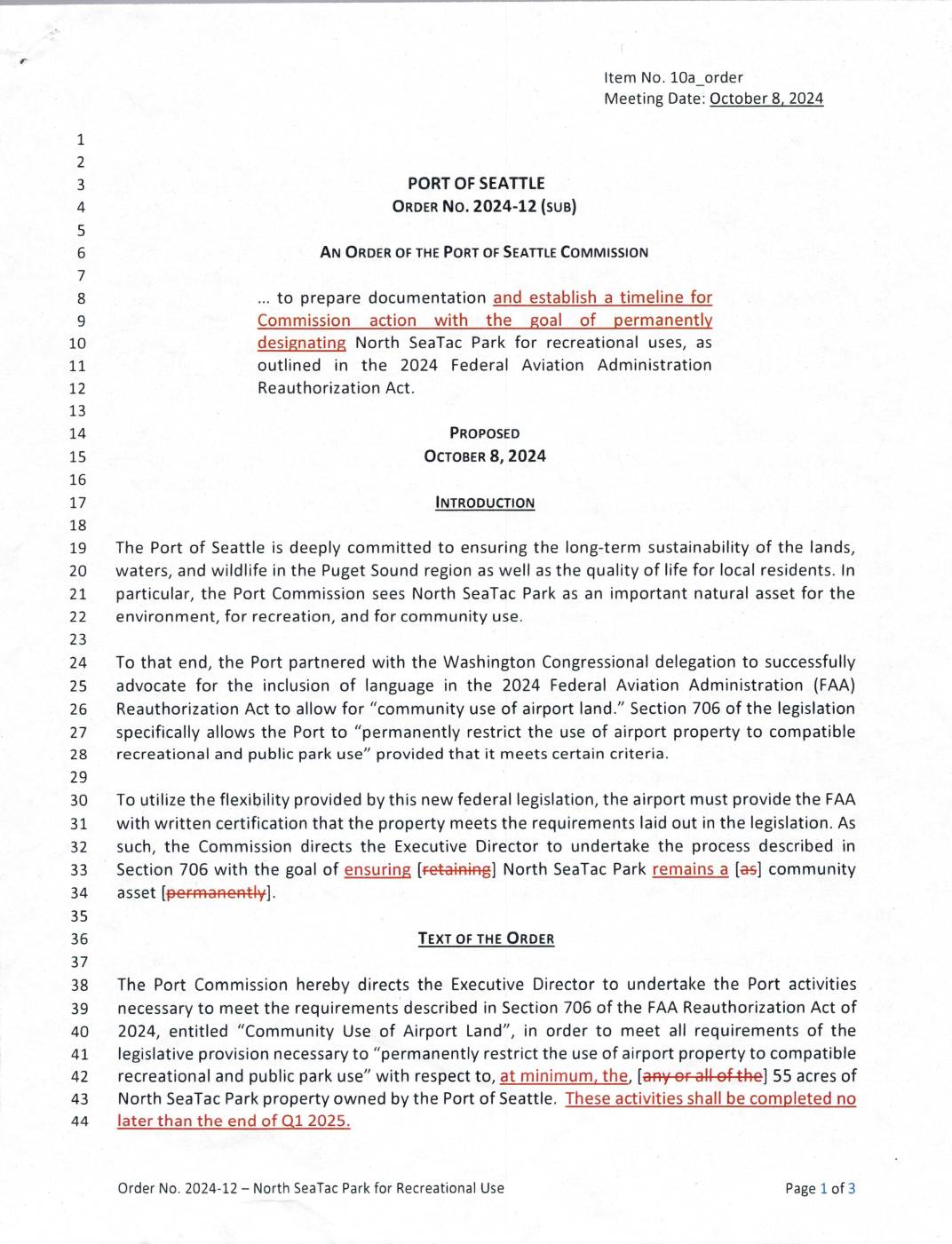
Port of Seattle Order No. 2024-12 – North SeaTac Park for Recreational Use
The Port of Seattle Commission issued Order No. 2024-12 in October 2024, directing its Executive Director to take the steps necessary under Section 706 of the 2024 FAA Reauthorization Act to permanently designate the 55-acre North SeaTac Park for recreational and public park use. The order requires the development of legally binding frameworks, a preferred protection methodology reported to the Commission by Q2 2025, and at least $150,000 in the 2025 budget for park improvements in partnership with the City of SeaTac. This action aims to ensure the park remains a permanent community and ecological asset, shielded from future aeronautical or commercial redevelopment. -
 2024-05-06
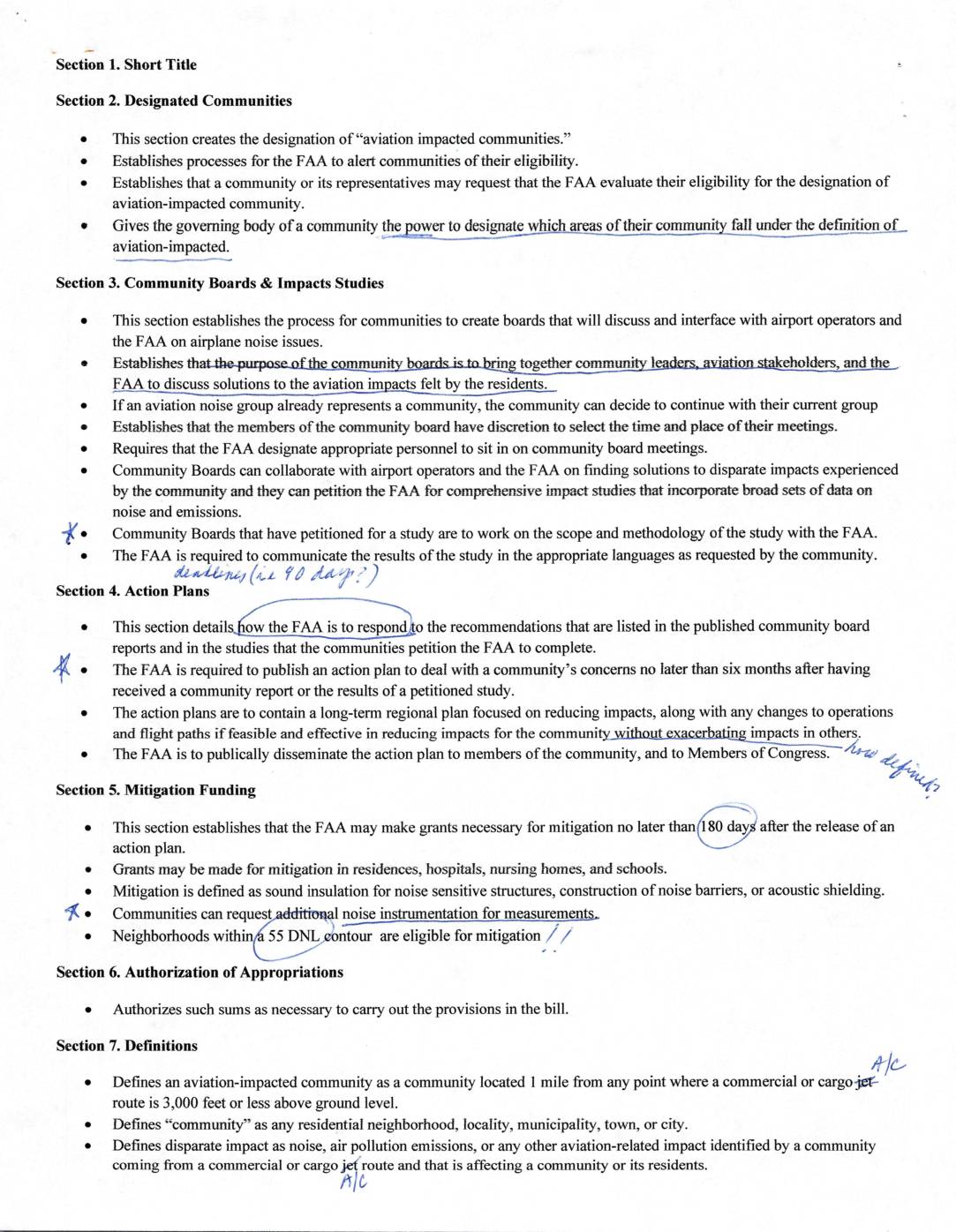
Airport impacted communities act summary
This legislative summary outlines a proposed bill to protect communities near busy flight routes from aviation noise and pollution. It establishes a process for the FAA to designate 'aviation-impacted communities' located within one mile of low-altitude commercial or cargo flight paths, create local community boards to engage with the FAA and airport operators, and develop action plans and mitigation funding for affected residents. Key provisions include grants for sound insulation and noise barriers, eligibility for neighborhoods within a 55 DNL contour, and requirements for the FAA to respond to community concerns within set deadlines. -
 2024-05-06
Overview: The Aviation Impacted Communities Act
This document provides an overview of the Aviation Impacted Communities Act, which establishes a formal process for communities affected by airport noise and flight paths. The process begins with the FAA notifying eligible communities of their 'designated community' status, then proceeds through board formation, meetings, studies, action plans, and ultimately grants for mitigation funds. A community qualifies as 'aviation impacted' if it is located no more than one mile from any commercial or cargo jet route at 3,000 feet or less above ground level. -
 2023-01-05
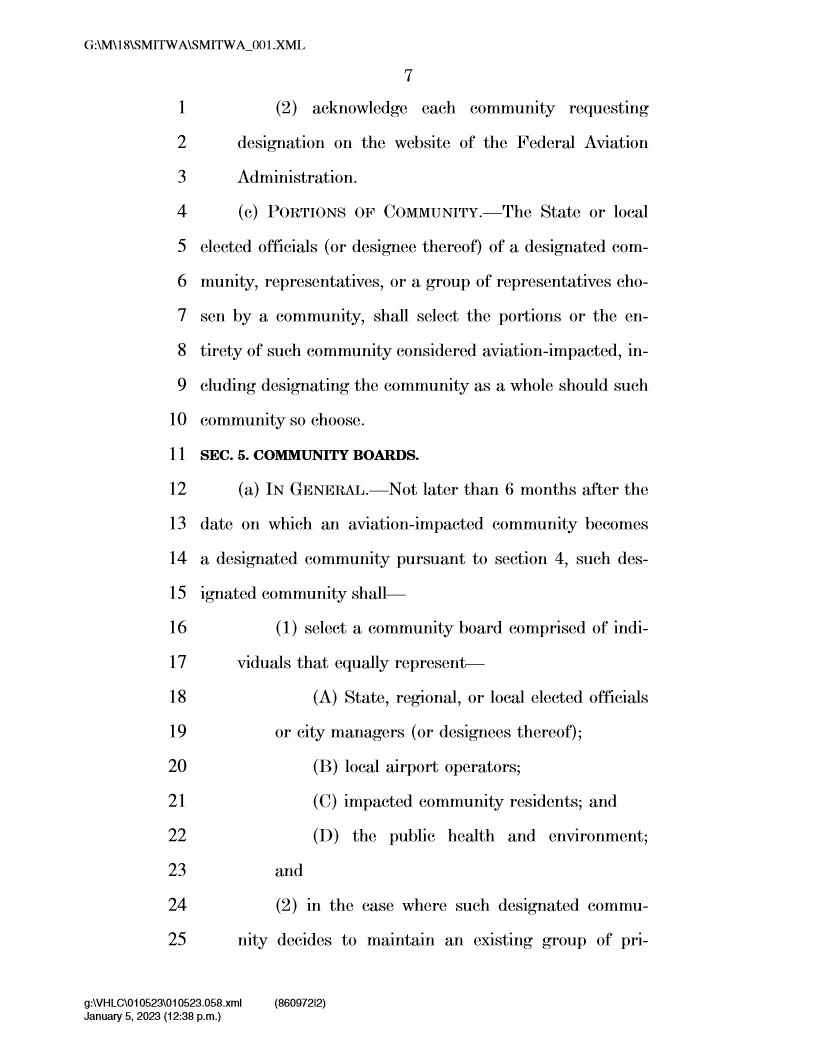
Aviation-Impacted Communities Act Draft — Community Board Structure (Page 7, January 2023)
Page 7 of a U.S. House legislative draft (file g:WHLC1052310523.058.xml, dated January 5, 2023) covering Sections 4–5 of what appears to be the Sen/Rep Smith aviation noise bill (SMITWA). The text establishes that designated aviation-impacted communities must, within 6 months, select a community board equally representing elected officials, local airport operators, impacted residents, and public health and environment interests. -
AICA Gone Local
For the past several years there has been a lot of energy directed at creating Federal legislation to correct the systemic unfairness we all experience living near a large airport like Sea-Tac. On the surface, this makes perfect sense: the FAA has direct authority over all airports. And many, many attempts at obtaining relief by -
 2019-08-20
Overview: The Aviation Impacted Communities Act
The Aviation Impacted Communities Act establishes a structured process to help neighborhoods affected by aircraft noise, starting with the FAA identifying eligible communities and ending with grants for noise mitigation. A community qualifies as 'aviation impacted' if it is located within 1 mile of any point where a commercial or cargo jet route passes at or below 3,000 feet above ground level. Once designated, communities can form boards, conduct studies, and develop action plans to address aviation-related impacts near airports like Sea-Tac.