TagEnvironmental Review(48)
-
 2026-05-01
Key takeaways from what’s heating up for spring: federal permitting policy update
Environmental Science Associates hosted a webinar examining rapid changes in federal environmental permitting, covering topics such as streamlined categorical exclusions under NEPA, cultural resources consultation under Section 106, and the growing use of AI tools in environmental review workflows. Experts noted that agencies face increasing pressure to accelerate infrastructure permitting timelines while maintaining legally defensible documentation, particularly as recent court decisions and regulatory rescissions create greater agency discretion and less standardized guidance. Organizations are advised to invest in adaptable workflows and early interagency coordination to manage permitting risk in this shifting landscape. -
 2025-10-13
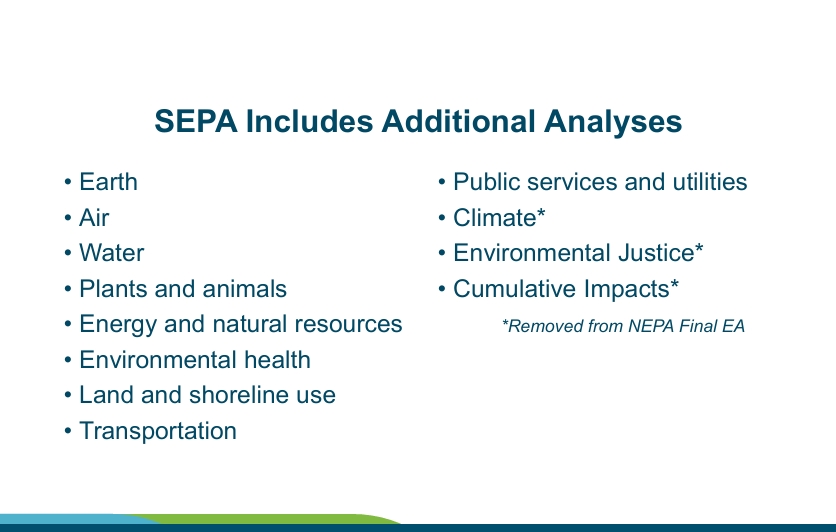
Port Commission briefing SAMP: SEPA Includes Additional Analyses
A presentation slide titled 'SEPA Includes Additional Analyses' lists environmental review topics covered under the State Environmental Policy Act (SEPA), including Earth, Air, Water, Plants and Animals, Energy and Natural Resources, Environmental Health, Land and Shoreline Use, Transportation, Public Services and Utilities, Climate, Environmental Justice, and Cumulative Impacts. A footnote notes that Climate, Environmental Justice, and Cumulative Impacts were removed from the NEPA Final EA, highlighting differences between state and federal environmental review processes relevant to Sea-Tac Airport proceedings. -
 2025-07-02
Draft Cultural Resources Assessment for the Port Of Seattle Industrial Wastewater Treatment Plant Project, King County, Washington
This July 2025 draft cultural resources assessment, prepared by Stell for WSP USA and the Port of Seattle, evaluates potential cultural and archaeological impacts associated with a proposed Industrial Wastewater Treatment Plant project in King County, Washington. The 10.6-acre study area is located near Des Moines and covers sections in Townships 22N and 23N. The assessment found no archaeological sites, isolates, or traditional cultural properties within the project area. -
2025-07-02
Draft Cultural Resources Assessment for the Port Of Seattle Industrial Wastewater Treatment Plant Project, King County, Washington
This July 2025 draft cultural resources assessment, prepared by Stell for WSP USA and the Port of Seattle, evaluates potential cultural and archaeological impacts associated with a proposed Industrial Wastewater Treatment Plant project in King County, Washington. The 10.6-acre study area is located near Des Moines and covers sections in Townships 22N and 23N. The assessment found no archaeological sites, isolates, or traditional cultural properties within the project area. -
 2025-01-15
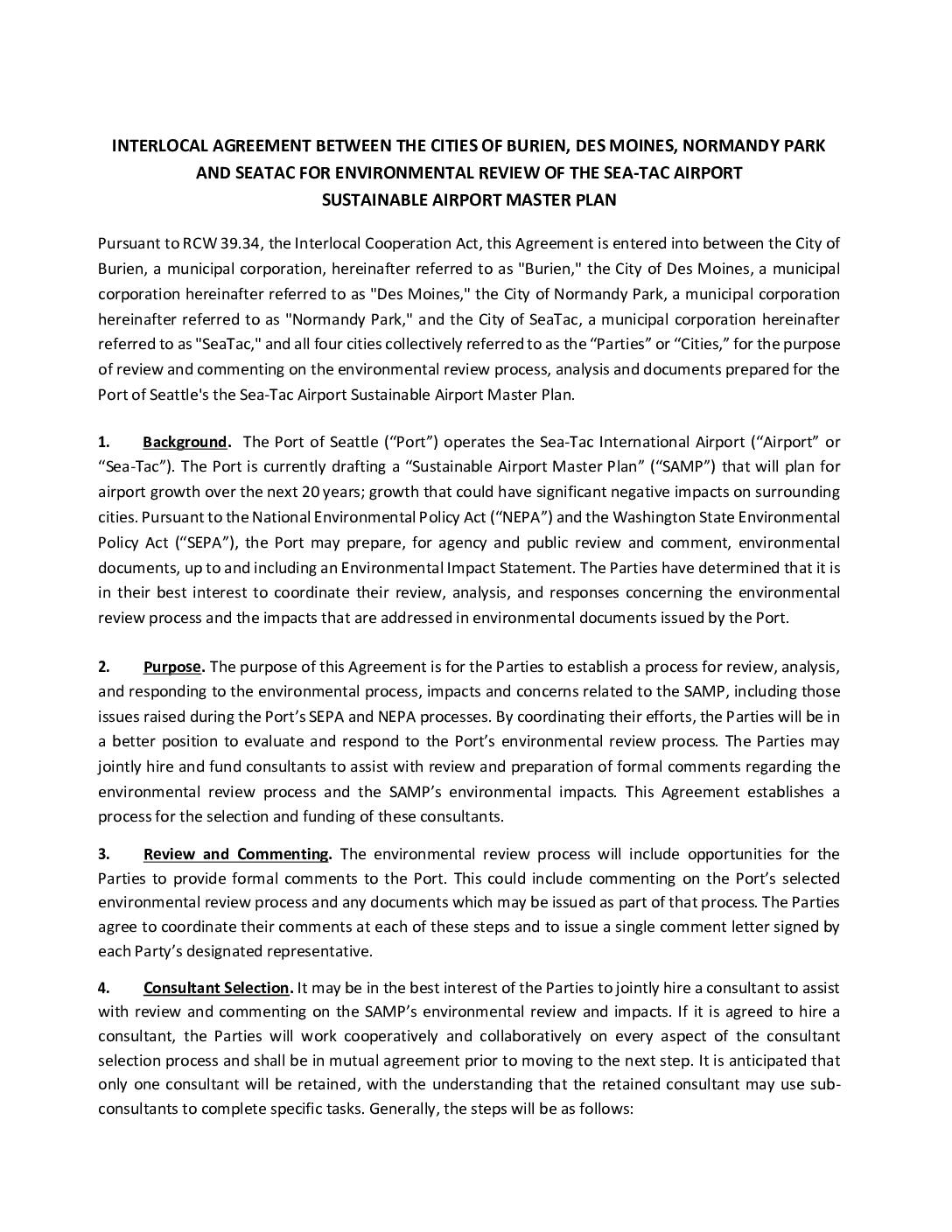
Interlocal agreement between the cities of Burien, Des Moines, Normandy Park and SeaTac for environmental review of the Sea-Tac Airport Sustainable Airport Master Plan
Four cities near Sea-Tac Airport — Burien, Des Moines, Normandy Park, and SeaTac — have joined together under a formal interlocal agreement to coordinate their review of the Port of Seattle's Sustainable Airport Master Plan (SAMP), which could bring significant noise and environmental impacts to surrounding communities over the next 20 years. The agreement establishes a shared process for hiring consultants, submitting joint public comments, and responding to environmental documents produced under federal (NEPA) and state (SEPA) law. The collaboration is set to run through December 31, 2027, with the City of Des Moines managing consultant contracts and the City of Burien overseeing fiscal matters. -
 2024-12-12
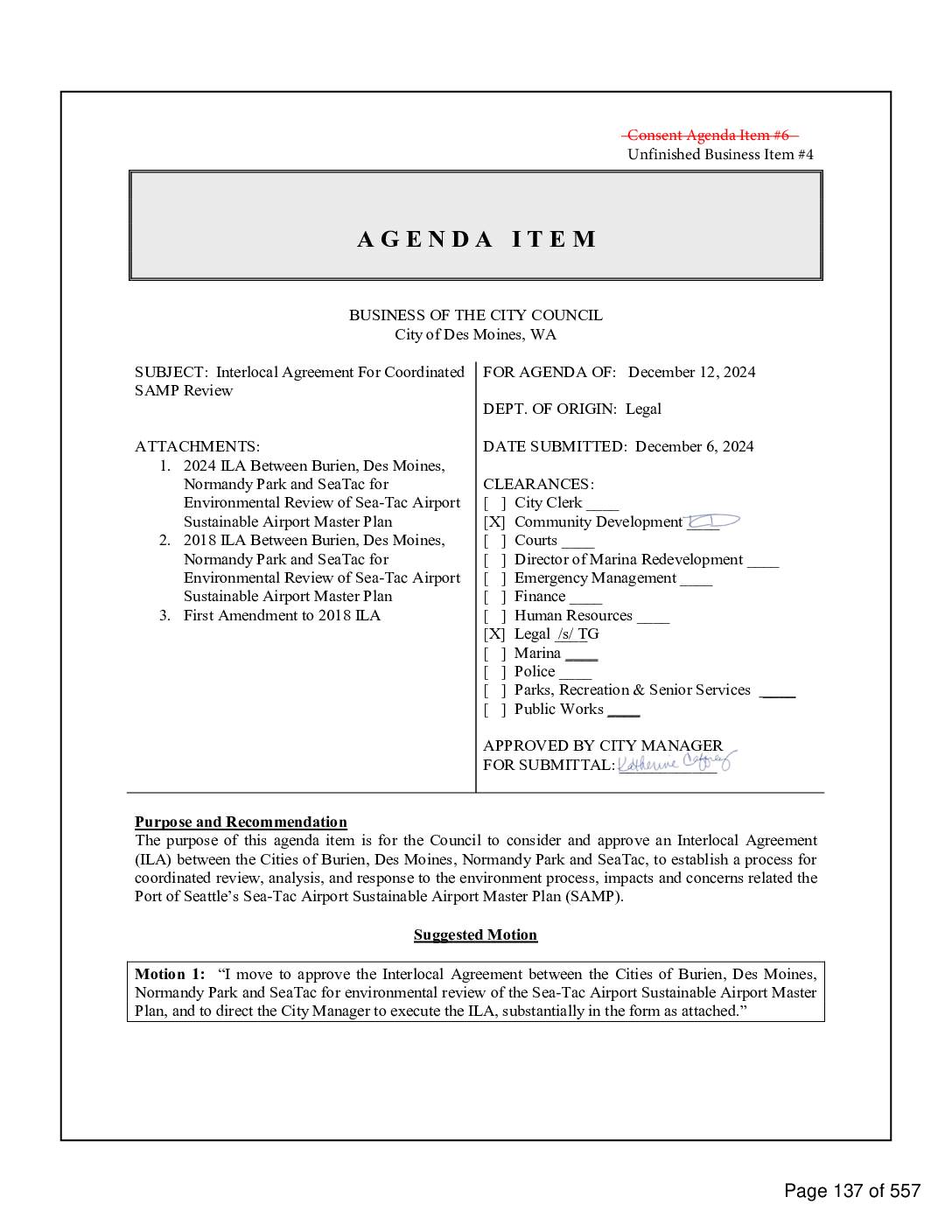
Interlocal agreement for coordinated SAMP review
The cities of Burien, Des Moines, Normandy Park, and SeaTac are renewing a cooperative agreement to jointly review and respond to the Port of Seattle's Sea-Tac Airport Sustainable Airport Master Plan (SAMP), which outlines future airport growth that could significantly impact neighboring communities. The new Interlocal Agreement (ILA), approved by Des Moines City Council in December 2024, extends collaboration through December 31, 2027, allowing the cities to share consultants and coordinate formal comments on the airport's environmental review process under NEPA and SEPA. Des Moines has committed up to $74,170 toward consultant services, with each city's share determined by relative population. -
 2024-12-10
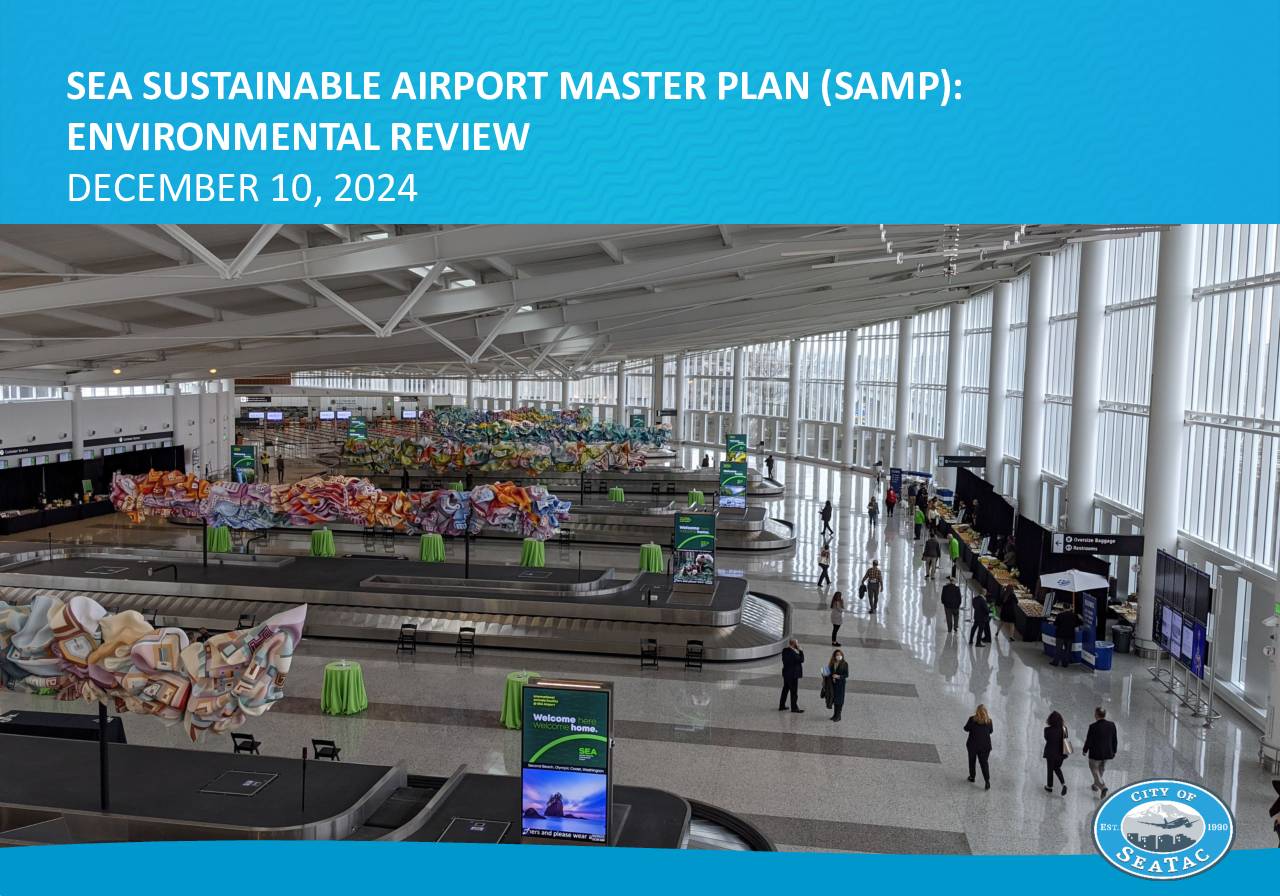
SEA Sustainable Airport Master Plan (SAMP): Environmental review
The FAA released a draft Environmental Assessment in October 2024 for Seattle-Tacoma International Airport's Sustainable Airport Master Plan (SAMP), which outlines 31 near-term projects to expand airport capacity for growing passenger demand. Key projects include a new passenger terminal and gates, taxiway extensions, cargo facility changes, and employee parking updates. The cities of SeaTac, Burien, Des Moines, and Normandy Park are collaborating to submit technical comments on the plan before the December 13, 2024 deadline. -
 2024-10-18
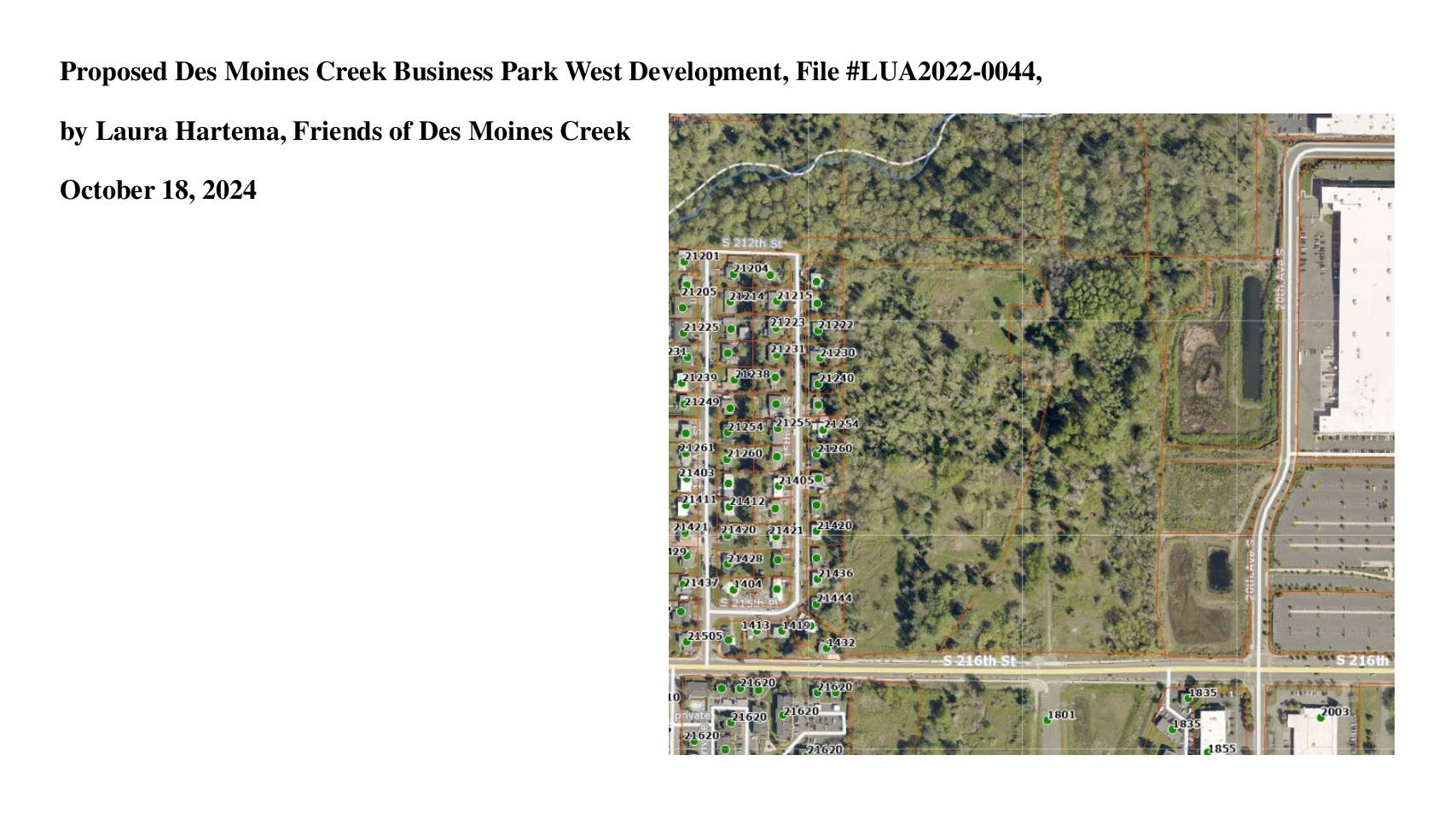
Proposed Des Moines Creek Business Park West Development: Hearing Presentation by Laura Hartema, Friends of Des Moines Creek
Laura Hartema of Friends of Des Moines Creek presented concerns about the proposed Des Moines Creek Business Park West Development (File #LUA2022-0044) in October 2024, highlighting significant environmental impacts including the removal of over 500 trees, filling of wetlands and streams, and more than 30 acres of site disturbance. The presentation compared 1936 and 2023 aerial photos showing the area remains largely forested, and raised issues such as arsenic in soils, stormwater management concerns, and negative effects on neighboring residential properties. The group argues the project requires more thorough environmental review to demonstrate it will not cause significant harm to critical natural areas and the surrounding community. -
Sustainable Airport Master Plan 2019 Scoping Documents
★1The same documents can be found here. [get_filebird_folder folder_id=170] 1We often provide replicas of important documents, news stories, etc. We refer to this as ‘belt and suspenders’. Although we always recommend that researchers source from the original sites, computers often fail. It’s good to have backup. -
 2024-09-20
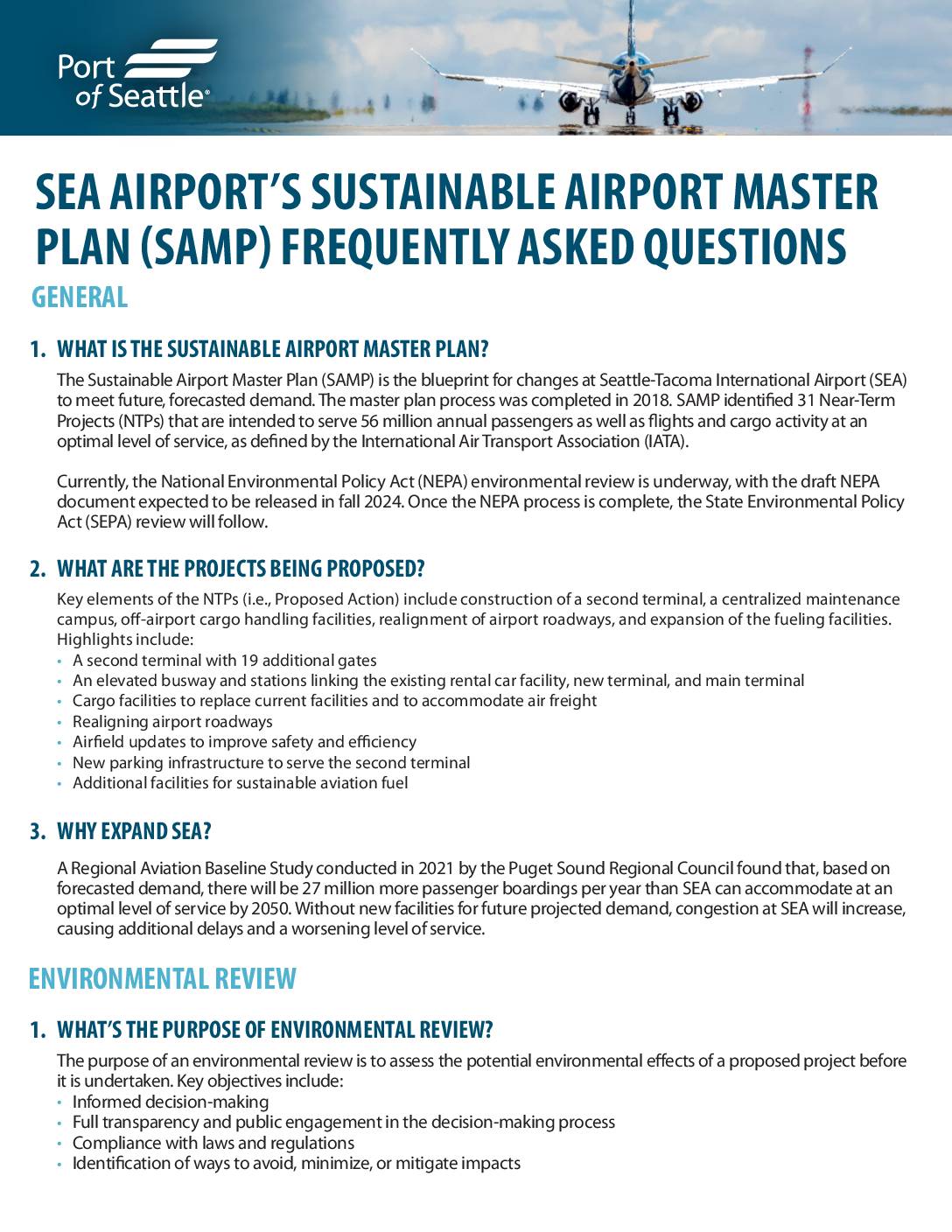
SEA Airport’s Sustainable Airport Master Plan (SAMP) Frequently Asked Questions
The Port of Seattle's Sustainable Airport Master Plan (SAMP) outlines 31 near-term construction projects at Seattle-Tacoma International Airport, including a second terminal with 19 gates, new cargo facilities, and roadway changes, all aimed at serving up to 56 million passengers annually by 2050. A federal environmental review (NEPA) is underway to assess potential impacts, with a 45-day public comment period opening October 21, 2024, allowing community members to submit feedback online, by mail, or at public libraries in Burien, Des Moines, and SeaTac. A separate state-level environmental review (SEPA) will follow once the federal process is complete.