TagPuget Sound(124)
-
 2026-09-03
Commercial Aviation Work Group
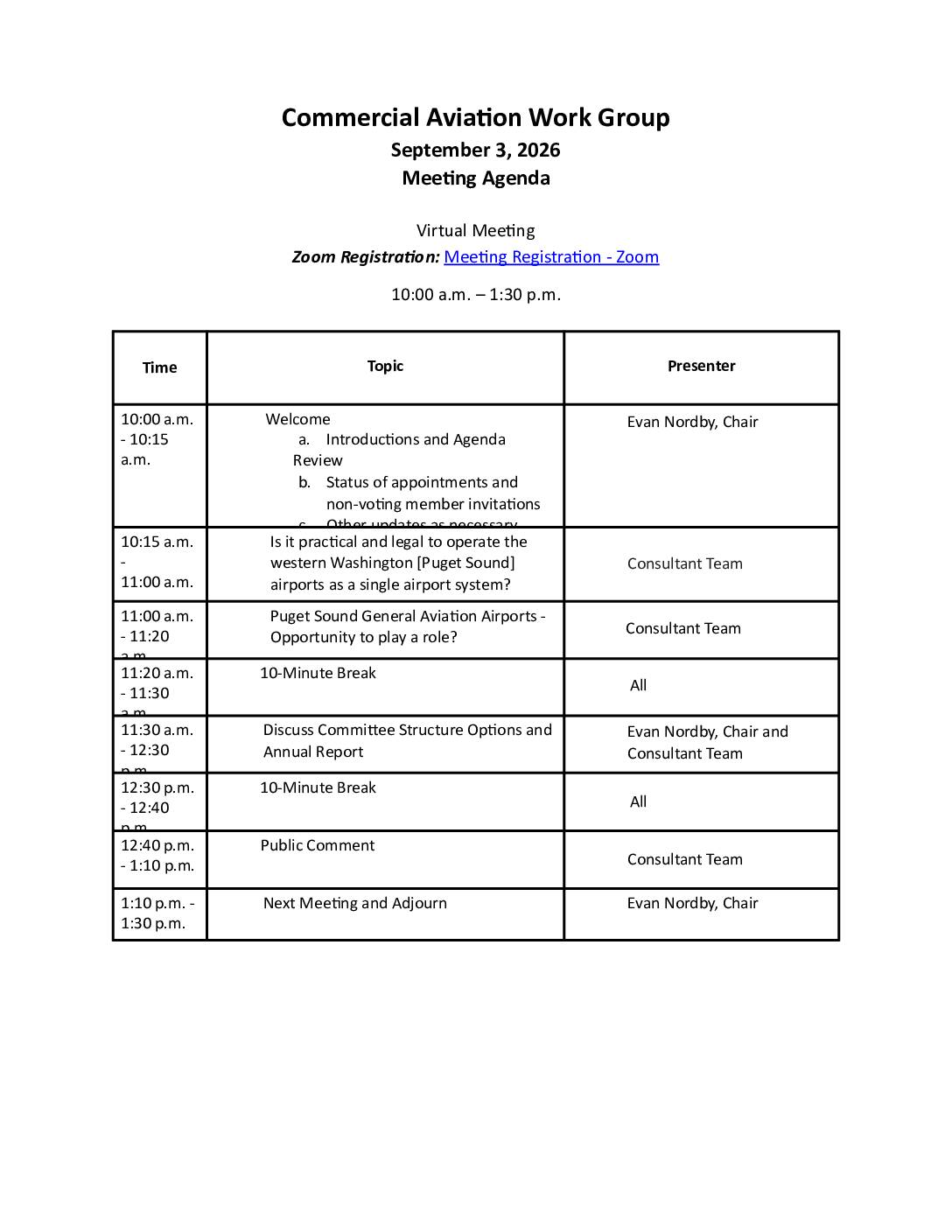
Meeting Agenda 10:00 a.m. – 10:15 a.m. | Welcome – Evan Nordby, Chair a. Introductions and Agenda Review b. Status of appointments and non-voting member invitations c. Other updates as necessary 10:15 a.m. – 11:00 a.m. | Is it practical and legal to operate the western Washington [Puget Sound] airports as a single airport system? -
2026-09-03
Commercial Aviation Work Group: Meeting Agenda, September 3, 2026
Meeting agenda for the Commercial Aviation Work Group (CAWG), the State ‘second airport’ committee, scheduled September 3, 2026, 10:00 a.m.–1:30 p.m. via Zoom virtual meeting. Topics include: practicality and legality of operating western Washington Puget Sound airports as a single airport system; Puget Sound General Aviation Airports role; Committee Structure Options and Annual Report discussion; -
 2026-09-03
Could the Puget Sound Commercial Airports Operate as a Single Airport System?
Presentation by Kaplan Kirsch for the Commercial Aviation Work Group (CAWG), dated September 3, 2026, examining whether Puget Sound commercial airports could operate as a unified airport system. Covers airport capacity versus demand, Washington State’s 17 busiest commercial airports by 2025 enplaned passengers (epax), including Sea-Tac Airport (SEA, 26.317M), Spokane International (GEG, 2.114M), Tri-Cities (PSC), -
 2026-09-03
Could the Puget Sound Commercial Airports Operate as a Single Airport System?
Presentation by Kaplan Kirsch for the Commercial Aviation Work Group (CAWG), dated September 3, 2026, examining whether Puget Sound commercial airports could operate as a unified airport system. Covers airport capacity versus demand, Washington State’s 17 busiest commercial airports by 2025 enplaned passengers (epax), including Sea-Tac Airport (SEA, 26.317M), Spokane International (GEG, 2.114M), Tri-Cities (PSC), -
 2026-08-28
Chapter 10 Utilities Element
This document is Chapter 10 of the City of SeaTac's Comprehensive Plan (Envision SeaTac 2044), covering the Utilities Element. It outlines the city's vision and policies for ensuring reliable, equitable, and resilient utility services—including water, sewer, electricity, natural gas, telecommunications, and stormwater—to support future growth through 2044. The chapter details goals for coordinating with utility providers such as Puget Sound Energy, Seattle City Light, and various water and sewer districts that serve the SeaTac community. -
 2026-08-28
Chapter 10 Utilities Element
This document is Chapter 10 of the City of SeaTac's Comprehensive Plan (Envision SeaTac 2044), covering the Utilities Element. It outlines the city's vision and policies for ensuring reliable, equitable, and resilient utility services—including water, sewer, electricity, natural gas, telecommunications, and stormwater—to support future growth through 2044. The chapter details goals for coordinating with utility providers such as Puget Sound Energy, Seattle City Light, and various water and sewer districts that serve the SeaTac community. -
 2026-08-28
Chapter 10 Utilities Background Report
This document is Chapter 10 of the City of SeaTac's Comprehensive Plan, providing a background report on utilities serving the city. It inventories electrical, natural gas, telecommunications, solid waste, sewer, and water utility systems, covering providers such as Puget Sound Energy, Seattle City Light, and several water and sewer districts. The report also references relevant federal and state regulations governing these utilities. -
 2026-08-28
Chapter 10 Utilities Background Report
This document is Chapter 10 of the City of SeaTac's Comprehensive Plan, providing a background report on utilities serving the city. It inventories electrical, natural gas, telecommunications, solid waste, sewer, and water utility systems, covering providers such as Puget Sound Energy, Seattle City Light, and several water and sewer districts. The report also references relevant federal and state regulations governing these utilities. -
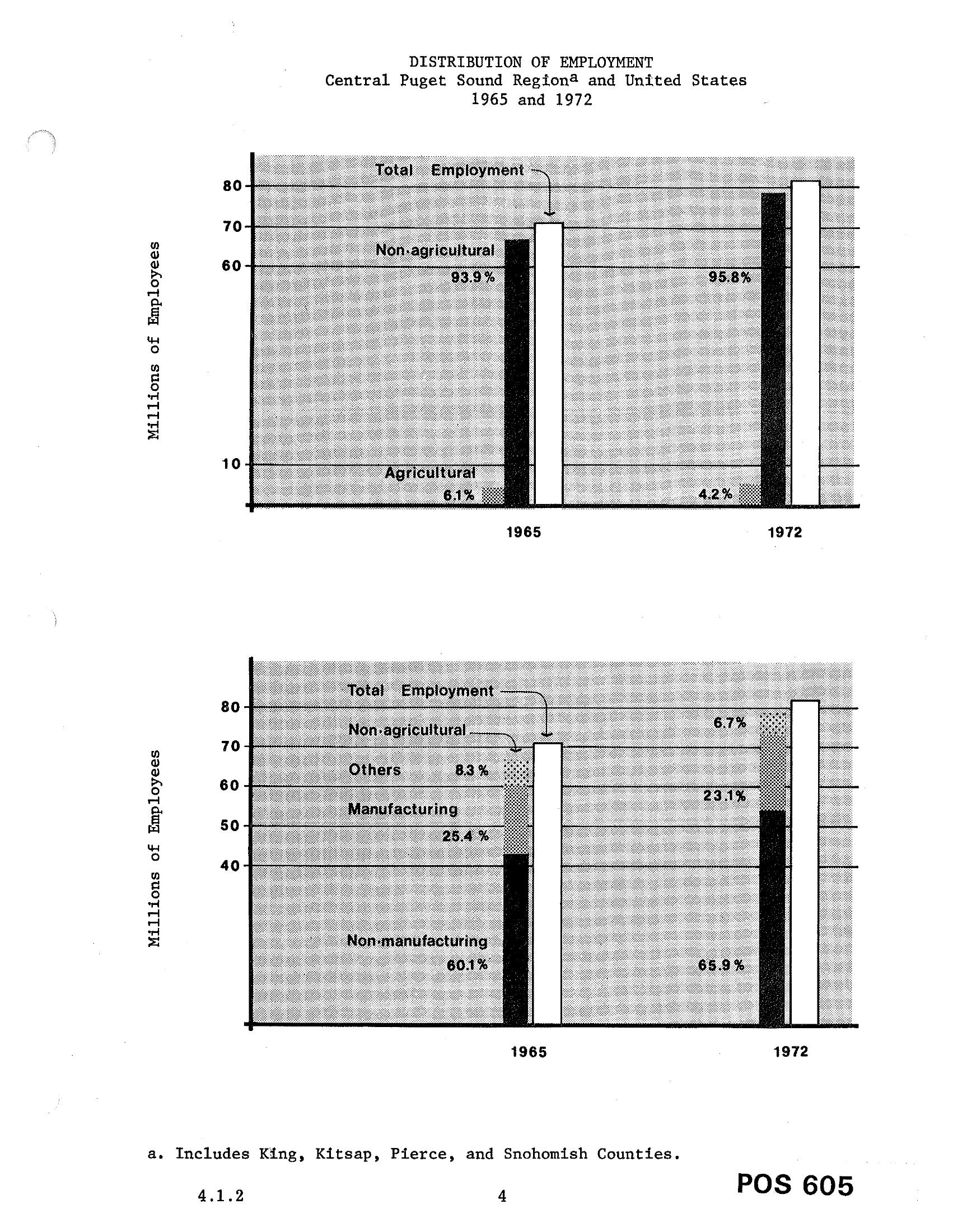
STCP Employment Distribution: Central Puget Sound Region and United States, 1965 and 1972
Two bar charts (document POS 605, page 4.1.2) compare employment distribution between 1965 and 1972 for the Central Puget Sound Region (King, Kitsap, Pierce, and Snohomish Counties) and the United States. The upper chart shows agricultural vs. non-agricultural employment shares, while the lower chart breaks non-agricultural employment into non-manufacturing (60.1% to 65.9%), manufacturing (25.4% to 23.1%), and others (8.3% to 6.7%). -
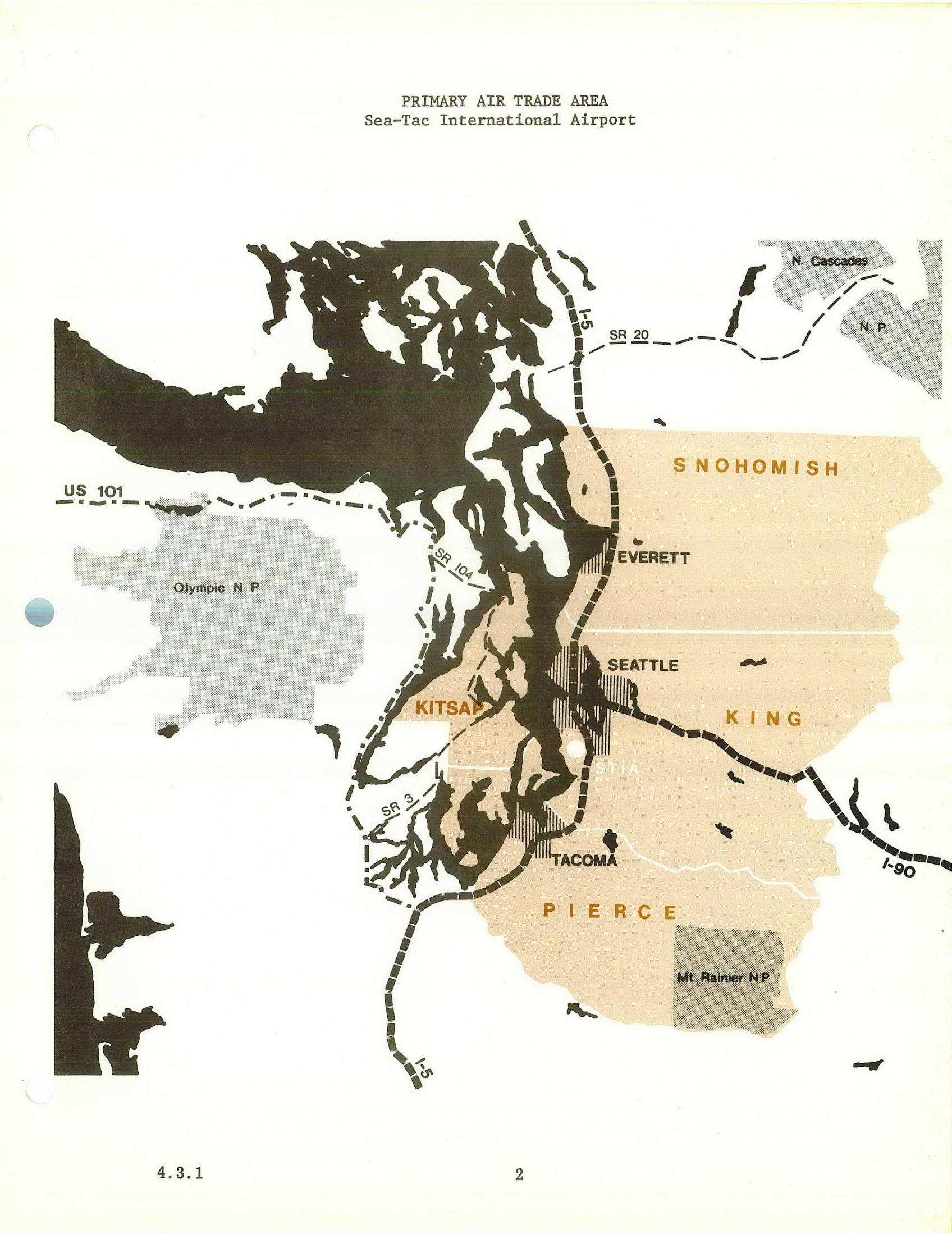
Primary Air Trade Area Planning Map – Sea-Tac Airport
A planning map labeled 'PRIMARY AIR TRADE AREA – Sea-Tac International Airport' (document reference 4.3.1, page 2) delineating the primary air trade catchment zone in tan/orange shading across Snohomish, King, and Pierce counties, with Kitsap County partially included. Major highways (I-5, I-90, US 101, SR 20, SR 104, SR 3) and cities (Seattle, Tacoma, Everett) are marked, along with national parks (Olympic NP, Mt. Rainier NP, N. Cascades NP) shown as excluded areas.