TagState of Washington(113)
-
 2026-04-28
Washington State Unconstrained Forecast Report
A draft working document prepared by the Commercial Aviation Work Group presents an unconstrained air travel demand forecast for Washington State's 17 busiest commercial airports, with Seattle-Tacoma International Airport (SEA) leading at approximately 26.3 million enplanements in 2025 out of a statewide total of nearly 29.8 million. The report, dated April 28, 2026, covers market analysis and air traffic forecasts across airports ranging from large hubs like Sea-Tac and Spokane International to smaller facilities such as Renton Municipal and Roche Harbor. The forecast is described as 'unconstrained,' meaning it projects potential demand without accounting for limitations in airport capacity or infrastructure. -
 2026-04-28
Washington State Unconstrained Forecast: Draft Presentation
This draft report, prepared by the Commercial Aviation Work Group and consulting firm Steer, presents an unconstrained air travel demand forecast for Washington State's 17 busiest commercial airports, with Seattle-Tacoma International (SEA) accounting for the vast majority of the state's approximately 29.8 million enplaned passengers in 2025. The forecast combines a short-term bottom-up model based on airline schedules with a long-term top-down model driven by macroeconomic factors such as GDP, population, and airfares, ultimately producing airport-level traffic projections. While focused on statewide aviation demand planning, the findings have direct relevance to Sea-Tac noise policy discussions given SEA's dominant share of regional air traffic. -
 2026-03-18
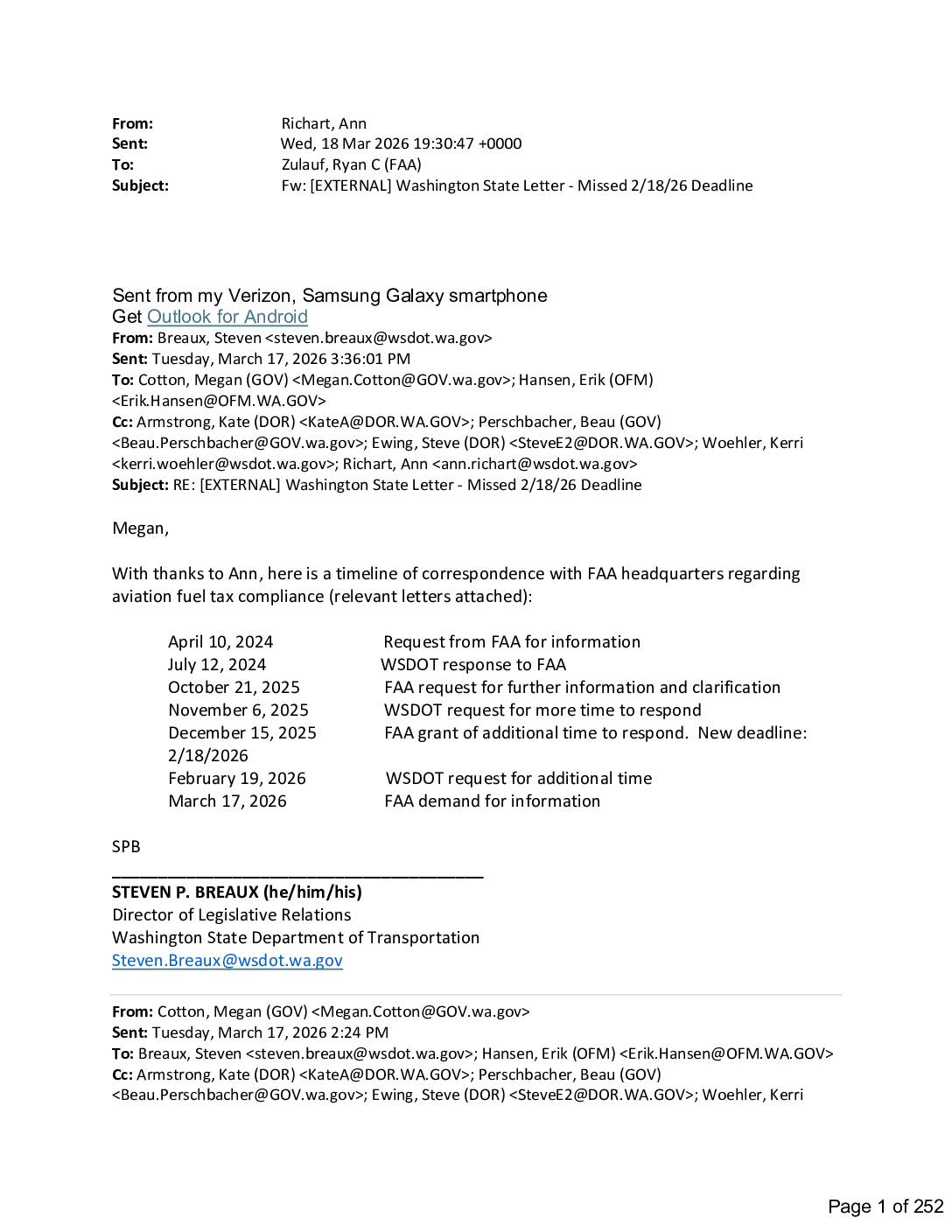
FAA Compliance Correspondence: WSDOT Aviation Fuel Tax Federal Revenue Use Requirements — Missed 2/18/26 Deadline
This document is an email chain from March 2026 between Washington State Department of Transportation (WSDOT), the Governor's Office, and the FAA regarding Washington State's compliance with federal aviation fuel tax requirements. WSDOT missed a February 18, 2026 deadline to provide information requested by the FAA, and the FAA subsequently issued a demand warning that compliance and enforcement actions would follow if the information was not received within 10 days. WSDOT officials indicated they do not have the ability to provide the requested information and sought guidance from the Governor's Office and the Office of Financial Management. -
 2026-03-17
P020444-042926 – FAA Review of Washington State Aviation Fuel Tax Compliance: Email Correspondence
These emails document a 2025–2026 federal compliance matter in which the FAA reviewed Washington State's aviation fuel tax practices to determine whether they met federal revenue-use requirements. After Washington missed a February 18, 2026 response deadline, the FAA notified state officials at the Department of Revenue and WSDOT, prompting coordination between multiple state agencies. While related to aviation finance rather than airport noise policy directly, the correspondence reflects ongoing federal oversight of Washington State's aviation funding obligations. -
 2025-12-10
Sustainable Aviation Fuel Use at a Washington State International Airport: Regional Air Quality Benefits
A University of Washington research team examined the air quality benefits of using Sustainable Aviation Fuel (SAF) at a Washington State international airport, covering activity during the year 2024. The report, prepared by the Department of Environmental & Occupational Health Sciences and submitted in December 2025, analyzes how SAF adoption can reduce harmful emissions in the surrounding region. It offers findings relevant to policymakers, airport operators, and communities concerned about the environmental impact of aviation fuel use. -
 2025-06-01
2025 Ambient Air Monitoring Network Plan
This 2025 Ambient Air Monitoring Network Plan, published by the Washington State Department of Ecology's Air Quality Program, outlines the state's ambient air quality monitoring network across Washington. Authored by Jill Schulte and released in June 2025, it provides regional office contact information and details the counties served by each of Ecology's four regional offices. Note: this document covers air quality monitoring statewide and does not contain content specifically related to Sea-Tac Airport noise policy. -
 2025-03-03
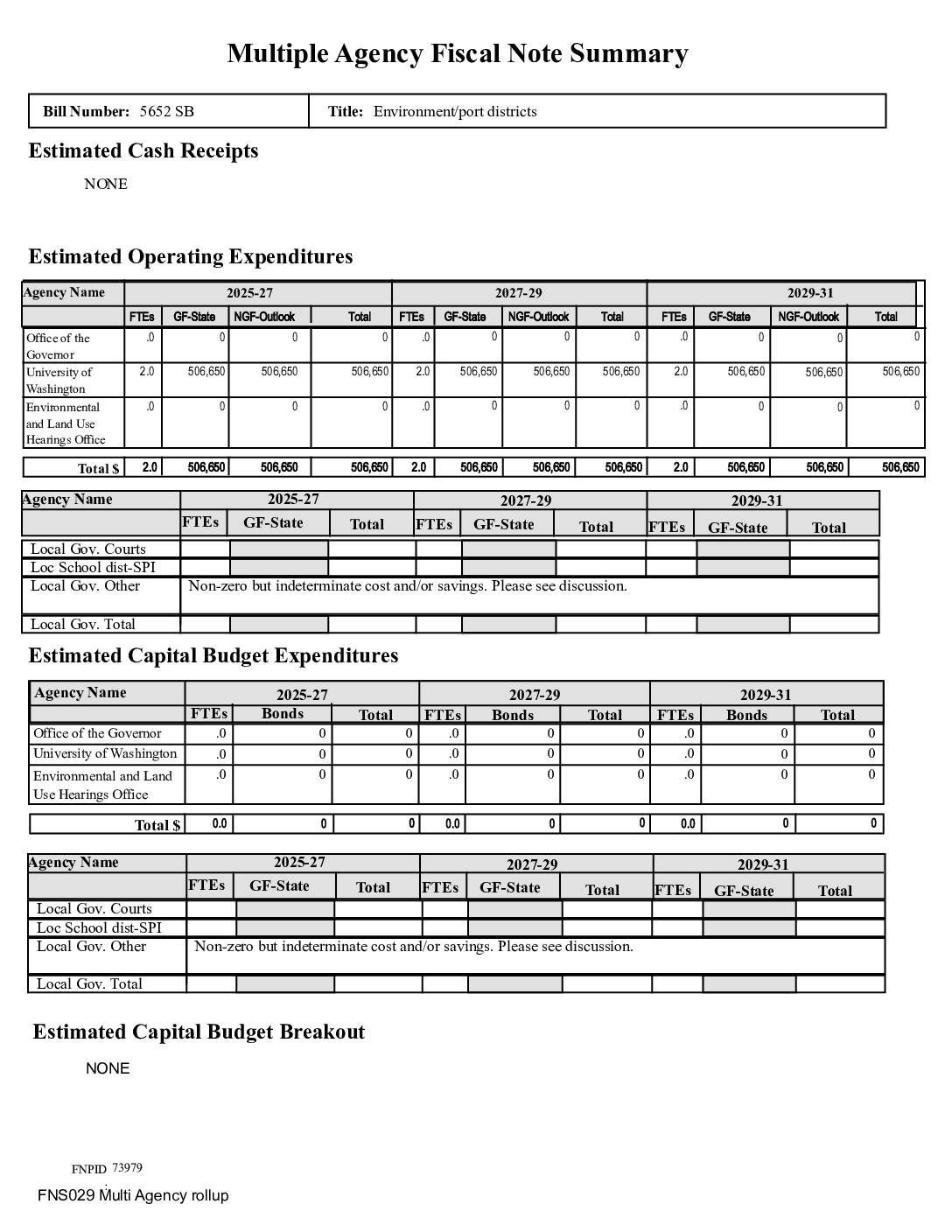
SB5652 Multiple Agency Fiscal Note Summary
Multiple Agency Fiscal Note Summary for Senate Bill 5652 regarding environment/port districts, showing estimated costs and expenditures across multiple state agencies. The University of Washington shows costs of $506,650 per biennium for 2.0 FTEs, while other agencies show no fiscal impact. -
2025-02-19
SHB1303 hearing in House Appropriations Committee
Substitute bill to address cumulative impacts faces stiff opposition Guillermo Morel: I’m here with Front and Centered, a network of 50 community-based organizations across the state working toward a just transition. We are led by communities of color and low-income populations. I want to take you back to 2021 when we passed the HEAL Act. -
 2024-12-17
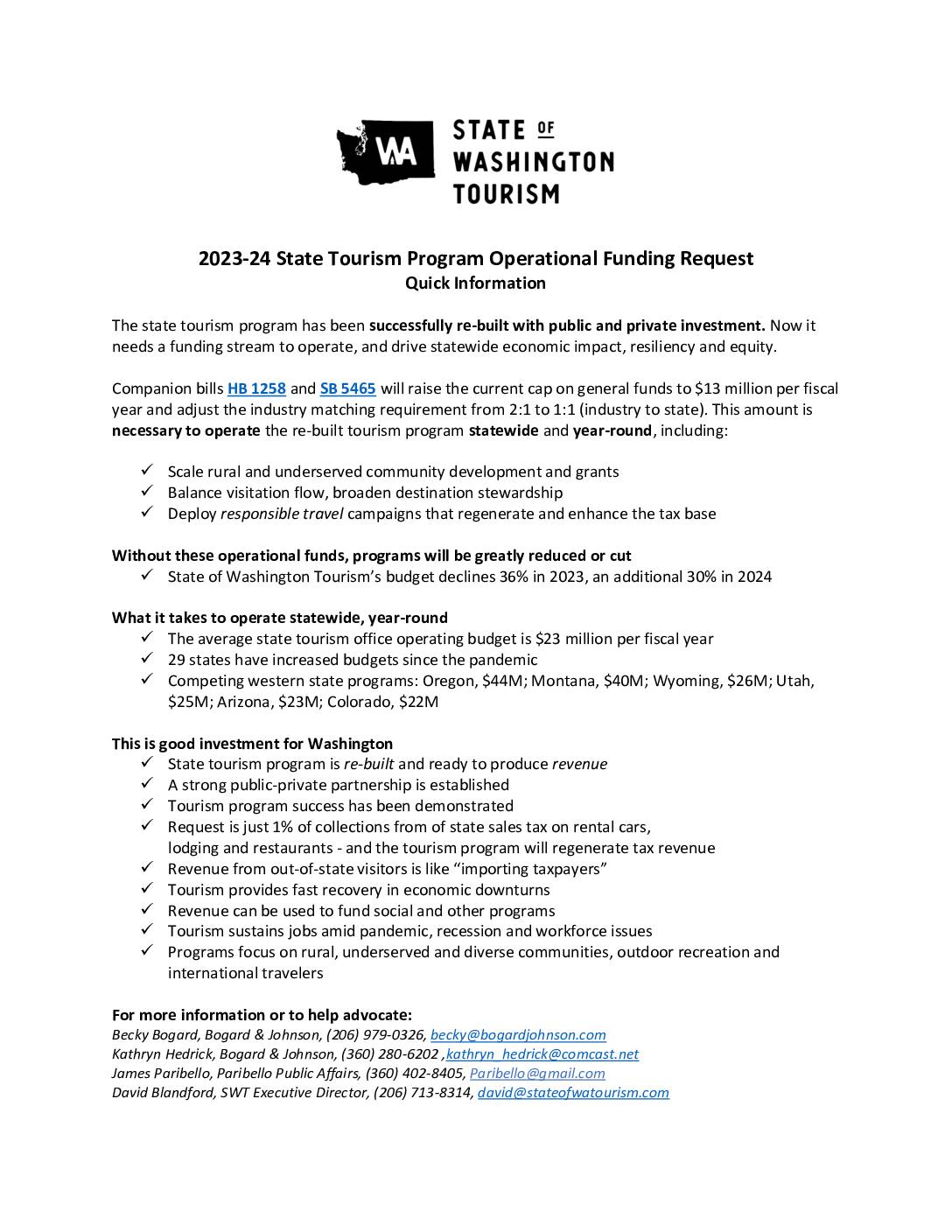
2023-24 State Tourism Program Operational Funding Request: Quick information
The State of Washington Tourism program is requesting operational funding through companion bills HB 1258 and SB 5465, which would raise the general funds cap to $13 million per fiscal year and adjust industry matching requirements. Without this funding, the program faces budget cuts of 36% in 2023 and an additional 30% in 2024, threatening statewide tourism initiatives. The request represents just 1% of state sales tax collections from rental cars, lodging, and restaurants, and aims to support rural communities, responsible travel campaigns, and economic resilience across Washington State. -
 2024-12-11
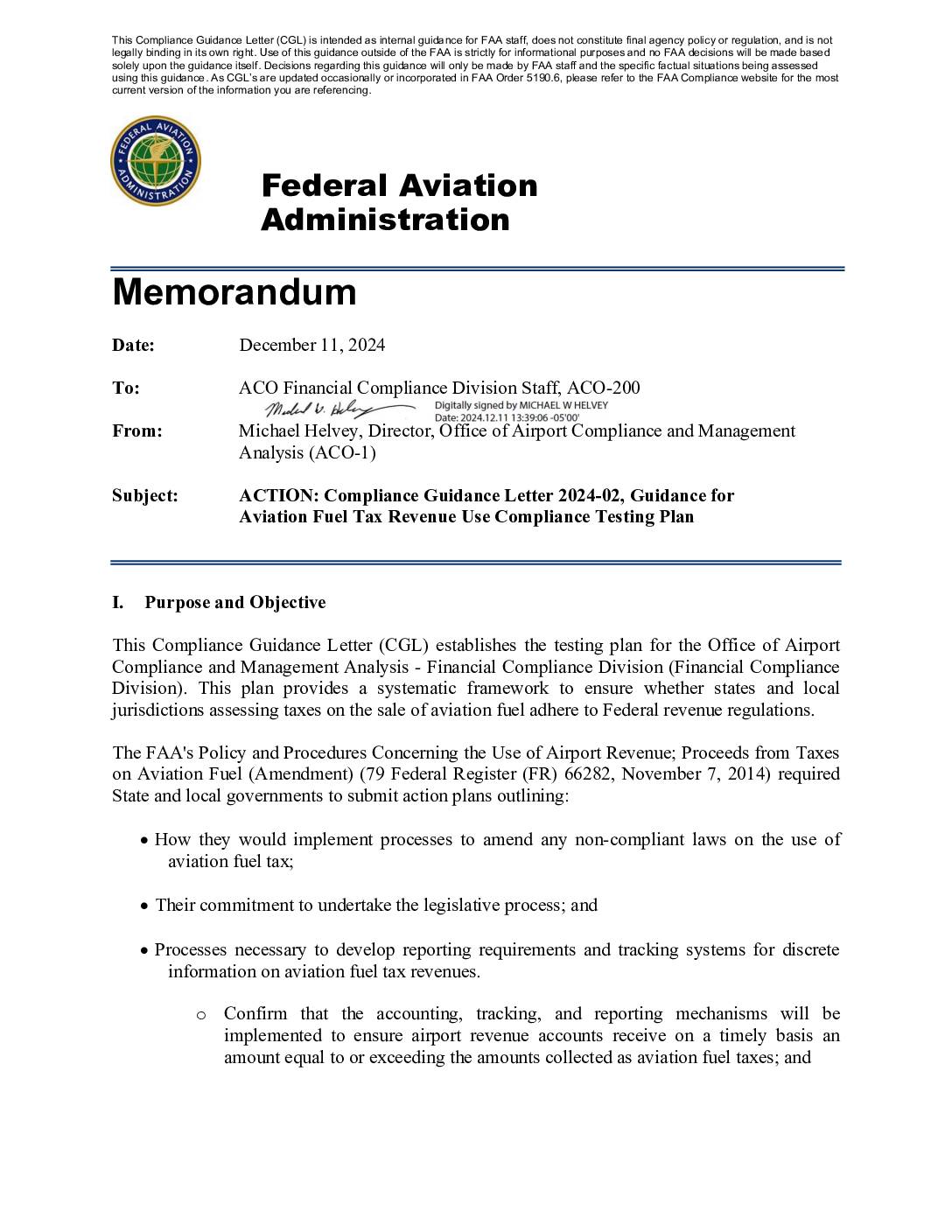
Compliance Guidance Letter 2024-02, Guidance for Aviation Fuel Tax Revenue Use Compliance Testing Plan
The FAA's Financial Compliance Division issued guidance in December 2024 establishing a testing plan to verify that states and local governments properly direct aviation fuel tax revenues toward airport and aviation purposes, as required by federal regulations. The plan outlines how jurisdictions are selected for review, what financial data they must submit, and how compliance is evaluated — with the State of Washington serving as the initial pilot case for the program.