TagSEPA(232)
-
 2026-08-20
Comments from Sea-Tac, Burien, and Des Moines on the SEPA Draft EIS for Sea-Tac Airport SAMP NTP
Joint comment letter filed August 20, 2026 by the Cities of SeaTac, Burien, and Des Moines to Port Of Seattle Senior Environmental Program Manager Steve Rybolt on the Draft SEPA Environmental Impact Statement (DEIS) for the Sustainable Airport Master Plan Near-Term Projects (SAMP NTPs) at Seattle-Tacoma International Airport (SEA). The letter documents cross-cutting deficiencies in -
 2026-08-19
STNI Comments on the SAMP Near-Term Projects Draft Environmental Impact Statement, May 2026
Sea-Tac Noise.Info (STNI) submitted formal comments in August 2026 challenging the Port of Seattle's Draft Environmental Impact Statement for its Sustainable Airport Master Plan, arguing the review is procedurally and analytically flawed. Key concerns include insufficient project design detail to support impact conclusions, missing hazardous materials surveys for 12 buildings slated for demolition, withheld technical documents that the public cannot independently verify, and the exclusion of over $5 billion in prior airport expansion projects from cumulative impact analysis. STNI requests the Port complete additional surveys and design work, extend the public comment period, and recalculate growth impacts using a pre-Third Runway baseline before finalizing the EIS. -
 2026-08-14
Comments on SAMP Near-Term Projects Draft Environmental Impact Statement (SEPA No. 2026-01)
Seattle resident David Ortman submitted formal comments on the Port of Seattle's Draft Environmental Impact Statement for its 'Sustainable' Airport Master Plan, arguing that the DEIS fails to adequately address noise and air pollution impacts on surrounding communities, property value effects, and meaningful alternatives to expansion. Ortman criticizes the Port for not issuing a full Sea-Tac EIS in over 30 years and for dismissing alternatives such as relocating airport operations to Joint Base Lewis-McCord. He also demands that airlines, not taxpayers, bear the costs of pollution mitigation, and calls for removal of the word 'sustainable' from a plan he views as promoting unchecked growth at a severely constrained airport. -
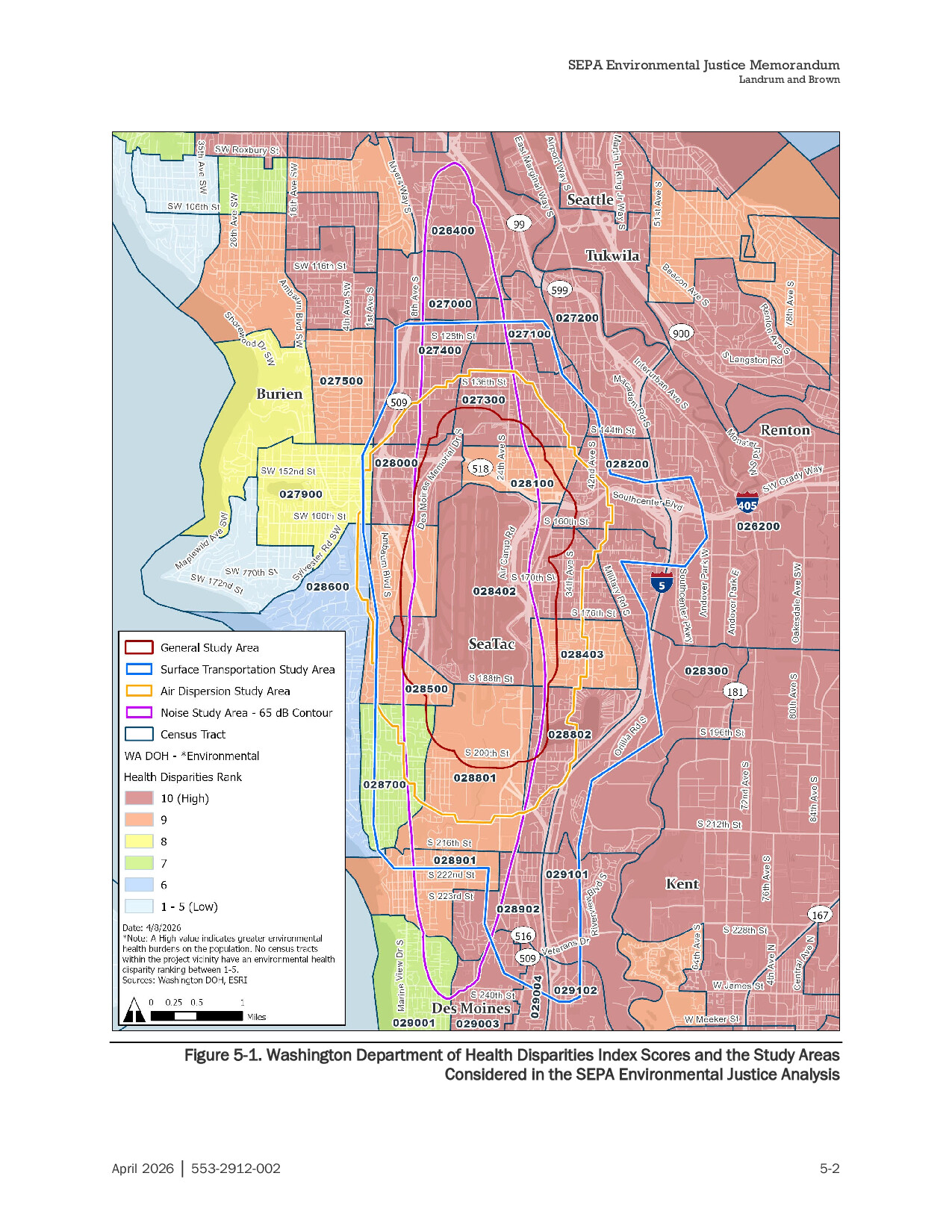
Appendix K SEPA Environmental Justice Disparities Map page 124
Figure 5-1 from a SEPA Environmental Justice Memorandum prepared by Landrum and Brown (document no. 553-2912-002, dated April 2026) maps Washington Department of Health Environmental Health Disparities Index scores across census tracts in the Sea-Tac Airport vicinity, including Seattle, Tukwila, Burien, SeaTac, Renton, Kent, and Des Moines. The map delineates four overlapping study areas—General Study Area, Surface Transportation Study Area, Air Dispersion Study Area, and Noise Study Area (65 dB contour)—over a background showing health disparity rankings ranging from 1–5 (Low) to 10 (High), with most tracts in the project vicinity ranked 9–10. -
 2026-08-11
Port of Seattle Commission Special Meeting – SEPA SAMP Near-Term Projects DEIS Listening Session
I. Call to Order – 3:00 p.m. II. Item of Business – 3:00 p.m. – 4:00 p.m. Port of Seattle Commission Listening Session Re: State Environmental Policy Act (SEPA) Sustainable Airport Master Plan (SAMP) Near-Term Projects (NTP) Draft Environmental Impact Statement (DEIS) ***This is not an official public hearing. The Port Commission is providing this -
2026-08-11
Port Of Seattle Commission Special Meeting Agenda: SEPA SAMP Near-Term Projects Draft Environmental Impact Statement Listening Session
Port Of Seattle Commission special meeting agenda for August 11, 2026, 3:00 p.m., held at Port of Seattle Headquarters Building Commission Chambers, 2711 Alaskan Way, Pier 69, Seattle, WA 98121. Single agenda item: informal public listening session on the State Environmental Policy Act (SEPA) Sustainable Airport Master Plan (SAMP) Near-Term Projects (NTP) Draft Environmental Impact -
 2026-08-07
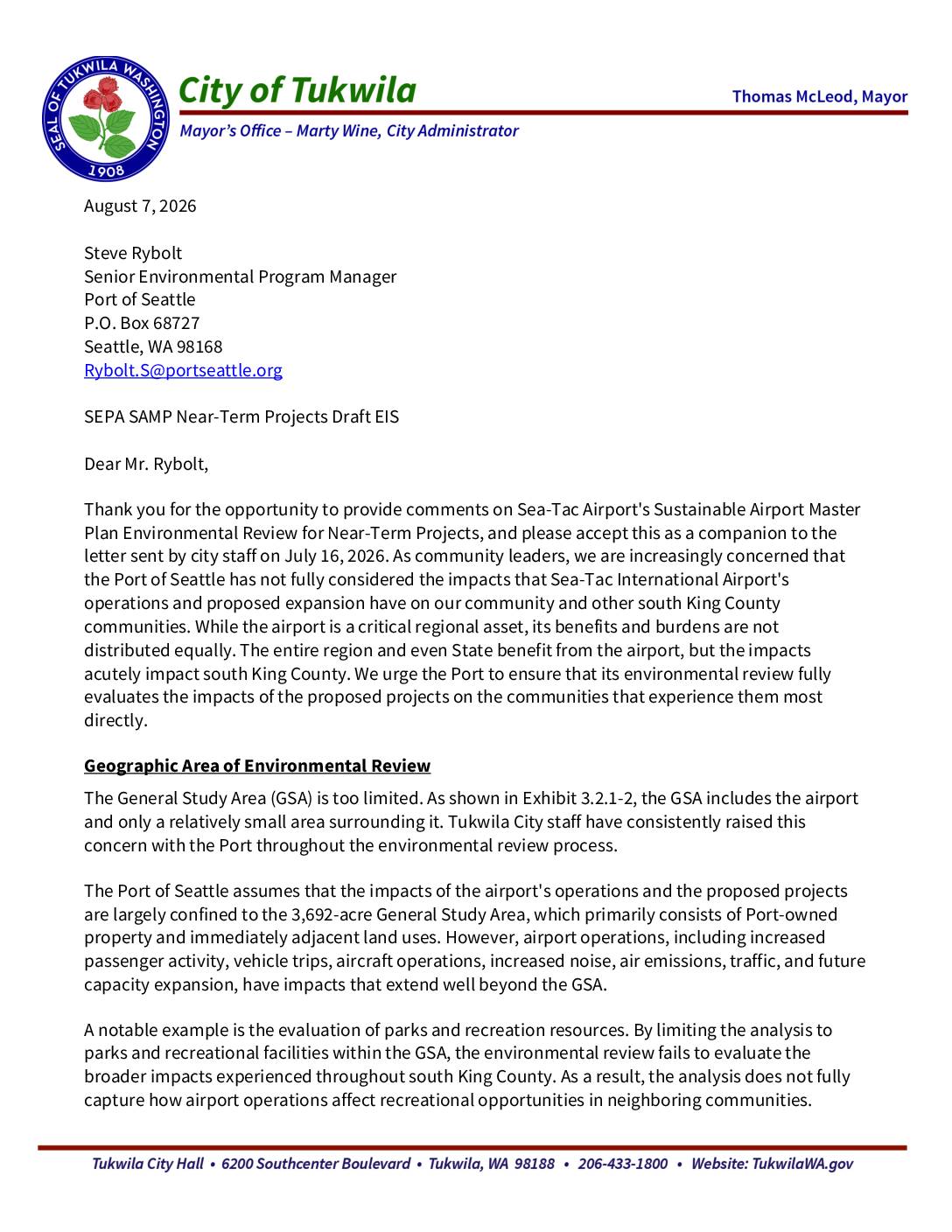
City of Tukwila Letter to Port Of Seattle on SEPA SAMP Near-Term Projects Draft EIS
Letter dated August 7, 2026 from Tukwila Mayor Thomas McLeod to Steve Rybolt, Senior Environmental Program Manager at Port Of Seattle, regarding the SEPA Sustainable Airport Master Plan (SAMP) Near-Term Projects Draft EIS. The City of Tukwila raises concerns that the 3,692-acre General Study Area (GSA) is too geographically limited to capture full impacts of -
 2026-07-16
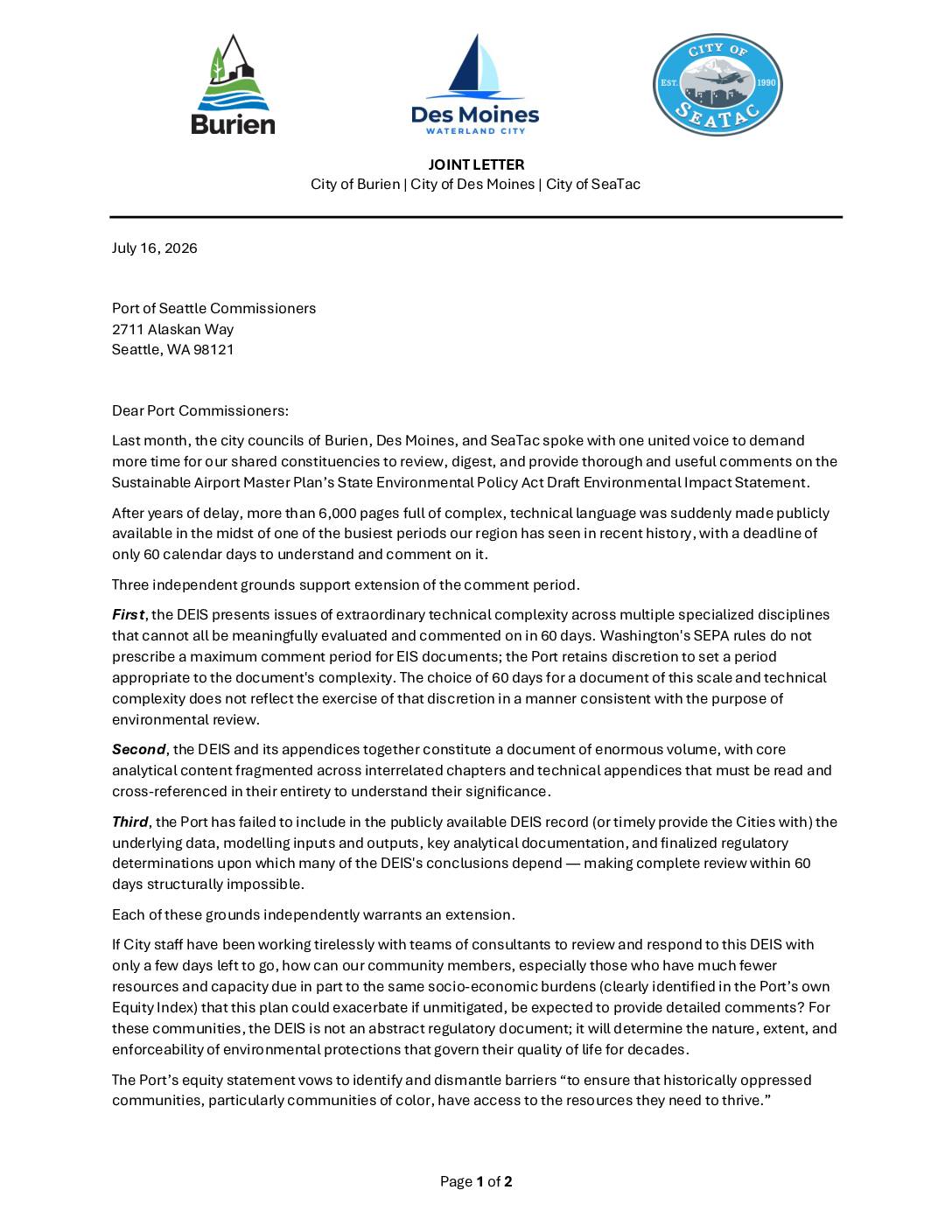
Joint letter from Burien, Des Moines, and SeaTac requesting extension of SAMP SEPA DEIS comment period
In July 2026, the city managers of Burien, Des Moines, and SeaTac jointly wrote to Port of Seattle Commissioners demanding that the public comment period for the Sustainable Airport Master Plan's Draft Environmental Impact Statement be extended from 60 to at least 120 days. The cities argued that the document's enormous size (over 6,000 pages), technical complexity, and missing underlying data made meaningful review within 60 days impossible, particularly for lower-resource community members most affected by airport impacts. The letter also called on the Port to honor its own equity commitments by ensuring historically overburdened communities surrounding the airport have a genuine opportunity to participate in the review process. -
 2026-07-09
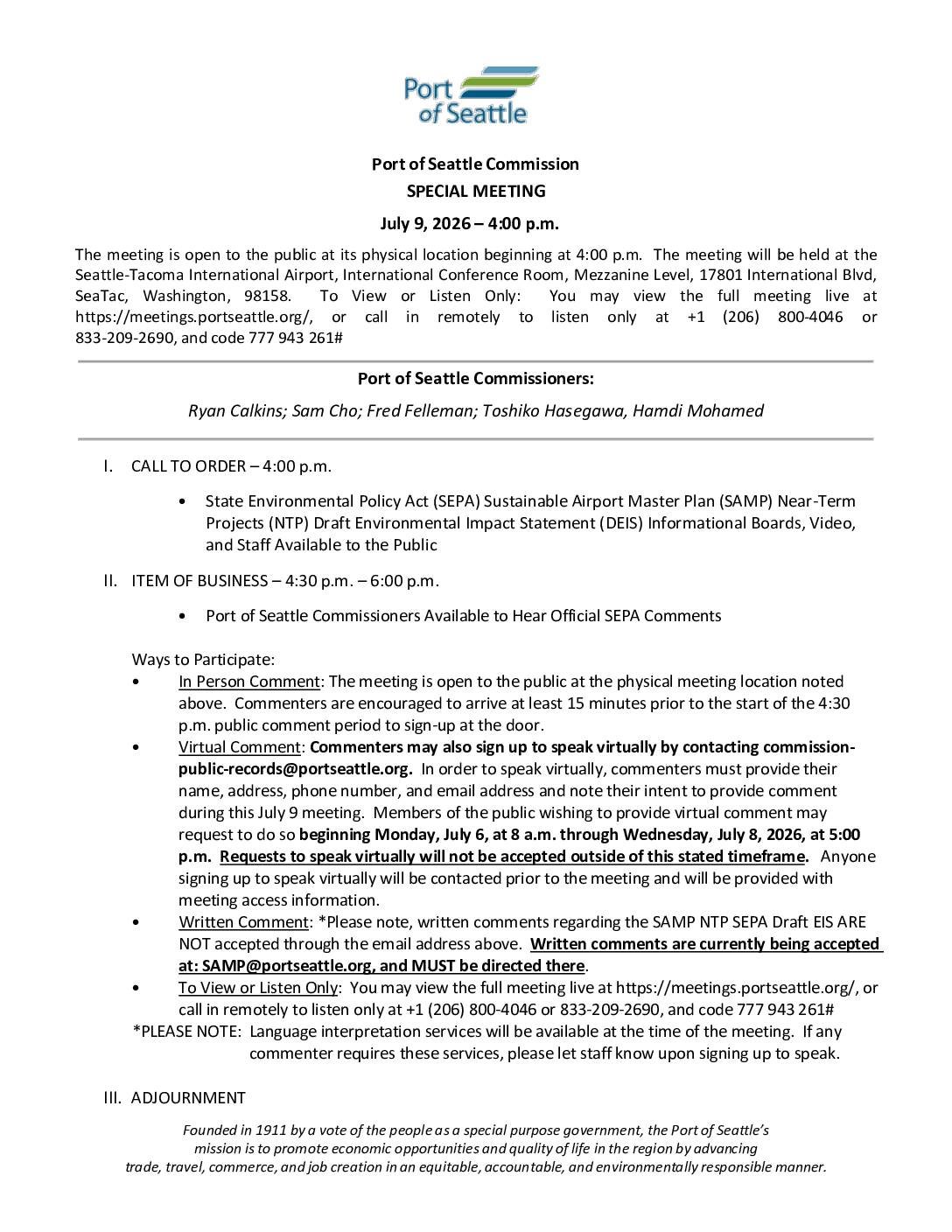
Port of Seattle Commission Special Meeting – SEPA SAMP NTP Draft EIS Public Comment
The Port of Seattle Commission is holding a Special Meeting to gather public input on the Sustainable Airport Master Plan (SAMP) Near-Term Projects Draft Environmental Impact Statement (DEIS) — and your voice matters. This critical environmental review shapes the future of Seattle-Tacoma International Airport and surrounding communities, making public participation essential. Meeting begins at 4:00 p.m. with informational displays and staff available to answer questions, followed by an official public comment period from 4:30–6:00 p.m. where Commissioners will be present to hear testimony directly. Virtual sign-ups are accepted July 6–8, 2026, and written comments can be submitted via email. The meeting is also available to view or listen to online or by phone. -
2026-07-09
Port Of Seattle Commission special meeting agenda: SAMP NTP SEPA DEIS public comment
The Port of Seattle Commission held a special public meeting on July 9, 2026, at Seattle-Tacoma International Airport to receive official comments on the Draft Environmental Impact Statement (DEIS) for the Sustainable Airport Master Plan (SAMP) Near-Term Projects. Community members could participate in person, virtually, or by submitting written comments to SAMP@portseattle.org. The meeting was part of the State Environmental Policy Act (SEPA) review process, giving the public an opportunity to weigh in on planned airport development and its potential environmental impacts.