TagBoston/Logan Airport(14)
-
 2026-09-29
Impacts of Aviation Emissions on Near-Airport Residential Air Quality: Supporting Information
Supporting information document for the academic study “Impacts of aviation emissions on near-airport residential air quality” by Neelakshi Hudda, Liam W. Durant, Scott A. Fruin, and John L. Durant (Tufts University, USC Keck School of Medicine). Contains detailed methods including preferred runway configurations (Northwest and Northeast flow operating configurations), maps of traffic volume estimates around -
 2026-09-29
Aviation Emissions Impact Ambient Ultrafine Particle Concentrations in the Greater Boston Area
Supporting information for an academic study by Hudda, Simon, Zamore, Brugge, and Durant (Tufts University) on aviation emissions and ultrafine particle (UFP) concentrations in the greater Boston area, published in Environmental Science & Technology. Document includes diurnal flight activity patterns at Logan International Airport (2014 hourly average LTO data), runway-specific arrival and departure statistics by -
Hanscom Field
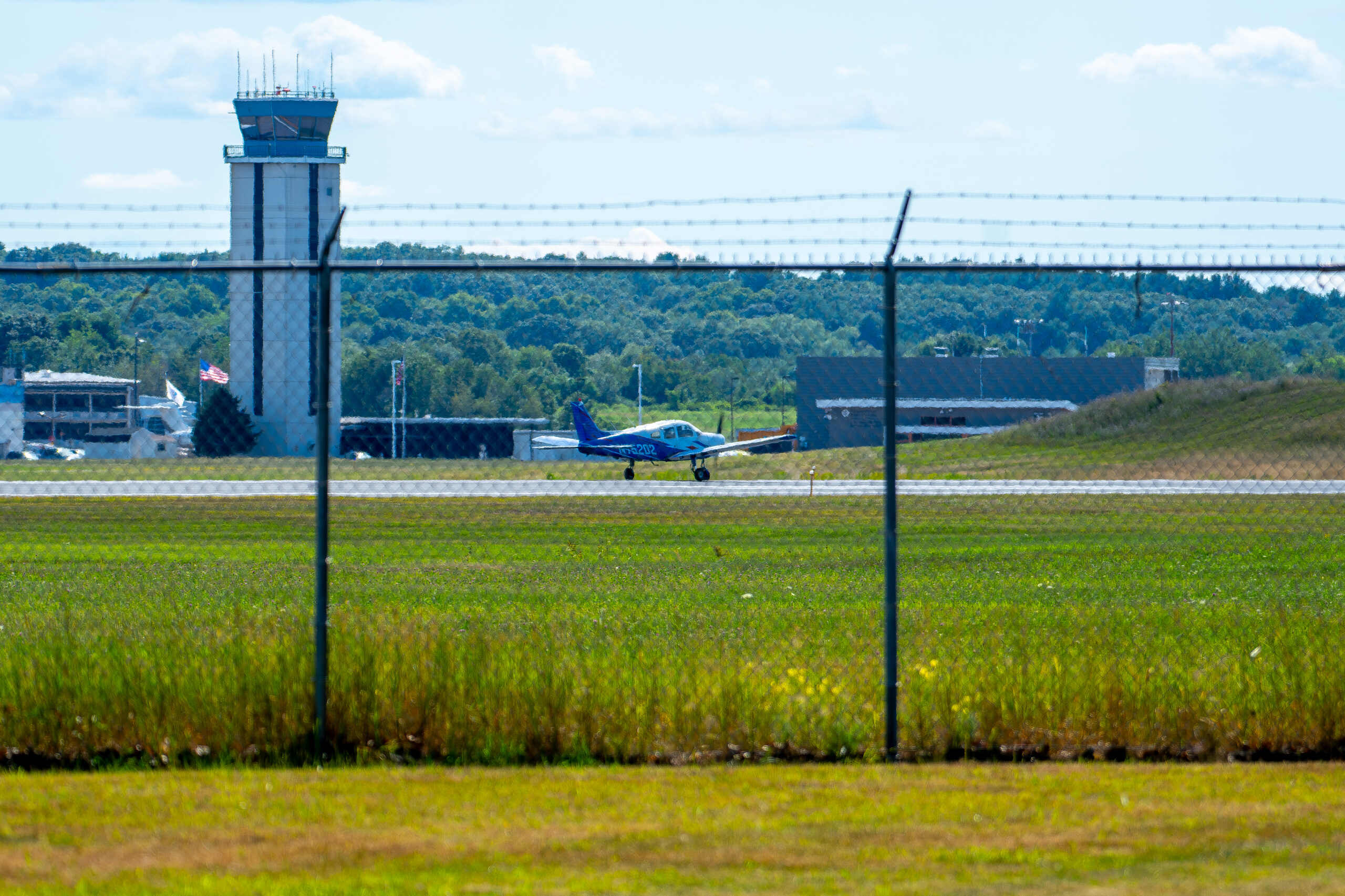
A blue single-engine propeller aircraft, partially readable registration ending in '202', taxis or lands on a runway at a general aviation airport. A concrete air traffic control tower is visible in the background, along with an American flag and airport terminal buildings, viewed from outside a chain-link perimeter fence. This does not appear to be Sea-Tac Airport. -
Boston/Logan Airport (Massport) Residential Sound Insulation Program
The Residential Sound Insulation Program https://www.massport.com/logan-airport/about-logan/noise-abatement/sound-insulation-program/ OVERVIEW The Massachusetts Port Authority (Massport) has initiated a voluntary Residential Sound Insulation Program (RSIP) to provide treatment of eligible properties to mitigate the effects of aircraft noise for properties surrounding Boston Logan International Airport (Logan). Massport is beginning with a 10 home Pilot Program to -

Massport Logo
This image shows the official logo of the Massachusetts Port Authority (Massport), featuring a stylized airplane graphic above the organization's name on a blue background. Massport is the public authority that operates Boston Logan International Airport and other transportation facilities in Massachusetts. -
 2023-05-23
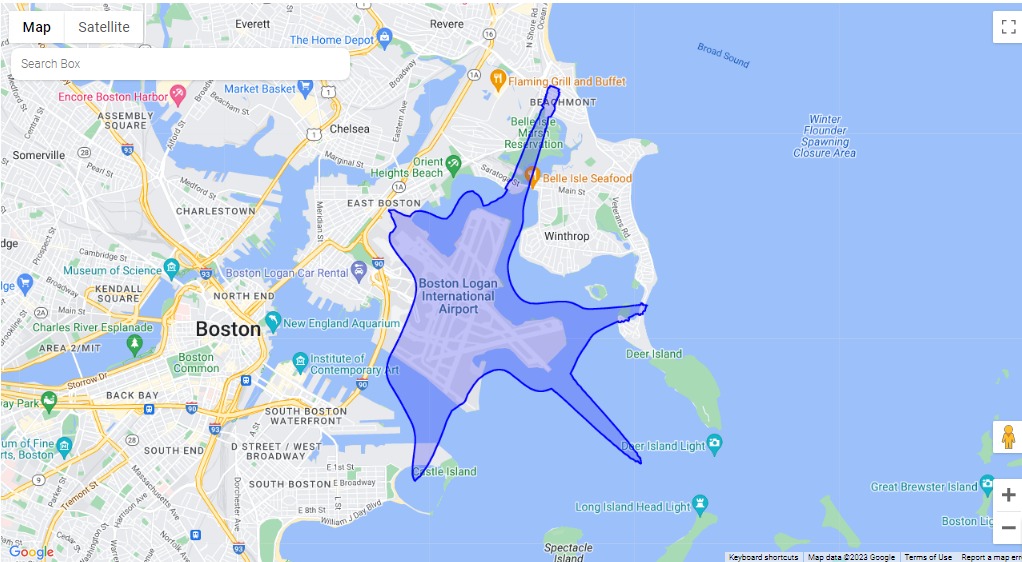
Boston Logan International Airport Noise or Flight Path Boundary Map
A Google Maps screenshot showing a blue polygon boundary drawn around Boston Logan International Airport (BOS) in East Boston, Massachusetts, extending over Boston Harbor toward Winthrop and Deer Island. The map includes visible labels for Boston Logan International Airport, surrounding neighborhoods, and landmarks such as Castle Island and Deer Island Light. -

FAA New England Region Boston Area Communities Public Information Workshop Zoom Webinar
A recorded Zoom webinar for the Boston Area Communities Public Information Workshop featuring FAA New England Region officials and aviation industry representatives, including Colleen D'Alessandro (FAA Regional Administrator), Richard Doucette and Veronda Johnson (FAA Environmental Protection Specialists), Barrett Brown (FAA Boston TRACON Operations Manager), Steve Sulprizio and Flavio Leo (MassPort), Heidi Williams (NBAA), Steve Phillips (Cape Air), and Lee Brown (JetBlue). This event is unrelated to Sea-Tac Airport and pertains to FAA noise and environmental matters in the Boston/New England region. -
 2020-11-10
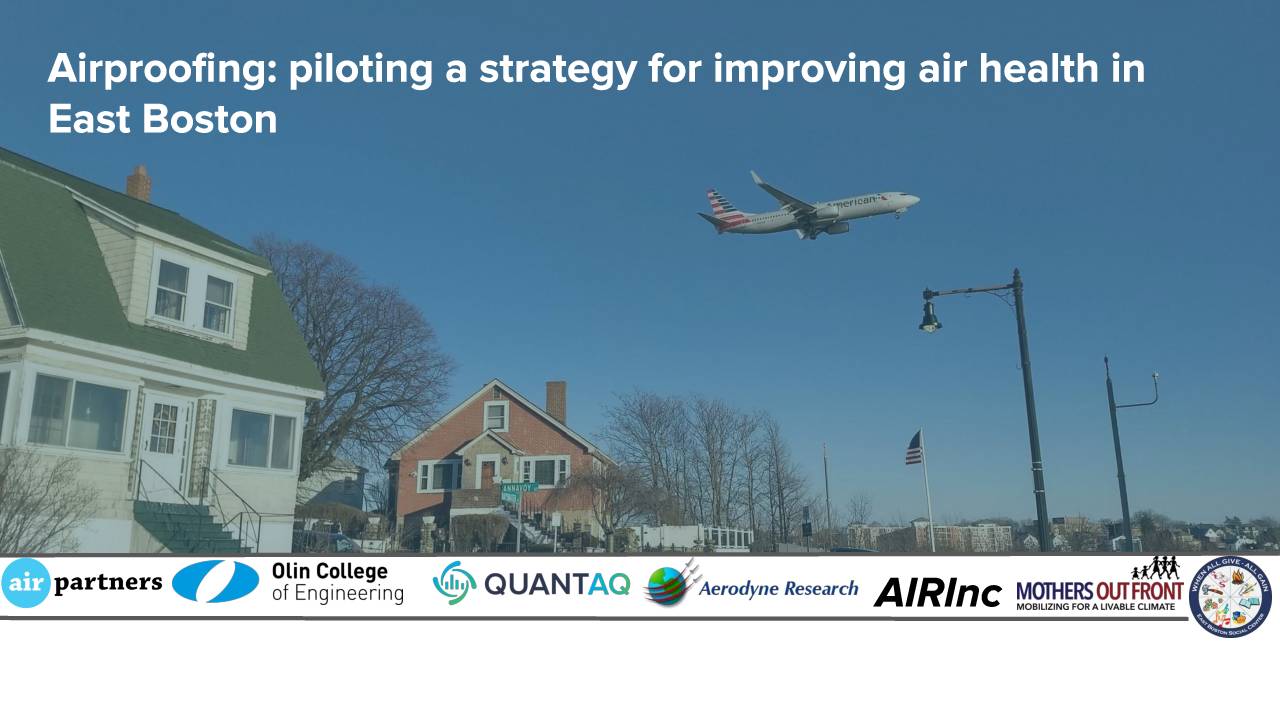
Airproofing: Piloting a Strategy for Improving Air Health in East Boston
This presentation outlines the 'Airproofing' pilot project aimed at improving air quality for residents of East Boston, a neighborhood heavily impacted by pollution from nearby Logan Airport. The project, a collaboration between Air Partners, Olin College of Engineering, Aerodyne Research, and community organizations, examines the problem of airport-related air pollution, explores protective solutions for homes and buildings, and describes testing methods and resource needs. While focused on East Boston, the initiative offers a potential model for addressing aviation-related air quality burdens in other airport-adjacent communities. -
 2020-05-29
Airport Case Studies: NPIAS, Boston Logan International Airport — Appendix A, Section 3
This document examines how Seattle-Tacoma International Airport and comparable U.S. airports handle community noise and growth impacts, using Boston Logan International Airport as a key case study. It outlines federal NPIAS guidelines requiring airports to balance aviation needs with community and environmental concerns, and details Boston Logan's noise abatement measures — including nighttime flight restrictions, soundproofing programs, and a 24-hour noise hotline — as models for addressing residential noise complaints. These examples provide context for evaluating Sea-Tac's own noise policies and community compatibility efforts.