TagWHO(6)
-
 2026-06-01
Night Flights in Europe: Trends, Impacts and Policy Responses
Aviation Environment Federation report for UECNA (June 2026) analyzing night flight operations (23:00–07:00) at 31 key European airports. Documents approximately 210,000 more night arrivals and 140,000 more night departures at EU27+EFTA airports in 2023 compared to 2005, with night flights comprising 5.5% of total traffic. Night flights per airport in 2025 ranged from 7,578 to -
 2026-05-28
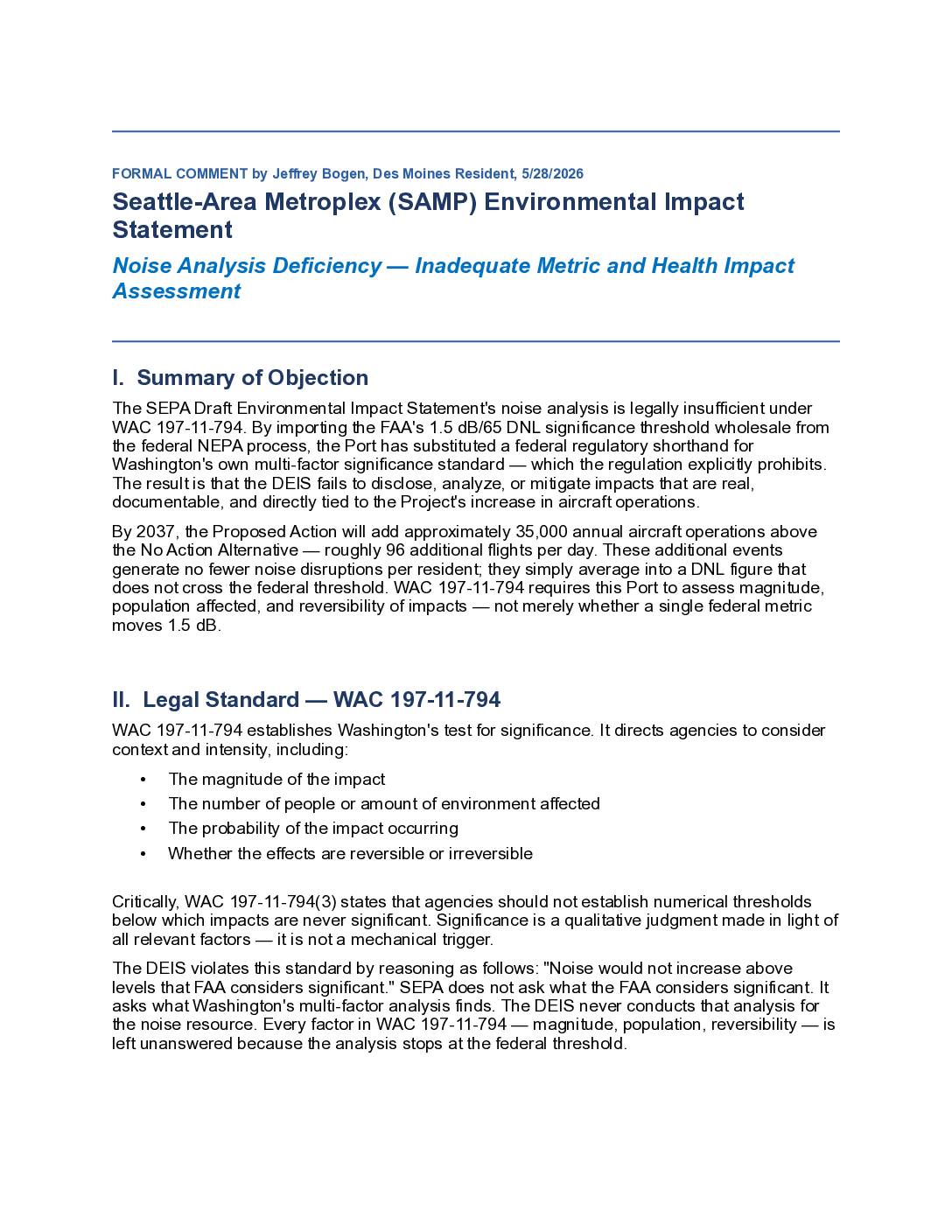
Formal Comment of Jeffrey Bogen: SAMP Draft EIS Noise Analysis Deficiency — Inadequate Metric and Health Impact Assessment
A Des Moines resident's formal comment argues that the Seattle-Area Metroplex Environmental Impact Statement's noise analysis is legally inadequate because it relies solely on a federal FAA noise threshold rather than Washington State's own multi-factor significance standard. The comment contends that the standard noise metric used (DNL) masks the real impact of roughly 96 additional daily flights projected by 2037, since it averages out individual disturbance events rather than counting them. The commenter calls for supplemental analysis using alternative metrics—such as single-event sound levels and nighttime averages—supported by peer-reviewed health studies linking aircraft noise to sleep disruption and cardiovascular harm. -
 2024-05-07
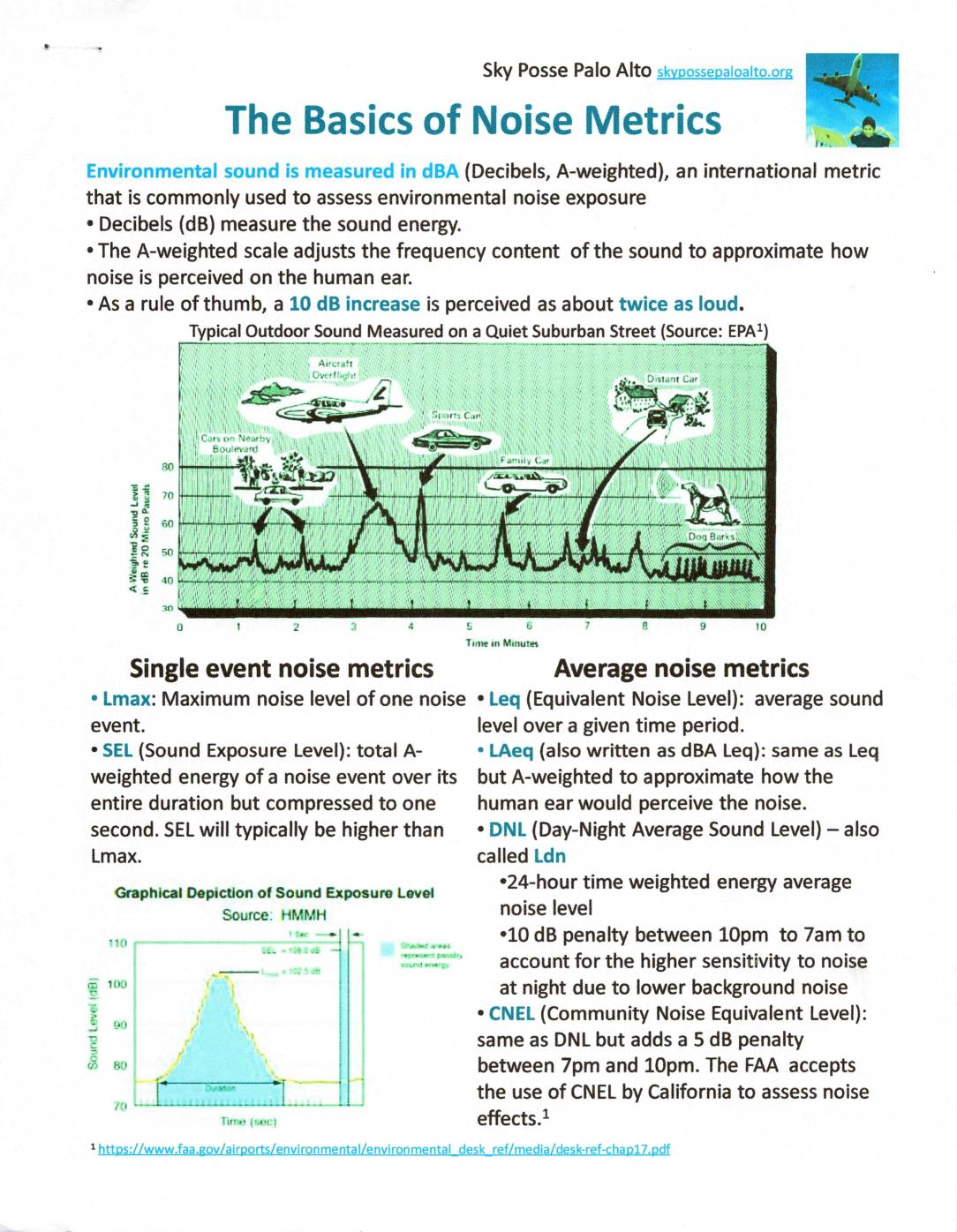
The basics of noise metrics
This document explains how aircraft noise is measured using decibel-based metrics such as DNL, CNEL, and SEL, and highlights that the FAA's accepted noise threshold of 65 dB exceeds the World Health Organization's recommended limits of 50–55 dB outdoors and 30–35 dB indoors. It also notes that standard metrics like SEL fail to capture the cumulative impact of repeated aircraft overflights. The international aviation body ICAO recommends a four-part 'Balanced Approach' to managing airport noise, encompassing noise reduction at the source, land-use planning, operational procedures, and operating restrictions. -
Compendium of WHO and other UN guidance on health and environment
Welcome to the global repository of interventions for creating healthier environments and improving health The Compendium is a comprehensive collection of available WHO and other United Nations (UN) guidance for improving health by creating healthier environments. It provides an overview and easy access of 500 actions, and a framework for thinking about health and environment -
 2022-01-01
Environmental noise: compendium of WHO and other UN guidance on health and environment, 2022 update
★ 32A 2022 World Health Organization report on environmental noise outlines the health risks posed by traffic, aircraft, and leisure noise, including increased risk of heart disease, sleep disturbance, and hearing impairment. The report recommends that aircraft noise levels stay below 45 dB for average exposure and below 40 dB at night to protect public health. It also defines mitigation strategies ranging from reducing noise at the source to behavior change and community education. -
 2022-01-01
Compendium of WHO and other UN guidance on health and environment: 2022 update
This 2022 WHO compendium brings together guidance from the World Health Organization and other United Nations agencies on the links between human health and environmental factors. It covers topics such as air quality, water, sanitation, and climate-related health risks, providing policymakers and practitioners with a consolidated reference for evidence-based standards. The document is produced in collaboration with UNDP, UN Environment, and UNICEF.