TagAviation Impacted Communities Alliance(6)
-
 2026-01-23
Senate Bill Report SB 6240 – Aircraft Noise and Air Quality Mitigation
Washington Senate Bill 6240 proposes creating a new state account funded by a portion of hazardous substance tax revenue collected on aviation fuel, with money directed toward communities affected by airport noise and air pollution. Starting October 1, 2026, the Department of Commerce would use these funds to run a grant program supporting noise and air quality mitigation projects in aviation-impacted neighborhoods. The bill does not include a direct appropriation and would take effect 90 days after the legislative session in which it is passed. -
Advanced Air Mobility Request for Public Comment
The Department of Transportation is seeking public comment on ‘Advanced Air Mobility’ which is a set of rules involving new forms of air transport, including drones and vertical take-off aircraft. You can read the complete description here: Federal Register-2023-10448 Since these changes will profoundly affect all aviation-impacted communities, we can use this as another chance -
 2023-06-12
AICA Response and Mark Up: House’s 6-9-23 Draft T&I FAA Reauthorization Act of 2023
The Aviation-Impacted Communities Alliance (AICA) published a detailed response to the House's June 9, 2023 draft FAA Reauthorization Act, opposing or requesting edits to numerous sections of the bill. Key concerns include the weakening of community noise and pollution protections, the exclusion of affected communities from stakeholder processes, and the prioritization of aviation industry interests over public safety and accountability. AICA argues that several provisions—covering aircraft data privacy, ADS-B enforcement, rotorcraft operations, and leaded fuel—fail to adequately protect communities living near airports like Sea-Tac from noise, pollution, and safety risks. -
 2022-10-07
Airport Noise Report, Vol. 34 No. 33: Port Of Seattle sued over public health study records; AICA urges REDAC to support six noise research proposals; Eviation Alice first flight
A Seattle attorney sued the Port of Seattle in September 2022 to force disclosure of a fully redacted consultant report examining public health impacts—including noise, air pollution, and higher rates of disease—on communities within 10 miles of Seattle-Tacoma International Airport. Separately, the Aviation-Impacted Communities Alliance urged a federal advisory committee to support six research proposals challenging the FAA's longstanding 65 DNL noise threshold, which new survey data suggests dramatically understates the number of people harmed by aircraft noise. The issue also covers the first successful test flight of Eviation's all-electric nine-passenger Alice aircraft in Moses Lake, Washington. -
 2019-08-20
Overview: The Aviation Impacted Communities Act
The Aviation Impacted Communities Act establishes a structured process to help neighborhoods affected by aircraft noise, starting with the FAA identifying eligible communities and ending with grants for noise mitigation. A community qualifies as 'aviation impacted' if it is located within 1 mile of any point where a commercial or cargo jet route passes at or below 3,000 feet above ground level. Once designated, communities can form boards, conduct studies, and develop action plans to address aviation-related impacts near airports like Sea-Tac. -
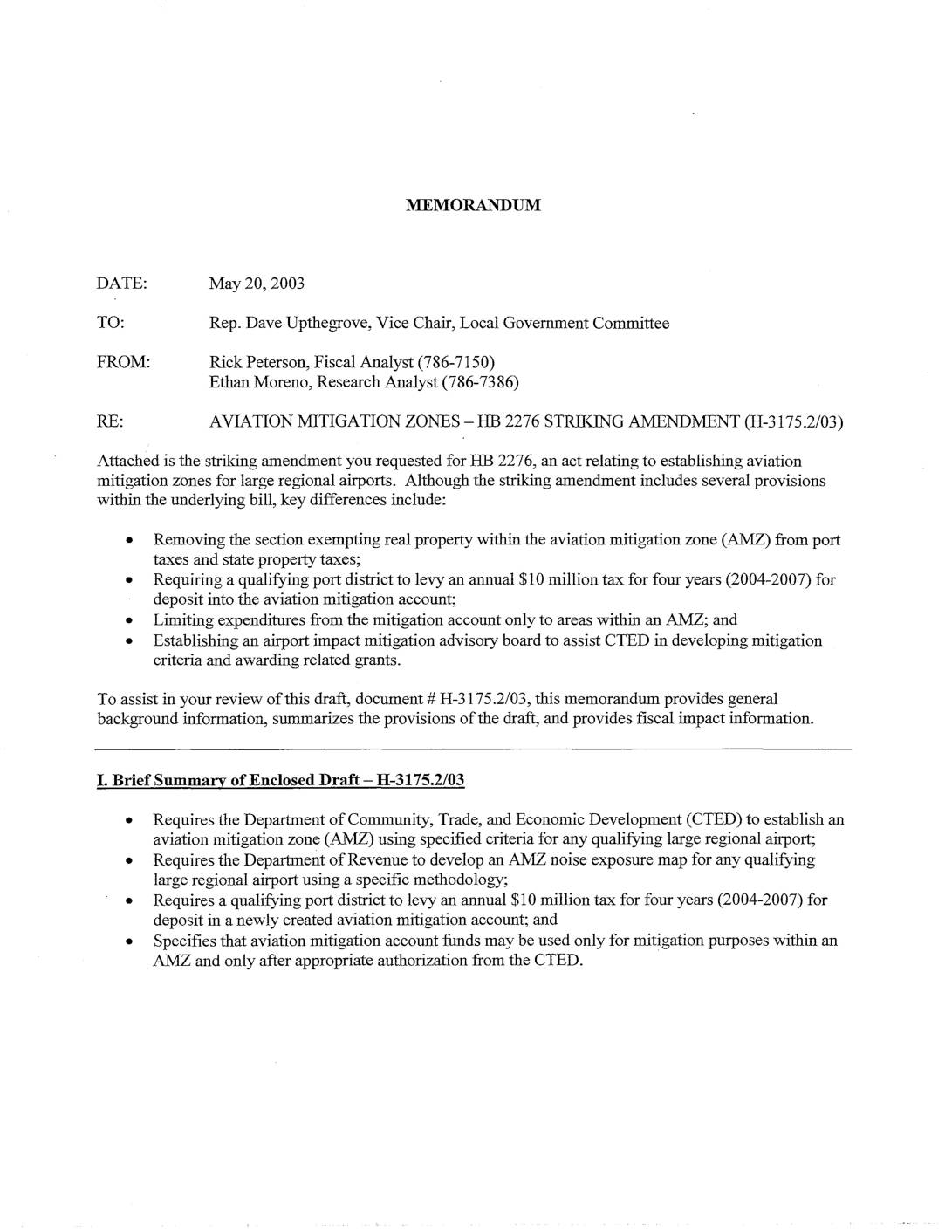 2003-05-20
Aviation Mitigation Zones – HB 2276 Striking Amendment (H-3175.2/03)
A 2003 Washington State legislative memorandum outlines a proposed striking amendment to HB 2276, which would establish Aviation Mitigation Zones (AMZs) around large regional airports like Seattle-Tacoma International Airport to address noise impacts on nearby communities. The amendment would require the Port of Seattle to levy $10 million annually from 2004 to 2007 into a dedicated mitigation fund, with spending restricted to affected areas within the AMZ. An advisory board and competitive grant process would be created to help distribute funds to eligible local governments, schools, and nonprofits in impacted neighborhoods such as Burien, Des Moines, Tukwila, and Normandy Park.