TagWashington Aviation System Plan(25)
-
 2024-05-13
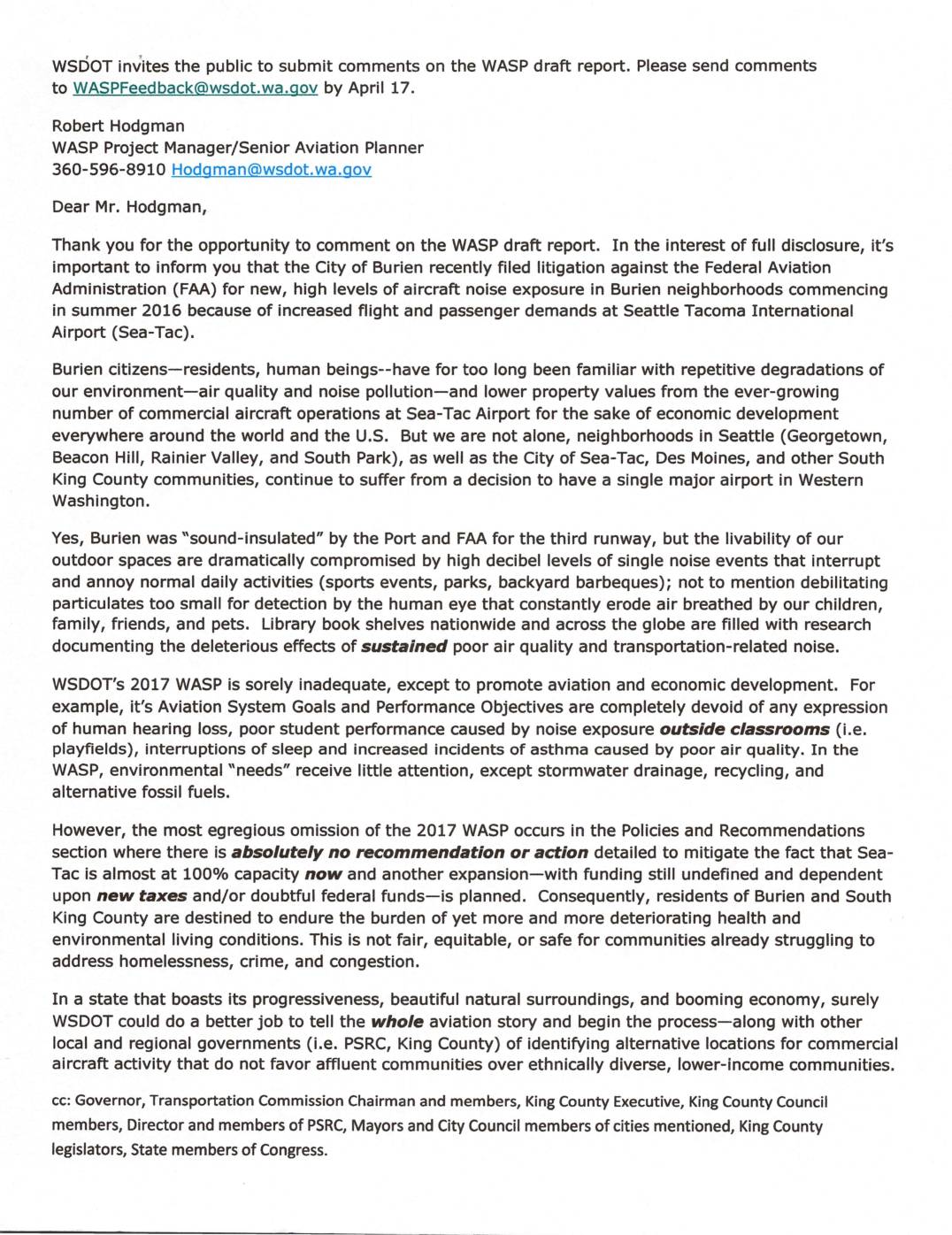
Comment letter on the Washington Aviation System Plan (WASP) draft report
A letter from the City of Burien to WSDOT criticizes the 2017 Washington Aviation System Plan (WASP) for failing to address the health and environmental impacts of growing aircraft noise and air pollution on communities near Seattle-Tacoma International Airport. The letter argues that the plan focuses too narrowly on aviation and economic development while ignoring issues such as hearing loss, poor student performance, sleep disruption, and asthma affecting lower-income and ethnically diverse neighborhoods. The author calls on WSDOT and regional governments to explore alternative airport locations to relieve the disproportionate burden placed on South King County communities. -
 2023-05-07
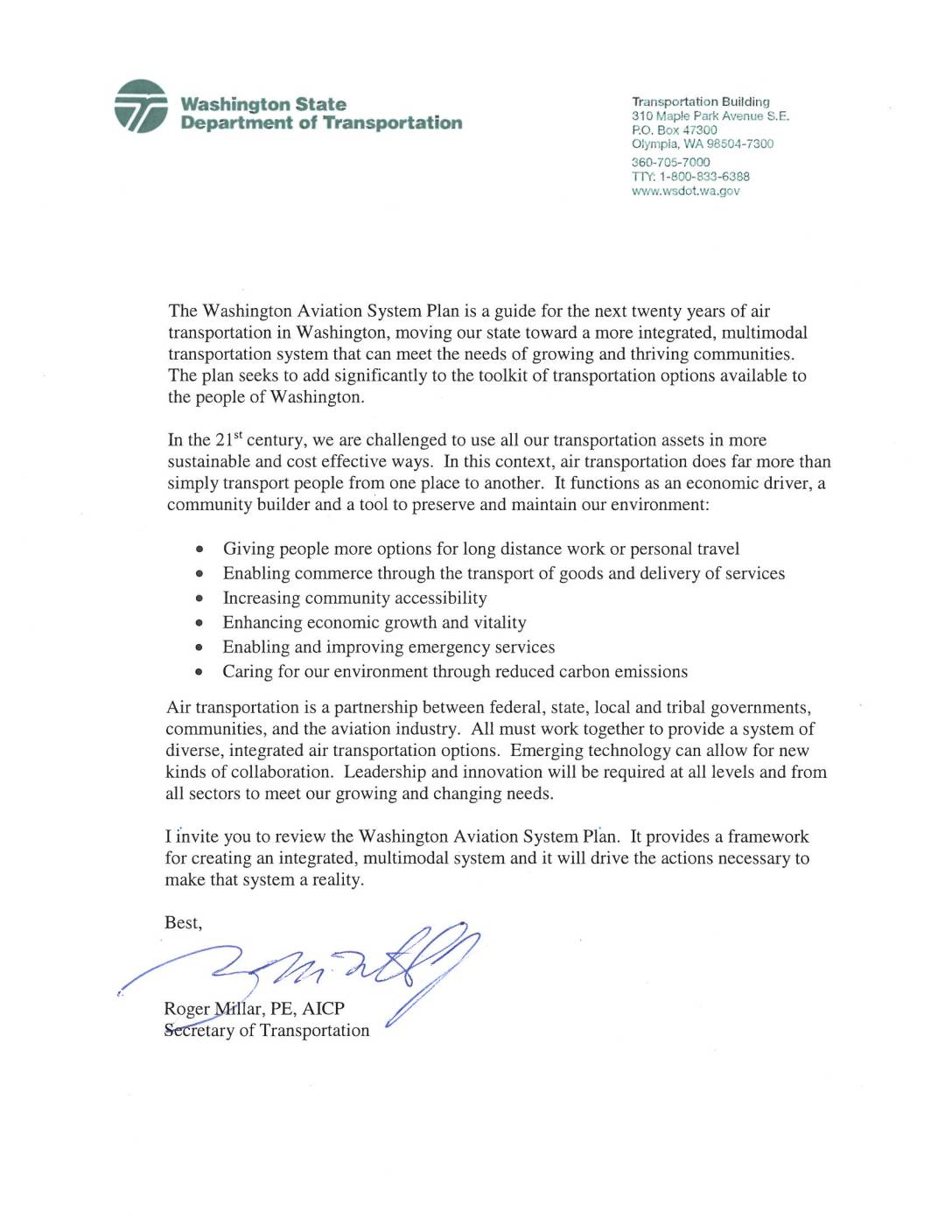
Washington Aviation System Plan Endorsement Letter
The Washington Aviation System Plan is a 20-year statewide guide aimed at building a more integrated, multimodal air transportation network across Washington State. Signed by Secretary of Transportation Roger Millar, the plan highlights aviation's role as an economic driver, community connector, and environmental tool, citing benefits such as expanded travel options, improved emergency services, and reduced carbon emissions. It calls for collaboration among federal, state, local, and tribal governments, communities, and the aviation industry to meet the state's growing transportation needs. -
 2023-04-12
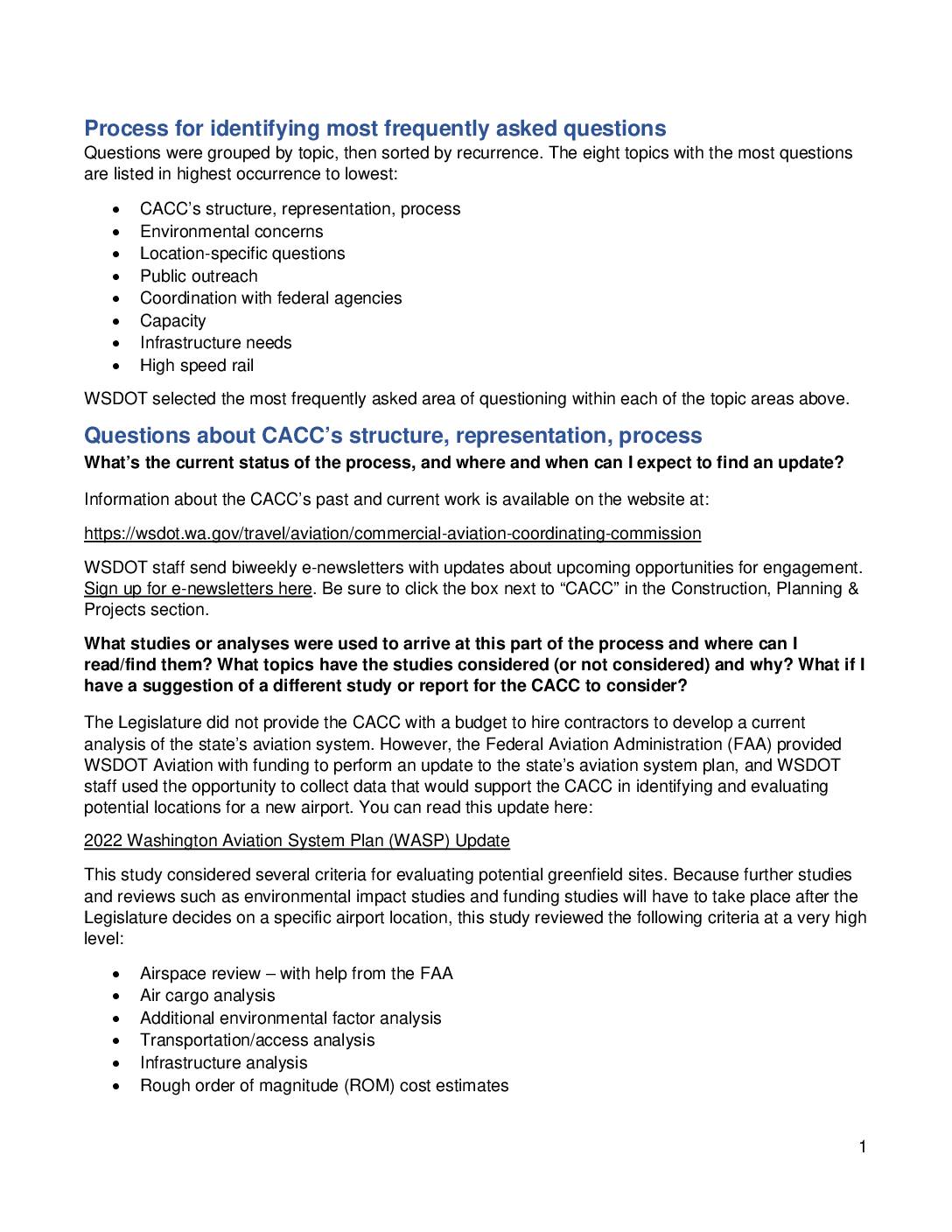
CACC Frequently Asked Questions
This document compiles frequently asked questions about Washington State's Commercial Aviation Coordinating Commission (CACC), which is studying potential locations for a new commercial airport in the region. It covers how the Commission was formed, what studies have been used to evaluate possible sites, and how environmental concerns—such as impacts on aquifers, the Nisqually River watershed, and tribal treaty rights—factor into site selection. The CACC can only recommend a site to the State Legislature, which retains final authority over any next steps. -
 2023-03-30
Commercial Aviation Coordinating Commission (CACC) WASP consultant presentation
The Washington Aviation System Plan (WASP) Airport Site Selection Study presented findings to the Commercial Aviation Coordinating Commission (CACC) on March 30, 2023, covering a secondary screening analysis and airspace review for potential greenfield airport sites in Washington State. The presentation also included preliminary air cargo forecasts to help evaluate future commercial aviation capacity needs for the region. -
 2022-02-09
Commercial Aviation Coordinating Commission report to legislative transportation committees
The Washington State Commercial Aviation Coordinating Commission's 2022 report to the Legislature identifies six existing airports — including Paine Field, Bremerton National, and Tacoma Narrows — as candidates for expanded aviation capacity, while also exploring potential greenfield sites for a new airport. The report summarizes public input showing that a majority of respondents support building new aviation capacity despite environmental costs, and outlines the Commission's guiding principles of public benefit, economic feasibility, environmental responsibility, and social equity. The Commission's final recommendations are expected by February 15, 2023. -
Washington Aviation System Plan 2017 (WASP)
*2020 Update* WSDOT Aviation, with the assistance of consulting firm Kimley-Horn, has completed a new statewide Aviation Economic Impact Study for the Washington Aviation System. The study revealed the state’s 134 public-use airport system contributes 407,042 jobs, $26.8 billion in labor income, and $107 billion in total economic impact (business revenues) to our state’s economy and communities. -
 2017-07-01
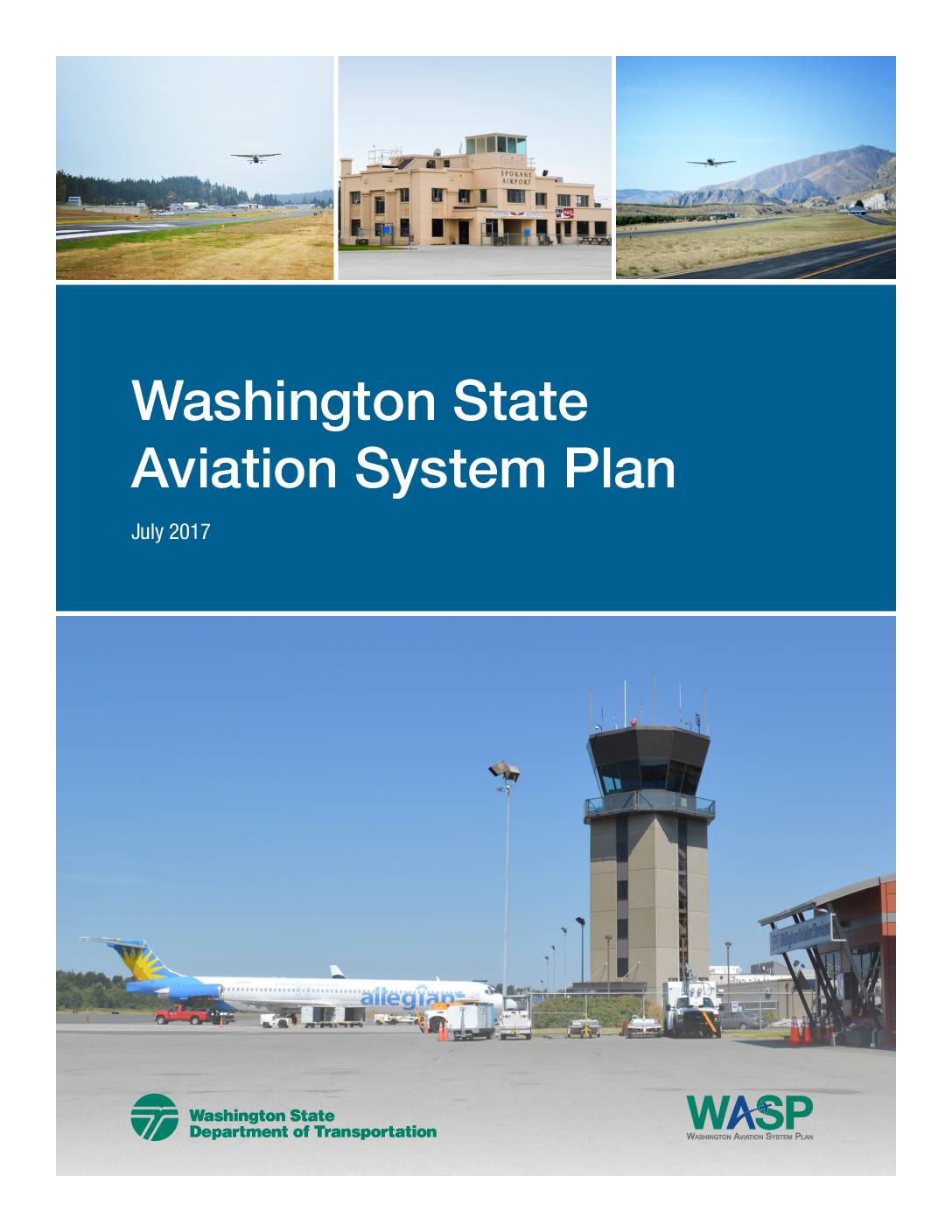
Washington State Aviation System Plan
The Washington State Aviation System Plan (WASP), published in July 2017 by the Washington State Department of Transportation (WSDOT), provides a comprehensive assessment of the state's airport system, covering infrastructure inventory, safety, economic development, and long-term planning goals. The plan examines runways, taxiways, landside facilities, and aviation services across both federally recognized and non-NPIAS airports throughout Washington State. Funded in part by a Federal Aviation Administration planning grant, it serves as a guiding framework for aviation investment and policy decisions statewide. -
 2017-07-01
Washington Aviation System Plan (WASP): Executive Summary
The Washington Aviation System Plan (WASP), completed in July 2017 by the Washington State Department of Transportation (WSDOT), is a statewide assessment of Washington's public-use airports covering both commercial and general aviation facilities. The plan evaluates how individual airports perform and interact as a system, identifies needed improvements, and develops policy recommendations to support communities, economic activity, and emergency services across the state. Funding was provided by the Federal Aviation Administration (FAA), and the plan builds on the earlier 2009 Long-term Air Transportation Study (LATS). -
 2016-07-20
Washington Aviation System Plan (WASP) Update
This July 2016 presentation by WSDOT's Aviation Division outlines an update to the Washington Aviation System Plan (WASP), covering the state's network of public-use airports. It reviews aviation system goals, airport classifications, and performance metrics across Washington State. The document does not specifically address Sea-Tac Airport noise policy. -
 2015-07-01
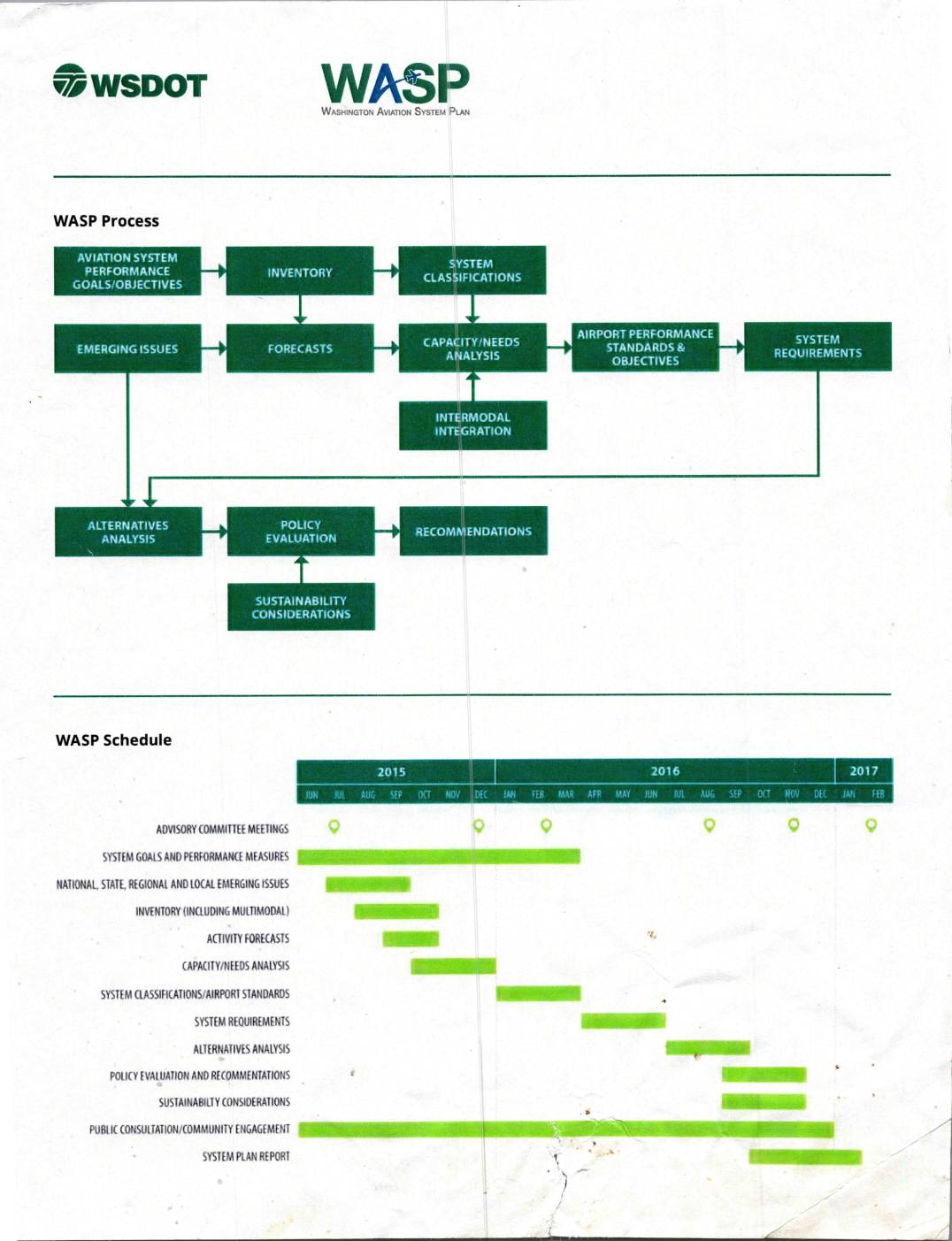
Washington Aviation System Plan Update: WASP Process and Schedule Flyer
The Washington State Department of Transportation (WSDOT) launched an update to the Washington Aviation System Plan (WASP) in July 2015, aimed at studying the performance of Washington's entire aviation system and identifying needed airport improvements. The plan involves analyzing aviation user requirements, airport capacity, and emerging issues such as unmanned aircraft systems, aviation fuels, and airport infrastructure funding challenges. A broad advisory committee representing airports, airlines, government agencies, and aviation associations was assembled to guide the process, which was scheduled for completion by early 2017.