• 1975-08-26

    HUD Response to Senator Jackson on FHA Mortgage Insurance in Noise Areas

    A August 26, 1975 letter from HUD's Assistant Secretary for Legislative Affairs, James A. Morrill, to U.S. Senator Henry M. Jackson of Washington responds to an inquiry about FHA mortgage insurance eligibility for homes in areas where local communities have established noise boundaries. The letter explains that HUD's basic policy, outlined in Circular 1390.2, is to avoid endorsing undesirable living environments, but that FHA does not automatically exclude existing housing in noise-affected areas from mortgage insurance. Individual applications may still be rejected if noise levels are particularly high and the property lacks sufficient soundproofing.
  • 1975-05-20

    Sea-Tac/Communities Plan briefing invitation and summary of key recommendations

    A 1975 letter from the Port of Seattle invites King County Council member Paul Barden to a briefing on the Sea-Tac/Communities Plan, a two-year, $640,000 study examining the relationship between Seattle-Tacoma International Airport and surrounding communities. The accompanying summary outlines key recommendations, including that the Port of Seattle assume primary responsibility for a comprehensive noise remedy program involving property acquisition, noise insulation, and avigation easements, while King County take the lead on land use changes and infrastructure improvements in affected areas. The plan also calls for both agencies to seek changes in federal and state legislation to expand funding and expand the scope of noise abatement programs.
  • 1974-09-23

    Letter from Superintendent of Public Instruction regarding FAA cleared zones school closure legislation

    Letter from Washington State Superintendent of Public Instruction Dr. Frank B. Brouillet to Mrs. Virginia Dana responding to her request for assistance in developing legislation to close public schools located in F.A.A. cleared zones. The superintendent suggests working directly through legislators and promises cooperation in seeking passage of such a proposal.
  • 1974-07-19

    Port of Seattle letter to FAA regarding school property acquisition

    In this July 19, 1974 letter, Donald G. Shay, Director of Aviation for the Port of Seattle, writes to the FAA's Planning Department to clarify the Port's intentions regarding land acquisition near Sea-Tac International Airport. He explains that negotiations with Highline Public Schools will result in the purchase of Maywood Elementary and Sunset Junior High schools, with educational buildings bought outright for extended clear zone land use, while playground and recreational areas will be handled separately and made available to the surrounding public. Shay emphasizes that recreational use is a high priority in the acquisition area and that any further development would undergo full citizen and government review.
  • 1974-07-01

    Letter to Arthur H. Yoshioka regarding SeaTac/Communities Plan public meetings

    In this July 1974 letter, George L. Buley of the FAA's Airports Planning Branch writes to Arthur H. Yoshioka of the Port of Seattle regarding the SeaTac/Communities Plan study. Buley recommends holding two or three public meetings in the study area to present the study's conclusions and recommendations to citizens before they are brought before elected officials of the Port and King County. He emphasizes the importance of well-publicized meetings that allow citizens adequate opportunity to ask questions, and urges that the topic be discussed at the upcoming July PAC and TAC meetings.
  • 1974-04-03

    FAA Response Letter to Virginia Dana Regarding Sunset Junior High School Closure

    A April 3, 1974 letter from FAA Northwest Region Chief of Airports Planning George L. Buley responds to Seattle resident Mrs. Virginia Dana regarding the possible closure of Sunset Junior High School. The letter acknowledges that the school falls within an area the Port of Seattle proposed to acquire under the FAA's Airport Development Aid Program, and confirms the FAA was actively working with the Port on an environmental impact statement covering the proposed acquisition. Both Sunset Junior High School and Maywood Elementary School were being considered in that environmental review process.
  • 1974-01-17

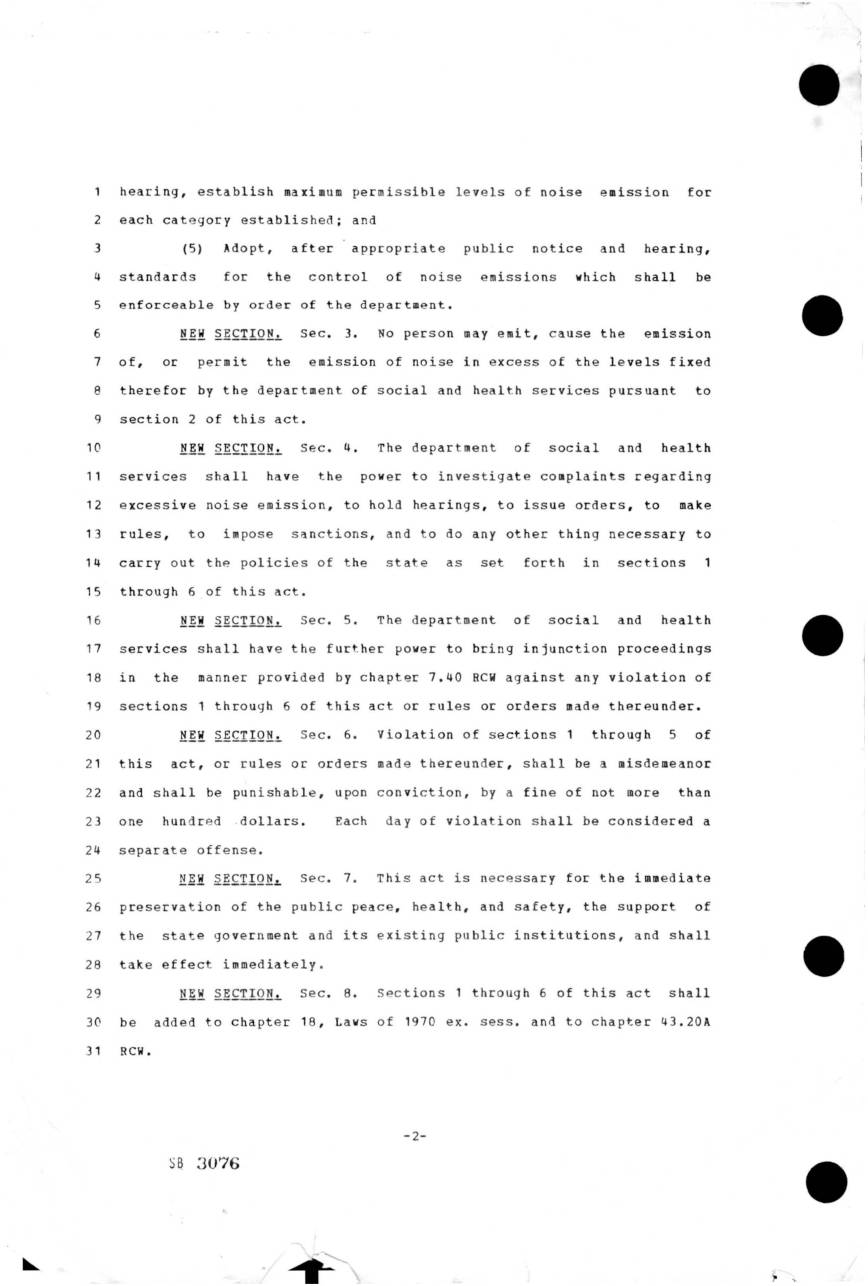
    Senate Bill No. 3076: Relating to noise abatement and control

    Washington State Senate Bill 3076, introduced in January 1974, aimed to combat noise pollution by granting the Department of Social and Health Services authority to establish statewide noise emission standards, including regulations covering motor vehicles and aircraft. The bill required the department to set maximum permissible noise levels, monitor emissions, and enforce compliance through hearings, orders, and sanctions. Violations were classified as misdemeanors, punishable by fines of up to $100 per day, with each day of violation counted as a separate offense.
  • 1973-02-19

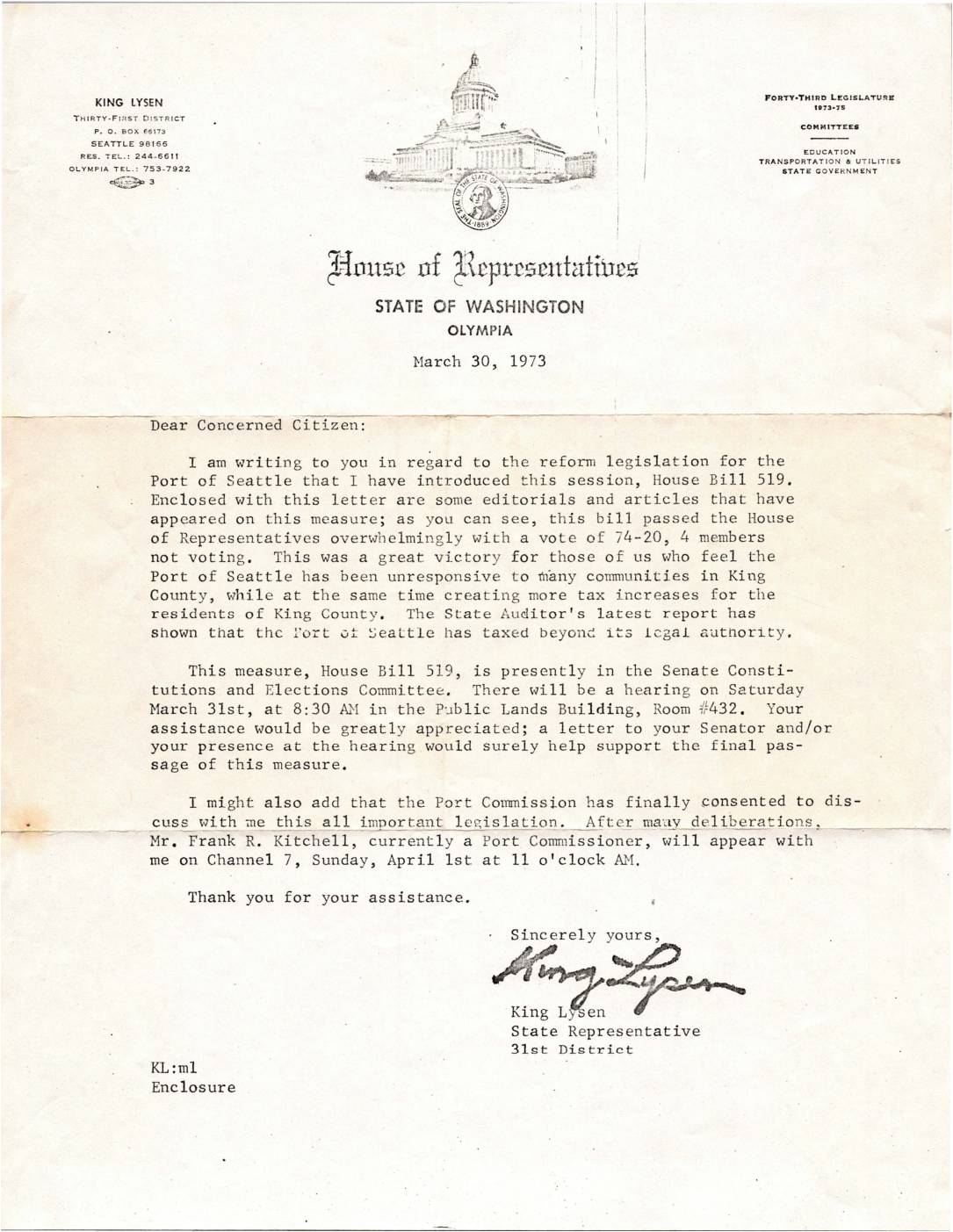
    House Bill 519 correspondence regarding Port Of Seattle reform legislation

    In early 1973, Washington State Representative King Lysen introduced House Bill 519 to reform the Port of Seattle's commission structure, partly in response to jet noise from Seattle-Tacoma Airport exceeding 100 decibels in some Highline school classrooms. The bill proposed expanding the Port Commission from five to nine members elected by district rather than county-wide, aiming to give affected communities like Highline more direct representation. The bill passed the House 74-20 but stalled in the Senate Constitution and Elections Committee, where Chairman Senator Gary Grant pledged to continue pushing for its passage.
  • 1972-09-01

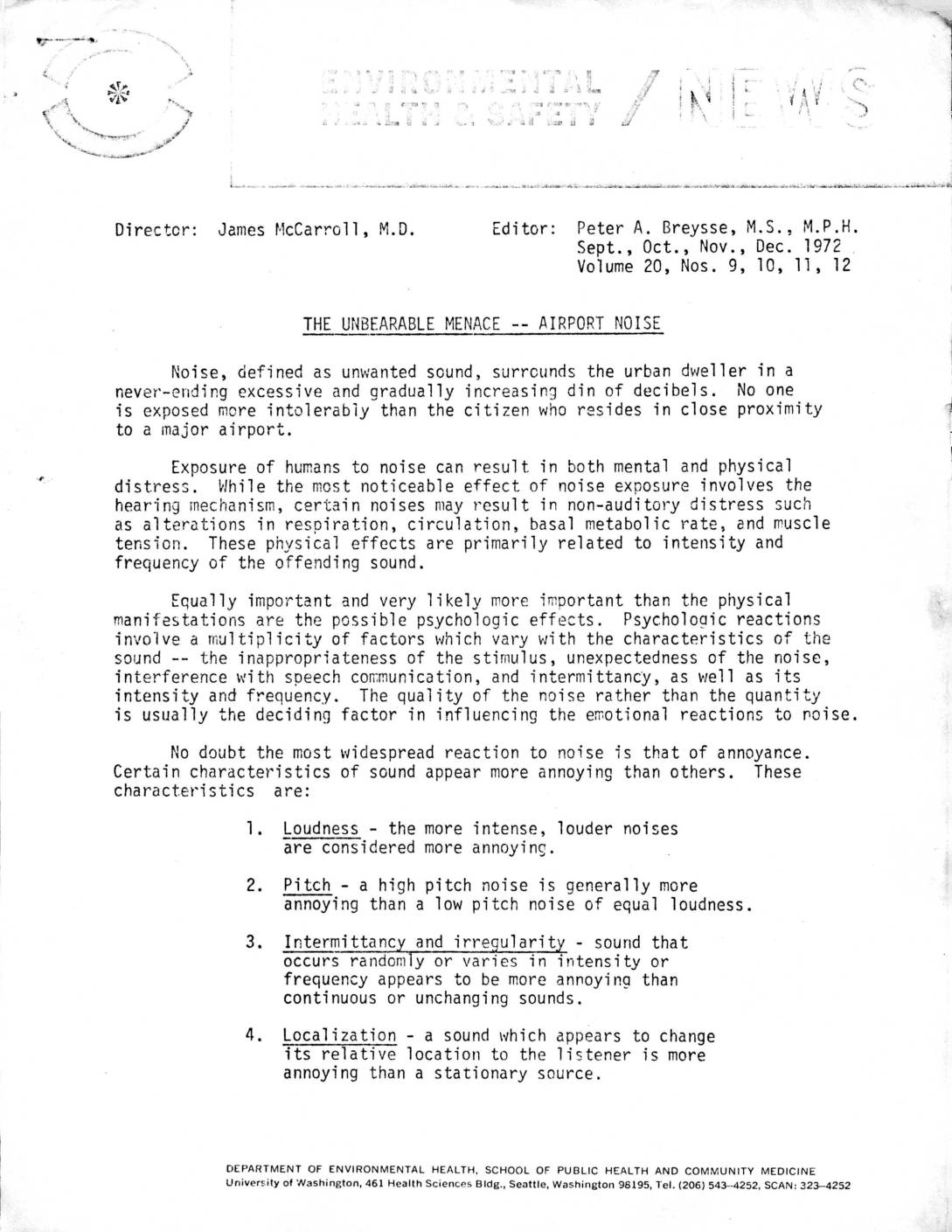
    The Unbearable Menace — Airport Noise

    A 1972 University of Washington environmental health report examines the serious health impacts of aircraft noise on residents living near Seattle-Tacoma Airport, including sleep disturbance, psychological effects, and interference with speech in schools. Noise measurements taken at four locations near the airport recorded up to 95 dBA, with dozens of flyovers exceeding 75 dBA even during nighttime sleeping hours, levels researchers considered potentially hazardous to mental and physical health. The report also highlights special risks for vulnerable groups such as young children, the elderly, the sick, and night-shift workers.