Category : Correspondence(303)
-
 2023-08-27
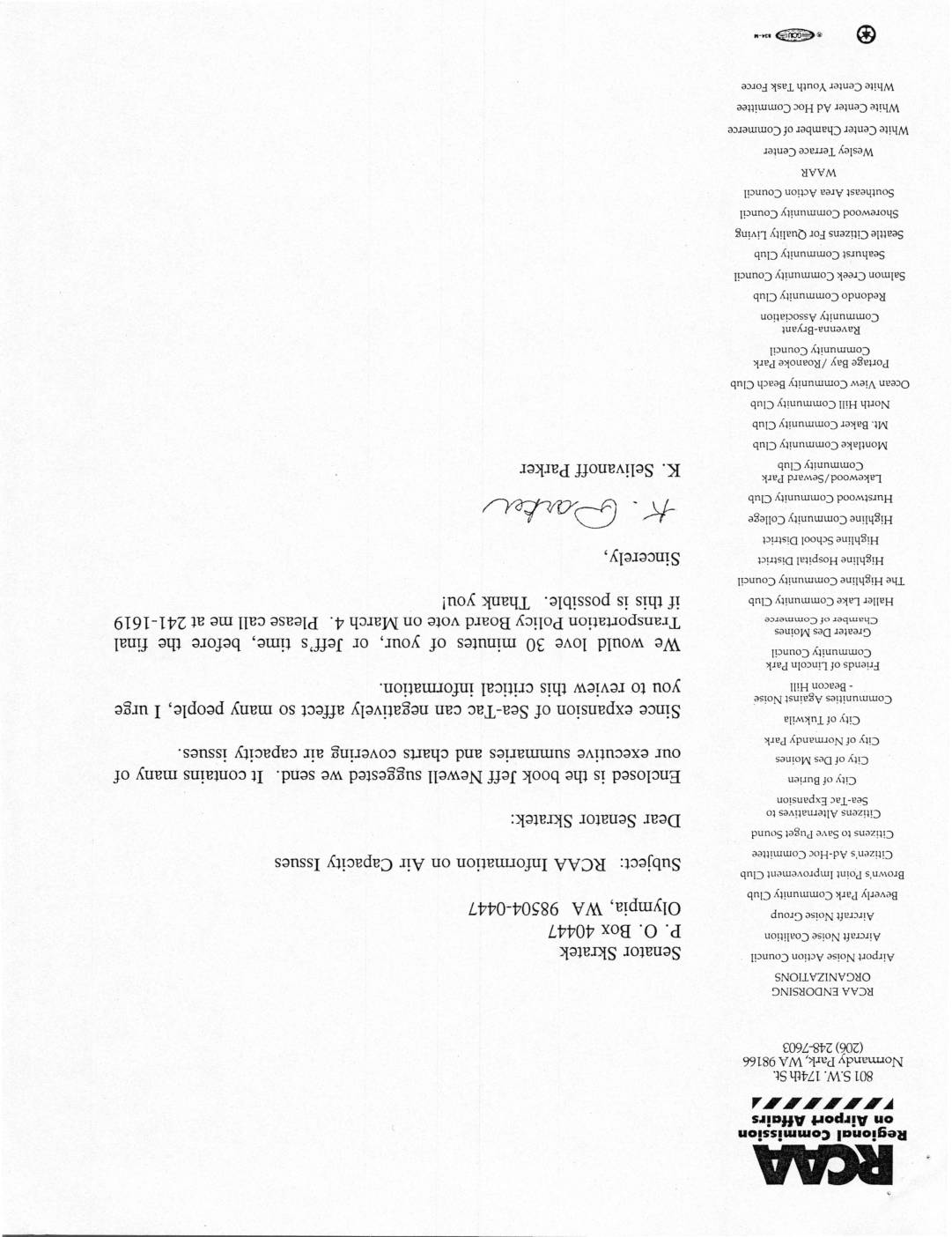
RCAA information on air capacity issues
A letter from the Regional Commission on Airport Affairs (RCAA) to Senator Skratek urges review of air capacity issues related to Sea-Tac Airport expansion, noting that the expansion could negatively affect many people. The letter encloses a book suggested by Jeff Newell containing executive summaries and charts covering air capacity issues, and requests 30 minutes of the Senator's time before the final Transportation Policy Board vote on March 4. The letter is endorsed by a wide range of community organizations, cities, and advocacy groups opposed to or concerned about Sea-Tac expansion. -
 2023-08-15
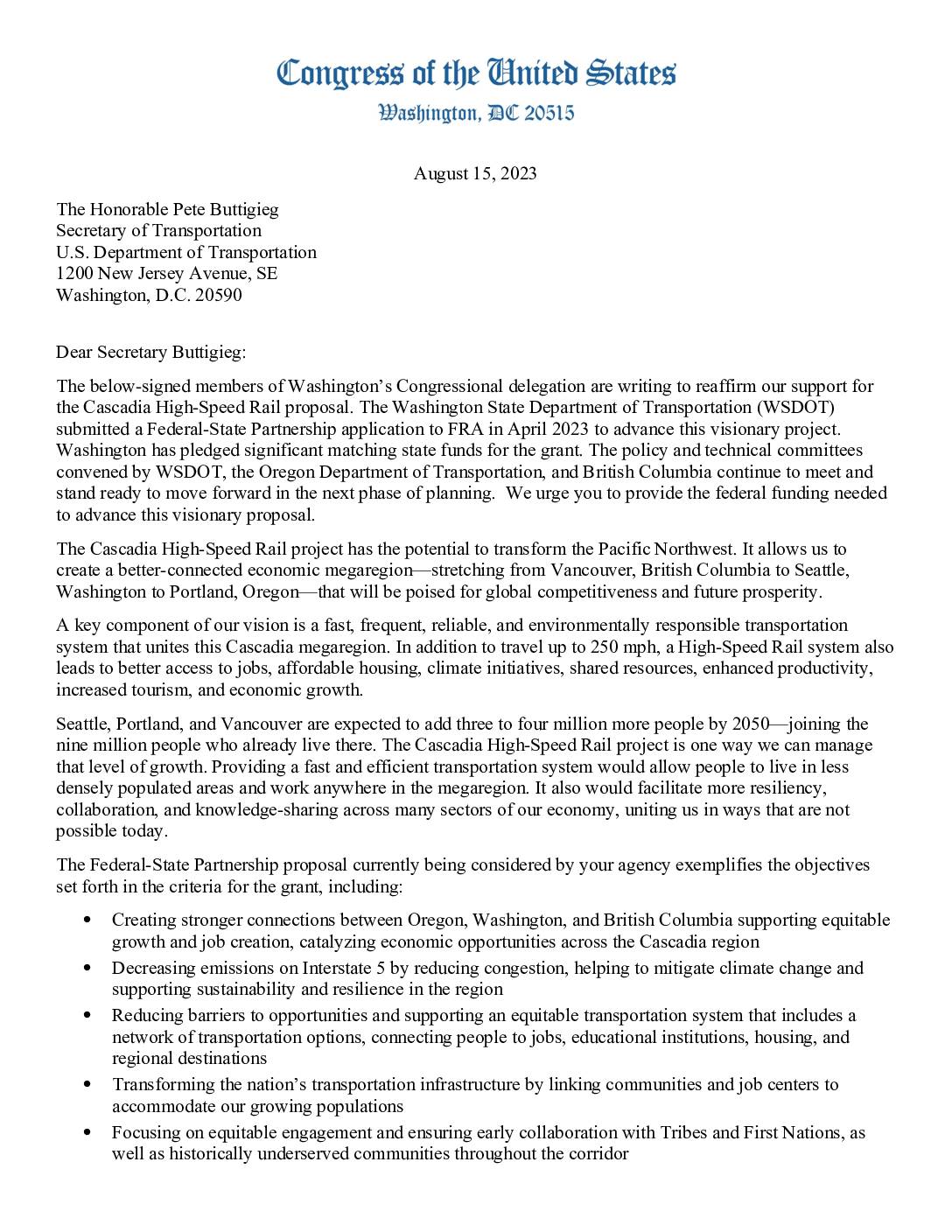
Washington State Congressional Delegation letter in support of Cascadia High Speed Rail proposal
A letter dated August 15, 2023, on U.S. Congress letterhead addressed to Secretary of Transportation Pete Buttigieg, in which members of Washington's Congressional delegation reaffirm support for the Cascadia High-Speed Rail proposal and urge federal funding for the project connecting Vancouver BC, Seattle, and Portland. -
 2023-05-16
Veto Letter for Engrossed Substitute House Bill 1791
Washington Governor Jay Inslee partially vetoed Engrossed Substitute House Bill 1791 on May 16, 2023, striking four sections while approving the rest of the bill, which creates a new State Commercial Aviation Work Group to study the need for additional airport capacity in Washington. The governor vetoed the section requiring simultaneous consideration of new airport sites alongside existing airport expansion, insisting the state should first fully explore increasing capacity at existing airports—excluding Sea-Tac—before pursuing a new airport. The vetoed sections also included a budget redirection of already-spent funds, a retroactive repeal of workgroup authority, and an emergency clause deemed unnecessary given the existing commission's June 2023 reporting timeline. -
2023-05-16
Veto Letter for Engrossed Substitute House Bill 1791
Washington Governor Jay Inslee partially vetoed Engrossed Substitute House Bill 1791 on May 16, 2023, striking four sections while approving the rest of the bill, which creates a new State Commercial Aviation Work Group to study the need for additional airport capacity in Washington. The governor vetoed the section requiring simultaneous consideration of new airport sites alongside existing airport expansion, insisting the state should first fully explore increasing capacity at existing airports—excluding Sea-Tac—before pursuing a new airport. The vetoed sections also included a budget redirection of already-spent funds, a retroactive repeal of workgroup authority, and an emergency clause deemed unnecessary given the existing commission's June 2023 reporting timeline. -
 2023-05-07
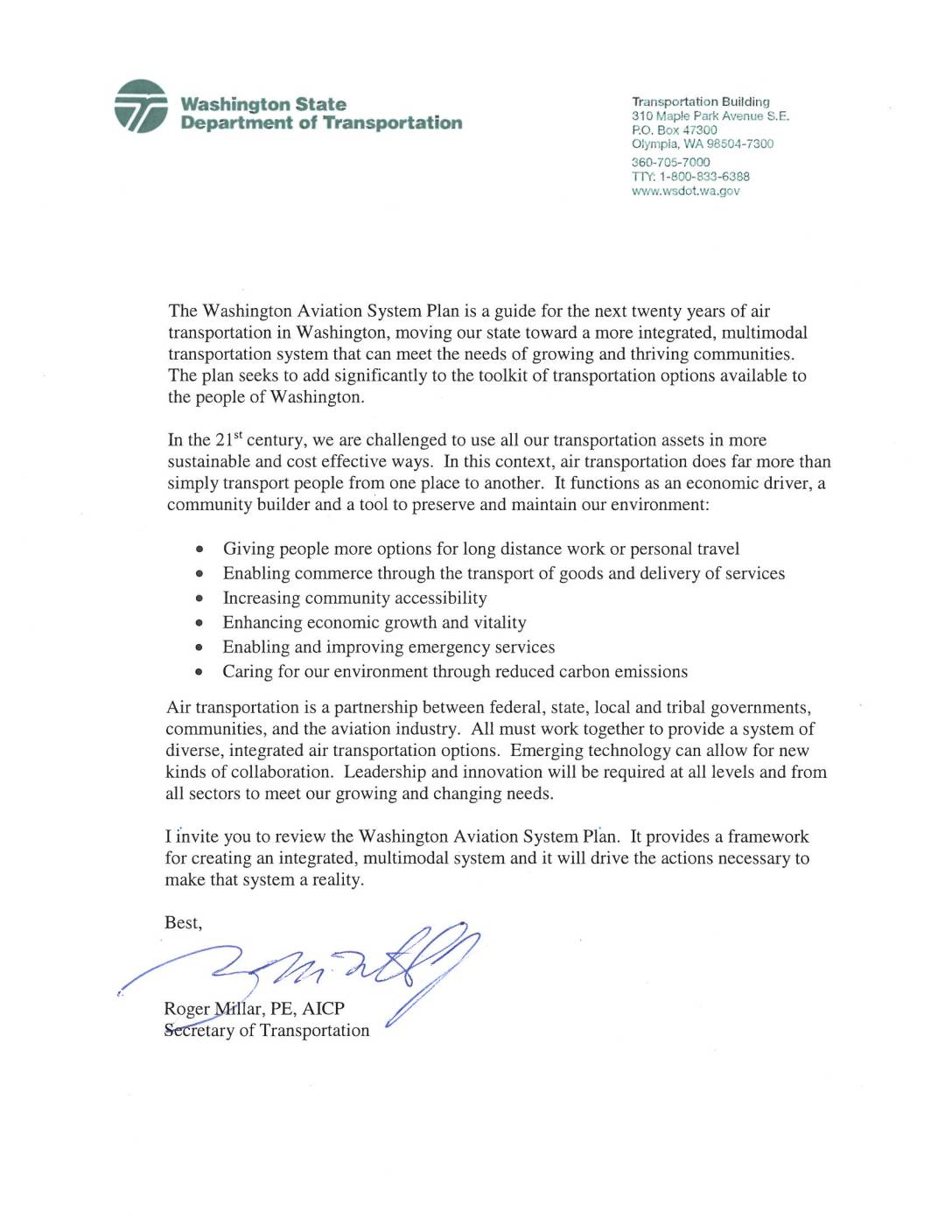
Washington Aviation System Plan Endorsement Letter
The Washington Aviation System Plan is a 20-year statewide guide aimed at building a more integrated, multimodal air transportation network across Washington State. Signed by Secretary of Transportation Roger Millar, the plan highlights aviation's role as an economic driver, community connector, and environmental tool, citing benefits such as expanded travel options, improved emergency services, and reduced carbon emissions. It calls for collaboration among federal, state, local, and tribal governments, communities, and the aviation industry to meet the state's growing transportation needs. -
2023-04-10
Port Package Update Letter – Spring 2023
Greetings, As always, this is behind schedule. However, in addition to the the usual procrastination, things change all the time. Sorry, but for newcomers we always start with some background. If you’ve heard all this, just skip down… Your original Port Package was almost certainly financed through FAA funding called the Airport Improvement Program (AIP). -
 2023-04-04
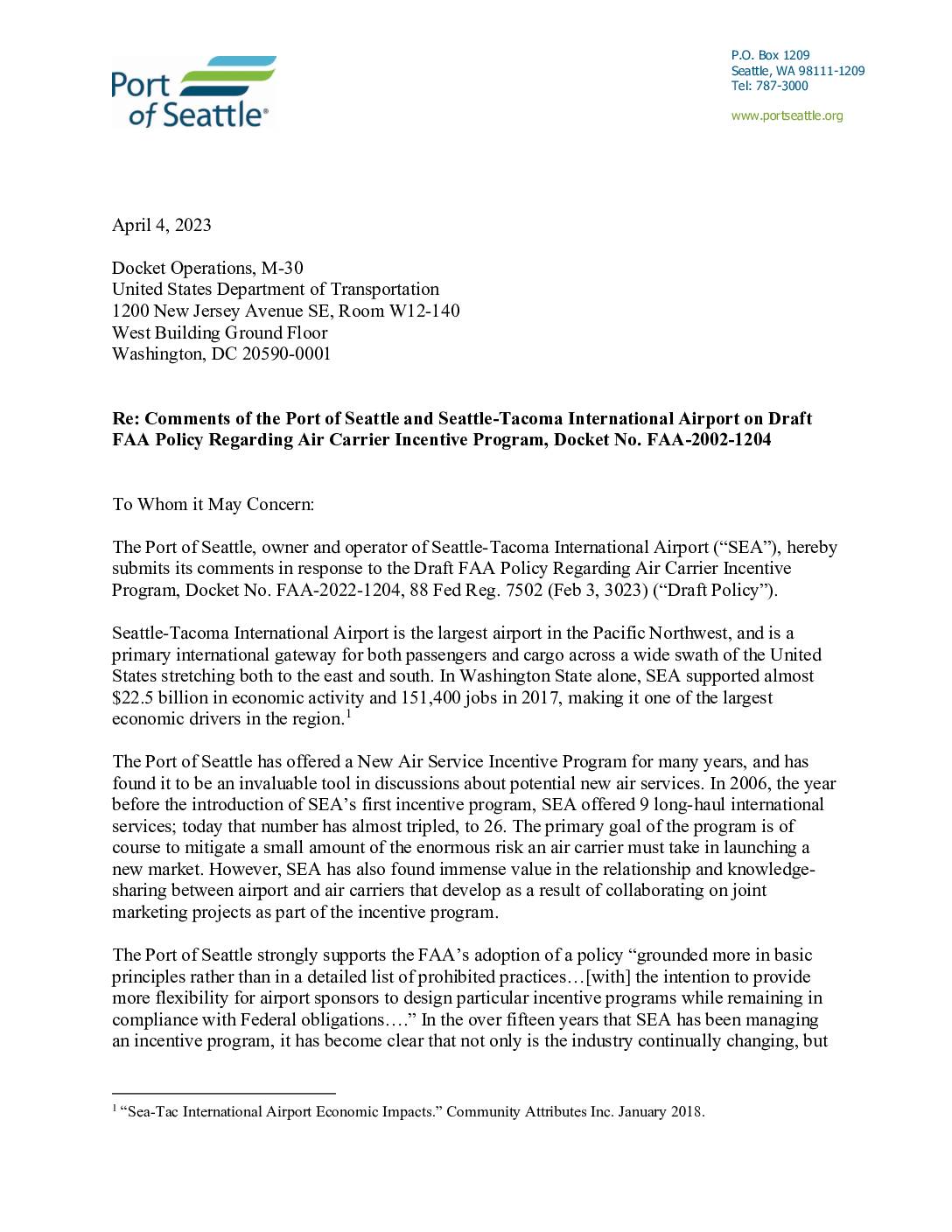
Comments of the Port Of Seattle and Seattle-Tacoma International Airport on draft FAA policy regarding air carrier incentive program, Docket No. FAA-2002-1204
The Port of Seattle submitted comments to the FAA in April 2023 regarding proposed rules for airport air carrier incentive programs, arguing that airports should have broad flexibility to design their own incentive programs rather than follow a rigid list of prohibited practices. Seattle-Tacoma International Airport (SEA), which has run a New Air Service Incentive Program for over 15 years, raised concerns about a blanket ban on transferring funds to carriers, arguing that reimbursing carriers for pre-approved marketing activities should not be considered a prohibited subsidy. The Port also sought clarification on eligibility rules for competitive services and the 30-day public notice requirement for incentive agreements. -
 2023-03-29
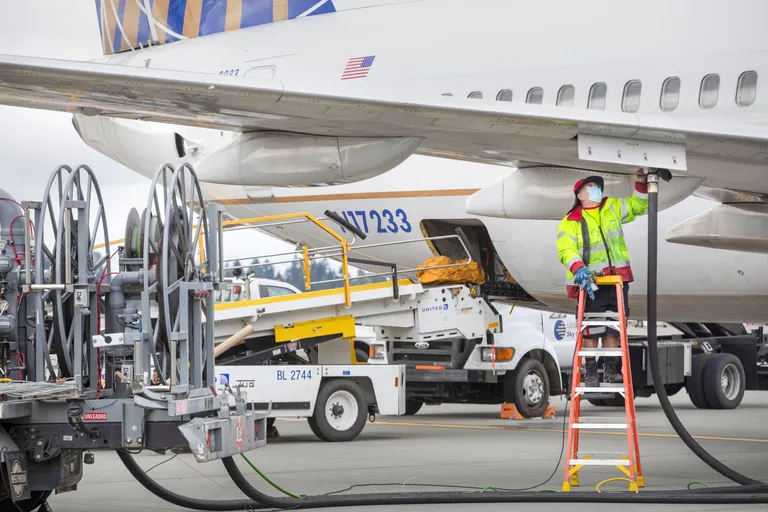
No to SAF, Yes to local funding
A letter to the Washington delegation of State and Federal electeds around Sea-Tac Airport concerning aviation biofuel commonly referred to as Sustainable Aviation Fuel or SAF. Senator Cantwell, Senator Murray, Representative Smith, Representative Orwall, Representative Gregerson, Senator Keiser, March 29, 2023 On behalf of SeaTacNoise.Info, I write you today to urge you to suspend (or at -
2023-03-22
Letter to Tina Orwall on 2023 Legislative Agenda…
Rep. Orwall is a member of the House, 33rd Legislative District in Des Moines. Thanks again for your time. I understand well that yer up to yer neck in now, but I’m hoping these are issues you will consider taking up.All my thinking comes from my group’s (SeaTacNoise.Info) research into the history of Sea-Tac Airport. -
 2023-03-15
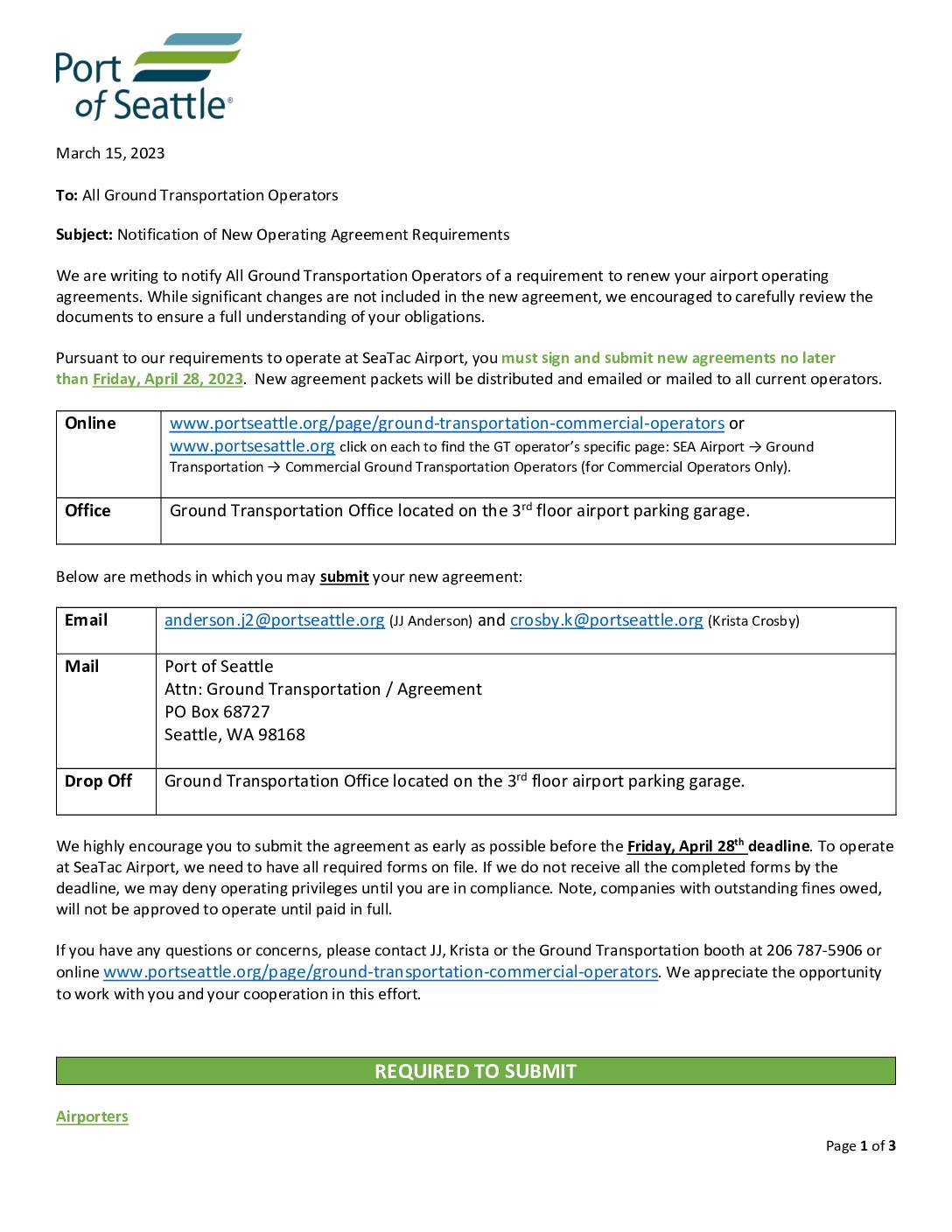
Notification of new operating agreement requirements
The Port of Seattle issued a March 2023 notice requiring all ground transportation operators at Seattle-Tacoma International Airport to sign and submit renewed operating agreements by April 28, 2023. Operators can submit agreements by email, mail, or in person at the Ground Transportation Office on the third floor of the airport parking garage. Required documents vary by operator type—such as airporters, charter buses, crew vans, and limousines—but generally include a signed agreement, proof of insurance, vehicle registrations, and a company information form.