TagAviation Safety Noise Abatement Act 1978(5)
-
 2024-01-09
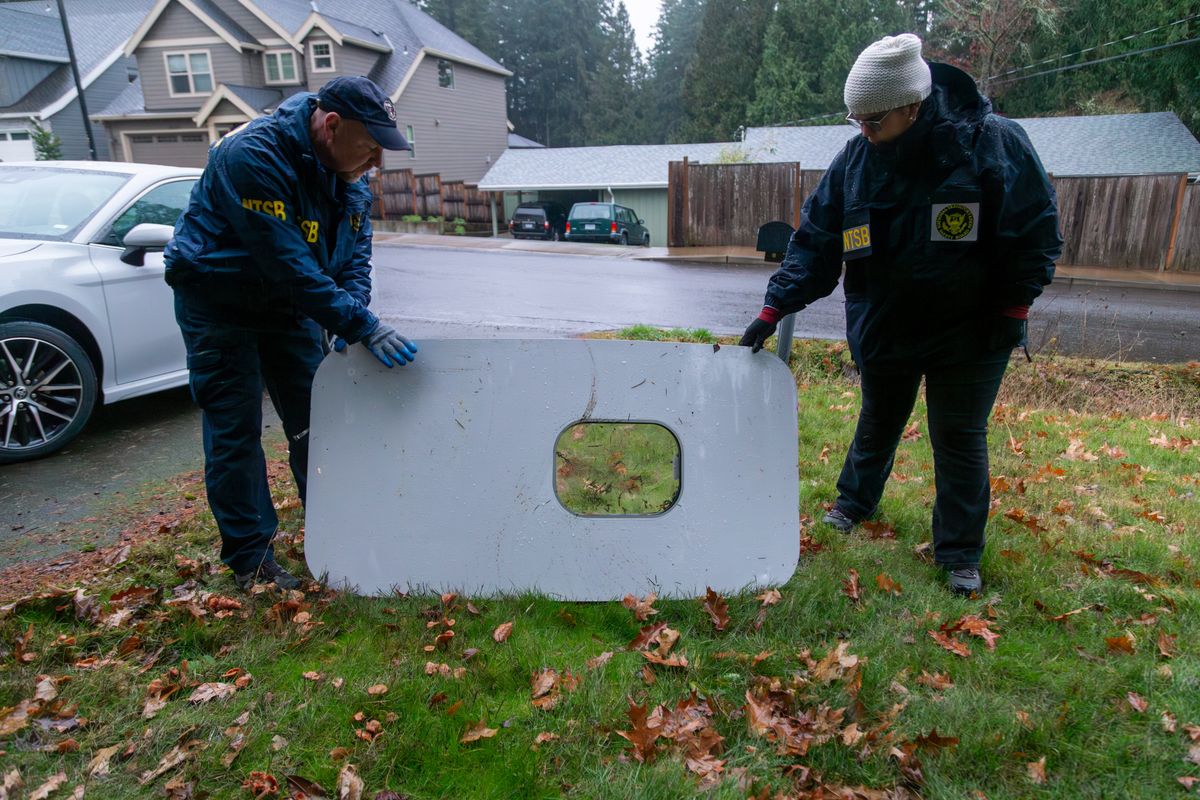
NTSB Investigators Examining Aircraft Debris
Two NTSB (National Transportation Safety Board) investigators, wearing agency-marked jackets, examine and recover a large aircraft door plug panel found on a residential lawn. The panel, which has a window cutout, is consistent with the door plug that detached from Alaska Airlines Flight 1282 (Boeing 737 MAX 9) in January 2024, with debris recovered in the Portland, Oregon area. -
 2023-08-25
New York Times – Aviation Close Calls
New York Times investigative article, "Airline Close Calls Happen Far More Often Than Previously Known" (Aug 2023) — reporting on the rise in near-miss air traffic incidents nationally, including sections on air traffic control staffing and specific close-call incidents. -
 2023-07-28
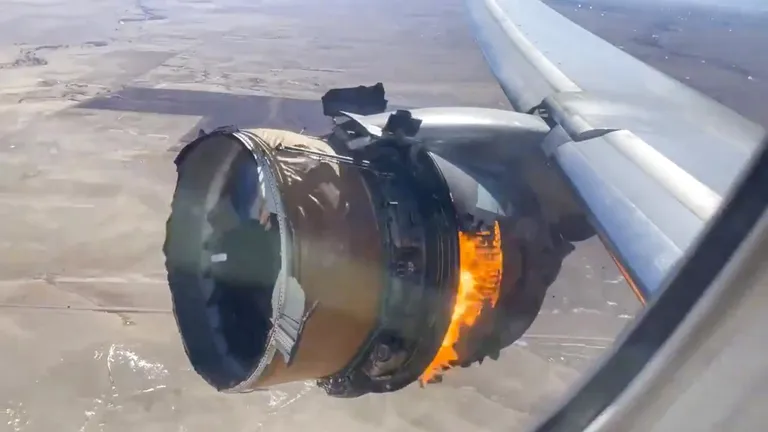
Aircraft Engine Failure with Fire During Flight
A Boeing 777 engine (Pratt & Whitney PW4000) is shown on fire and with its cowling torn away, photographed from a passenger window seat. This image is widely recognized as being from United Airlines Flight 328, which suffered an engine failure shortly after takeoff from Denver International Airport on February 20, 2021. -
 2023-04-24
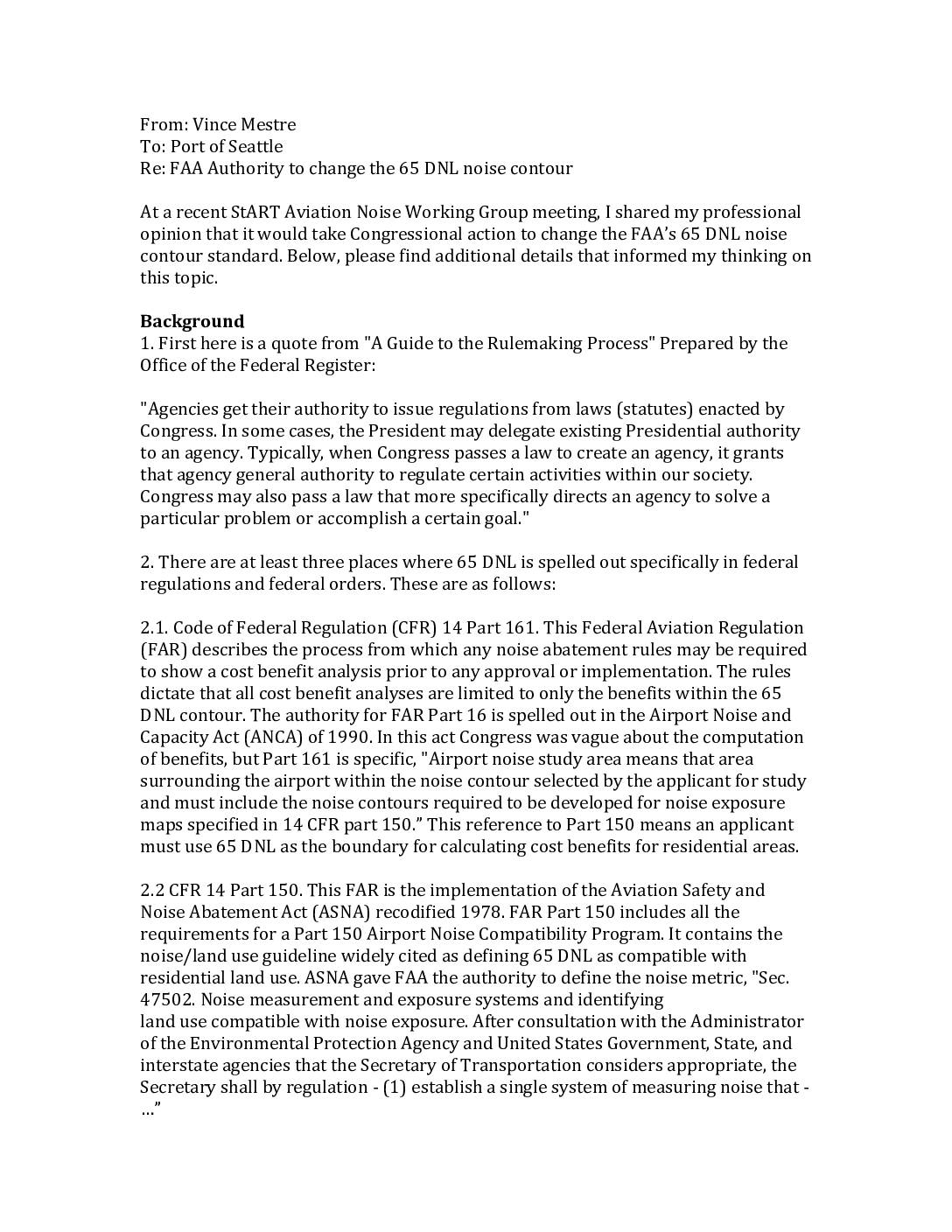
FAA authority to change the 65 DNL noise contour
Aviation noise consultant Vince Mestre explains to the Port of Seattle why changing the FAA's 65 DNL noise contour standard — the threshold used to determine acceptable aircraft noise near residential areas — would likely require an act of Congress rather than a simple regulatory update. The 65 DNL standard is embedded in at least three federal regulations and orders (CFR 14 Parts 150 and 161, and FAA Order 1050.1F), all of which trace their authority back to enabling legislation such as the Aviation Safety and Noise Abatement Act (ASNA) of 1978 and the Airport Noise and Capacity Act (ANCA) of 1990. Because the FAA's rulemaking authority is granted and bounded by those Congressional statutes, modifying ASNA would most likely be required before the FAA could formally lower or otherwise change the noise compatibility standard. -
 2000-02-25
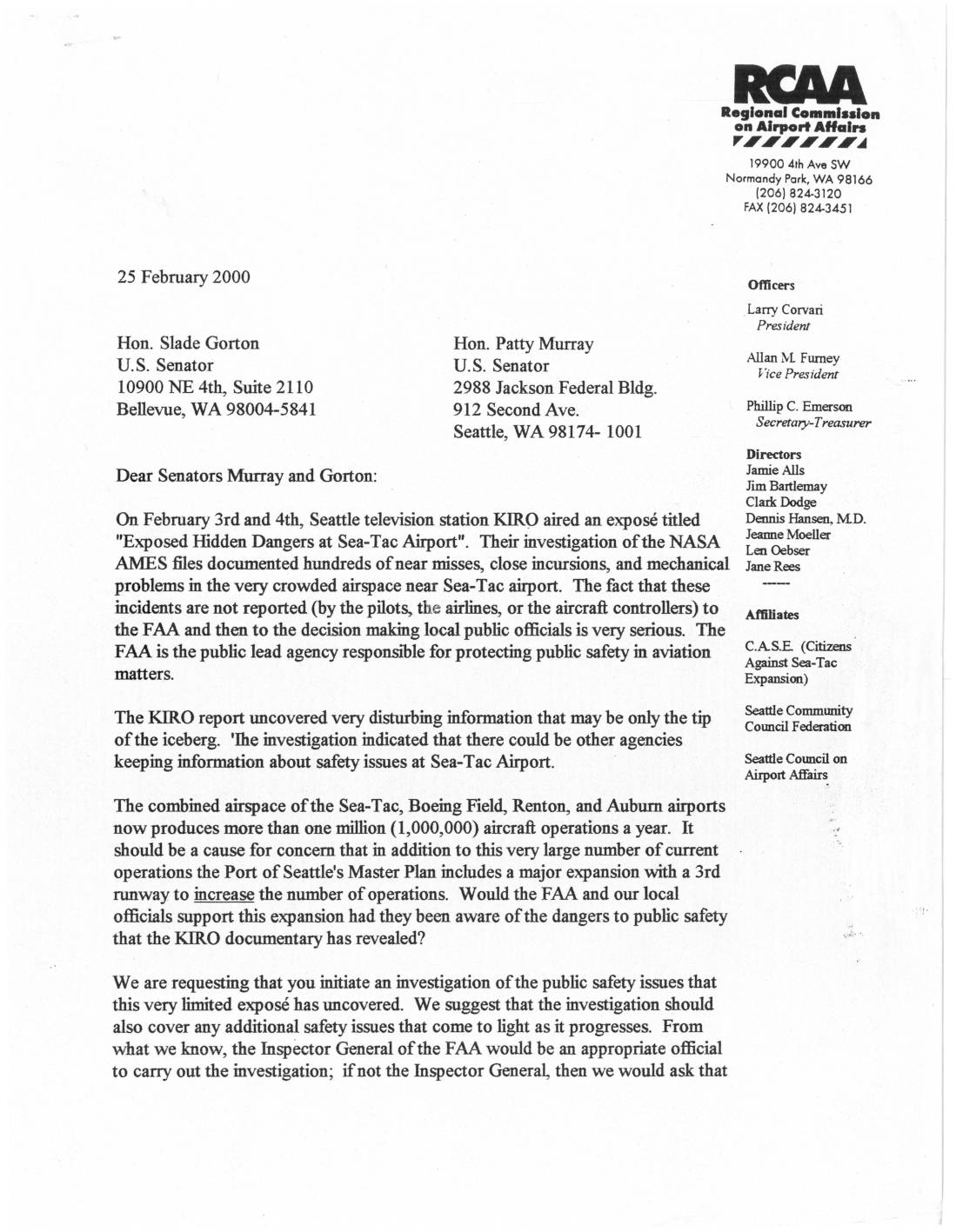
Letter to U.S. Senators Gorton and Murray Regarding Sea-Tac Airport Safety Issues
In February 2000, the Regional Commission on Airport Affairs (RCAA) wrote to U.S. Senators Patty Murray and Slade Gorton urging an investigation into aviation safety concerns at Sea-Tac Airport, following a KIRO-TV news report that revealed hundreds of unreported near-misses, runway incursions, and mechanical problems documented in NASA AMES files. The RCAA argued that these hidden dangers raised serious questions about the Port of Seattle's plans to expand the airport with a third runway. The letter also requested a moratorium on expansion-related construction permits until a full safety investigation — ideally led by the FAA Inspector General — could be completed.