TagElena Austin(11)
-
 2025-08-11
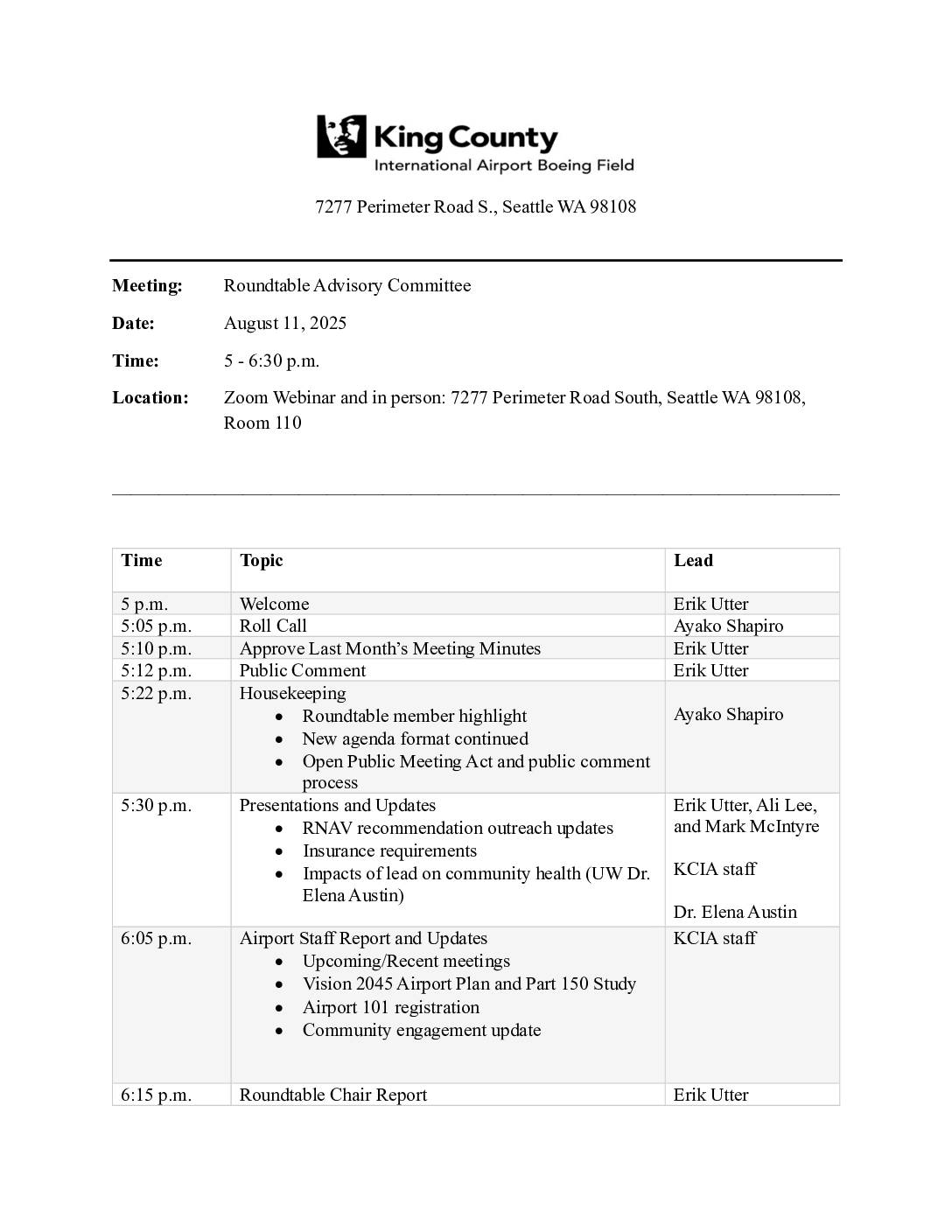
KCIA Roundtable meeting packet August 11, 2025
Agenda for the August 11, 2025 King County International Airport Boeing Field Roundtable Advisory Committee meeting, including topics such as RNAV recommendation outreach, insurance requirements, lead impacts on community health, and Vision 2045 Airport Plan updates. Also includes minutes from the July 14, 2025 meeting covering approval of June minutes, public comment on meeting facilitation -
 2025-08-11
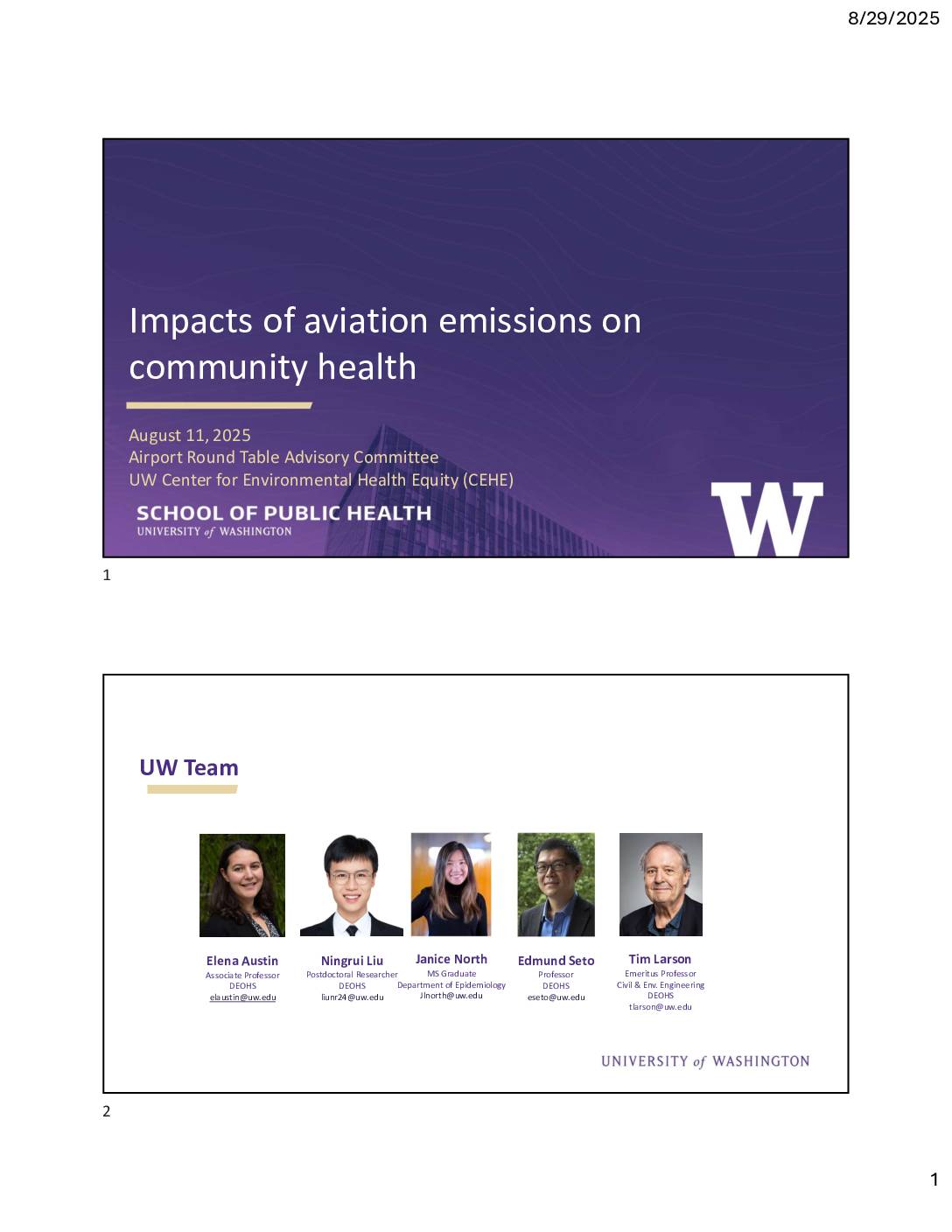
Impacts of Aviation Emissions on Community Health
Researchers from the University of Washington presented findings to King County's Airport Round Table Advisory Committee showing that aviation emissions pose significant public health risks to nearby communities. Airports account for 70% of airborne lead emissions in King County, primarily from piston-engine aircraft burning leaded aviation gasoline, and multiple studies link living close to such airports with elevated blood lead levels in children. The presentation also highlighted broader health harms from aviation pollutants—including ultrafine particles and nitrogen oxides—affecting neurological, cardiovascular, and respiratory health. -
 2024-10-24
Assessing exposures to source-specific air pollution through a multi-pollutant mobile monitoring campaign in Seattle, WA
This presentation from the 2024 International Society of Exposure Science annual meeting describes a mobile air quality monitoring study conducted in Seattle, Washington, aimed at measuring exposure to pollutants from specific pollution sources. Researchers from the University of Washington used a multi-pollutant mobile monitoring campaign to assess how residents are exposed to various types of air pollution across different locations in the city. The study covers methods, results, and conclusions related to source-specific air pollution exposure assessment. -
ANES 2023 Program Information
Adapting for Tomorrow, Today While climate change is an urgent challenge for every sector, forcing businesses and people to rethink their actions, the airline industry and affected communities are also facing even deeper challenges in attempting to alleviate continued noise, health and climate change impacts. This year’s sessions will take a deep dive into how aviation noise and emissions assessments -
 2022-08-08
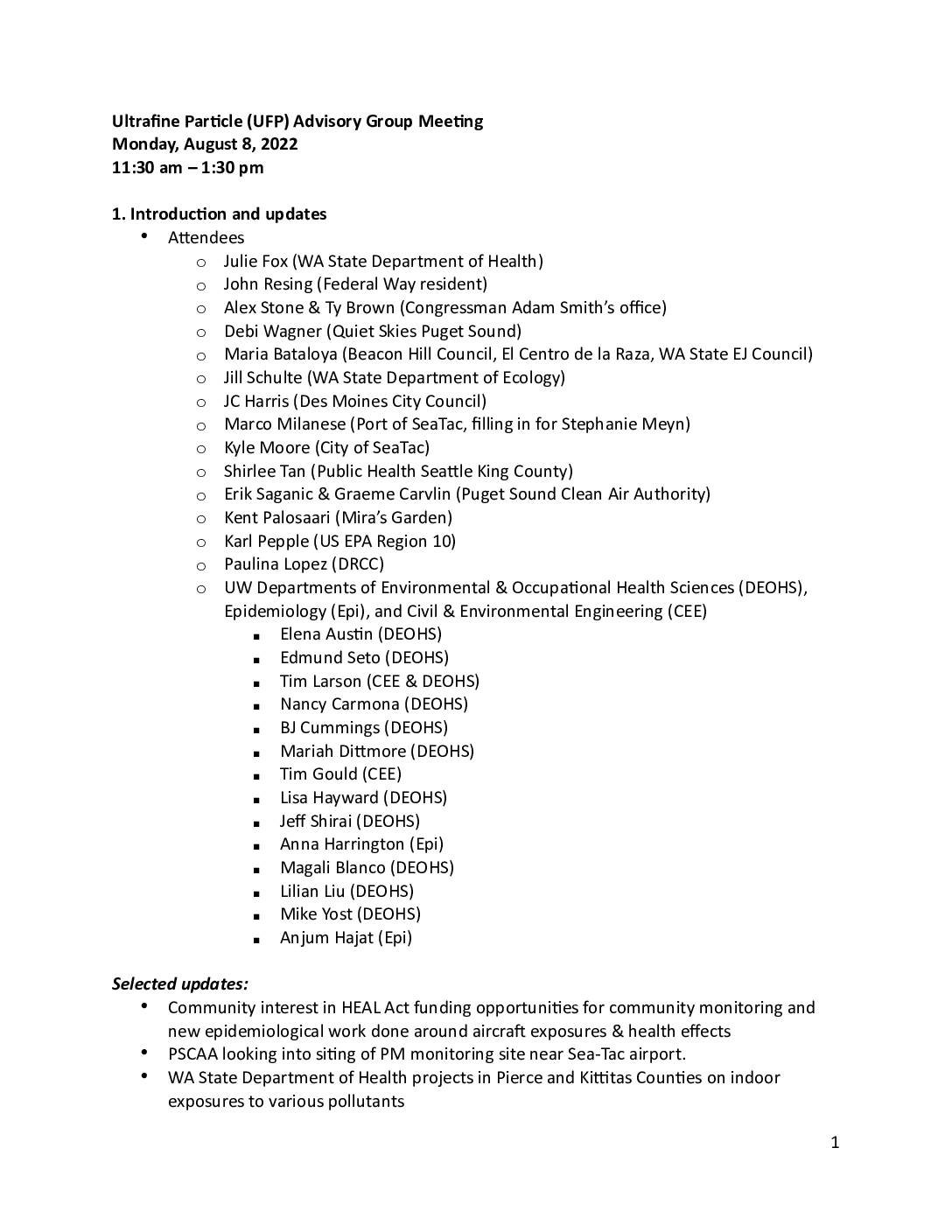
UFP Advisory Group Meeting Minutes: August 8, 2022
A University of Washington research team presented findings to a community advisory group showing that HEPA air purifiers in classrooms near Sea-Tac Airport reduced ultrafine particle (UFP) levels from 50% down to just 10% of outdoor concentrations. The meeting, held August 8, 2022, also covered a small pilot health study suggesting short-term cardiovascular and respiratory differences in people exposed to aircraft UFPs while walking under flight paths. Participants from government agencies, community organizations, and public health departments discussed next steps including expanded outdoor monitoring, wildfire response planning, and potential new funding through the HEAL Act. -
 2022-08-01
Urban ultrafine – advisory group meeting, August 2022
A University of Washington research team held an advisory group meeting in August 2022 to discuss ultrafine particle (UFP) pollution in urban areas near airports. The meeting covered topics including indoor air quality in schools affected by aircraft emissions, short-term health effects of UFPs, and plans for mobile air quality monitoring. The multidisciplinary team includes environmental health scientists, researchers, and public health experts examining how aviation-related pollution impacts surrounding communities. -
 2021-05-01
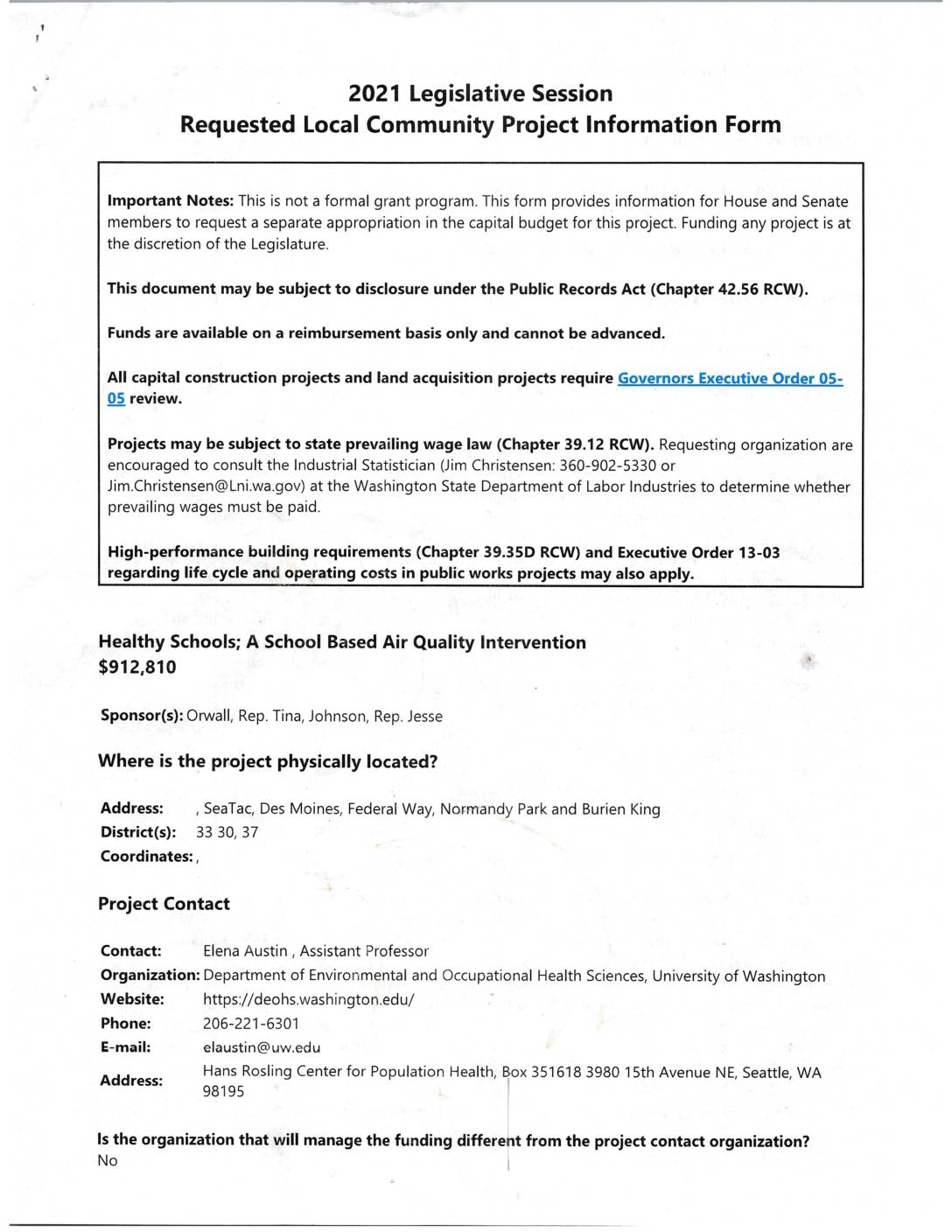
Healthy schools; A school based air quality intervention
A 2021 Washington State legislative funding request of $912,810, sponsored by Representatives Tina Orwall and Jesse Johnson, seeks to deploy HEPA portable air cleaners in 20 schools across SeaTac, Des Moines, Federal Way, Normandy Park, and Burien to reduce students' exposure to outdoor air pollution from traffic and wildfire smoke. The University of Washington's Department of Environmental and Occupational Health Sciences would lead the project, measuring indoor air quality improvements and student performance outcomes. The initiative builds on an ongoing 2021 pilot study monitoring air quality in five schools within the Highline and Federal Way School Districts. -
Monitoring air quality in schools
January 27, 2021 | Deirdre Lockwood Does ultrafine air pollution infiltrate schools near Sea-Tac Airport? DEOHS researchers partner with cities in South King County to find out. DEOHS Assistant Professor Elena Austin is leading a project to track air quality in public schools near Sea-Tac Airport. Photo: Mark Stone. As students in King County public -
 2021-01-18
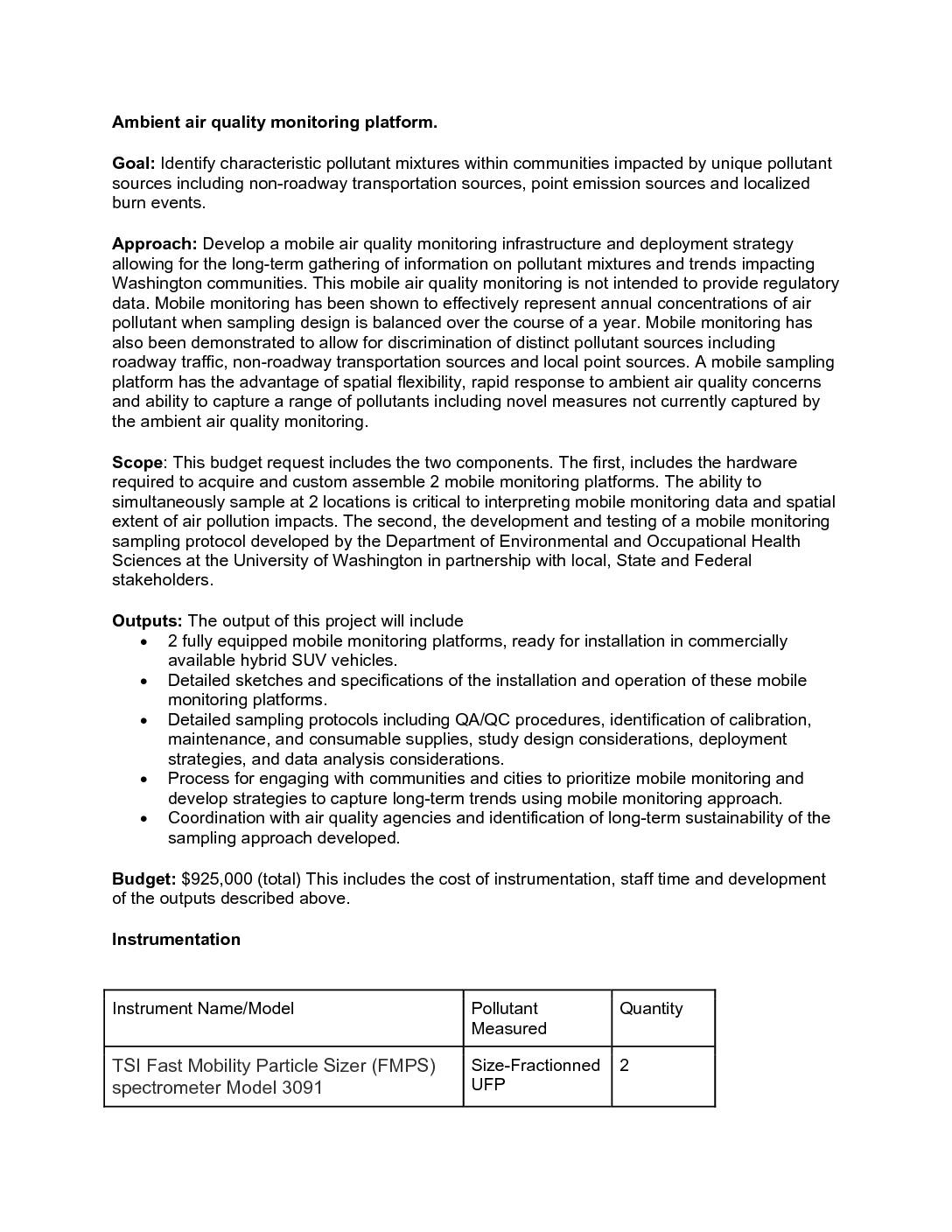
Ambient air quality monitoring platform
The University of Washington's Department of Environmental and Occupational Health Sciences is developing two mobile air quality monitoring platforms to identify pollutant mixtures in Washington communities affected by sources such as non-roadway transportation, industrial emissions, and burn events. The $925,000 project will equip hybrid SUV vehicles with instruments measuring ultrafine particles, black carbon, nitrogen dioxide, carbon monoxide, and other pollutants, enabling flexible and simultaneous monitoring at multiple locations. The project will also produce standardized sampling protocols and community engagement strategies to support long-term air quality trend analysis. -
 2020-12-05
The relationship between flight traffic, ultrafine particles and noise from the Seattle Aircraft Air and Noise Study
Researchers from the University of Washington School of Public Health examined how aircraft flight traffic at Seattle-Tacoma International Airport relates to ultrafine particle pollution and noise levels in surrounding communities. The study highlights that neighborhoods such as Beacon Hill and other South King County areas already rank among the most environmentally burdened in Washington State, facing cumulative hazards including both air and noise pollution from aircraft. The findings are intended to inform policy discussions about the health impacts of airport operations on nearby, often disadvantaged, communities.