TagAirport Community Ecology Fund(9)
-
The Grant Explainer
The current Port of Seattle grant programs began in 2016 with a proposal by Commissioner John Creighton–responding to the uproar over the Flight Corridor Safety Program. As the name implies, the Airport Community Ecology (ACE) Fund (2016–2020) was meant as an environmental grants program. In late 2018 the Port created a separate, much broader South -
 2025-09-16
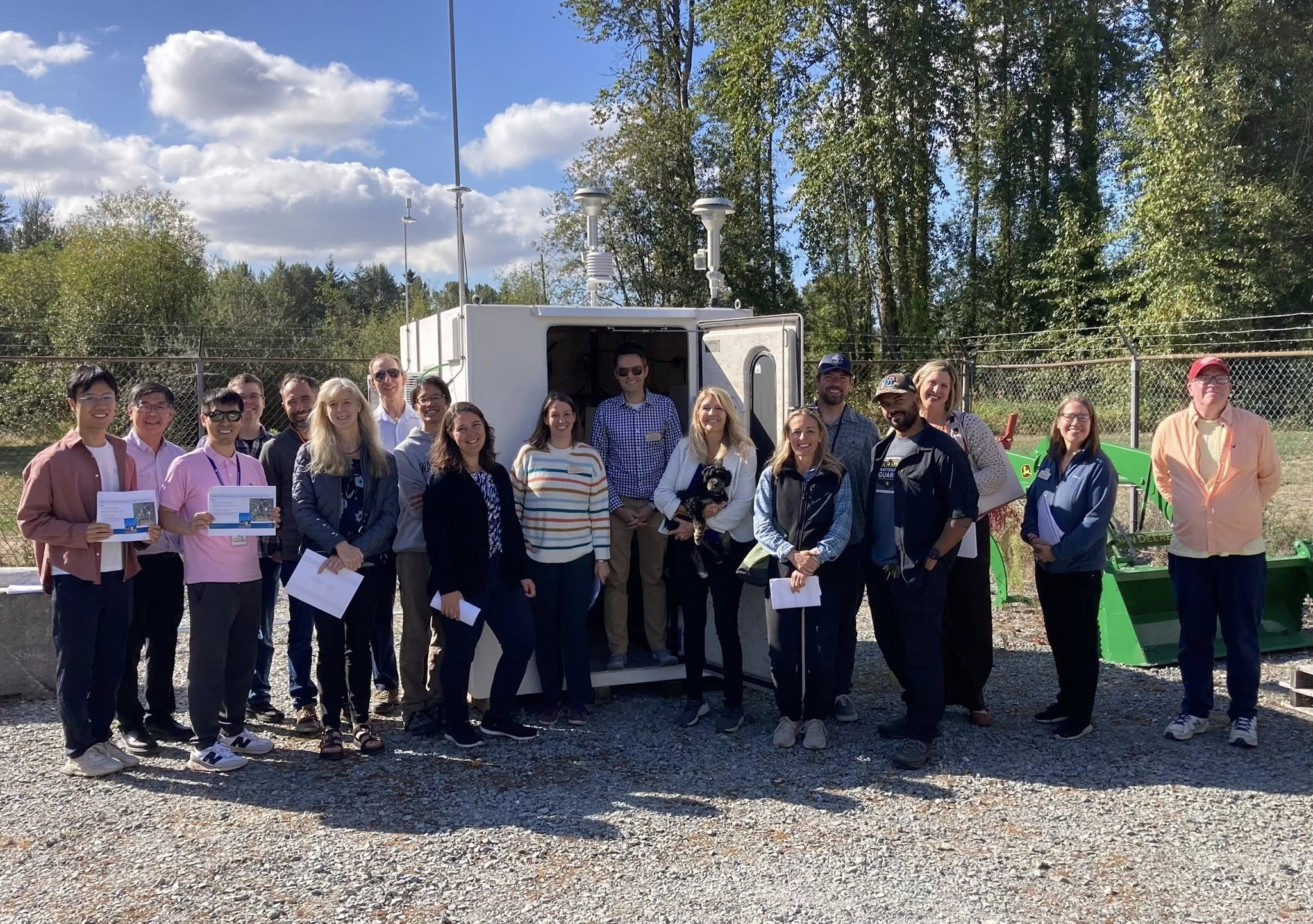
Air Quality Monitoring Equipment Training Group Photo
A group of approximately 18 people pose in front of a white environmental monitoring enclosure equipped with air sampling instruments and an antenna mast. The setting appears to be a fenced outdoor monitoring site with gravel ground cover, trees in the background, and a green piece of equipment visible at right; several participants are holding papers or documents. -
 2025-01-21
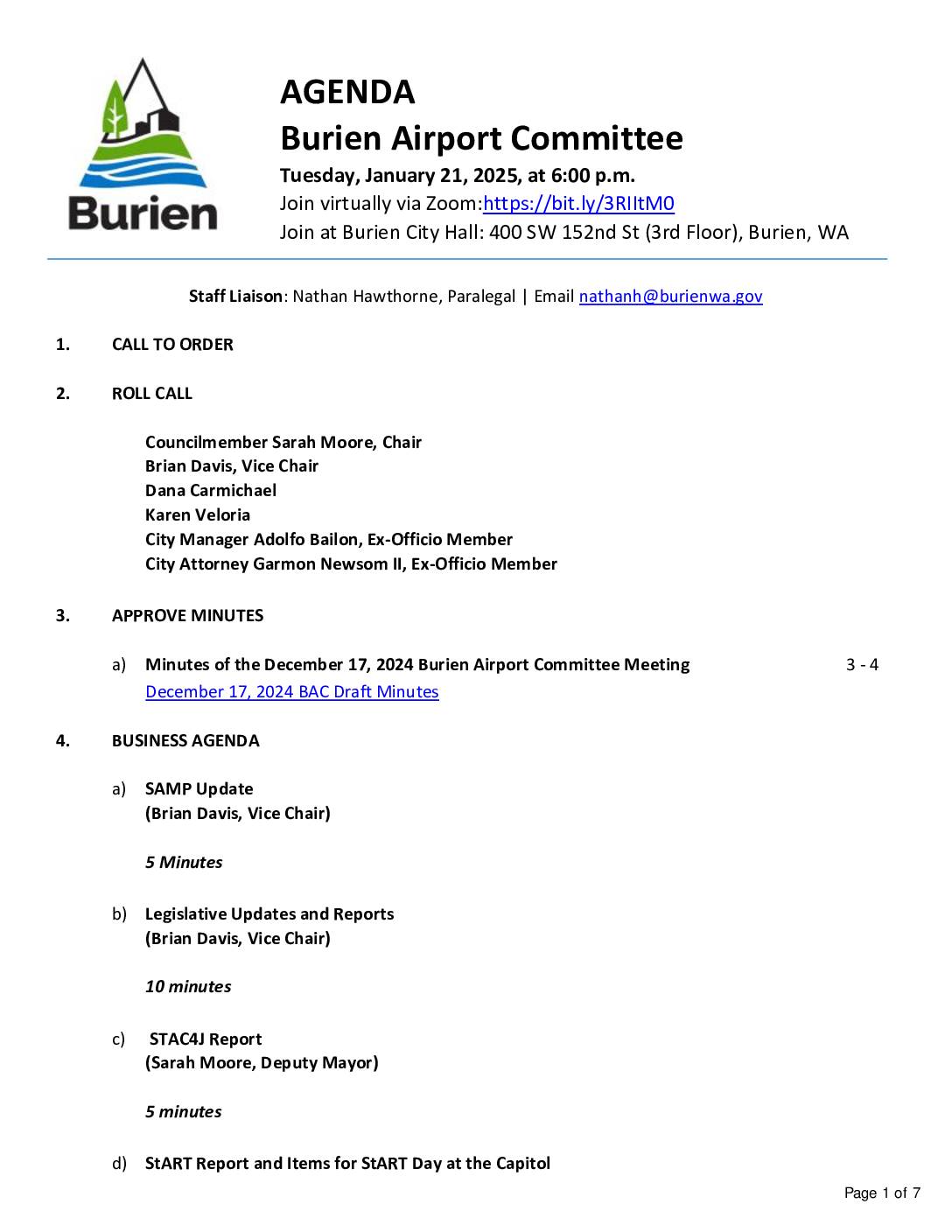
Burien Airport Committee Agenda – January 21, 2025
The Burien Airport Committee met on January 21, 2025, to discuss issues related to Seattle-Tacoma International Airport, including updates on the Sustainable Airport Master Plan (SAMP), state legislative developments, and regional coordination efforts through bodies like STAC4J and StART. The agenda also included a proposal to amend the committee's composition. Draft minutes from the December 17, 2024 meeting reflect earlier discussions on the SAMP comment process and a multi-city response coordinated under an existing Interlocal Agreement. -
 2022-05-03
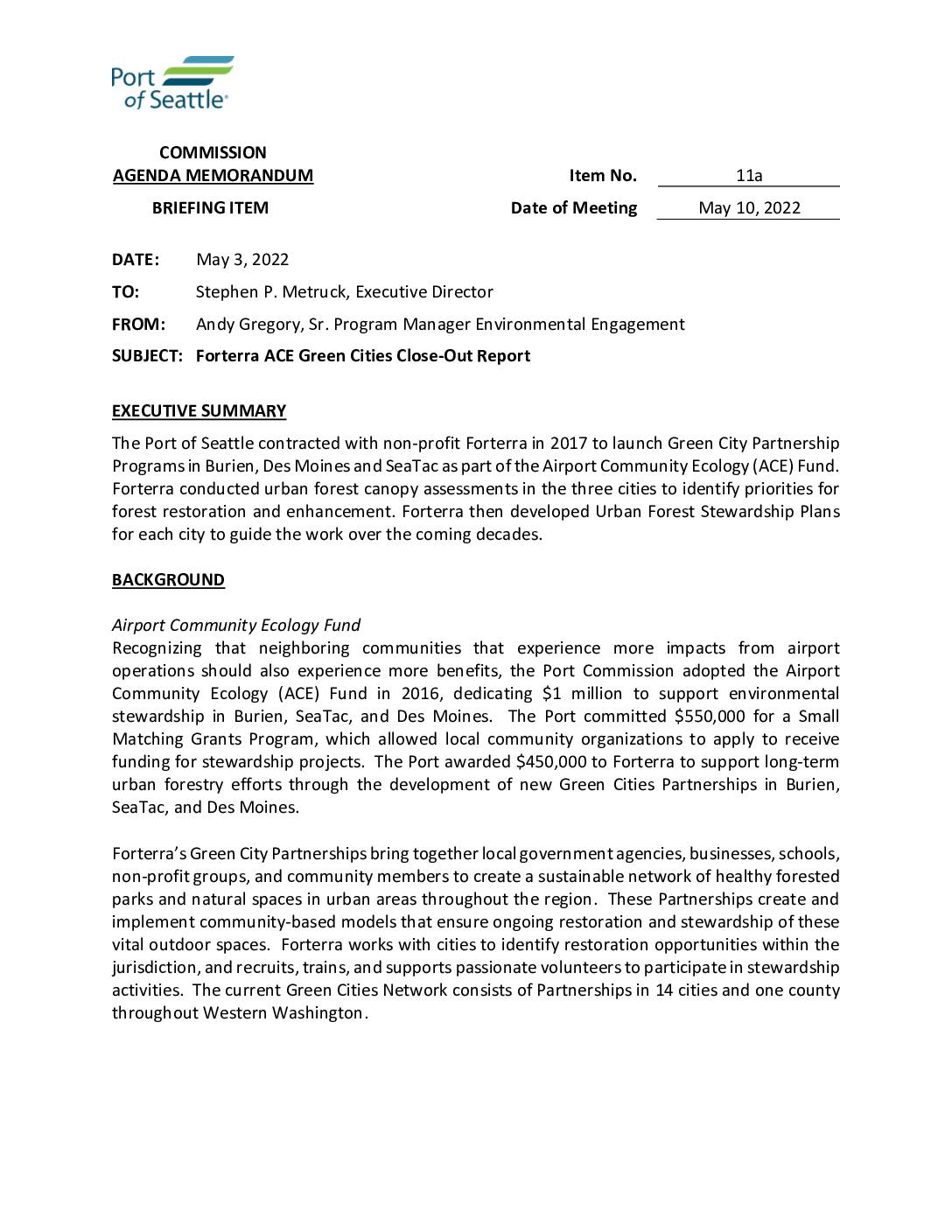
Forterra ACE Green Cities close-out report
The Port of Seattle partnered with non-profit Forterra from 2017 to 2022 to improve urban forests in the airport-adjacent communities of Burien, SeaTac, and Des Moines using $450,000 from the Airport Community Ecology (ACE) Fund. The program conducted tree canopy assessments across 738 acres, planted nearly 3,000 trees and plants, and engaged over 800 volunteers to restore parks and green spaces in neighborhoods most impacted by airport operations. Equity-focused mapping helped direct resources to low-income and minority communities with less tree cover, and the work ultimately leveraged an additional $260,000 in outside funding for school-area canopy improvements. -
 2021-07-19
Flight Corridor Safety Program On-line Open House
The Port of Seattle has an ongoing program to remove trees around SEA to improve safety during takeoffs and landings and replant in their place, native, low-growing trees. The first phase of work, completed in 2019, centered around removing and replanting trees on Port property. During this phase, the Port established low-growing native forests onsite -
 2017-06-22
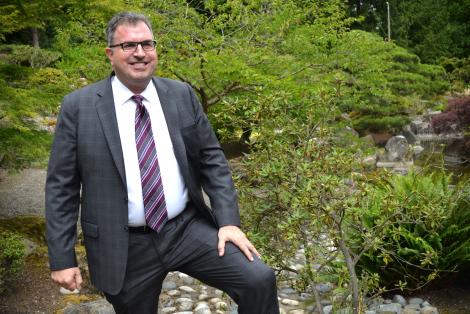
Port of Seattle launches Airport Community Ecology (ACE) Fund, joins with Forterra for Green City Partnerships
By Lindsay Peyton The Port of Seattle selected the Highline SeaTac Botanical Garden as the site to make a special announcement, launching a $1 million program to fund environmental projects in communities around the Sea-Tac Airport, on the morning of Tuesday, June 20. The public green space, located at 13735 24th Ave S, was created -
 2017-06-01
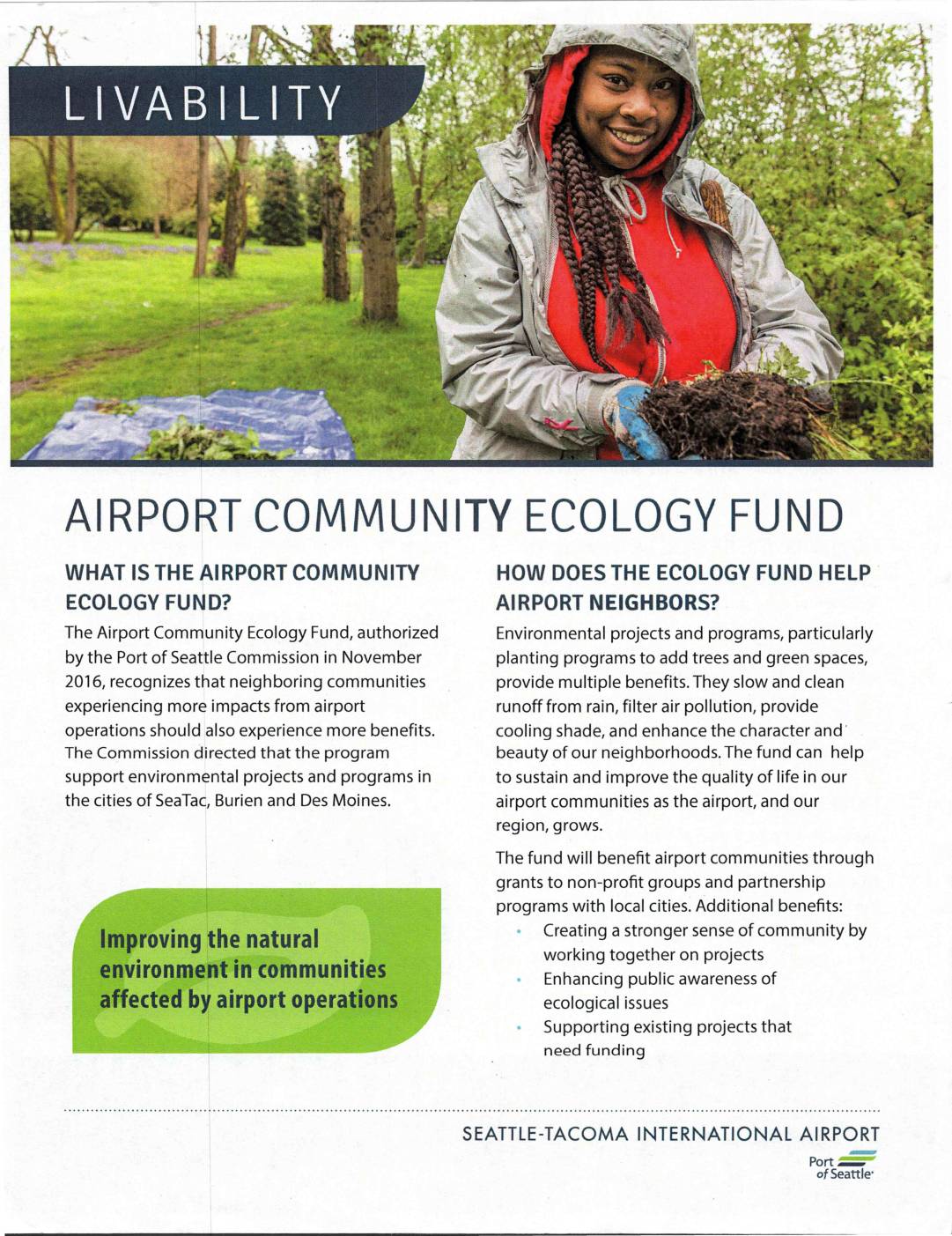
Airport Community Ecology Fund
The Airport Community Ecology Fund, authorized by the Port of Seattle Commission in November 2016, provides grants and partnership programs to improve the natural environment in communities affected by Seattle-Tacoma International Airport operations, specifically in SeaTac, Burien, and Des Moines. The fund supports environmental projects such as tree planting and green space development to help offset airport impacts through benefits like cleaner air, reduced runoff, and improved neighborhood character. Local non-profit organizations and community groups in the three eligible cities can apply for grants, provided their projects demonstrate measurable outcomes and a local match of three times the grant value. -
 2016-11-22
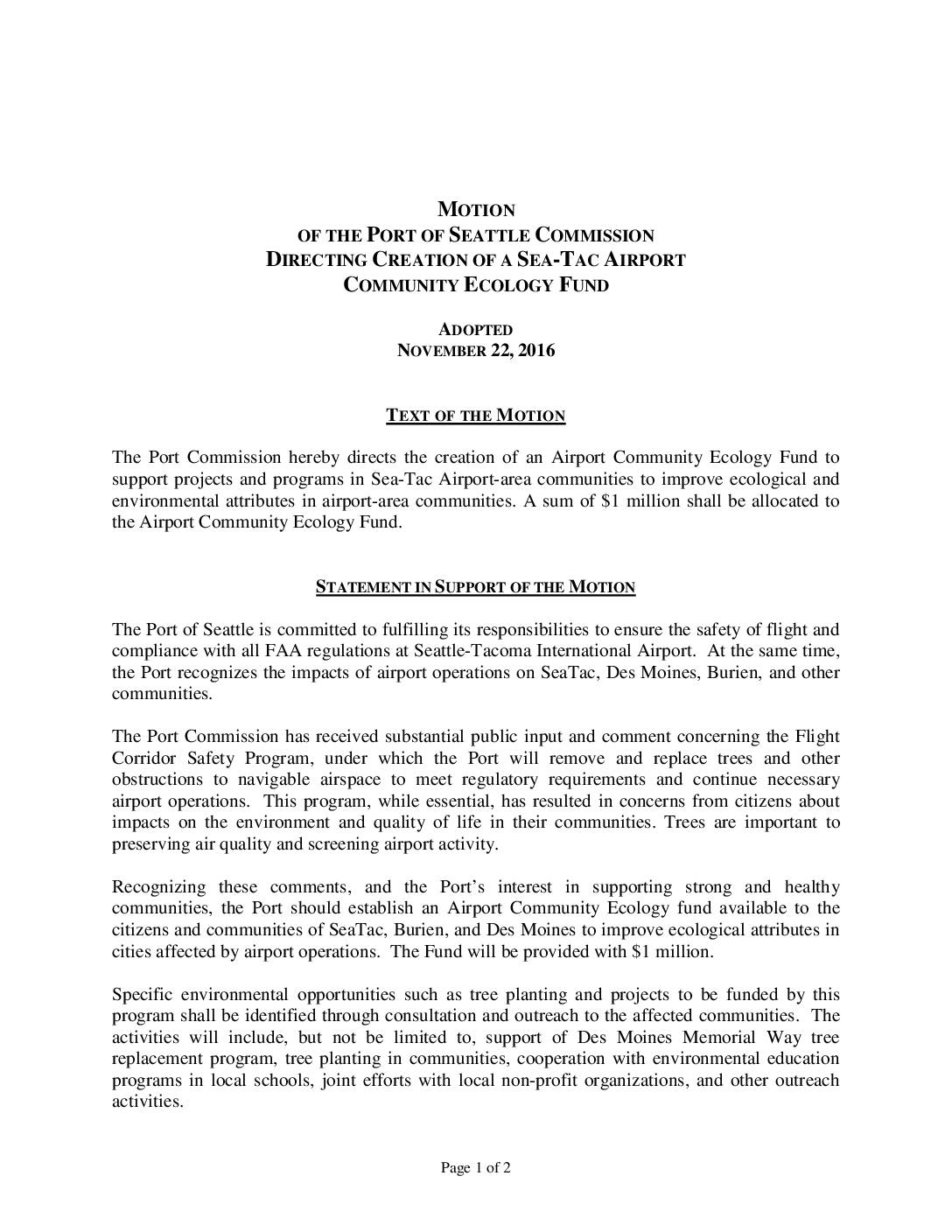
Motion of the Port Of Seattle Commission Directing Creation of a Sea-Tac Airport Community Ecology Fund
In November 2016, the Port of Seattle Commission voted to create a $1 million Airport Community Ecology Fund to support environmental projects in the SeaTac, Burien, and Des Moines communities affected by Seattle-Tacoma International Airport operations. The fund was established in response to community concerns about tree removal under the Port's Flight Corridor Safety Program, and is intended to support initiatives such as tree planting, environmental education in local schools, and partnerships with nonprofit organizations. Port staff were directed to develop project selection criteria and community outreach procedures, with a full plan to be presented to the Commission by early 2017. -
 1973-07-01
Technical Report #2 Public Facilities and Services in the Sea-Tac Communities Plan Study Area
This 1973 technical report from King County's Office of Community and Environmental Development surveys the public facilities and services available in the SeaTac Communities Plan Study Area. It covers schools, parks, libraries, fire protection, sewer and water services, and other community infrastructure. The report was produced to support land use planning in the area surrounding Seattle-Tacoma International Airport.