TagSupersonic(5)
-
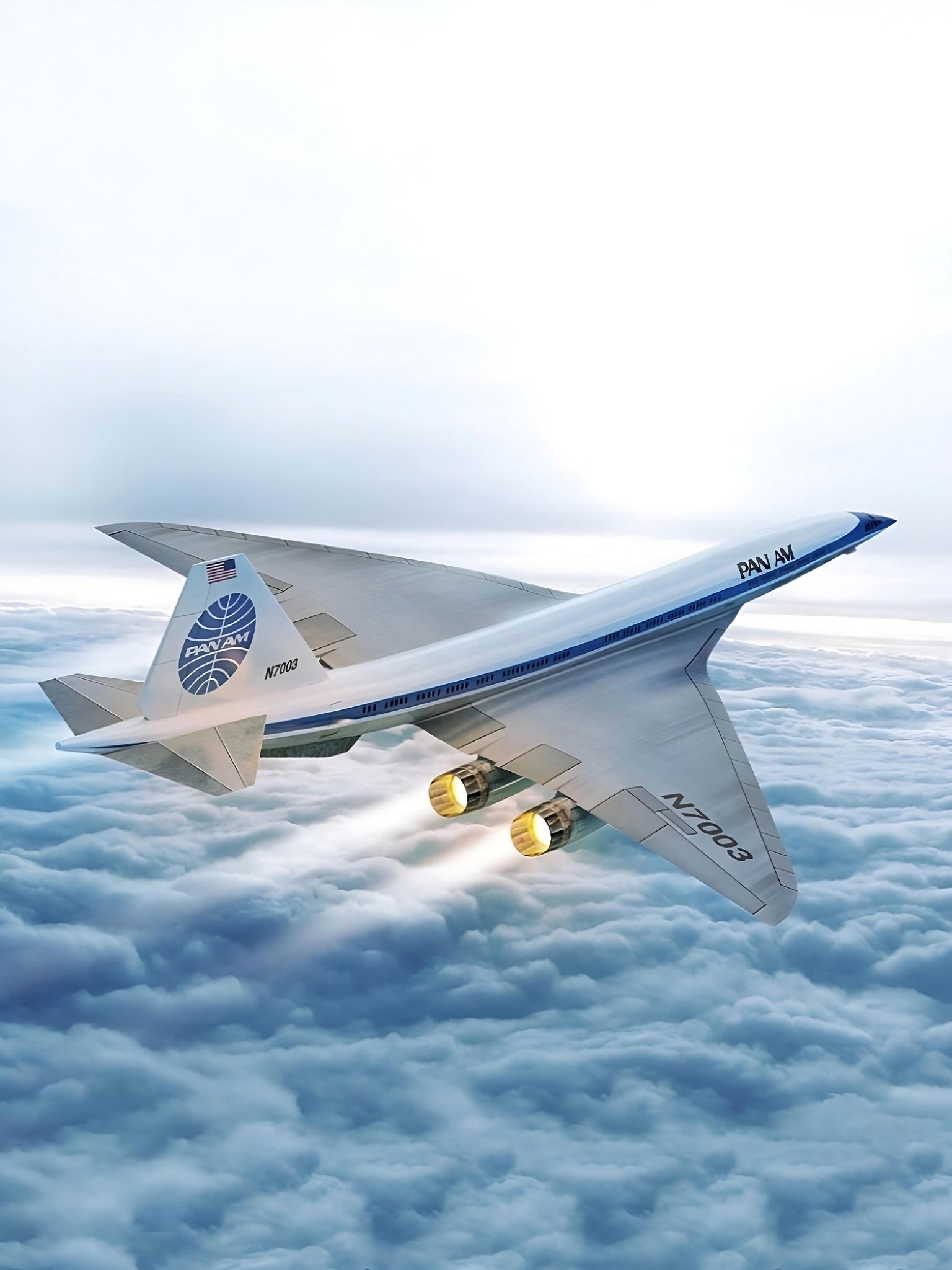
Boeing 2707
A rendered or artistic depiction of a Pan American World Airways (Pan Am) supersonic transport aircraft bearing registration number N7003, shown flying above cloud cover with afterburners lit. This appears to be a concept or promotional illustration of the American SST program, for which Pan Am held early options in the 1960s-70s before the U.S. government cancelled the Boeing 2707 program. -
 2023-05-03
Overview of community response test campaign with NASA’s X-59 aircraft
NASA's X-59 aircraft is being used in a community response test campaign to study how people on the ground react to sonic booms from supersonic flight. The mission, called Quesst, aims to collect data that could help regulators move from a blanket speed-based ban on supersonic flight over U.S. land to a noise-based standard. Current federal rules prohibit civil aircraft from flying faster than Mach 1 over the United States, but NASA hopes its findings could lead to updated, sound-level-focused regulations. -
 2020-11-17
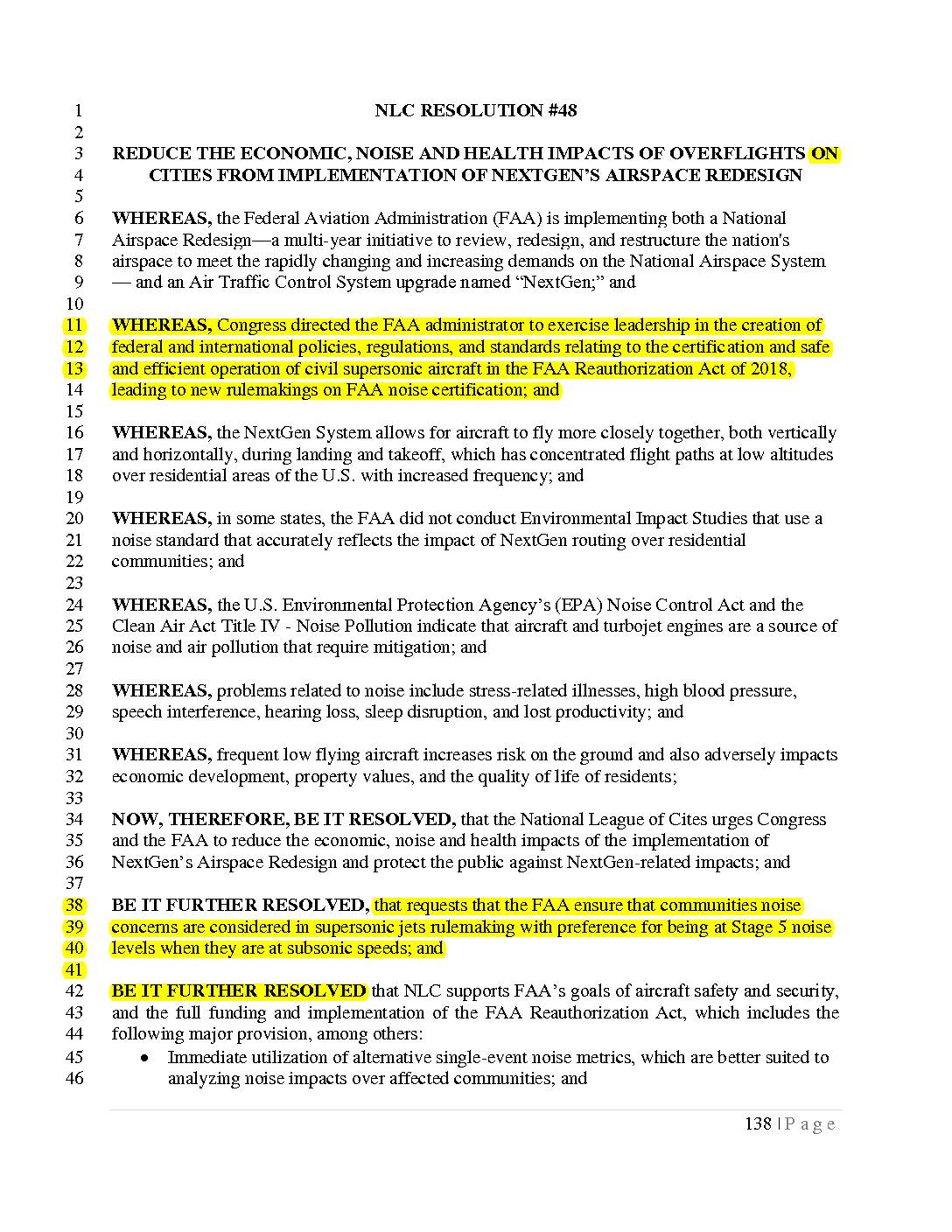
NLC Resolution #48: Reduce the Economic, Noise and Health Impacts of Overflights on Cities from Implementation of NextGen’s Airspace Redesign
NLC Resolution #48 calls on Congress and the FAA to reduce the noise, health, and economic burdens placed on residential communities resulting from the FAA's NextGen air traffic control system, which has concentrated flight paths at low altitudes over neighborhoods. The resolution highlights concerns such as stress-related illness, hearing loss, reduced property values, and inadequate environmental review, and urges the FAA to adopt better noise measurement standards and consider community noise impacts in supersonic jet rulemaking. It also supports increased NASA funding for research into quieter aircraft engines and airframes. -
 1978-02-06
Background report on Concorde flight operations
This 1978 background report, prepared for the Washington State House of Representatives, examines the potential impact of allowing Concorde supersonic jet flights at Seattle-Tacoma International Airport (SeaTac). It finds that even one Concorde flight per day would expose an additional 1,000 residents to severe aircraft noise and could increase the Port of Seattle's property acquisition costs by $10–15 million. The report also explores the legal boundaries of airport noise regulations following a landmark court case that affirmed airport proprietors may set their own noise rules, provided those rules are reasonable, non-arbitrary, and non-discriminatory. -
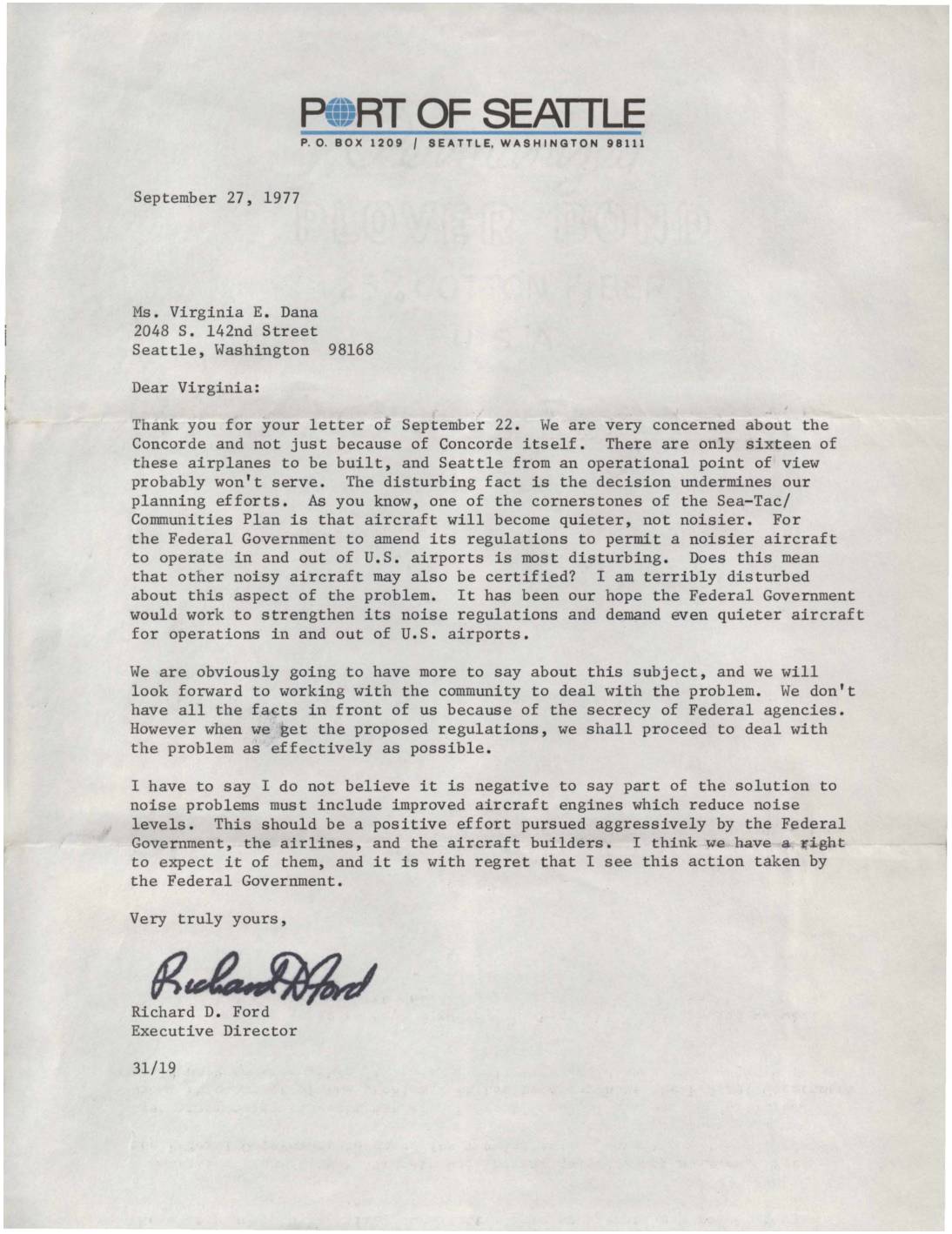 1977-09-27
Letter from Port of Seattle Executive Director Richard D. Ford regarding Concorde aircraft noise concerns
In this September 1977 letter, Port of Seattle Executive Director Richard D. Ford responds to a community member's concerns about the Concorde supersonic jet, expressing alarm that the Federal Government amended its noise regulations to allow a noisier aircraft to operate at U.S. airports. Ford warns this decision undermines the Sea-Tac/Communities Plan, which was built on the expectation that aircraft would become progressively quieter over time. He calls on the federal government, airlines, and aircraft manufacturers to aggressively pursue quieter engine technology as a necessary solution to airport noise problems.