Tagordinances(5)
-
 2025-03-27
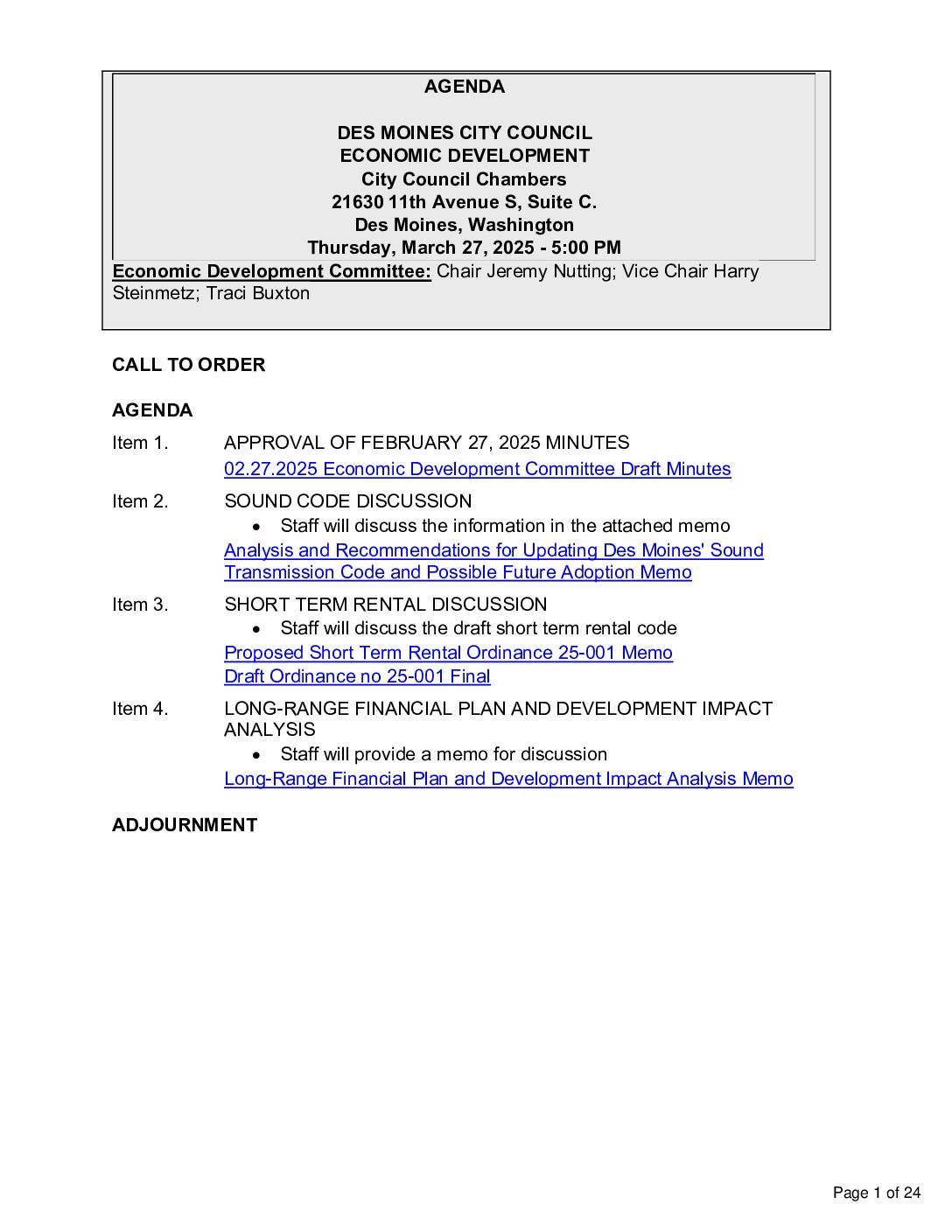
Des Moines City Council Economic Development Committee agenda and draft minutes, March 27, 2025
The Des Moines, Washington City Council Economic Development Committee held a meeting on March 27, 2025, which included a discussion on updating the city's Sound Transmission Code, a topic that had been postponed from the previous February 27 meeting due to time constraints. The agenda also covered short-term rental regulations, a long-range financial plan, and development impact analysis. While the sound code discussion is relevant to ongoing concerns about noise transmission in the area near Sea-Tac Airport, no specific policy decisions or recommendations are recorded in these meeting documents. -
 2013-10-24
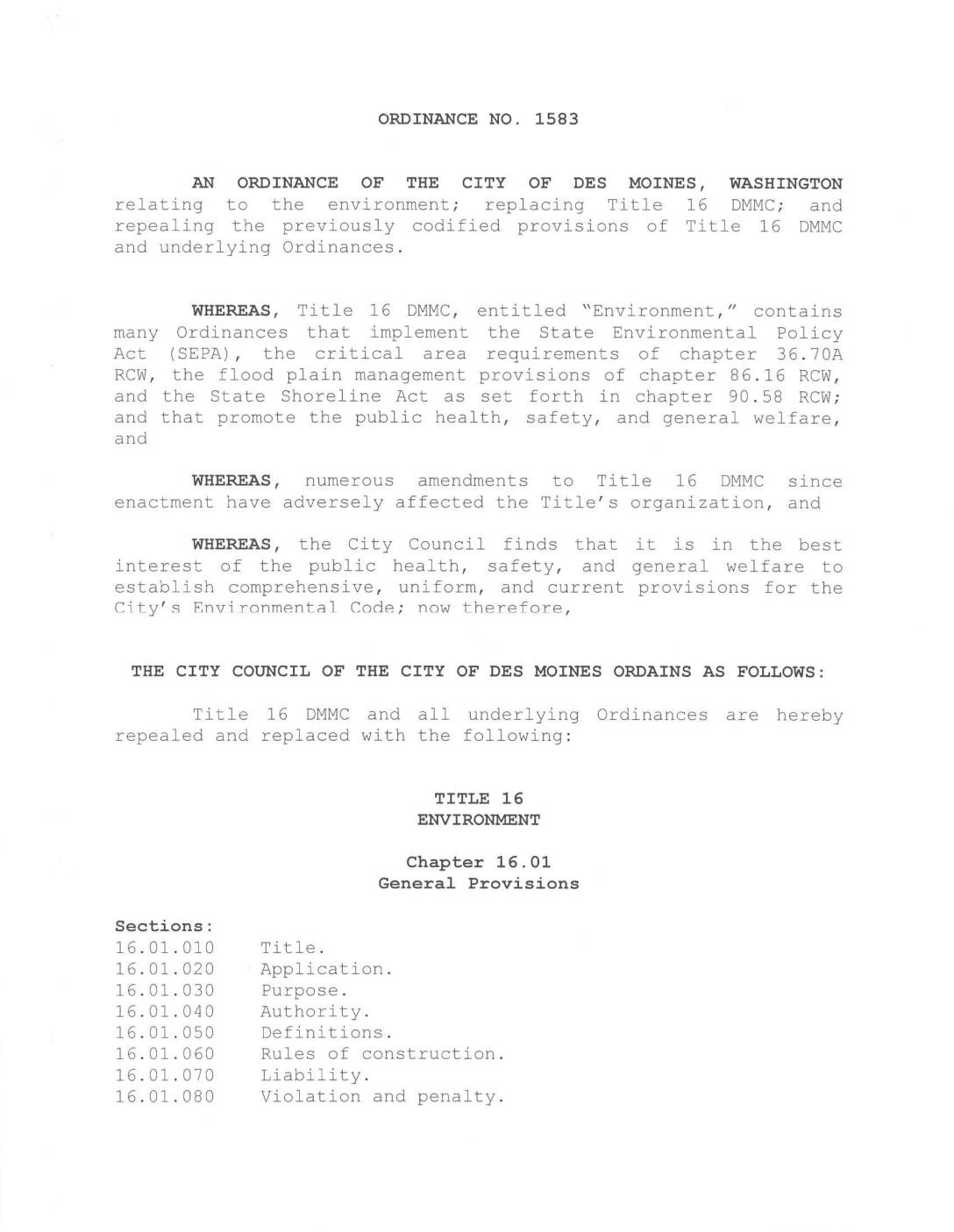
Ordinance No. 1583: An ordinance of the City of Des Moines, Washington relating to the environment
Ordinance No. 1583 is an environmental regulations ordinance from the City of Des Moines, Washington, that replaces and reorganizes the city's Title 16 Environmental Code. It implements state laws covering environmental policy, critical areas, floodplain management, and shoreline protection, while providing definitions and general provisions applicable across all related chapters. -
 2012-05-02
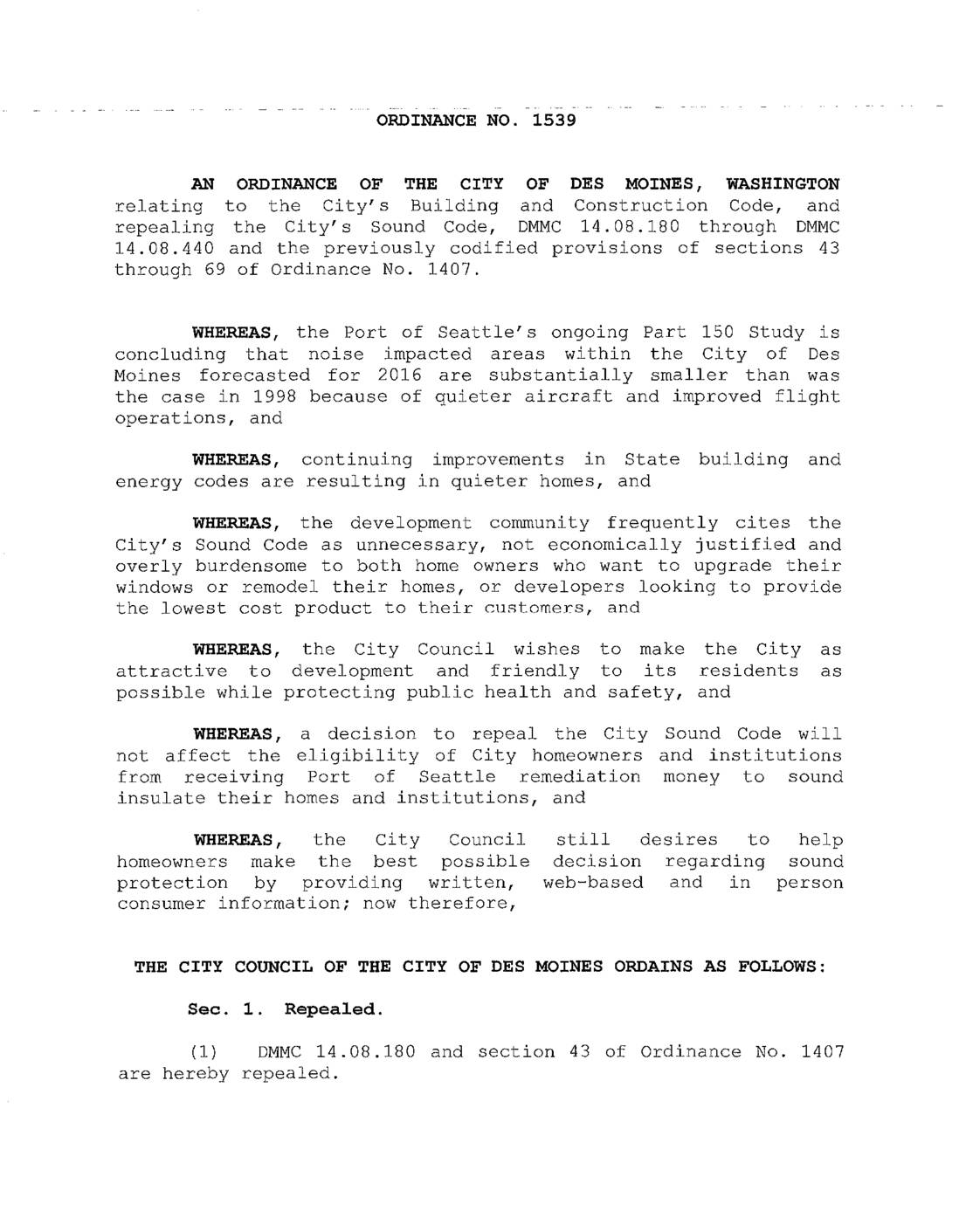
Ordinance No. 1539: An ordinance of the City of Des Moines, Washington relating to the City’s Building and Construction Code, and repealing the City’s Sound Code
The City of Des Moines, Washington repealed its local Sound Code (DMMC 14.08.180–14.08.440) in response to reduced aircraft noise projections from the Port of Seattle's Part 150 Study, improved State building codes, and concerns from the development community that the code was unnecessarily burdensome. The repeal does not affect homeowners' eligibility for Port of Seattle sound insulation remediation funding. The city indicated it would continue to support residents through consumer information resources on sound protection options. -
 2007-08-09
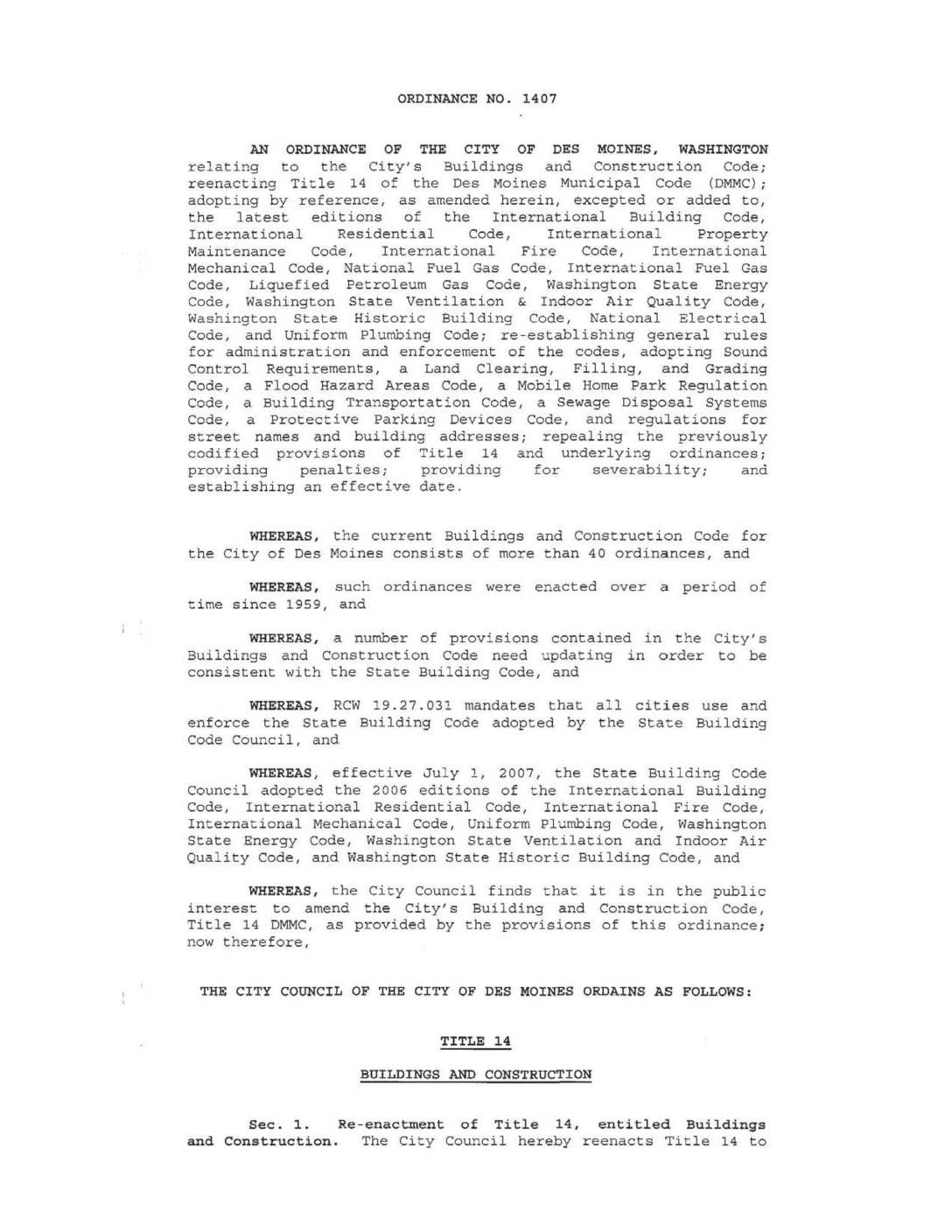
Ordinance No. 1407: Buildings and construction code
Ordinance No. 1407 is a City of Des Moines, Washington municipal ordinance that updates and consolidates the city's Buildings and Construction Code (Title 14) by adopting the latest editions of major building, fire, mechanical, electrical, and plumbing codes, including Sound Control Requirements relevant to the Sea-Tac Airport noise environment. The ordinance repeals more than 40 previously enacted building-related ordinances dating back to 1959 and brings the city into compliance with state-mandated building standards under RCW 19.27.031. It establishes updated rules for administration, enforcement, and a range of construction-related regulations applicable within the City of Des Moines. -
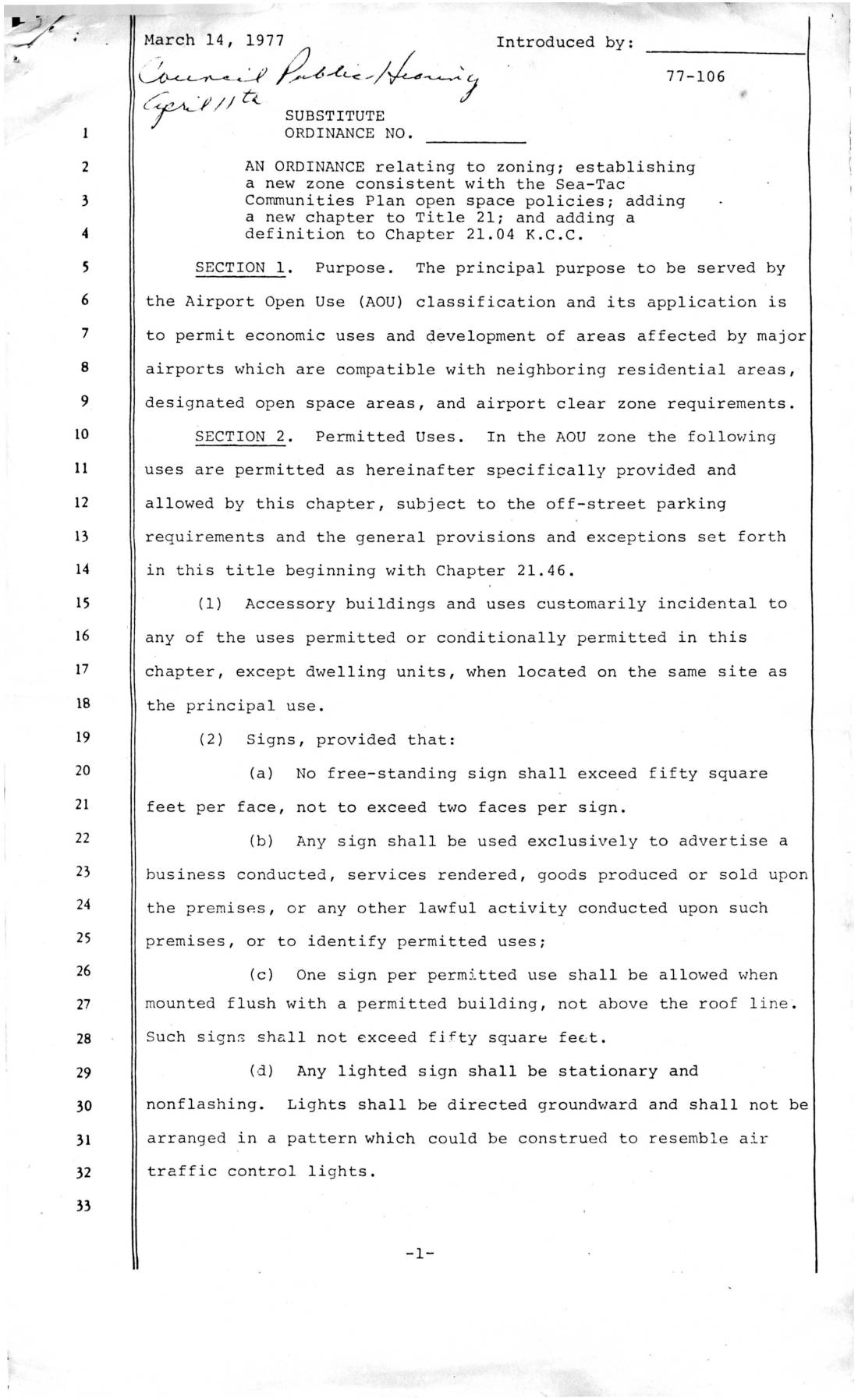 1977-03-14
Substitute ordinance establishing Airport Open Use (AOU) zoning classification
Ordinance 77-106, introduced in March 1977, established the Airport Open Use (AOU) zoning classification for areas around major airports like Sea-Tac, allowing compatible economic activities such as agriculture, public parks, commercial recreation, and public utility facilities while protecting neighboring residential areas. The ordinance sets strict conditions on signage, building setbacks, landscaping buffers, and livestock density to minimize conflicts with adjacent residential zones. Uses like golf courses, outdoor storage, and cemeteries require conditional use permits when the property borders residential (R or S) zones.