TagPSAPCA(7)
-
 2022-07-10
Part 5: The Environment — Chapter 5.1: Air Quality
This document presents an air quality study conducted by Environmental Systems Laboratories, Inc. for Sea-Tac Airport, examining pollutant levels—including particulates, carbon monoxide, hydrocarbons, nitrogen oxides, and oxidants—at and around the airport. Using monitoring data collected in 1973–1974 from seven sites near the airport and surrounding communities, the study assessed existing conditions and predicted future air quality impacts under various aviation and land use scenarios. -
 2009-11-11
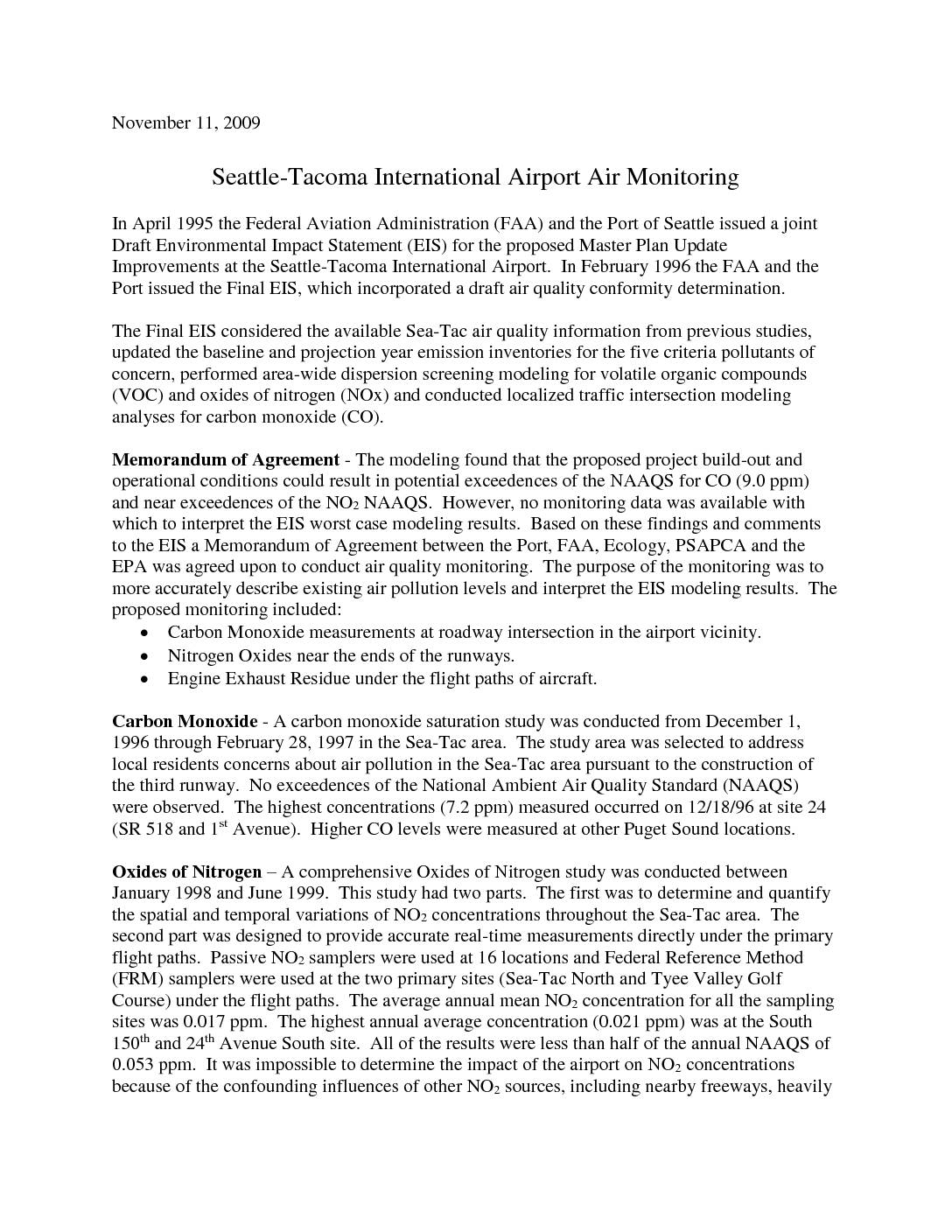
Seattle-Tacoma International Airport air monitoring
This 2009 report summarizes air quality monitoring studies conducted near Seattle-Tacoma International Airport between 1996 and 2002, following concerns raised during the airport's expansion planning. Measurements of carbon monoxide, nitrogen dioxide, particulate matter, and air toxics were taken at multiple sites around the airport, and none of the pollutants exceeded federal air quality standards. While some elevated levels of metals like chromium were detected at the Sea-Tac monitoring site, overall cancer risk from air toxics was lower than the regional average for the Seattle area. -
 2009-11-11
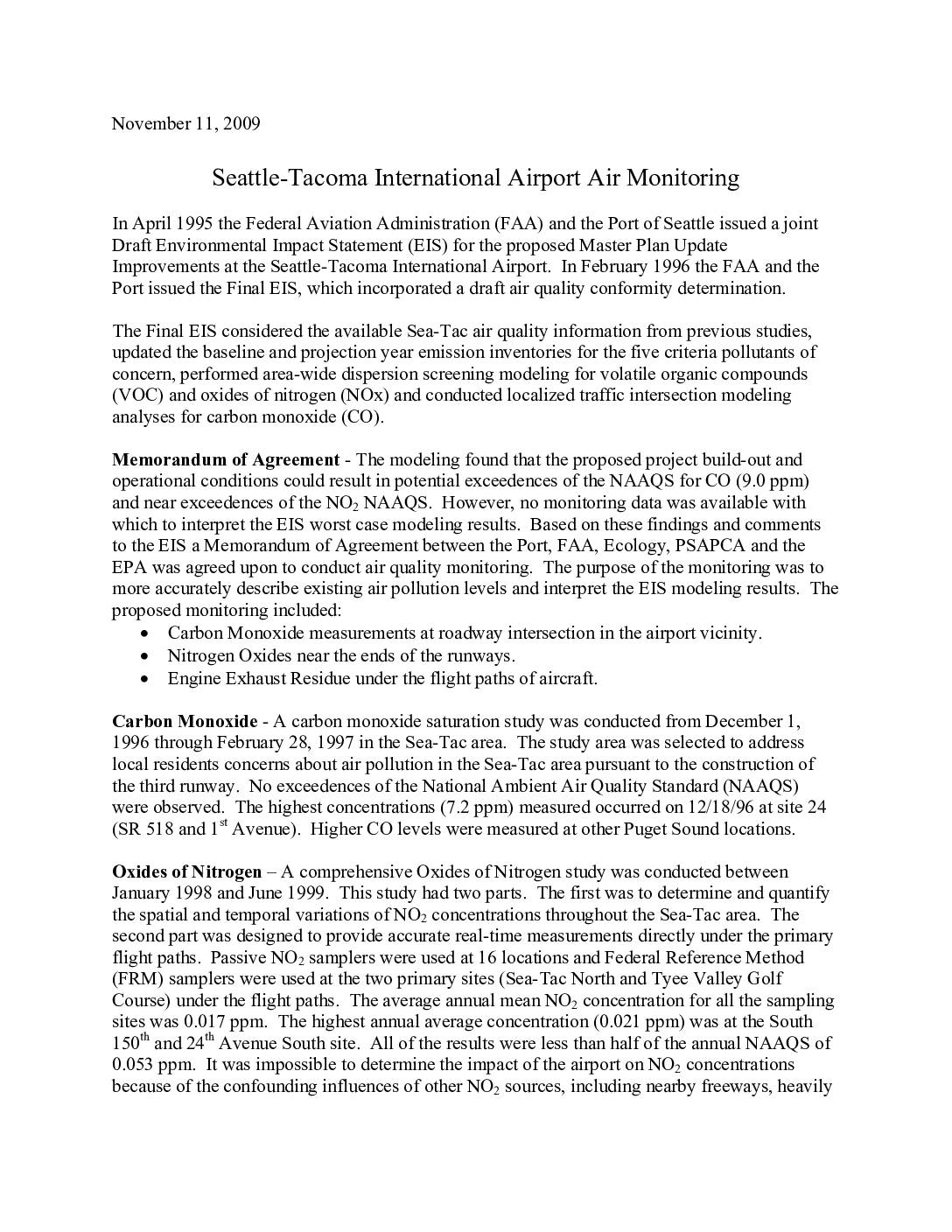
Seattle-Tacoma International Airport Air Monitoring
This 2009 report summarizes air quality monitoring conducted near Seattle-Tacoma International Airport between 1996 and 2002, covering carbon monoxide, nitrogen dioxide, particulate matter, and air toxics. Monitoring found that levels of all measured pollutants remained below federal National Ambient Air Quality Standards (NAAQS), though chromium concentrations at the Sea-Tac North site exceeded EPA's lifetime risk-based threshold. The studies were prompted by a Memorandum of Agreement among the Port of Seattle, FAA, and environmental agencies following an Environmental Impact Statement for proposed airport expansion. -
 1996-10-01
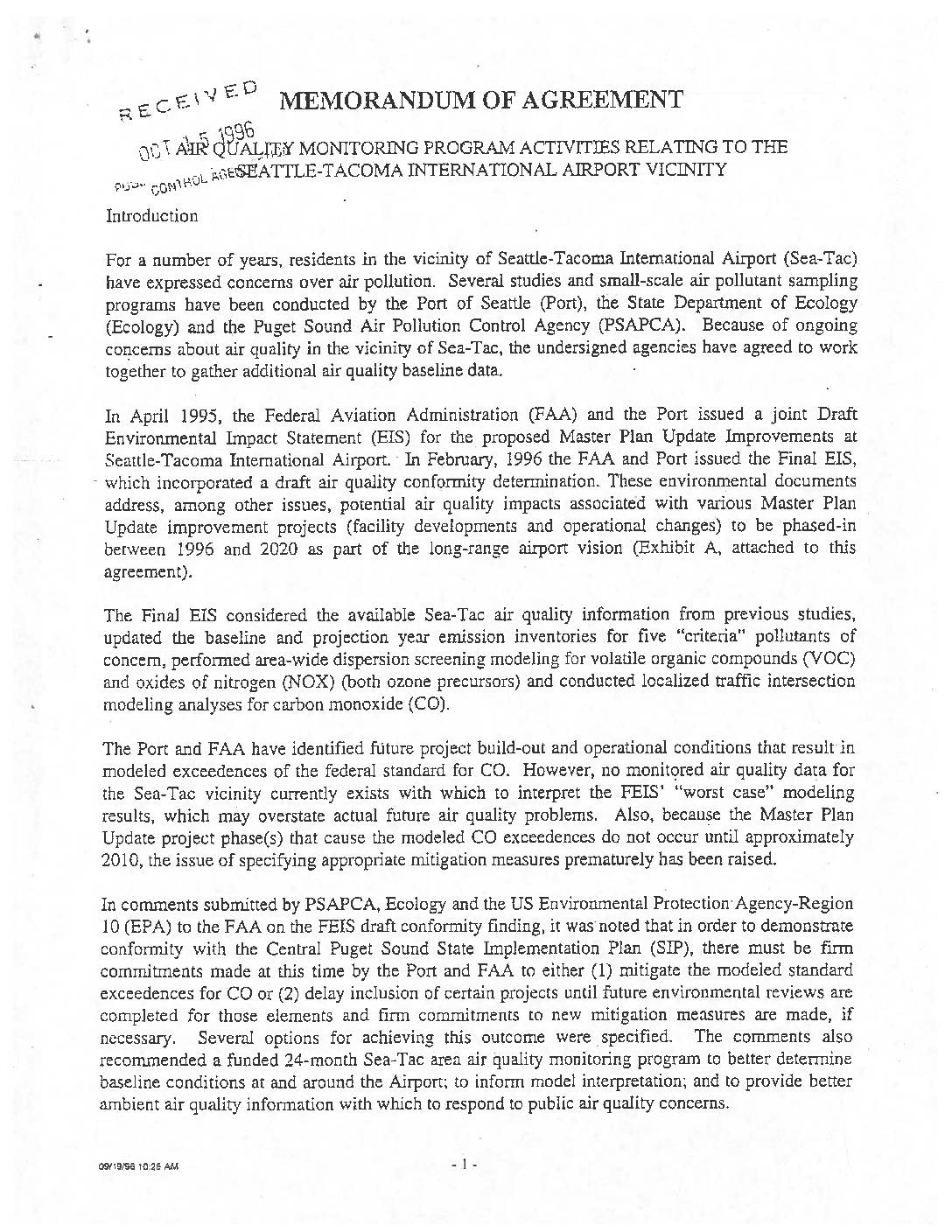
Memorandum of Agreement: Air Quality Monitoring Program Activities Relating to the Seattle-Tacoma International Airport Vicinity
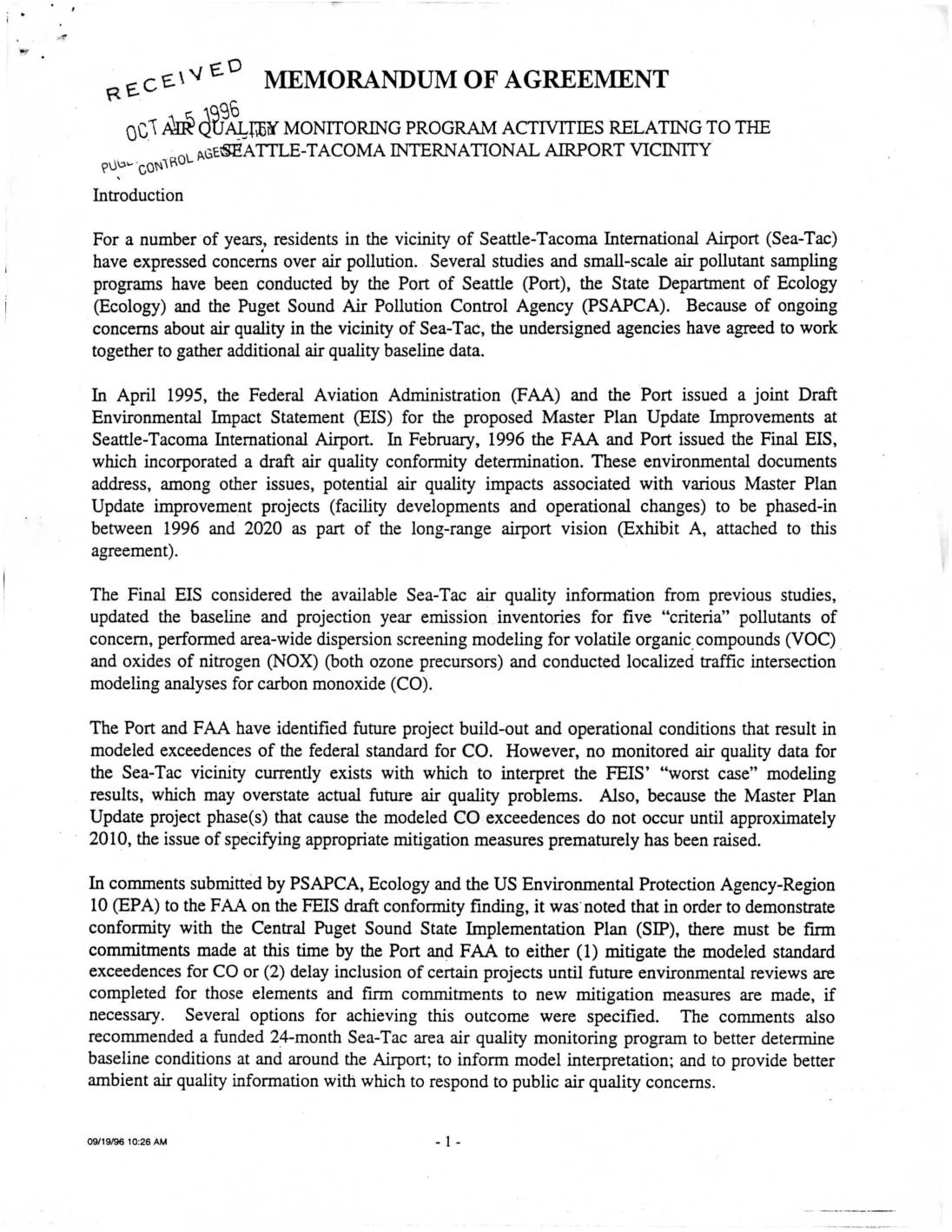
This 1996 Memorandum of Agreement establishes a 24-month air quality monitoring program near Seattle-Tacoma International Airport, involving the Port of Seattle, FAA, EPA, Washington State Department of Ecology, and the Puget Sound Air Pollution Control Agency. The program, funded at $195,000, focuses on measuring carbon monoxide, nitrogen oxides, and aircraft fuel particle residue to establish baseline air quality data and evaluate potential pollution impacts from planned airport expansion projects. The Port agreed not to proceed with expansion elements projected to cause carbon monoxide standard violations until monitoring is complete and, if necessary, mitigation measures are identified. -
 1996-09-19
Memorandum of Agreement: Air Quality Monitoring Program Activities Relating to the Seattle-Tacoma International Airport Vicinity
A 1996 Memorandum of Agreement between the Port of Seattle, FAA, EPA, Washington State Department of Ecology, and the Puget Sound Air Pollution Control Agency established a 24-month air quality monitoring program near Seattle-Tacoma International Airport. The $195,000 program was designed to measure carbon monoxide, nitrogen oxides, and aircraft fuel particle residue in order to establish baseline pollution data and assess the accuracy of earlier 'worst case' air quality models from the airport's Final Environmental Impact Statement. The Port agreed not to proceed with Master Plan expansion projects projected to cause CO standard exceedances until monitoring was complete and, if necessary, appropriate mitigation measures were identified. -
 1996-06-06
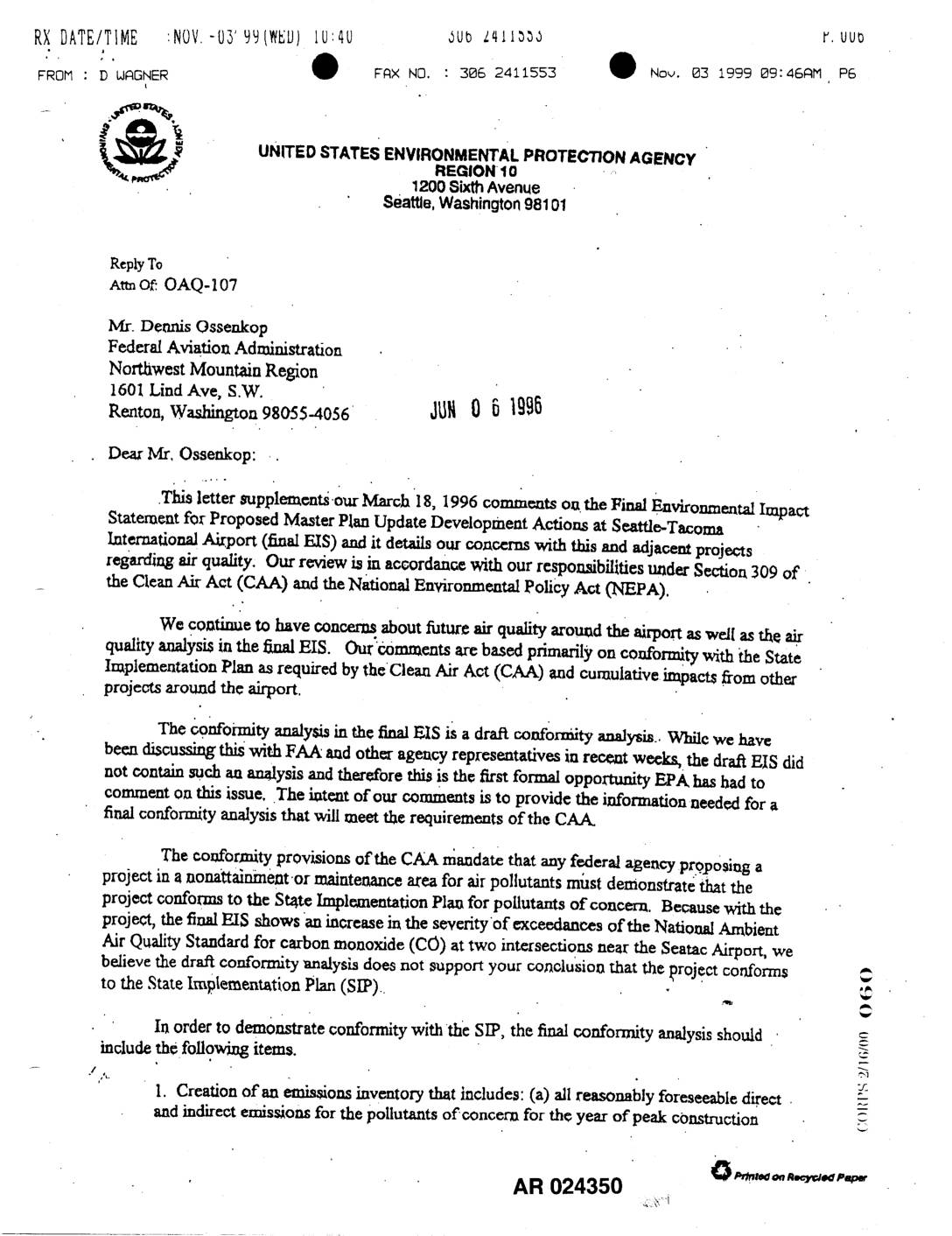
EXH AR024350: EPA Region 10 Letter to FAA Air Quality Conformity Analysis STIA Master Plan Update EIS
In a 1996 letter to the Federal Aviation Administration, the U.S. Environmental Protection Agency (EPA) Region 10 raised concerns about air quality impacts from the proposed Master Plan expansion at Seattle-Tacoma International Airport, noting that the project was projected to worsen carbon monoxide levels at nearby intersections in violation of federal air quality standards. The EPA called for a comprehensive emissions inventory, a comparison of air quality with and without the project, and enforceable mitigation measures, while also highlighting inconsistencies in air quality modeling across multiple related development projects in the airport area. The agency urged the FAA and Port of Seattle to coordinate data sharing with regional authorities and establish a long-term air quality monitoring program to address cumulative impacts from surrounding projects. -
 1993-02-02
PSAPCA’s role regarding airport air quality
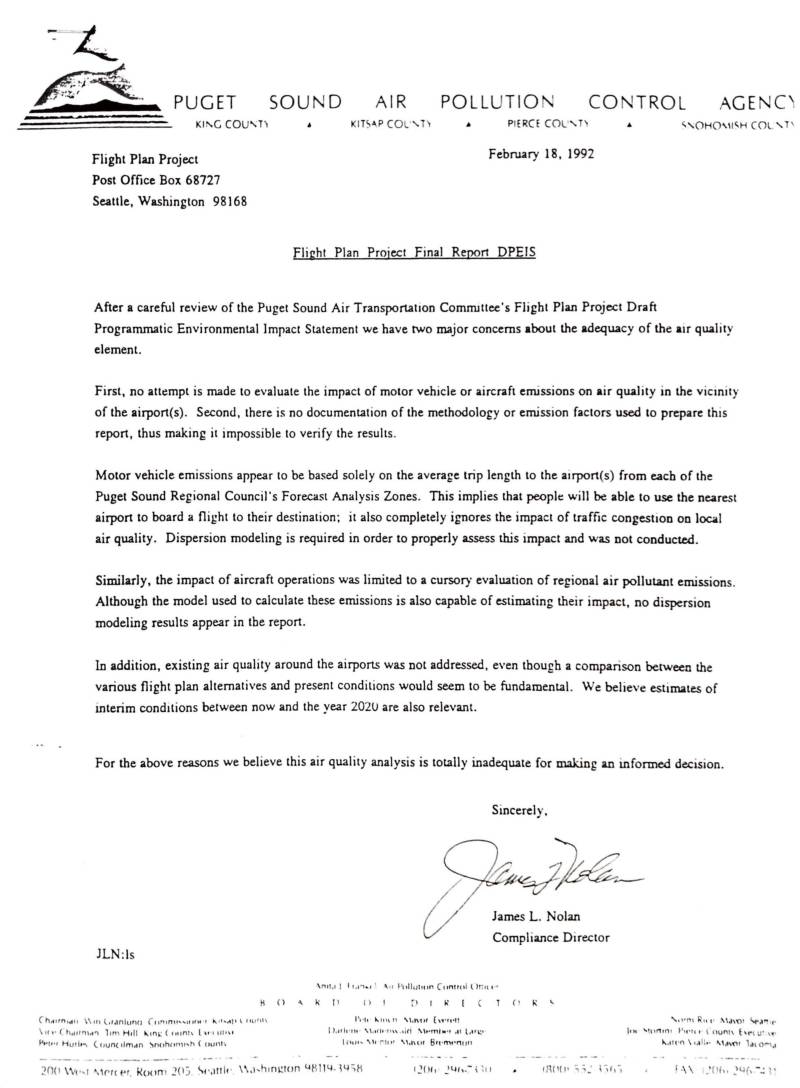
The Puget Sound Air Pollution Control Agency (PSAPCA) raised concerns in 1992 about inadequate air quality analysis in the Flight Plan Project's environmental impact statement, citing missing dispersion modeling for both vehicle and aircraft emissions near Sea-Tac Airport. A follow-up 1992 letter addressed the use of ethylene glycol as a de-icing agent at Sea-Tac, concluding it was unlikely to pose a significant air quality risk due to its low vapor pressure. A 1993 internal memo clarified PSAPCA's role in reviewing airport-related environmental impact statements and conducting annual inspections of registered equipment at airports within its jurisdiction.